

Are Students Learning Better With AI or Becoming Too Dependent on It?
Artificial intelligence is changing the way students study, write, research, revise, and complete assignments. A…
 Harika July 18, 2026
  By HarikaUpdated July 16, 202611 min read49 views
Artificial intelligence has quietly entered almost every part of modern life.
Students use it to complete assignments. Employees use it to write emails and reports. Developers use it to generate code. Content creators use it for ideas, scripts, images, and captions. Business owners rely on it for marketing, customer support, research, and planning.
A task that once required an hour can sometimes be completed in a few minutes.
That sounds like progress—and in many ways, it is.
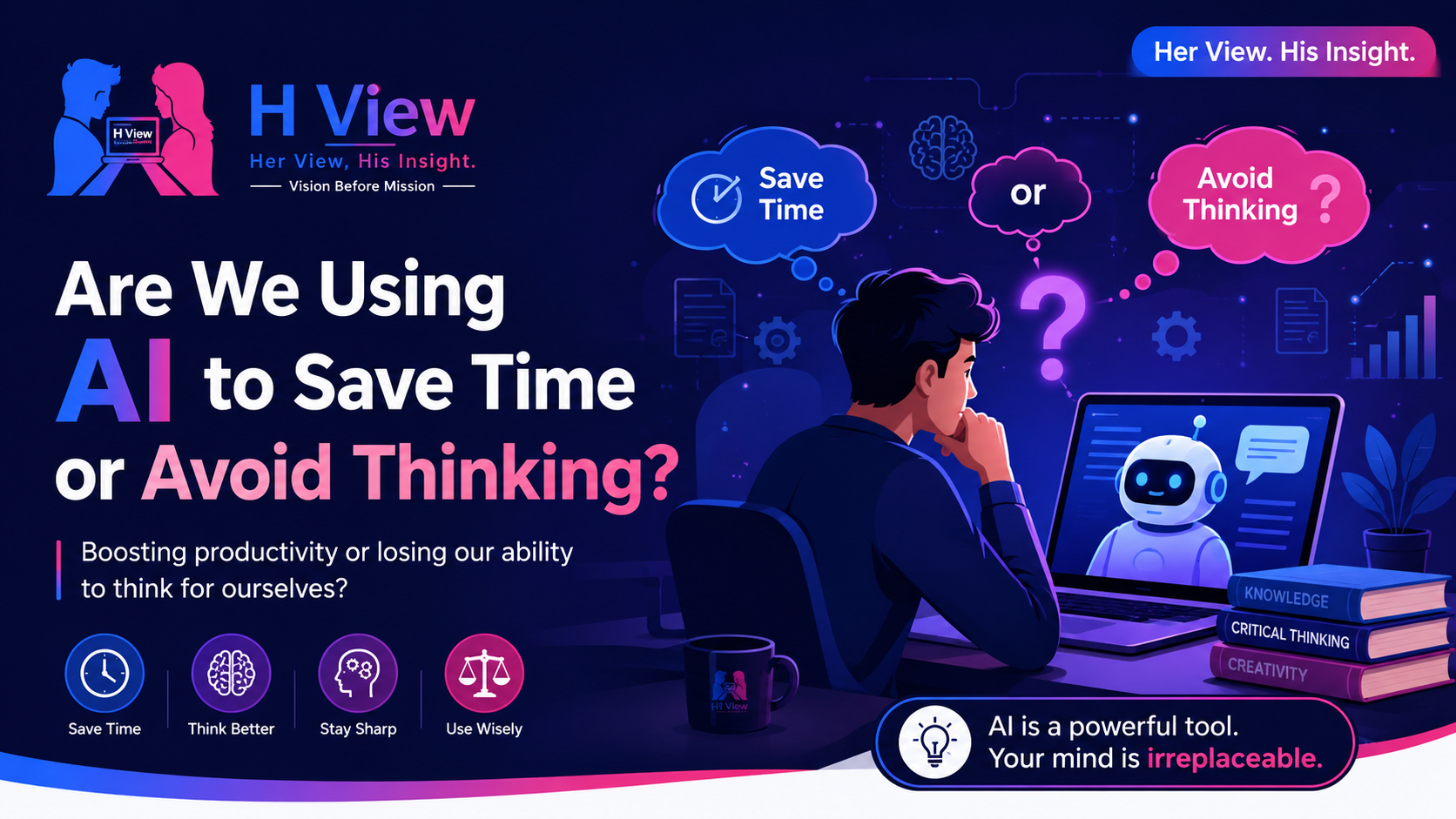
But a more uncomfortable question is beginning to emerge: are we using AI to save time, or are we slowly using it to avoid thinking?
There is an important difference between the two.
Saving time means using AI to reduce repetitive effort while keeping human judgment, creativity, and responsibility at the centre. Avoiding thinking means allowing AI to make decisions, form opinions, solve problems, and communicate on our behalf without fully understanding the output.
AI can be a powerful assistant. The concern begins when the assistant quietly becomes the thinker.
AI tools are attractive because they remove the friction from difficult or time-consuming tasks.
Writing a professional email can feel stressful. Researching a new topic can take hours. Creating a presentation requires planning, design, and structure. Learning a programming language involves making mistakes and searching for solutions.
AI can provide a starting point almost instantly.
A person can ask:
This kind of support is genuinely valuable, especially for people who may lack time, confidence, experience, or access to professional guidance.
AI can help users move past the fear of a blank page. It can simplify complex information, improve communication, automate repetitive work, and make knowledge more accessible.
The problem is not that people are using AI.
The problem is how quickly convenience can become dependence.
Consider two people using AI to write an important office report.
The first person prepares the key data, identifies the main findings, explains the business situation to the AI, reviews the generated draft, corrects errors, and adds personal insights.
The second person uploads a few documents, asks AI to create the complete report, and submits it without thoroughly reading or understanding it.
Both have used AI. However, only one has used it responsibly.
The first person saved time while remaining involved in the thinking process. The second person skipped the thinking process and trusted the tool to replace it.
This difference matters because the value of work is not always limited to the final output. The process of researching, questioning, comparing, writing, correcting, and reflecting helps people develop stronger skills.
When the process disappears, learning may disappear with it.
From one side, AI is an empowering tool.
Not everyone is naturally confident in writing, design, coding, communication, or research. Some people may understand an idea clearly but struggle to express it professionally. Others may know what they want to create but lack the technical skills to begin.
AI can reduce these barriers.
A small business owner can create product descriptions without hiring a large marketing team. A student can ask for a simpler explanation of a difficult topic. A job seeker can improve a résumé. A non-native English speaker can communicate more confidently. A beginner can build a basic website while learning how the code works.
AI can also support people with disabilities, language barriers, limited educational resources, or demanding work schedules.
Used well, it can make expertise more accessible.
It can help ordinary people attempt things they previously believed were beyond their reach.
This is one of AI’s most meaningful benefits: it does not only save time; it can also create confidence, independence, and opportunity.
The other side deserves equal attention.
When people rely on AI for every task, some abilities may gradually weaken.
Someone who uses AI for every email may struggle to communicate independently. A student who generates every answer may pass an assignment without understanding the subject. A developer who copies AI-generated code may build something that works temporarily but be unable to fix it later.
Similarly, a content creator who depends completely on AI-generated ideas may slowly lose originality. A manager who asks AI to make every decision may stop developing professional judgment.
These changes may not be immediately visible.
The work still gets completed. The report looks polished. The email sounds professional. The presentation appears organised.
But beneath the output, the person may not be developing the skills that the work was supposed to build.
AI can create the appearance of competence without always creating real competence.
Education is one of the clearest examples of this dilemma.
AI can be an excellent tutor. It can explain a concept in simple language, provide examples, generate practice questions, translate lessons, and offer feedback.
A student who does not understand algebra can ask for a step-by-step explanation. Someone learning English can practise conversations. A student preparing for an examination can create a customised revision plan.
These uses strengthen learning.
However, the same tool can also complete assignments, write essays, solve equations, prepare project reports, and answer questions without requiring the student to understand anything.
The result may look correct, but the learning objective is lost.
The deeper risk is not merely academic dishonesty. It is the development of a habit in which every difficult question is immediately handed over to a machine.
Struggle is not always a sign of failure. In learning, struggle often helps the brain understand, remember, and improve.
When AI removes every difficulty, it may also remove the opportunity to grow.
In offices, AI is often promoted as a productivity tool.
It can summarise meetings, draft proposals, analyse data, prepare presentations, automate customer responses, and reduce administrative work.
These capabilities can save employees several hours every week.
But productivity should not be measured only by how quickly documents are produced.
A team may generate more emails, reports, presentations, and meeting notes while making no better decisions. Employees may use AI to create lengthy documents that no one fully reads. Managers may receive polished summaries that hide weak analysis.
This creates a new kind of performance theatre: more output, faster delivery, and professional language—but not necessarily better thinking.
Real productivity means improving the quality of decisions, outcomes, customer experiences, and problem-solving.
AI should reduce unnecessary work so that humans can focus on higher-value thinking. It should not simply help us create more unnecessary work at a faster speed.
AI-generated responses often sound clear, structured, and confident.
That confidence can make them difficult to question.
However, a well-written response is not automatically a correct response. AI may misunderstand the question, miss important context, combine unrelated information, or provide inaccurate details.
This becomes especially dangerous when people use AI for sensitive decisions involving:
AI can support research and help users organise their thoughts, but important decisions still require verification, professional expertise, and human responsibility.
The easier it becomes to receive an instant answer, the more important it becomes to ask whether that answer is reliable.
AI is also changing the way people communicate.
Emails sound increasingly similar. Social-media captions follow familiar patterns. Articles use the same phrases, structures, and conclusions. Professional messages can feel polished but emotionally empty.
When everyone uses similar prompts and accepts similar outputs, communication begins to lose personality.
A perfectly written message may still fail to sound like the person sending it.
Human communication includes imperfections, cultural expressions, humour, hesitation, emotion, and personal experience. These details create trust and connection.
AI can improve clarity, but it should not remove identity.
The strongest use of AI is not asking it to replace your voice. It is asking it to help you express your own voice more effectively.
Avoiding thought is not a new human behaviour.
People have always searched for shortcuts, copied successful methods, relied on experts, and avoided difficult decisions. AI simply makes this easier, faster, and less visible.
Several factors encourage overdependence.
After a long day, people may not have the energy to write, plan, research, or make another decision.
AI provides a seemingly safe answer, allowing users to avoid the discomfort of uncertainty.
Employees and students are often rewarded for quick delivery rather than deep understanding.
People may believe AI can produce a better answer than they can.
Once someone uses AI for a task repeatedly, completing it independently can begin to feel unnecessarily difficult.
These reasons are understandable. But when convenience becomes automatic, people may stop noticing which decisions they have handed over.
The solution is not to reject AI.
Avoiding AI completely may be as impractical as refusing to use search engines, calculators, smartphones, or online banking.
The more useful approach is to develop clear boundaries.
Before opening an AI tool, spend a few minutes identifying the problem, your opinion, and the result you need.
Use AI to create options, improve structure, explain difficult areas, or review your work.
Check facts, calculations, sources, names, dates, and technical instructions before using them.
Do not accept the first output as the final version. Add your experience, tone, examples, and judgment.
Never send a report, publish an article, submit an assignment, or use code that you cannot explain.
Write an email, solve a problem, prepare an outline, or complete a small task independently. This helps preserve confidence and skill.
AI may suggest a decision, but the person using it remains responsible for the outcome.
Before using AI for any meaningful task, it may help to classify the task into one of three levels.
Formatting text, correcting grammar, organising notes, converting data, or creating basic templates are generally suitable for greater automation.
Brainstorming, writing, coding, design, research, and planning benefit from collaboration between the person and the AI.
Medical, legal, financial, hiring, safety, academic, and major business decisions require strong human oversight and, where appropriate, qualified professionals.
The higher the impact of the task, the less comfortable we should be with handing over complete control.
Her View: AI can remove barriers, improve confidence, save valuable time, and help more people create, learn, communicate, and work efficiently. It gives individuals access to abilities and guidance that were once expensive or difficult to obtain.
His Insight: When AI becomes the default answer to every difficult task, people may stop building judgment, creativity, communication, and problem-solving skills. Convenience can slowly turn into dependence without users realising it.
Both perspectives are valid.
AI is neither automatically empowering nor automatically harmful. Its effect depends on how consciously it is used.
AI should save us from repetitive work, not from meaningful thought.
It should help us research faster, communicate better, explore ideas, and overcome technical barriers. But it should not become a substitute for curiosity, judgment, experience, or responsibility.
The real danger is not that AI will suddenly take away our ability to think. It is that we may gradually stop using that ability because receiving an instant answer feels easier.
The smartest AI users will not be the people who ask it to do everything.
They will be the people who know what to delegate, what to verify, what to question, and what must remain human.
The next time we open an AI tool, perhaps the first question should not be, “Can AI do this for me?”
It should be, “Which part of this task should I still do myself?”
Using AI does not automatically make people less intelligent. The risk appears when users accept answers without understanding, questioning, or verifying them. AI can support learning when it is used to explain concepts, provide examples, and review work rather than replace thinking completely.
AI should handle repetitive or time-consuming work such as formatting, summarizing, organizing notes, and improving grammar. The user should still define the problem, evaluate the output, make decisions, and take responsibility for the final result.
Using AI for writing is not wrong when it helps with brainstorming, outlining, editing, or improving clarity. Problems arise when AI-generated content is submitted or published without review, fact-checking, personal insight, or proper disclosure where required.
AI can reduce critical-thinking practice when people immediately ask it for every answer. However, it can also strengthen critical thinking when users ask it to present opposing views, identify weaknesses, compare alternatives, or challenge their assumptions.
Students can use AI as a learning assistant for explanations, practice questions, feedback, and revision. It should not replace assignments, independent problem-solving, or the learning process the task is designed to develop.
AI-generated answers should not be trusted automatically, especially in medical, legal, financial, academic, security, or business-critical situations. Important information must be verified using reliable sources or qualified professionals.
High-impact decisions involving health, money, hiring, legal matters, safety, education, and business strategy should retain strong human oversight. AI may support these tasks, but it should not become the final authority.
The healthiest approach is to think first, prompt clearly, review critically, verify important details, rewrite in your own voice, and occasionally complete tasks without AI. This keeps the tool useful without weakening personal skills.
Harika is the co-founder of H View and covers AI, technology, gadgets, digital tools, online platforms, and modern internet trends. Her articles focus on simplifying complex topics with practical explanations, balanced opinions, and reader-first insights.
Share your real experience and help other readers decide better.
No community views yet. Be the first to share yours.
Artificial intelligence is changing the way students study, write, research, revise, and complete assignments. A…
Harika July 18, 2026