

Best Digital Marketing Tools in 2026: What Marketers Actually Need and What They Can Skip
Open LinkedIn for a few minutes and you will probably come across a colourful graphic…
 Harika October 6, 2026
  By HarikaUpdated September 20, 202610 min read42 views
AI can now answer questions that people once reserved for doctors, financial advisers, career counsellors, lawyers, teachers, or experienced family members.
A person can upload a medical report and ask what it means. They can request an investment plan based on their salary. They can ask whether they should resign, accept a new job, change careers, take a loan, or start a business.
The response often arrives within seconds.
It may be clear, confident, personalised, and surprisingly comforting. Unlike a busy professional, AI is available at any hour. It does not rush the conversation, judge the question, or charge for every interaction.
That convenience makes AI feel trustworthy.
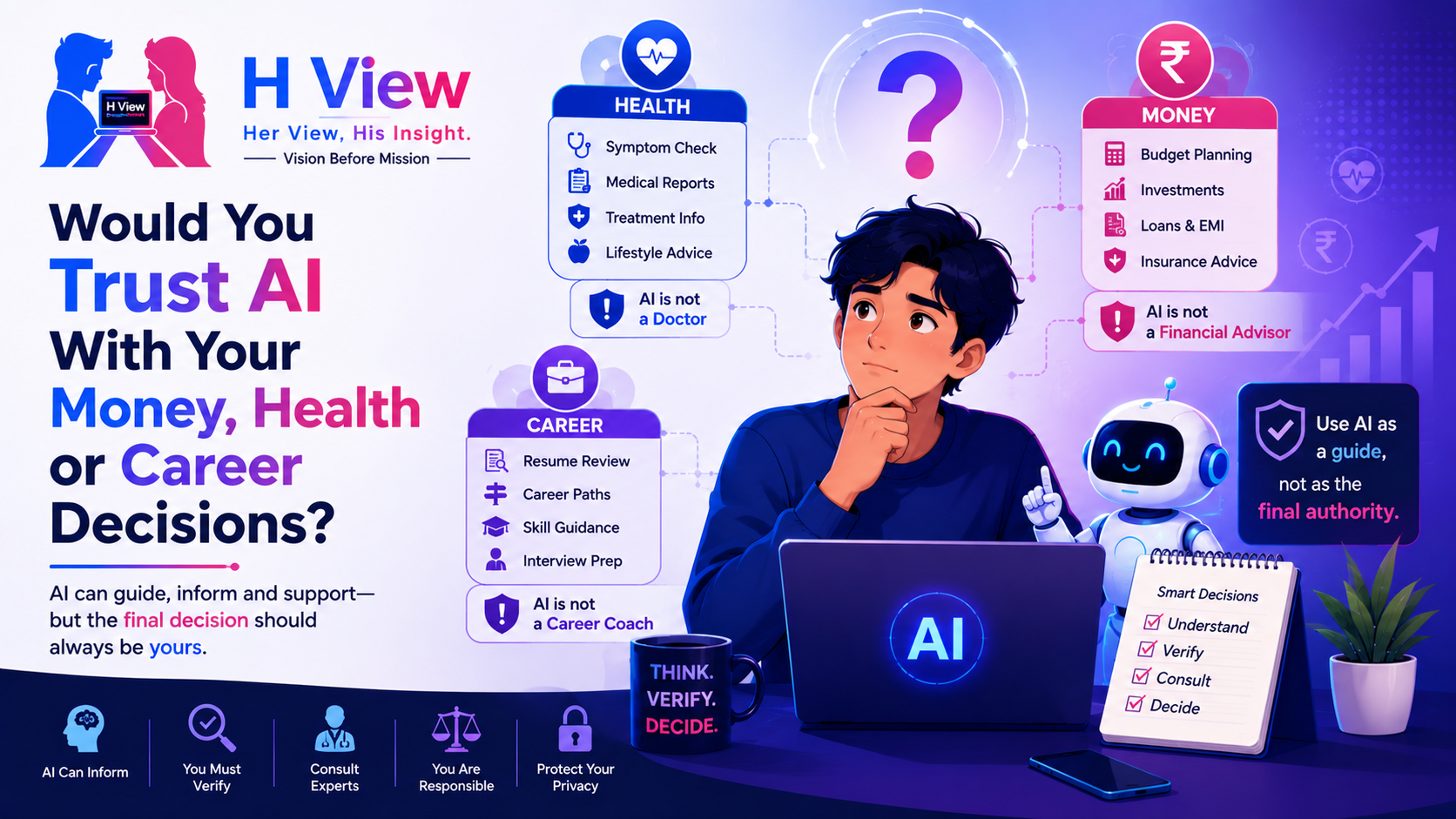
But should we actually trust it with decisions that could affect our health, savings, livelihood, or future?
The answer is not a simple yes or no.
AI can help us understand information, compare choices, prepare questions, and recognise issues we may have overlooked. But it does not fully understand our life, accept responsibility for the outcome, or guarantee that every answer is accurate.
The real challenge is knowing when AI is assisting a decision and when it is quietly making the decision for us.
Professional advice can be expensive, difficult to access, or emotionally uncomfortable.
A person may hesitate to speak with a doctor about a sensitive symptom. Someone facing debt may feel embarrassed to discuss it with family. A fresher may not know an experienced career mentor. A small business owner may not be able to afford consultants for every decision.
AI appears to close that gap.
People commonly ask it to:
Many of these uses can be valuable when AI is treated as a starting point.
The risk begins when users stop asking, “What should I consider?” and start asking, “Tell me exactly what to do.”
From one perspective, AI can make useful information available to people who previously had limited access to it.
A patient can ask for a medical term to be explained in simpler language before speaking with a doctor. A young employee can understand the basic differences between saving, investing, insurance, and debt repayment.
A job seeker can improve a resume, practise interviews, and identify skills needed for a particular role. Someone considering a career change can explore possible paths before spending money on a course.
AI can also help users prepare better questions for qualified professionals.
Instead of entering a medical appointment without clarity, a patient may arrive with an organised list of symptoms and concerns. Before meeting a financial adviser, a person may understand basic investment concepts and know what fees or risks to ask about.
The World Health Organization recognises that AI has significant potential in healthcare, while emphasising the need for governance, ethics, safety, transparency, and human oversight.
Used carefully, AI does not have to replace expertise. It can help ordinary people participate more confidently in decisions about their own lives.
The most dangerous feature of an inaccurate AI answer is that it may not sound inaccurate.
It can be detailed, professional, and logically structured. It may provide steps, reasons, warnings, and conclusions. This presentation can create a level of confidence that the underlying information does not deserve.
AI may misunderstand context, overlook an important condition, rely on incomplete information, or produce false details.
This matters in any topic, but the consequences become more serious when the decision involves medication, investments, debt, employment, or legal obligations.
The United States Securities and Exchange Commission’s investor education office warns people not to rely solely on AI-generated information when making investment decisions and recommends confirming underlying sources and consulting registered professionals where appropriate.
The answer may sound personal, but AI does not experience the consequences if the advice fails.
The user does.
AI can be helpful for understanding general health information.
It may explain unfamiliar terminology, help a person prepare for an appointment, organise symptoms by timeline, or suggest questions to ask a doctor.
However, medical decisions depend on factors an AI chat may not fully know:
Two people with similar symptoms may require very different treatment.
A symptom that appears minor in isolation may become important when combined with other details. AI may also produce either unnecessary fear or false reassurance.
WHO’s recent guidance on generative AI in health highlights the importance of protecting autonomy, privacy, safety, equity, accountability, and the role of health professionals.
A sensible boundary is to use AI to improve understanding—not to diagnose yourself, change medication, delay urgent care, or replace qualified medical judgment.
Money decisions often look mathematical, which can make AI advice feel especially reliable.
A user can provide their salary, expenses, loans, and goals and receive a neatly organised plan. AI can help calculate repayment options, create a budget, explain financial terms, and compare possible scenarios.
These are useful functions.
But financial decisions involve more than calculations.
An investment recommendation should consider risk tolerance, time horizon, tax situation, emergency savings, family responsibilities, income stability, and the possibility of loss.
AI may also produce outdated product details, inaccurate return assumptions, or recommendations that do not fit local regulations.
Consumer finance regulators have warned that financial chatbots can be wrong even while consumers use them for advice involving bank accounts, credit cards, mortgages, and loans.
Scammers can also use AI-generated websites, images, voices, and videos to promote investment fraud or impersonate trusted people.
AI can support budgeting and education. It should not be the only basis for investing savings, taking major loans, buying insurance, or transferring money.
Career decisions may not create immediate physical danger, but they can shape income, confidence, and long-term opportunity.
AI can help someone:
The difficulty is that career decisions are deeply personal.
An AI tool may not understand a person’s workplace culture, family responsibilities, financial pressure, health, confidence, manager relationship, or local opportunities.
It may recommend changing careers because a role appears to be growing, without considering whether the person enjoys the work or can realistically access the required training.
AI is also increasingly involved on the employer’s side. Automated systems may be used for recruitment, screening, hiring, monitoring, promotion, and other employment decisions. The US Equal Employment Opportunity Commission has highlighted both the growing use of such systems and concerns about discrimination and accessibility.
AI can help organise a career decision, but the final choice should include personal priorities, real market information, and conversations with people who understand the field.
AI can only work with the information it receives and the patterns available to it.
A user asking whether to resign may mention a difficult manager but forget to mention an upcoming financial commitment.
Someone asking for an investment plan may share income but not disclose unstable employment or family debt.
A person seeking medical advice may describe the main symptom but omit a medication, previous diagnosis, or recent procedure.
Human professionals can ask follow-up questions based on experience, body language, examination, records, and professional responsibility.
AI can ask questions too, but it does not always know which missing detail will completely change the answer.
This is why personalisation should not be confused with full understanding.
To receive a personalised answer, users often share highly personal information.
They may upload:
Before sharing such material, users should understand how the tool handles data, whether the account is personal or organisation-managed, and whether confidential information is permitted.
Names, addresses, account numbers, identification numbers, passwords, medical identifiers, and confidential company information should not be shared casually.
The more sensitive the decision, the more carefully the data should be handled.
The safest approach is to use AI as a thinking partner rather than a decision-maker.
Instead of asking:
“Which investment should I buy?”
Ask:
“What factors should I compare before choosing an investment, and what risks should I verify?”
Instead of:
“Do I have this medical condition?”
Ask:
“What questions should I discuss with my doctor, and which symptoms may require urgent attention?”
Instead of:
“Should I resign?”
Ask:
“Help me compare the financial, professional, and personal factors involved in leaving this job.”
These questions keep the user in control.
AI becomes a tool for organising thought rather than an authority issuing instructions.
Before acting on AI advice involving health, money, career, law, or safety, follow four steps.
Do not act on anything you cannot explain in your own words.
Verify key facts through official organisations, current documents, and trusted references.
A doctor, registered financial professional, lawyer, career mentor, or qualified specialist may identify risks AI missed.
AI can provide options, but responsibility and final judgment must remain human.
The higher the possible harm, the stronger the human oversight should be.
AI is generally more suitable for:
These tasks support judgment without replacing it.
AI should not independently decide:
The cost of a wrong answer is simply too high.
Her View: AI can make important knowledge more accessible, help people prepare better questions, simplify complicated information, and support those who cannot easily access professional guidance.
His Insight: Personalised language can create false trust. AI may be incomplete, inaccurate, biased, outdated, or unaware of crucial context. It does not carry responsibility for the consequences.
Both views are valid.
The goal should not be to reject AI advice completely. It should be to recognise its proper role.
AI can help you think about money, health, and career decisions.
It should not be allowed to make those decisions for you.
Use it to understand terminology, organise concerns, compare possibilities, prepare questions, and identify what requires further investigation.
But when the decision could affect your body, savings, livelihood, legal rights, or family, an instant answer is not enough.
Trust should increase only when information is verified, context is complete, and a qualified person accepts professional responsibility for the guidance.
AI may be able to provide an impressive answer.
Wisdom lies in knowing whether that answer deserves to influence your life.
AI can explain general medical information and help users prepare questions, but it should not replace diagnosis, examination, treatment, or qualified medical advice.
AI may help explain investment concepts and risks, but users should not rely solely on its recommendations. Important investment decisions should be verified through reliable sources and qualified professionals.
AI is designed to produce clear and coherent language. A professional tone does not guarantee that the answer is accurate, complete, current, or appropriate for the individual user.
Avoid sharing passwords, bank account details, identification numbers, confidential medical identifiers, private company information, or documents containing unnecessary personal data.
AI can help you understand basic terms and prepare questions. It should support the professional conversation rather than replace it.
Use it to explore factors and possible questions, verify important claims through reliable sources, consult a qualified professional, and keep the final decision under human control.
The user generally remains responsible for acting on the advice. This is why high-impact decisions should not be delegated entirely to an AI system.
Harika is the co-founder of H View and covers AI, technology, gadgets, digital tools, online platforms, and modern internet trends. Her articles focus on simplifying complex topics with practical explanations, balanced opinions, and reader-first insights.
Share your real experience and help other readers decide better.
No community views yet. Be the first to share yours.
Open LinkedIn for a few minutes and you will probably come across a colourful graphic…
Harika October 6, 2026 
When an employee resigns, many organisations move quickly into replacement mode. The manager informs HR,…
Harika October 6, 2026 
For many corporate employees, the workday begins long before they actually start working. They wake…
Harika October 5, 2026 
Many projects begin with an assumption that sounds reasonable on paper: the client will explain…
Harika October 1, 2026