

Best Digital Marketing Tools in 2026: What Marketers Actually Need and What They Can Skip
Open LinkedIn for a few minutes and you will probably come across a colourful graphic…
 Harika October 6, 2026
  By HarikaUpdated September 20, 202611 min read40 views
CMF Clip Pro has officially moved from launch announcement to a product people can actually buy.
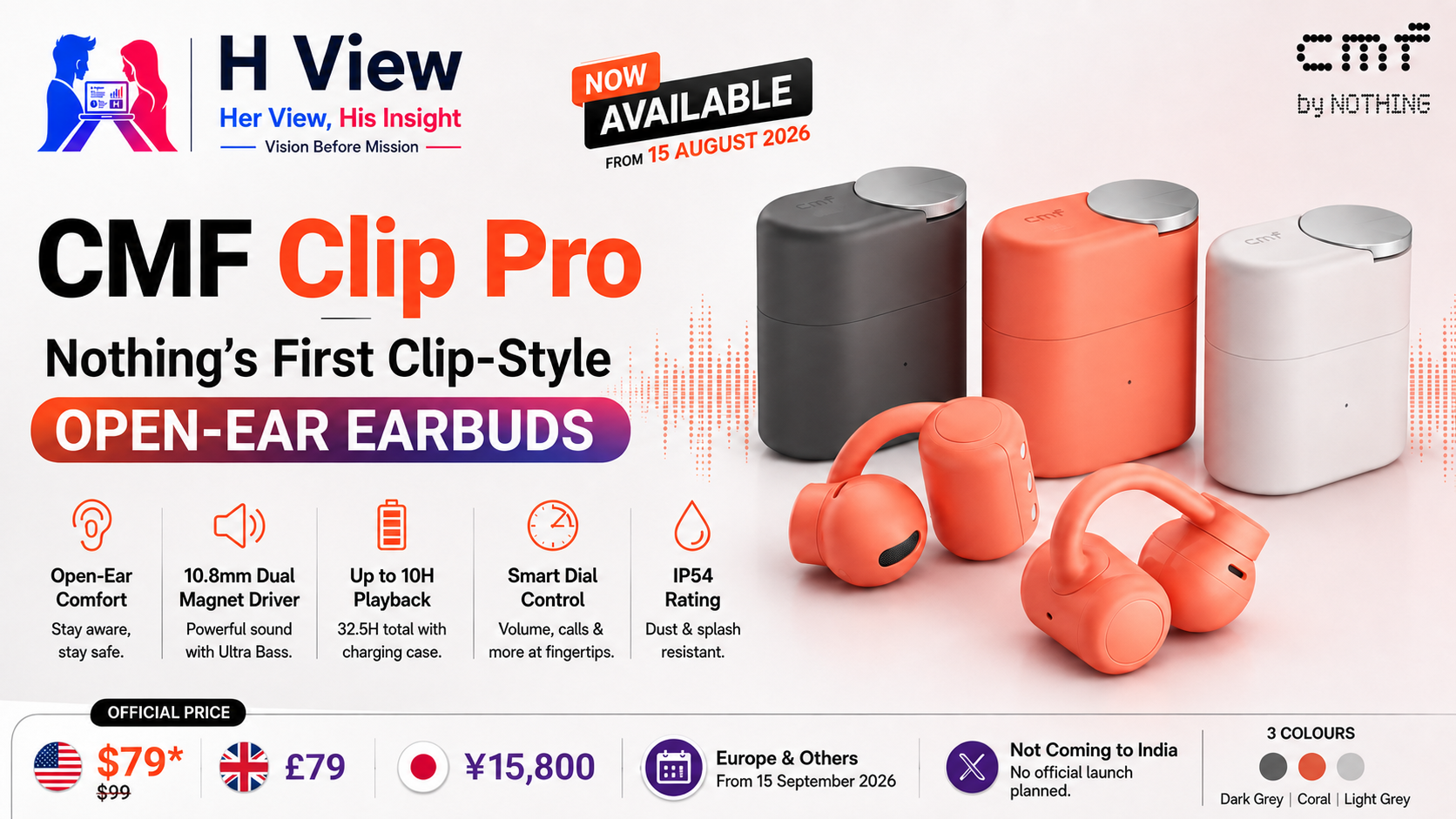
Sales began on 15 August 2026 in the US, UK and Japan, giving CMF its first proper entry into the rapidly growing clip-style open-ear earbud category. The timing is interesting because open-ear audio is no longer a niche idea reserved for runners or people who dislike silicone ear tips. Bose, Sony, Shokz and several smaller brands have already been experimenting with ways to let people listen to music without sealing the ear canal, and CMF is now trying to bring that concept to a lower price.
The Clip Pro costs $99 officially in the US and £79 in the UK, although Nothing’s US store is already showing it at $79 instead of $99 as of 17 August. It comes in Dark Grey, Light Grey and Coral. Europe and additional markets are scheduled to receive it on 15 September, while buyers in India have a less exciting answer: CMF has confirmed that there is currently no official Indian release planned.
That makes the Clip Pro an unusual product for H View readers in India. It may not be something most people can order locally today, but it tells us a lot about where CMF—and the wider Nothing audio ecosystem—is heading.
The easiest way to understand Clip Pro is to forget about conventional TWS earbuds for a moment.
Traditional in-ear models sit inside the ear canal and normally use silicone tips to create a seal. That seal helps with bass, passive isolation and active noise cancellation, but not everyone enjoys the pressure or blocked-ear feeling that comes with it.
Clip Pro takes almost the opposite approach.
Each earbud clips around the outer ear and positions its speaker close to the ear canal without actually plugging it. CMF uses a three-point clip structure with a flexible titanium-wire core, and each side weighs about 5.9g. The idea is to keep the earbuds secure without creating the pressure associated with in-ear tips.
That changes how you use them. You can listen to a podcast while walking and still hear a vehicle approaching. You can keep music playing in an office while remaining aware that someone is speaking to you. A runner does not have to choose between audio and environmental awareness.
But there is an obvious trade-off: outside sound is always allowed in.
If your daily commute involves a noisy metro, crowded bus or long flight, that can quickly become a disadvantage.
Before 15 August, most information about Clip Pro came from CMF’s own specification sheet. Now that reviewers have spent time with the product, the picture is becoming more useful.
The Verge found the Clip Pro comfortable and competitive for the price, particularly for people who dislike conventional in-ear earbuds. The review also highlighted the fundamental weakness of open-ear audio: sound response can vary depending on positioning, outside noise remains clearly audible, and users may increase the volume enough that some sound can leak to nearby people.
That is probably the most important thing to understand before buying.
Clip Pro is not trying to outperform a pair of sealed ANC earbuds in an aircraft cabin. It is trying to make listening more comfortable when completely blocking the outside world would be inconvenient.
A person who spends two hours a day on the Delhi Metro would probably benefit more from good ANC. Someone who walks to work, cycles, spends hours in an office or dislikes having silicone tips inside their ears may appreciate the Clip Pro far more.
The technology is interesting, but the use case matters more than the specification sheet.
Open-ear does not mean CMF has treated the audio hardware casually.
Each Clip Pro uses a 10.8mm dual-magnet dynamic driver, with CMF’s Ultra Bass technology attempting to compensate for one of the biggest weaknesses of open-ear designs: bass loss.
There is also support for Hi-Res Audio Wireless and LDAC, alongside AAC and SBC codecs. LDAC can carry higher-bitrate Bluetooth audio on compatible Android devices, although the benefit becomes less obvious when environmental noise is entering the ear at the same time.
That is a good example of why specifications need context.
LDAC on a quiet evening at home may add value. LDAC while walking beside heavy traffic is unlikely to transform the experience because the environment itself becomes the limiting factor.
Early reviews suggest the Clip Pro can sound surprisingly good for this form factor, but buyers expecting the low-end impact of sealed Nothing Ear or CMF Buds models should moderate their expectations.
Open-ear earbuds create another socially awkward problem: if the speaker is not sealed inside your ear, the person sitting next to you may hear some of what you are listening to.
CMF addresses this with a feature it calls Sound Seal. The system is designed to manage certain frequencies to reduce how much audio escapes towards people nearby. Users can adjust related settings through the Nothing X app.
We would still avoid treating that as complete privacy.
If you are sitting beside someone in a silent library and playing music loudly, no software can completely defeat the physics of an exposed speaker sitting beside your ear.
Sound Seal is better viewed as an attempt to reduce leakage rather than eliminate it.
That distinction becomes particularly relevant for podcasts, private voice messages and calls. Even if other people cannot hear every word clearly, an open-ear design is never going to provide the same acoustic isolation as a properly sealed in-ear model.
The charging case is where CMF has added some personality.
Clip Pro includes a Smart Dial built into the case. It can be used for functions such as volume adjustment, media control, answering calls and device pairing without requiring you to unlock your phone.
CMF has experimented with physical controls before, and this approach makes more sense than turning a charging case into a miniature touchscreen.
A dial is tactile. You can reach into a pocket, turn it and understand what you are doing without staring at another display.
There is a practical concern, though. Previous CMF implementations have been criticised for accidental dial movements inside a pocket, and reviewers are already paying attention to whether Clip Pro improves that behaviour.
This is one feature we would want to live with for several weeks before calling it essential.
When it works well, it is exactly the kind of physical interaction that makes CMF products feel different. When it triggers accidentally, it becomes another clever idea that would have been better as a normal button.
CMF claims up to 10 hours of playback from the earbuds and up to 32.5 hours with the charging case. Fast charging can provide around four hours of playback from a ten-minute charge.
That is comfortably enough for most workdays.
Clip Pro also uses four microphones with VPU-powered Clear Voice technology to separate speech from surrounding noise during calls. Early testing has generally been positive, although The Verge noted that aggressive noise processing can occasionally affect softer voices.
There is Bluetooth 5.4, multipoint connectivity for two devices, a low-latency gaming mode and an IP54 rating for dust and splash resistance.
These details make Clip Pro feel less like an experimental first-generation product and more like CMF adapting familiar earbud features to a different shape.
Imagine working from a laptop and phone during the day. Multipoint lets the earbuds remain connected to both. You can hear a colleague approaching because the ear remains open, answer a phone call, then return to music without repeatedly removing and reconnecting earbuds.
That is where this design begins to make practical sense.
For Indian Nothing and CMF fans, this is the frustrating part.
Nothing’s official announcement specifically states that CMF Clip Pro will not be available in India. The first markets are the US, UK and Japan, followed by Europe and other regions from 15 September.
There is therefore no official Indian price at the moment.
You may see websites converting $99 into approximately ₹9,000–₹9,500, but that is not an Indian retail price. Currency conversion does not account for tax, distribution, import duties, local positioning or promotions.
We would not recommend importing the product simply because an international review looks attractive unless you are comfortable dealing with warranty and support complications.
The more interesting question is whether CMF eventually changes its mind.
India is an important market for CMF, making the omission unusual. But until the company announces something different, buyers should treat “CMF Clip Pro India launch” claims cautiously.
This is where Nothing’s audio lineup gets interesting.
Nothing Ear (3a) costs $99 in the US and is a conventional sealed wireless earbud with adaptive ANC, Audio Snapshot, call recording in supported regions and up to roughly 42 hours of total battery life. Clip Pro officially carries the same $99 US MSRP, although Nothing’s US store currently has it reduced to $79.
The two products are therefore not really separated by “cheap versus expensive.”
They are separated by how you want to listen.
Ear (3a) makes more sense if you want stronger isolation, deeper bass and ANC for commuting or travel. Clip Pro makes more sense when comfort, awareness and long periods of wear are more important than shutting out your surroundings.
Someone who already owns conventional earbuds could even see Clip Pro as a second pair rather than a replacement.
Our earlier CMF Clip Pro Explained article covers the technology in more detail, while our Nothing Ear (3a) Explained guide is worth linking here for readers trying to choose between the two designs.
Open-ear earbuds make more sense to me when I think about how people actually wear audio devices throughout a normal day rather than how impressive they sound during a five-minute demonstration.
There are situations where I simply do not want to be sealed away from everything around me. Walking outside, working beside other people or listening casually for several hours is different from sitting alone and concentrating on music. In those situations, being able to hear what is happening around you can feel less tiring and more natural.
The Clip Pro design also feels more intentional than simply removing the silicone tips from an ordinary earbud. The jewellery-like clip, small case and Coral colour give it enough personality to fit CMF’s design identity. I would still keep normal ANC earbuds for travel, but I can understand why someone who constantly removes one earbud to hear people around them might prefer this approach.
From a value perspective, the current $79 US promotional price makes Clip Pro considerably more interesting than its $99 MSRP. At $99, it sits directly beside products such as Nothing Ear (3a), forcing buyers to choose a specialised open-ear form over stronger isolation and ANC. At $79, there is more room for the Clip Pro to succeed on comfort and design without having to beat normal earbuds on every technical measure.
The biggest risk is buying it because the form factor looks new. Open-ear audio has unavoidable compromises. There is less isolation, bass depends heavily on fit and position, and loud environments can force you to increase volume. Those weaknesses are not failures unique to CMF—they are part of the category.
For the right buyer, that compromise is sensible. For someone mainly listening on flights, metros or in noisy gyms, it probably is not.
Now that CMF Clip Pro is actually available, it looks less like a design experiment and more like a credible alternative for people who have never been completely comfortable with conventional earbuds.
Its strongest qualities are not ANC numbers or extreme bass. It is the combination of a lightweight clip design, environmental awareness, physical controls, respectable battery life and enough audio technology to prevent “open ear” from automatically meaning “poor sound.”
Early reviews also reinforce something we suspected from the announcement: this product is about compromise. You gain comfort and awareness, but you give up isolation. CMF can reduce sound leakage, boost bass and support LDAC, but it cannot rewrite the physics of an open speaker sitting beside the ear.
For US buyers, the current $79 official-store price makes the Clip Pro much easier to recommend than at $99. UK and Japanese buyers can now purchase it as well, while Europe and other supported markets still have to wait until September. Indian buyers, unfortunately, should not expect an official launch unless CMF changes its current position.
The Clip Pro is therefore not the earbud everyone should buy.
It may, however, be exactly the earbud for someone who is tired of having something pushed into their ears all day.
Yes. CMF Clip Pro went on sale on 15 August 2026 in the US, UK and Japan. Europe and additional supported regions are scheduled for 15 September.
The official MSRP is $99 in the US and £79 in the UK. As of 17 August 2026, Nothing’s US store is showing the Clip Pro at a promotional price of $79.
No official Indian launch is currently planned. Nothing’s own release announcement explicitly states that Clip Pro will not be available in India.
No. Its open-ear design intentionally allows environmental sound to remain audible. Buyers wanting strong isolation or ANC should consider conventional in-ear models instead.
CMF claims up to 10 hours from the earbuds themselves and up to 32.5 hours total with the charging case. A ten-minute fast charge can provide roughly four hours of playback.
Neither is universally better. Clip Pro prioritises comfort and awareness, while Ear (3a) is better suited to people who want a sealed fit, stronger isolation and ANC. The choice depends more on where you listen than on which model is newer.
Harika is the co-founder of H View and covers AI, technology, gadgets, digital tools, online platforms, and modern internet trends. Her articles focus on simplifying complex topics with practical explanations, balanced opinions, and reader-first insights.
Share your real experience and help other readers decide better.
No community views yet. Be the first to share yours.

Open LinkedIn for a few minutes and you will probably come across a colourful graphic…
Harika October 6, 2026 
When an employee resigns, many organisations move quickly into replacement mode. The manager informs HR,…
Harika October 6, 2026 
For many corporate employees, the workday begins long before they actually start working. They wake…
Harika October 5, 2026 
Many projects begin with an assumption that sounds reasonable on paper: the client will explain…
Harika October 1, 2026