

Best Digital Marketing Tools in 2026: What Marketers Actually Need and What They Can Skip
Open LinkedIn for a few minutes and you will probably come across a colourful graphic…
 Harika October 6, 2026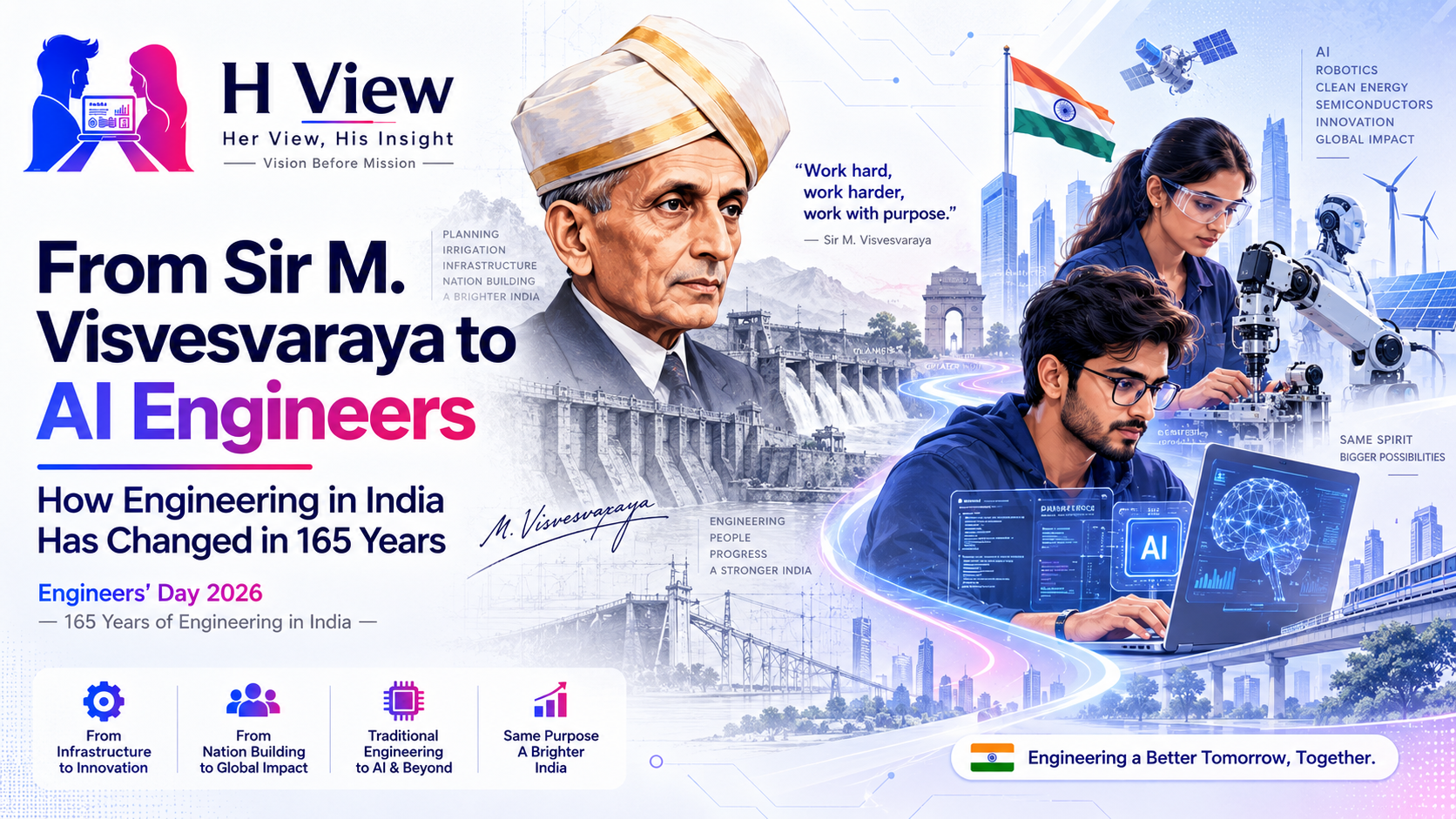
 By Satya HemanthUpdated September 21, 202611 min read30 views
Every September 15, India celebrates Engineers’ Day on the birth anniversary of Sir Mokshagundam Visvesvaraya, one of the country’s most respected engineers and nation-builders. Born in 1861, Visvesvaraya belonged to an age when engineering meant canals, dams, water supply systems, flood protection, roads and industrial infrastructure. In 2026, on his 165th birth anniversary, an engineer may instead spend the day designing semiconductor chips, training artificial intelligence models, securing cloud systems, building electric vehicles or developing software that millions of people use without ever seeing the physical machinery behind it.
The tools could hardly look more different. Visvesvaraya worked in an era of surveying instruments, masonry, hydraulic calculations and physical infrastructure. Today’s engineers work with GPUs, simulation software, cloud platforms, digital twins, robotics and generative AI. Yet the distance between those worlds is smaller than it first appears, because the purpose of engineering has remained remarkably consistent: understand a real problem, work within constraints, design a solution that can survive outside the drawing board, and take responsibility for what happens when people begin depending on it.
That is what makes Visvesvaraya particularly relevant on Engineers’ Day 2026. Remembering him should not be limited to repeating his achievements. His life gives us a useful way to understand how India moved from an era of foundational civil engineering into one where AI, semiconductors and advanced digital systems are becoming part of national infrastructure.
When Visvesvaraya began his engineering career in the nineteenth century, many of the problems confronting an engineer were basic to everyday survival and economic development. Cities needed reliable water. Agriculture needed irrigation. Floods needed to be controlled. Sanitation, roads and industrial infrastructure had to be expanded.
After studying engineering in Pune, Visvesvaraya joined the Bombay Public Works Department in the 1880s. His career would eventually span water supply, irrigation, flood control, industrialisation and infrastructure planning. The Institution of Engineers (India) records his work on water and drainage schemes, irrigation systems and the automatic gates he designed for Khadakvasla reservoir. His engineering advice also contributed to flood protection work in Hyderabad, while later stages of his career were deeply associated with Mysore’s development.
One of the reasons Visvesvaraya continues to command respect is that his work was rarely engineering for engineering’s sake. It usually began with a public problem.
If water had to be stored more efficiently, the question became how to increase usable capacity without simply making a dam higher. If agricultural water had to reach more people, irrigation had to be organised differently. If a city was vulnerable to flooding, engineering became a question of protecting lives as well as infrastructure.
That philosophy feels surprisingly modern.
We talk today about “problem statements,” “user needs” and “systems thinking,” but Visvesvaraya’s career shows that good engineering has always started with the same question: what problem are we actually trying to solve?
Visvesvaraya should not be remembered only as the man associated with dams.
His larger vision connected engineering with industrial and economic development. During his years in Mysore, he was involved with major infrastructure and industrial initiatives, and his work extended into areas such as iron and steel, electrification, education and planning. He received the Bharat Ratna in 1955, decades after his major engineering career had begun.
That broader perspective matters because modern engineering increasingly works in exactly the same way.
A semiconductor engineer cannot operate independently of fabrication facilities, supply chains, research institutions and manufacturing policy. An AI engineer needs computing infrastructure, datasets, cloud systems, cybersecurity, electricity and specialised hardware. An EV engineer depends on batteries, charging infrastructure, electronics, materials and manufacturing.
The individual engineer remains important, but modern engineering problems are increasingly systems problems.
Visvesvaraya understood that principle long before the term became fashionable.
If Visvesvaraya could walk into an engineering organisation in India today, the technologies would probably look almost unrecognisable. The engineering mindset, however, would be familiar.
India is currently building engineering capability across semiconductors, artificial intelligence, advanced manufacturing and digital infrastructure. The IndiaAI Mission has expanded shared AI compute capacity to more than 45,000 GPUs, while government programmes are supporting indigenous AI models, datasets and research. India is simultaneously expanding semiconductor design and manufacturing, with multiple fabrication and packaging facilities progressing across the country.
The engineer of 2026 may therefore solve problems at an entirely different layer.
A civil engineer can model structural behaviour digitally before construction begins. An electronics engineer may work on a chip containing billions of transistors. A manufacturing engineer can combine robotics, computer vision and predictive systems on a factory floor. A software engineer may build services used by millions of people simultaneously, while an AI engineer can work on systems that interpret language, images and complex datasets.
Even traditional fields are becoming deeply digital. India’s 2026 discussions around manufacturing engineering explicitly connect AI with industrial systems and advanced manufacturing rather than treating it as a separate software industry.
Engineering has not moved from “physical” to “digital.” It has become increasingly both at the same time.
A simple comparison makes the scale of that transition easier to see.
| Engineering dimension | Visvesvaraya’s era | Engineering in 2026 |
|---|---|---|
| Major problems | Water, irrigation, floods, sanitation, roads, industrial infrastructure | AI, chips, clean energy, smart infrastructure, cybersecurity, robotics, climate resilience |
| Primary tools | Surveying, drawings, hydraulic calculations, physical testing | Simulation, cloud computing, GPUs, AI models, digital twins, automation |
| Typical scale | Cities, dams, irrigation regions, industrial facilities | Physical infrastructure plus systems serving millions of digital users |
| Design process | Primarily manual calculation and field engineering | Human engineering supported by modelling, automation and AI |
| Required expertise | Strong core engineering with broad practical knowledge | Core engineering plus software, data, systems thinking and cross-disciplinary work |
| Responsibility | Safety, reliability, cost and public utility | The same responsibilities plus privacy, cybersecurity, algorithmic risk and sustainability |
| Engineer’s value | Turning scientific knowledge into practical infrastructure | Turning science, software and intelligent systems into dependable real-world outcomes |
The table shows how dramatically the tools have changed, but it also exposes something more important: the responsibility column has not disappeared.
If anything, modern engineers carry more forms of responsibility.
A dam that fails can cause physical catastrophe. A cybersecurity design that fails can expose millions of people. A biased AI system can make unfair decisions at scale. A poorly designed autonomous system can act faster than a human operator can intervene.
Modern technology has not reduced engineering responsibility. It has expanded the number of ways engineering decisions can affect society.
This is especially important in 2026 because AI can now perform work that once looked inseparable from engineering expertise.
AI can generate code, analyse designs, identify patterns in large datasets, create documentation, suggest circuit layouts and assist with simulations. Coding agents can inspect repositories and implement multi-file changes. Generative systems can produce possible solutions in seconds.
It is tempting to interpret this as the beginning of the end of engineering jobs.
A more realistic interpretation is that some engineering tasks are being automated while the definition of useful engineering skill is moving upward.
Imagine two software engineers using the same AI coding system. One simply accepts whatever the model generates. The other understands architecture, security, databases, deployment and the business requirement well enough to recognise when the generated solution is inappropriate.
Both have access to the same AI.
Only one is providing engineering judgement.
This distinction applies well beyond software. AI may generate several possible designs, but somebody still has to decide whether they are safe, economically realistic, maintainable and appropriate for the environment in which they will operate.
That is why the future engineer may write fewer things manually while making more consequential decisions about what should be built.
India became globally recognised for software talent, but the next stage of engineering development is increasingly moving deeper into the technology stack.
The semiconductor industry is a good example. At the India AI Impact Summit in February 2026, government and industry discussions emphasised that India needs engineers who understand the complete fabrication ecosystem rather than people trained only on isolated tools. Officials also highlighted India’s substantial global presence in chip design while stressing the need to expand manufacturing capability.
That change creates opportunities across electronics, materials, mechanical systems, chemical processes, industrial automation and advanced manufacturing—not only computer science.
AI itself depends on this wider engineering ecosystem. A powerful AI model ultimately runs on semiconductor hardware inside data centres that require electricity, cooling, networking, construction and sophisticated operational engineering.
The popular image of an “AI engineer” sitting at a laptop therefore tells only part of the story.
Behind every AI system sits a remarkable amount of traditional engineering.
He would certainly not recognise Python code, GPUs or large language models.
He might recognise the discipline behind them.
Visvesvaraya’s work repeatedly involved constraints: limited resources, physical geography, growing populations, public needs and technologies that were far less advanced than what engineers have today. His reputation came from applying technical knowledge to those constraints carefully and practically.
An AI engineer faces different constraints, but the principle is similar. Computing capacity is finite. Data can be incomplete. Models make mistakes. Businesses have budgets. Users behave unpredictably. Systems need to remain secure and reliable after deployment.
The engineer’s job begins where the ideal demonstration ends.
That may be one of the best lessons Visvesvaraya’s career offers today. Engineering is not about making something impressive once. It is about making something dependable enough for other people to rely on repeatedly.
Engineering is often represented through machines, buildings, software and spectacular inventions, but its human impact deserves equal attention. A water system matters because a family receives safe water. A bridge matters because somebody can travel safely. An AI system matters because a real person may eventually depend on its recommendation.
That connection between technical work and ordinary life is one reason Visvesvaraya remains relevant. Modern engineers have more powerful tools than he could have imagined, but greater capability should make human consequences more important, not less important.
An engineer who understands technology without understanding whom it affects is only solving half the problem.
The most interesting change over 165 years is that engineers have become increasingly specialised while the problems themselves have become increasingly interconnected.
AI depends on semiconductors. Semiconductors depend on materials, precision equipment and manufacturing. Data centres depend on electrical and cooling systems. Electric vehicles combine software, batteries, electronics and mechanical engineering. Smart cities combine civil engineering, sensors, networks, energy and data.
That means tomorrow’s strongest engineers may need deep expertise in one field while being capable of collaborating across several others.
India’s current semiconductor and AI programmes recognise exactly this challenge: talent development cannot simply mean teaching people individual tools; engineers need to understand why complete systems behave the way they do.
The story from Sir M. Visvesvaraya to the AI engineer is not really a story about old engineering being replaced by new engineering.
It is a story about the scale of problems engineers are capable of solving expanding dramatically.
Visvesvaraya worked on water, irrigation, flood protection and industrial development when India needed foundational infrastructure. Today’s engineers inherit those responsibilities while also confronting climate resilience, clean energy, semiconductors, cybersecurity, automation, artificial intelligence and digital infrastructure.
The tools have changed beyond recognition.
The principle has not.
A real engineer does not merely know how to use technology. An engineer understands a problem deeply enough to decide what should be built, why it should be built, what could go wrong and who will be affected when it does.
That may be the most appropriate message for Engineers’ Day 2026.
We should celebrate how far engineering has travelled in 165 years, but we should also remember that the best engineers are still doing what Visvesvaraya did in his own time: turning knowledge into solutions that improve how people live.
India observes Engineers’ Day on September 15 to honour the birth anniversary of Sir Mokshagundam Visvesvaraya. The Institution of Engineers (India) observes the date to commemorate his contribution and inspire the engineering community through his ideals.
Sir Mokshagundam Visvesvaraya was an Indian civil engineer, administrator and nation-builder born in 1861. His work covered water supply, irrigation, flood protection, industrial development and infrastructure planning. He received the Bharat Ratna in 1955.
Yes. Visvesvaraya was born on September 15, 1861, making Engineers’ Day 2026 his 165th birth anniversary.
Engineering has expanded from primarily physical infrastructure and industrial development into highly interconnected fields involving software, artificial intelligence, semiconductors, robotics, cybersecurity and advanced manufacturing. Traditional disciplines such as civil, mechanical and electrical engineering remain essential and increasingly interact with digital technologies.
AI can automate parts of engineering work, including coding, analysis, documentation and some design tasks. However, engineering also requires problem definition, systems thinking, safety, judgement, validation and accountability. AI is more likely to change how engineers work than eliminate the need for engineering expertise entirely.
Strong fundamentals remain essential. Engineers will increasingly benefit from AI literacy, software and data awareness, systems thinking, communication and the ability to work across disciplines. The goal is not simply to learn every new AI tool, but to understand enough engineering to judge whether the tool’s output is actually correct and appropriate.
Satya Hemanth is the founder of H View and writes on careers, sports, leadership, digital trends, and practical decision-making. His articles focus on clear explanations, real-world examples, and useful insights for students, young professionals, and everyday readers.
Share your real experience and help other readers decide better.
No community views yet. Be the first to share yours.

Open LinkedIn for a few minutes and you will probably come across a colourful graphic…
Harika October 6, 2026 
When an employee resigns, many organisations move quickly into replacement mode. The manager informs HR,…
Harika October 6, 2026 
For many corporate employees, the workday begins long before they actually start working. They wake…
Harika October 5, 2026 
Many projects begin with an assumption that sounds reasonable on paper: the client will explain…
Harika October 1, 2026