

Best Digital Marketing Tools in 2026: What Marketers Actually Need and What They Can Skip
Open LinkedIn for a few minutes and you will probably come across a colourful graphic…
 Harika October 6, 2026
  By HarikaUpdated September 20, 20269 min read33 views
Online shopping used to begin with a fairly clear action. You knew what you wanted, opened a search engine or marketplace, compared several options, checked prices and reviews, and eventually made a decision. The internet influenced what appeared in front of you, but the process still felt active because you were doing most of the searching, comparing and filtering yourself.
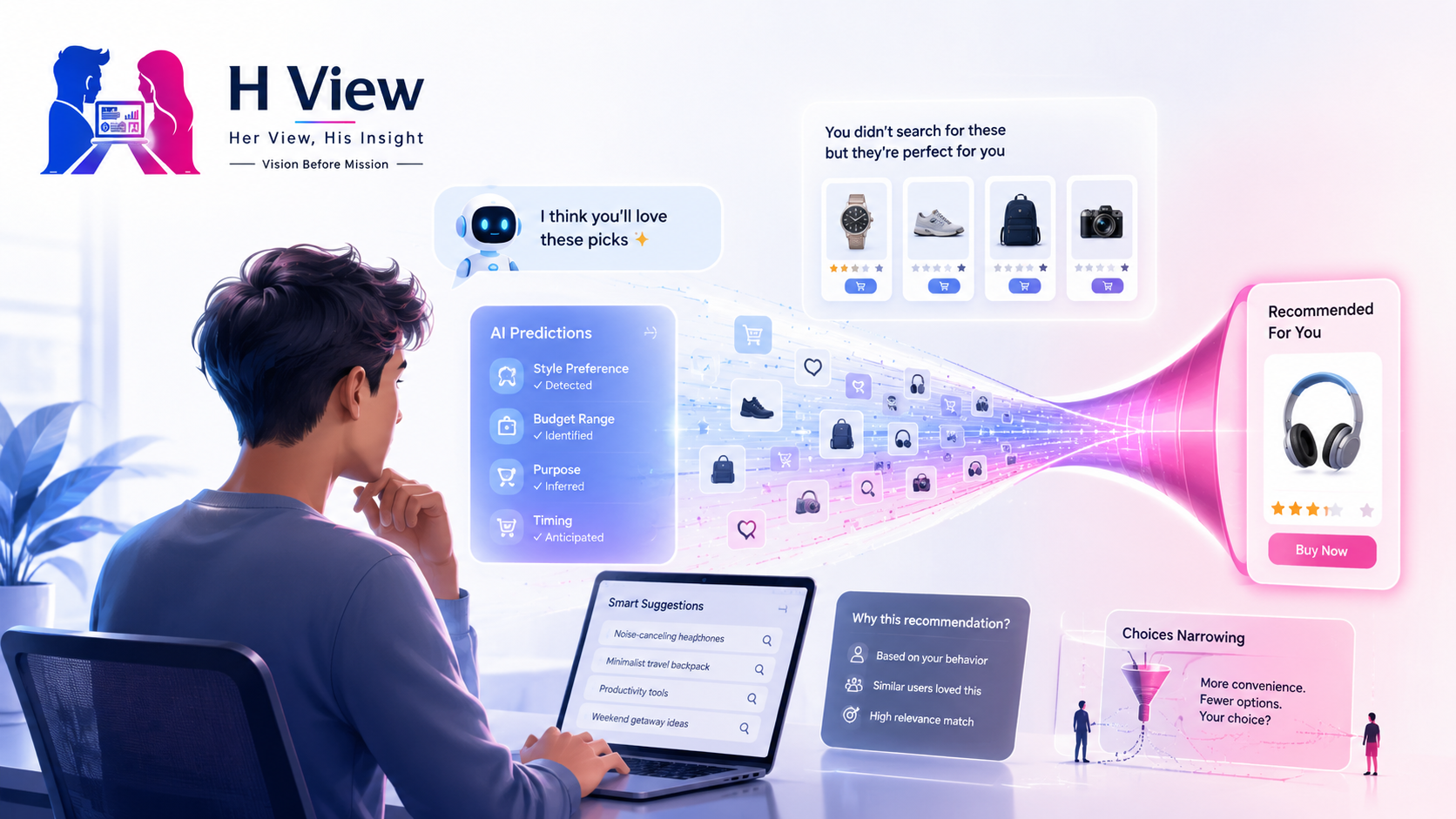
AI is changing that experience. Instead of typing “best walking shoes under ₹6,000,” you can now explain that you walk every morning, prefer neutral colours, occasionally experience knee discomfort and want something comfortable enough for travel. An AI assistant can understand those details, reduce hundreds of choices to a few suitable options and explain why each one might fit your situation. For many people, that is genuinely useful because online shopping has become so crowded that finding the right product can feel like work.
The concern begins when the system becomes so good at narrowing our choices that we stop asking how those choices were selected. Personalisation may save time, but it also gives the platform enormous influence over what we see, what we ignore and what eventually feels worth buying.
Recommendation systems are not new. Streaming platforms have suggested films and music for years, while ecommerce websites routinely show products based on previous browsing or purchases. What has changed is the way generative AI communicates those recommendations.
A normal product carousel still feels like part of a shop. An AI assistant feels more conversational. It can ask questions, remember preferences, compare products and respond when you challenge its recommendation. That creates a stronger sense that somebody—or something—is helping you rather than merely selling to you.
Imagine buying a laptop for your parents. You explain that they mainly use video calls, browsing and documents, want a larger screen and do not need gaming performance. A useful AI assistant could remove dozens of unsuitable models immediately and explain why three simpler options make more sense.
The advice may be excellent, but there is still an important question behind it. Why were those three laptops shown instead of ten others? The answer could involve product quality, price, availability, retailer access, previous behaviour or commercial relationships. The user may only see a clean recommendation, while the system has already made several invisible decisions.
That is where convenience begins turning into influence.
A sophisticated recommendation system does not need to lie in order to influence spending. It may simply learn which arguments matter most to a particular person.
Suppose you originally intend to spend ₹20,000 on a smartphone. You tell the assistant that battery life and camera quality matter most. It explains that moving slightly above your budget improves the camera considerably, then introduces a ₹28,999 phone with longer software support and a temporary bank offer. When you ask whether the difference is worth paying, the assistant explains that keeping the phone for four years could make the more expensive option better value.
Every statement may be reasonable, yet the conversation has gradually moved your budget from ₹20,000 to nearly ₹30,000.
A salesperson can do the same thing, but consumers usually understand that a salesperson wants to close a sale. AI often feels more neutral because it speaks in calm, analytical language and appears to be responding specifically to our needs. That perceived neutrality may make its recommendations more persuasive than traditional advertising.
The problem is therefore not simply whether AI recommends products. It is whether users understand whose interests the recommendation is serving.
It is too simple to describe AI shopping as either helpful or manipulative because both outcomes can exist at the same time.
A grocery assistant may help someone plan a complete dinner by remembering ingredients they would otherwise forget. The customer benefits because the shopping becomes easier, while the retailer benefits because the final basket becomes larger. Neither outcome automatically cancels the other.
This is normal business. Retailers want to sell, and customers want useful products. The difficulty appears when the commercial objective becomes difficult to see because the recommendation feels like independent advice.
The same question already exists in search engines and marketplaces. Sponsored results can be useful, but users deserve to know when money influenced their visibility. AI assistants will need similarly understandable boundaries as product recommendations become more conversational.
If a brand has paid for preferential placement, the user should not have to search through terms and conditions to discover that relationship. A recommendation can still be valuable when sponsored, but the commercial influence should be visible enough to evaluate.
Traditional online shopping gave consumers several opportunities to discover alternatives. You could open manufacturer websites, compare retailers, watch independent reviews and move between marketplaces before buying.
AI can compress that entire journey into one conversation.
If an assistant presents four products from an available catalogue, the hundreds of products left outside that shortlist may effectively stop existing for the shopper. A smaller company might make an excellent product but never appear because the system has limited access to its inventory or because larger retailers integrate more effectively with the AI platform.
That creates a new kind of gatekeeper.
The user experiences less information overload, which is beneficial. At the same time, the intermediary gains greater power over which products become visible in the first place.
This matters for consumers and businesses alike. Retailers may lose part of their direct relationship with customers if AI assistants increasingly become the place where product discovery happens. Consumers may gradually stop comparison shopping because a trusted assistant already appears to have done the comparison for them.
The more convenient the system becomes, the easier it is to forget that narrowing choice is itself a powerful decision.
The quality of an AI recommendation improves when the system knows more about the person asking.
Knowing that you want running shoes helps. Knowing your size, previous purchases, preferred brands, spending habits and injury history helps much more. An assistant could eventually use information from several connected services to predict not only what you are likely to buy but when you may need it.
That can make technology remarkably useful, but it also raises difficult questions about personal data.
Most people may be comfortable allowing an assistant to remember a shoe size or favourite colour. The decision becomes more complicated when the information involves income, debt, medical conditions, family circumstances or other sensitive details.
The same information that allows an AI assistant to protect a financially stressed user from overspending could theoretically be used to present financing offers more persuasively. The data itself is neutral; the incentive behind the system determines how that data is used.
Personalisation therefore should not be discussed separately from privacy. The more an assistant knows about us, the more important control, disclosure and understandable permissions become.
Technology companies often try to remove friction because many forms of friction are pointless. Nobody wants to enter the same delivery address three times or navigate twelve screens to complete a simple purchase.
But some friction protects us.
Taking time before buying an expensive product can prevent regret. Comparing another retailer may reveal that a supposed discount is not especially good. Reading an independent review can expose a weakness that the product page never mentioned.
If AI removes every pause between wanting something and buying it, shopping may become more efficient while becoming less deliberate.
One of the most interesting tests for future shopping assistants will therefore be whether they can recommend not buying.
Imagine asking an assistant whether you should replace a two-year-old phone. You explain that performance is still good, battery life is acceptable and the camera meets your needs. A genuinely user-focused assistant should be capable of saying that an upgrade probably does not provide enough value yet.
That recommendation produces no sale, but it could produce something more valuable in the long term: trust.
There is real value in making online shopping easier because the current experience can be exhausting. Product names are confusing, sponsored listings are mixed with ordinary results and even simple purchases can require several tabs before a person understands what they are comparing.
For parents buying technology, older shoppers or anyone unfamiliar with technical specifications, conversational AI can remove a lot of unnecessary frustration. Being able to describe a need naturally is much easier than learning how every marketplace filter works.
What should not disappear is the feeling that the final decision still belongs to the shopper. Personalisation should help people understand their options rather than quietly deciding which options deserve to exist. If commercial relationships or behavioural data influence the recommendation, that should be understandable without requiring technical knowledge.
Convenience feels most useful when it removes confusion without removing independence.
The most important question in AI commerce is not how intelligent the assistant becomes but what it is rewarded for achieving.
A retailer-owned assistant may naturally care about conversion and revenue. An independent comparison service may focus more heavily on price or user satisfaction. A platform earning commission from purchases may have another incentive entirely.
Those differences can shape recommendations even when the underlying AI technology is similar.
Consumers therefore do not need to understand every algorithm. They do need enough transparency to understand the commercial environment around the recommendation. Was the assistant searching broadly? Were sponsored products included? Did a particular retailer receive preference? Was the recommendation optimised mainly for relevance, price, conversion or something else?
The future of trustworthy AI shopping will depend less on claiming neutrality and more on explaining incentives clearly.
AI shopping systems can use information you provide directly along with signals such as previous purchases, browsing behaviour and saved preferences. The amount of information available depends on the platform and the permissions you have given it.
No. Recommendations may be based mainly on relevance, but factors such as product availability, retailer partnerships, sponsored placement or commercial priorities can also influence what appears.
It can. Personalised recommendations can reduce comparison effort, suggest complementary products and make expensive options feel more relevant. That does not automatically mean manipulation, but consumers should remain aware of how recommendations can gradually change the original buying decision.
It can be useful as one source of information, but expensive purchases still deserve independent comparison. Checking current prices, warranty terms, reviews and at least one alternative source can reduce the risk of relying too heavily on one recommendation system.
Not necessarily. More personalization may improve recommendations, but it often requires sharing more information. Users should decide whether the added convenience is worth the additional data access.
Harika is the co-founder of H View and covers AI, technology, gadgets, digital tools, online platforms, and modern internet trends. Her articles focus on simplifying complex topics with practical explanations, balanced opinions, and reader-first insights.
Share your real experience and help other readers decide better.
No community views yet. Be the first to share yours.
Open LinkedIn for a few minutes and you will probably come across a colourful graphic…
Harika October 6, 2026 
When an employee resigns, many organisations move quickly into replacement mode. The manager informs HR,…
Harika October 6, 2026 
For many corporate employees, the workday begins long before they actually start working. They wake…
Harika October 5, 2026 
Many projects begin with an assumption that sounds reasonable on paper: the client will explain…
Harika October 1, 2026