

Best Digital Marketing Tools in 2026: What Marketers Actually Need and What They Can Skip
Open LinkedIn for a few minutes and you will probably come across a colourful graphic…
 Harika October 6, 2026
  By HarikaUpdated September 20, 20267 min read134 views
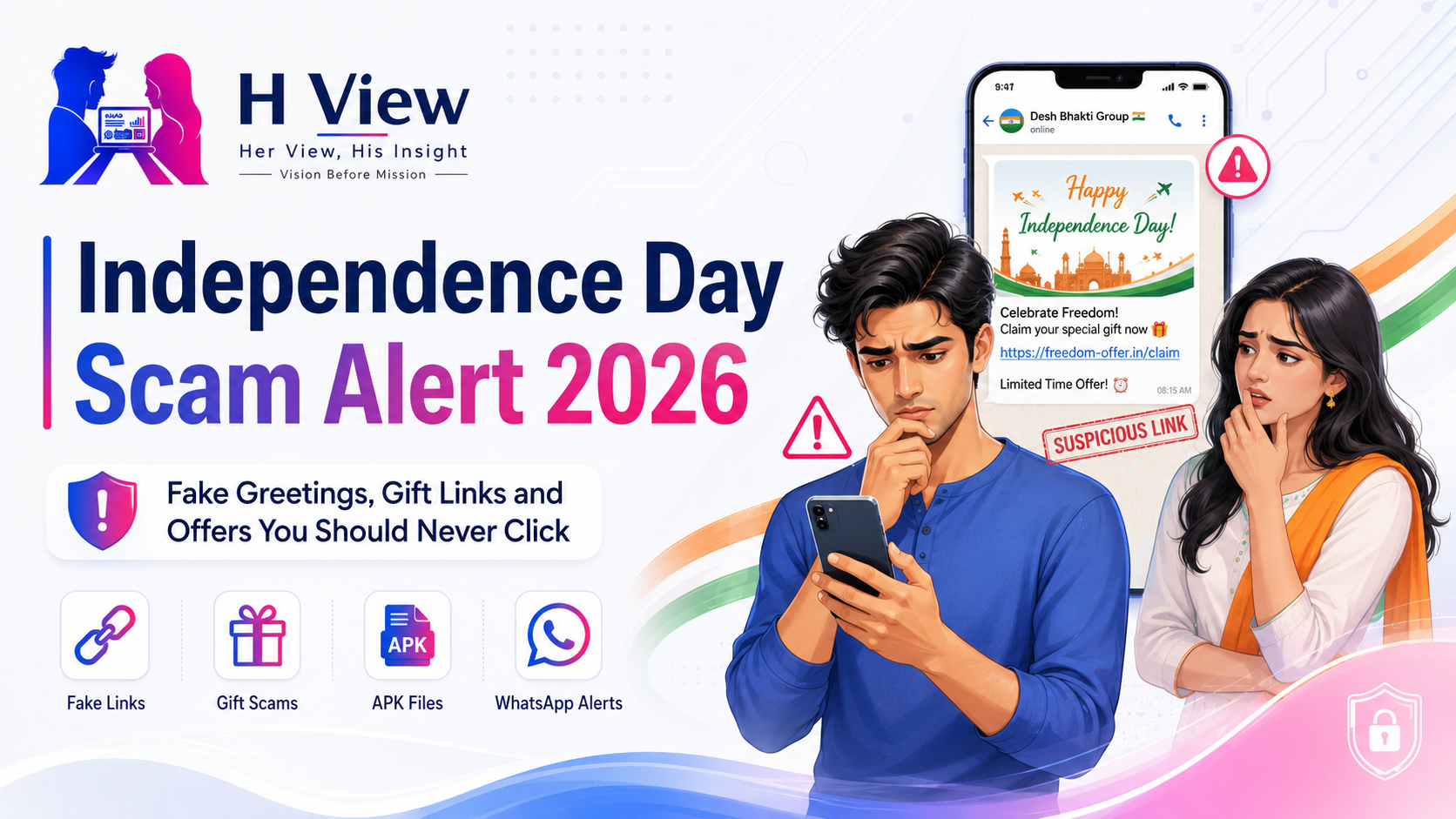
A WhatsApp message arrives with the Indian flag, a patriotic greeting and a link saying:
“Click here to create your personalised Independence Day greeting.”
Another promises a free recharge, Independence Day gift, shopping voucher or government reward.
Because the message is connected to August 15—and may even come from somebody you know—it feels harmless enough to open.
That is exactly what cybercriminals are counting on.
Cybersecurity officials have issued fresh warnings ahead of Independence Day 2026 about malicious links being circulated through patriotic greetings on SMS, WhatsApp and social media. Such links can redirect users to fraudulent websites, steal personal or financial information, or attempt to install malicious software on their devices.
Celebrating Independence Day online is perfectly safe. The danger begins when a greeting asks you to click, download, install, scan, pay or share personal information.
The scam often starts with a message that does not look threatening.
It may say:
“Create your Independence Day photo with the Tricolour.”
“Government is giving ₹5,000 Independence Day reward—claim now.”
“Free ₹299 mobile recharge for August 15.”
“Answer three questions and win an Independence Day gift.”
“Download this special Independence Day greeting app.”
The link may open a website designed to resemble a recognised company, government department or popular shopping platform.
CERT-In has previously documented festival-themed campaigns in which criminals impersonated prominent brands and distributed fake gift or prize links through WhatsApp, Telegram and Instagram. Victims were directed to phishing websites and encouraged to provide personal details, banking information, passwords or OTPs.
Independence Day gives criminals another emotionally familiar theme around which to build the same technique.
One of the most misleading assumptions is:
“My friend sent it, so it must be safe.”
Not necessarily.
Your friend may simply have forwarded the message without checking it.
More seriously, compromised WhatsApp accounts can themselves be used to distribute fraudulent messages.
In June 2026, India’s Indian Cyber Crime Coordination Centre, or I4C, warned about sophisticated attacks capable of compromising Windows computers and active WhatsApp Web sessions. Criminals could then communicate through genuine WhatsApp accounts and impersonate the actual account owner.
Therefore, judge the link, not merely the person who appears to have sent it.
A greeting may sometimes arrive as something like:
Independence_Day_Greeting.apk
That should be treated as a major warning sign.
APK stands for Android Package Kit. It is an installation file for Android applications.
Installing an unknown APK can give malicious software access to the device depending on the permissions granted.
Indian cybercrime authorities have previously warned about festive greeting scams using APK files, with malicious applications capable of compromising personal and banking information.
This risk is not theoretical. In a separate 2026 case, a woman reportedly lost more than ₹6 lakh after installing a malicious APK disguised as an RTO challan sent through WhatsApp.
A patriotic name does not make a file safe.
Festivals and national celebrations naturally create genuine promotional campaigns from retailers.
Scammers exploit that expectation.
A fake offer might claim:
The website may ask you to answer a few questions before displaying:
“Congratulations! You won.”
Then comes the real objective.
You may be asked for your:
Or the website may tell you that the reward can be unlocked only after forwarding the link to five or ten WhatsApp groups.
That forwarding mechanism helps the scam spread using the trust between friends and family.
CERT-In has previously observed exactly this pattern in festival-themed phishing campaigns: fake prize links encouraging recipients to share them with other people.
August 15 also creates an opportunity for another believable-looking scam:
“Government launches special Independence Day scheme.”
The message may include:
.gov appearing somewhere in misleading textDo not assume a scheme is genuine because an image contains government branding.
Open the relevant ministry or government portal independently and search for the announcement.
The National Cyber Crime Reporting Portal currently warns citizens even about fraudulent communications impersonating I4C, the Intelligence Bureau and Delhi Police.
If scammers are willing to impersonate cybercrime authorities themselves, a copied logo should never be treated as proof.
Before opening an Independence Day link, ask:
Who created this?
Why do they need me to click?
Is there anything to download?
Are they asking for personal information?
Can I find the same offer on the organisation’s official website?
The more urgency the message creates—“Only today,” “Last 10 minutes,” “Limited 100 winners”—the more carefully you should verify it.
A real promotion can survive thirty seconds of checking.
Simply opening a webpage does not automatically mean your bank account has been compromised.
What you do next matters.
If you did not enter information or install anything, close the page and avoid returning to it.
If you downloaded an unknown file, do not open or install it.
If an application has already been installed, remove suspicious permissions and uninstall it. Review applications and device settings for anything unfamiliar.
If you entered a password, change it immediately from the legitimate website or app. Do not reuse that password elsewhere.
If you shared banking credentials, card information or OTPs, contact your bank immediately.
Act quickly.
Contact your bank or payment provider immediately and report the transaction as fraudulent.
Financial cyberfraud can be reported through India’s 1930 cybercrime helpline and the National Cyber Crime Reporting Portal. I4C specifically advises victims to report fraudulent applications or scam incidents through these channels.
Preserve:
Do not delete everything in panic. Those details may assist the investigation.
You do not have to become a financial victim before reporting suspicious activity.
I4C’s National Cyber Crime Reporting Portal now includes Report Suspect and Suspect Repository facilities. Citizens can report suspicious website URLs, WhatsApp numbers, Telegram handles, phone numbers, email addresses, SMS identifiers and social-media URLs.
That means a suspicious Independence Day link can potentially be reported before it reaches another victim.
Do not tell family members simply:
“Never click any link.”
People receive legitimate links every day.
Give them a more practical rule:
Never enter banking information, OTPs or passwords into a page opened from a forwarded festival or greeting message.
And:
Never install an APK received through WhatsApp simply because it promises a greeting, reward or government benefit.
If an offer is genuine, you should normally be able to find it independently through the company’s or government’s official channel.
Festivals and national celebrations are supposed to bring people together.
Unfortunately, the trust that makes us forward wishes to relatives, friends and family groups is exactly what scammers try to exploit.
The safest response is not to stop sending greetings.
It is to stop attaching trust automatically to every link that accompanies them.
Cybercriminals do not always need advanced hacking techniques.
Sometimes all they need is the right timing.
An Independence Day greeting works because people are already expecting Independence Day messages.
The strongest cybersecurity habit is therefore simple: when something arrives exactly when you expect it, verify it anyway.
Celebrate August 15. Send messages, photographs and wishes.
But treat links, QR codes, APK files, giveaways and unexpected rewards separately from the greeting itself.
If a message asks you to download an app, provide an OTP, enter bank details or forward the link before receiving a prize, stop immediately.
And remember:
A message can look patriotic and still be phishing.
Normal text messages and images are generally not the issue. The main concern is suspicious links, attachments, APK files and fake promotions attached to those greetings. Cybersecurity officials have warned about malicious patriotic links ahead of Independence Day 2026.
Yes. They may have forwarded it unknowingly, or in some cases an account or linked device could be compromised. I4C has documented attacks capable of hijacking active WhatsApp sessions.
Do not install an APK from an unverified WhatsApp, Telegram, SMS or social-media message. Malicious APK files can be used to compromise devices and sensitive information.
Immediately contact your bank and report financial cyberfraud through 1930 and the National Cyber Crime Reporting Portal.
Yes. I4C’s portal provides facilities for citizens to report suspicious website URLs, phone numbers, WhatsApp or Telegram identifiers, email addresses and social-media links.
Harika is the co-founder of H View and covers AI, technology, gadgets, digital tools, online platforms, and modern internet trends. Her articles focus on simplifying complex topics with practical explanations, balanced opinions, and reader-first insights.
Share your real experience and help other readers decide better.
No community views yet. Be the first to share yours.

Open LinkedIn for a few minutes and you will probably come across a colourful graphic…
Harika October 6, 2026 
When an employee resigns, many organisations move quickly into replacement mode. The manager informs HR,…
Harika October 6, 2026 
For many corporate employees, the workday begins long before they actually start working. They wake…
Harika October 5, 2026 
Many projects begin with an assumption that sounds reasonable on paper: the client will explain…
Harika October 1, 2026