



Fake Instant Loan Apps in India: How “Loan Approved in 5 Minutes” Can Turn Into a Financial Nightmare
“Loan approved in five minutes.” “No salary slip required.” “₹50,000 instantly.” “100% approval—even with a…

A WhatsApp message arrives from an unknown recruiter:
“Earn ₹2,000 to ₹5,000 daily from home. No experience required.”
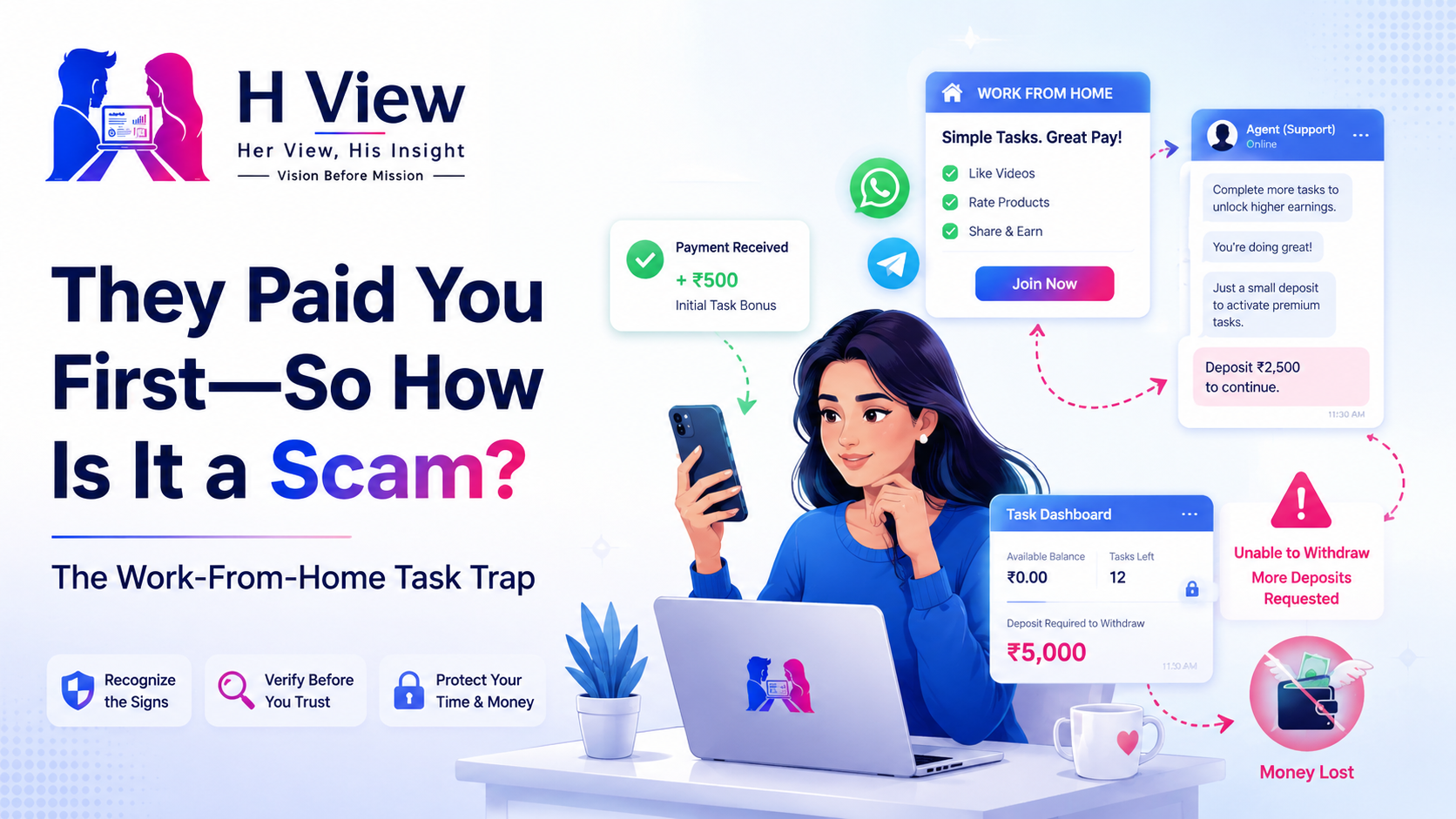
The work appears simple. You may be asked to like a YouTube video, rate a hotel, review a product, follow a social-media account or complete a few online tasks.
You finish the first assignment and receive ₹150 or ₹300 in your bank account.
The payment feels like proof that the job is genuine.
Then the recruiter offers a “premium task” with higher earnings—but asks you to deposit money first.
This is where the trap begins.
Work-from-home task scams are dangerous because fraudsters may intentionally pay victims a small amount at the beginning. That first payment is not evidence of a legitimate job. It is part of the strategy used to build trust before demanding much larger deposits.
India’s cybercrime authorities have identified organised investment and task-based part-time job frauds operating through online platforms. In one enforcement action, more than 100 websites connected to these schemes were identified and recommended for blocking.
Victims are commonly contacted through:
The sender may claim to represent a digital-marketing agency, ecommerce company, hotel-booking platform or recruitment firm.
The first task is usually easy and does not require payment.
You may be asked to:
After completion, the scammer may transfer a small reward quickly.
The purpose is psychological: once money reaches your account, you are more likely to trust the person and follow the next instruction.
Most people are suspicious when an unknown recruiter asks for money.
The first payment reduces that suspicion.
The victim may think:
The first payment may be treated as a marketing expense by the fraud network. Losing a few hundred rupees is worthwhile to the scammer when it convinces the victim to deposit thousands later.
After the initial tasks, the recruiter may move the victim into a Telegram group or fake online dashboard.
The next assignments may be called:
The victim is asked to deposit ₹1,000, ₹5,000 or more to unlock a larger commission.
A fake dashboard may show that the money has grown. But the displayed balance is only a number controlled by the scammers.
When the victim tries to withdraw, new problems suddenly appear:
Every new payment is presented as the final step needed to recover the earlier money.
Telegram groups used in these scams may contain dozens of supposed participants posting screenshots of profits and successful withdrawals.
Some may say:
“I deposited ₹10,000 and received ₹18,000.”
These accounts may be controlled by the fraudsters or used to create false confidence.
The victim begins comparing themselves with people who appear to be earning successfully. They may fear losing the opportunity or appearing too cautious.
A legitimate employer does not require employees to compete with anonymous group members by depositing their own money.
After losing ₹5,000, a victim may be asked to deposit another ₹15,000 to release the full balance.
Logically, they should stop.
Emotionally, stopping means accepting that the first payment may already be lost.
The victim thinks:
“I have already invested so much. One more payment may recover everything.”
This is the sunk-cost trap.
Fraudsters continue increasing the amount because the victim becomes more desperate to recover previous deposits.
The safest decision is to stop immediately. Sending more money does not protect what was already sent.
Some fake jobs do not ask you to complete tasks. Instead, they ask you to receive money into your bank account and transfer it elsewhere in exchange for commission.
This may turn the account holder into a money mule—someone whose bank account is used to move proceeds from fraud.
The Reserve Bank of India has warned that money mules may be recruited through job advertisements, emails and social-networking channels. Accounts involved may be suspended, and account holders may face financial and legal consequences.
Never allow a recruiter to use your account to receive or forward unknown funds.
Treat the opportunity as suspicious when:
The National Cyber Crime Reporting Portal defines online job fraud as giving people false hope of better employment or higher wages in order to defraud them.
Stop communicating and do not make another deposit.
Immediately preserve:
Contact your bank or payment provider and report the transaction as suspected fraud.
Online financial fraud should be reported immediately through India’s cybercrime helpline 1930 and the National Cyber Crime Reporting Portal. Suspicious WhatsApp numbers, Telegram handles, websites, phone numbers and email addresses can also be reported through the portal’s suspect-reporting facility.
Quick reporting may improve the chance of funds being traced or blocked, although recovery cannot be guaranteed.
Her View: Genuine remote work can provide flexibility, accessibility and income opportunities for students, parents and people unable to commute.
His Insight: A real employer pays for completed work. Any so-called job that requires repeated deposits, recharges or withdrawal payments is not ordinary employment.
Both views matter.
Work from home is real.
Paying to complete anonymous online tasks is not the same thing.
The first ₹200 payment is not proof that the opportunity is genuine.
It may be the bait.
Fraudsters pay small amounts early because trust is more valuable to them than the initial money. Once the victim believes the platform works, the deposits become larger and the withdrawals become impossible.
Remember one rule:
You should never have to deposit money to receive wages.
Pause when an unknown recruiter promises easy income. Verify the company independently. Never transfer money to unlock tasks, commissions or withdrawals.
A genuine job may require skill, effort and verification.
It should not require you to finance the person claiming to employ you.
The small payment builds trust and makes later deposit requests appear safer.
Some legitimate marketing work exists, but unexpected offers promising high daily earnings for simple tasks should be treated cautiously—especially when deposits are required.
Recovery is not guaranteed. Report the fraud immediately to your bank, helpline 1930 and the cybercrime portal.
It is a task that requires the victim to deposit money before receiving a supposed commission. It is a common fraud warning sign.
Do not send more money to unlock a suspicious task-platform balance. Additional fees are commonly used to deepen the loss.
Yes. Your account may be used as a money mule, leading to account suspension, investigation and possible legal consequences.
Satya Hemanth is the founder of H View and writes on careers, sports, leadership, digital trends, and practical decision-making. His articles focus on clear explanations, real-world examples, and useful insights for students, young professionals, and everyday readers.
Share your real experience and help other readers decide better.
No community views yet. Be the first to share yours.
“Loan approved in five minutes.” “No salary slip required.” “₹50,000 instantly.” “100% approval—even with a…
A stranger messages you with what sounds like an easy opportunity. “Use your bank account…
A phone call arrives from someone claiming to be a police officer, customs official, courier…
A long employment gap can make job seekers feel that honesty is working against them.…