

Best Digital Marketing Tools in 2026: What Marketers Actually Need and What They Can Skip
Open LinkedIn for a few minutes and you will probably come across a colourful graphic…
 Harika October 6, 2026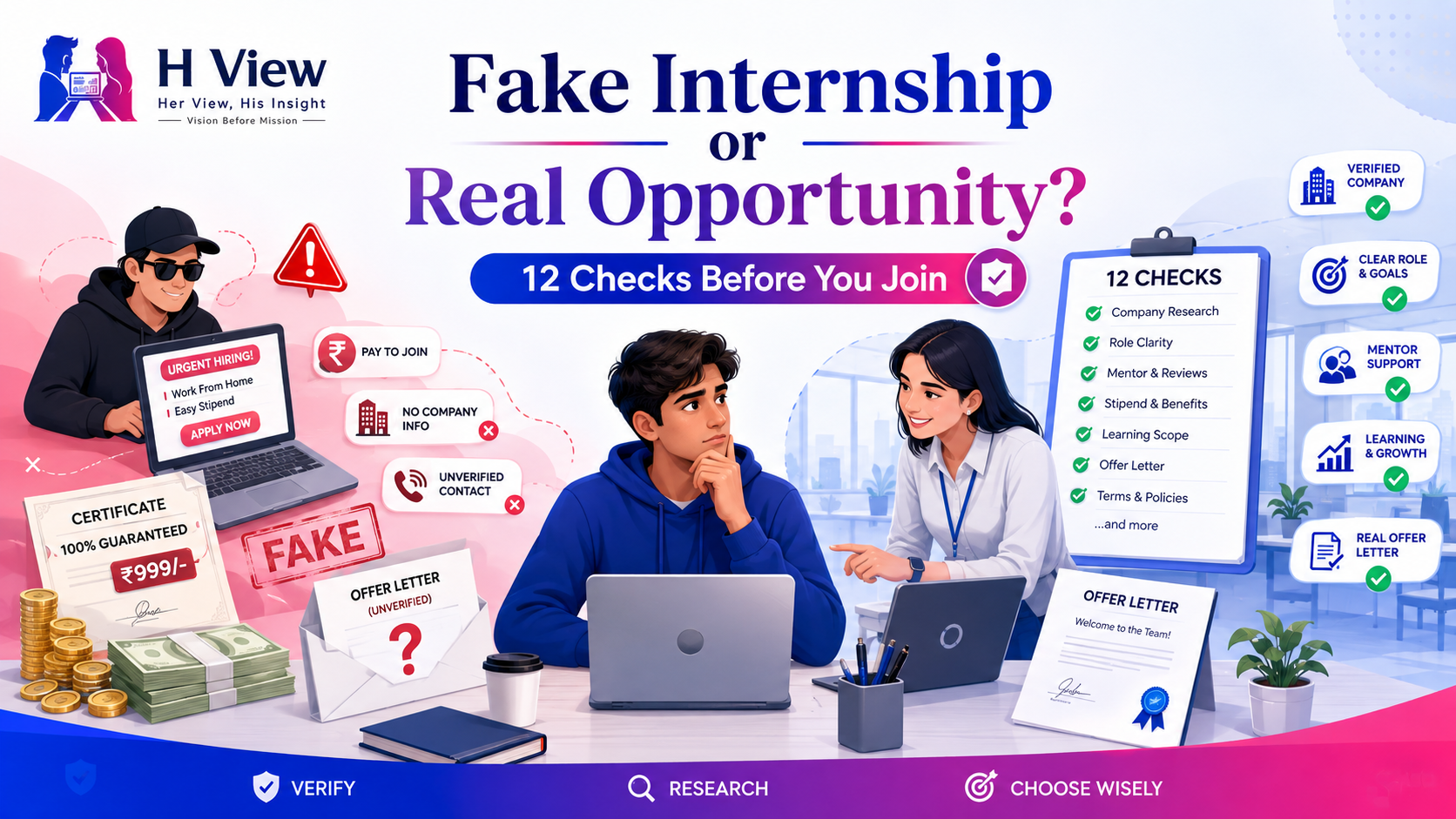
 By Satya HemanthUpdated September 20, 20266 min read26 views
Internships are supposed to help students move from classroom learning to real workplace experience.
A good internship can teach professional communication, teamwork, deadlines, tools, documentation and practical problem-solving. It may also give a student their first mentor, portfolio project, reference or full-time opportunity.
But the word internship is now being used for many very different arrangements.
Some organisations ask students to pay registration or certificate fees. Some provide no meaningful work, mentor or feedback. Others advertise free internships, collect money later and disappear after adding students to a WhatsApp group.
Recent reports from Bengaluru described students paying small fees for supposed online internships and then receiving unclear instructions, little actual work and questionable certificates.
This raises an important question:
Is the opportunity a genuine internship—or simply a course, certificate sale or source of free labour?
Before joining, students should verify what they will learn, what work they will perform and whether the organisation is real.
Freshers constantly hear that companies will not hire them without experience.
This creates pressure to accept almost anything carrying the word “internship.”
Students may think:
Fraudulent organisations understand this urgency.
In some regions, mandatory internship requirements have reportedly created a market where students pay companies for placements that provide limited practical exposure.
A student should never assume that paying money automatically creates a better learning opportunity.
Not every unpaid internship is fraudulent or exploitative.
A small startup, nonprofit organisation or research group may be unable to provide a stipend but still offer meaningful work, direct mentoring and useful exposure.
An unpaid internship may be worth considering when:
The most important value is not the certificate.
It is whether the student leaves with stronger skills, credible experience and work they can explain.
Some companies recruit interns mainly to avoid paying regular employees.
Others collect hundreds of students, provide generic recorded lessons and issue certificates without offering any real workplace experience.
Be cautious when the internship involves:
A student should clearly know whether they are joining an internship, purchasing training or performing unpaid work.
These are not the same arrangement.
Check its official website, registered name, address, employee profiles and visible business activity.
The letter should mention the role, duration, location, working hours, reporting manager and stipend, where applicable.
Important communication should come through an official company email rather than only Gmail, Telegram or WhatsApp.
Government consumer guidance on job fraud warns candidates not to pay money in exchange for employment opportunities.
Request two or three examples of actual weekly tasks.
Ask who will review your work and how frequently feedback will be provided.
Confirm the amount, payment date, conditions and whether it depends on targets.
An unpaid internship should not quietly become an uncontrolled full-time job.
“Possibility of full-time employment” is not the same as a guaranteed job.
Ask about the work, guidance, payment and whether the promised certificate was delivered.
Do not casually share bank details, complete Aadhaar copies, passwords or original certificates.
Understand whether you can leave, whether notice is required and what happens to completed work.
A well-structured internship usually has:
Research on structured software internships also highlights the importance of meaningful industry engagement and active support from educators and companies.
An internship should involve learning through work—not merely attending promotional webinars.
Treat that as a serious warning sign.
A formal letter protects both the organisation and the student by documenting the agreed role and conditions.
A company may claim that issuing one is unnecessary for interns. But without written terms, it becomes difficult to prove:
Do not begin significant work based only on a phone conversation.
Save all evidence:
Ask the organisation for clarification and a refund in writing.
Suspected cyber-enabled financial fraud can be reported through India’s National Cyber Crime Reporting Portal. Consumer complaints may also be submitted through the National Consumer Helpline by calling 1915 or using its official channels.
Do not continue paying because you already invested money.
A genuine internship should help a student gain experience.
It should not exploit the fear of having no experience.
Before joining, verify the company, offer letter, mentor, tasks, stipend and learning outcome. Never pay simply to receive selection, onboarding or a certificate.
A small company can offer an excellent internship. A professional-looking organisation can still offer a meaningless one.
Judge the opportunity by the work, supervision and proof it provides—not by the title alone.
No. They may be useful when hours are reasonable and the student receives genuine work, mentoring and portfolio value.
Paying for optional training is different from paying for selection. Students should be extremely cautious when a company demands money to provide an internship or certificate.
Yes. It should clearly mention the role, duration, working conditions, stipend and reporting person.
Usually no. Conversion depends on performance, available roles and company decisions.
Real assignments, mentorship, feedback, professional exposure and work that can be demonstrated later.
Preserve all evidence and report cyber-related fraud through the National Cyber Crime Reporting Portal. Consumer grievances can also be raised through the National Consumer Helpline.
Satya Hemanth is the founder of H View and writes on careers, sports, leadership, digital trends, and practical decision-making. His articles focus on clear explanations, real-world examples, and useful insights for students, young professionals, and everyday readers.
Share your real experience and help other readers decide better.
No community views yet. Be the first to share yours.

Open LinkedIn for a few minutes and you will probably come across a colourful graphic…
Harika October 6, 2026 
When an employee resigns, many organisations move quickly into replacement mode. The manager informs HR,…
Harika October 6, 2026 
For many corporate employees, the workday begins long before they actually start working. They wake…
Harika October 5, 2026 
Many projects begin with an assumption that sounds reasonable on paper: the client will explain…
Harika October 1, 2026