

Hiring Is Up—So Why Are Freshers Still Not Getting Jobs?
Open any job portal today and you will see thousands of vacancies. Companies announce hiring…
 Satya Hemanth August 11, 2026
  By Satya HemanthUpdated August 13, 202610 min read35 views
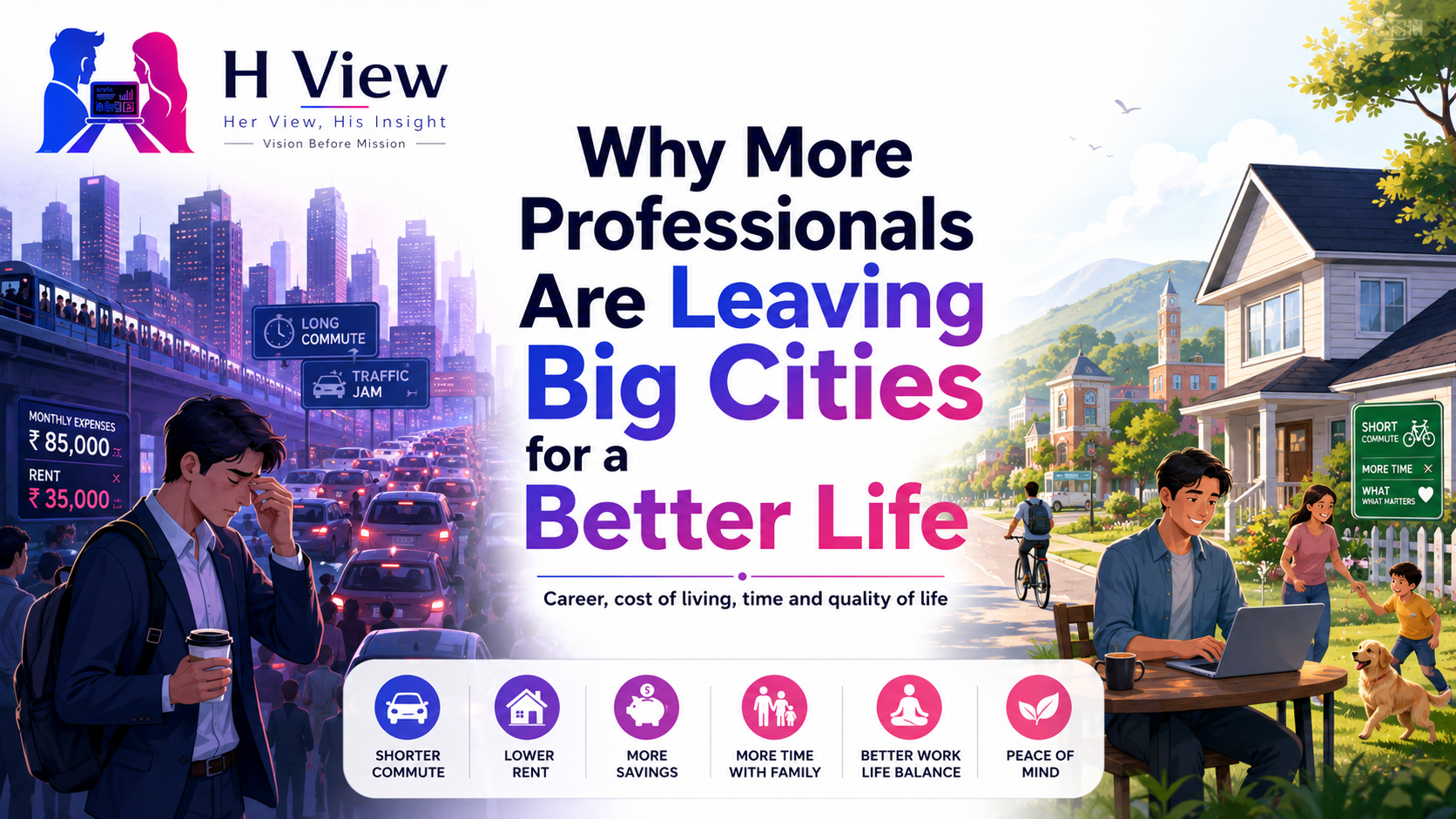
For decades, moving to a major city was considered an important step towards professional success.
Bengaluru offered technology careers. Mumbai represented ambition and opportunity. Delhi NCR attracted professionals across industries. Hyderabad, Chennai and Pune became major destinations for education, employment and business growth.
A bigger city usually promised a better salary, stronger professional networks and faster career progression.
But many professionals are now asking a different question:
What is the value of a higher salary if most of life is spent paying rent, sitting in traffic and recovering from work?
Some employees are leaving metropolitan cities for Tier-2 cities, hometowns and smaller urban centres. Others are actively considering the move but are waiting for the right remote role or local job opportunity.
This is not necessarily a rejection of ambition.
It may be a new attempt to balance ambition with affordability, health, family time and peace of mind.
A 2026 workforce survey found that housing was the biggest quality-of-life concern among employees, while 54% of metro-based respondents said they would consider moving to a Tier-2 or Tier-3 city if comparable career opportunities were available.
The trend raises an interesting question:
Are professionals giving up better careers—or finally building better lives?
Metropolitan cities still offer many advantages.
They provide access to larger companies, specialised roles, professional communities, entertainment, healthcare, education and transport connections. For many industries, the best opportunities remain concentrated in major cities.
However, the cost of accessing those opportunities has increased.
A professional may receive a strong salary but spend a large portion of it on:
The financial cost is only one part of the experience.
A two-hour daily commute may consume hundreds of hours every year. Crowded roads, noise, pollution and unreliable infrastructure can gradually reduce the quality of time outside work.
The salary may be higher, but the usable portion of life may feel smaller.
People rarely reject a career opportunity because of one traffic jam.
The frustration builds slowly.
A professional leaves home early to avoid congestion, works through a demanding day, and returns late with little energy for exercise, family, hobbies or rest.
Weekdays become almost entirely work-related. Weekends are used for recovery, household errands and preparation for the next week.
Over time, people begin evaluating jobs differently.
They no longer compare only:
₹18 lakh in a metro versus ₹14 lakh in a smaller city.
They also compare:
When time and stress are included, the apparently lower-paying option may not feel like a downgrade.
From one perspective, leaving a metro can create immediate improvements.
Housing may be more spacious. Commutes may be shorter. Parents and extended family may be nearby. Children may have more room and stronger family connections.
Professionals may also regain time for:
The improvement is not always dramatic or glamorous.
It may simply mean reaching home before dinner, seeing children while they are awake, or having enough mental energy to talk to a spouse after work.
Recent reporting on reverse migration in India has highlighted better air quality, shorter commutes, family support and improved mental well-being among the reasons professionals choose smaller cities.
These benefits can be difficult to measure in a salary comparison.
But they are experienced every day.
The move also carries real risks.
Major cities remain powerful economic centres because they bring companies, talent, investors, educational institutions and specialised services together.
Professionals in smaller cities may face:
Remote work can reduce these limitations, but remote employment is not always permanent. A company may introduce office attendance, restructure teams or change hiring locations.
Someone who relocates based entirely on one remote role may face difficulty if that job ends.
The financial calculation must therefore include career resilience—not only current expenses.
Economic Times reporting on this relocation trend notes that reduced earning potential and fewer career options remain major concerns even for people attracted by lower costs and better quality of life.
The decision is becoming more realistic because employment is gradually spreading beyond traditional metros.
Technology, financial services, manufacturing, education, retail, logistics and Global Capability Centres are expanding into emerging urban hubs.
LinkedIn’s Cities on the Rise 2026 list placed Visakhapatnam first, followed by Ludhiana, Surat, Vadodara and Prayagraj, reflecting growing professional activity beyond India’s largest metros.
Earlier research also identified cities such as Ranchi, Vijayawada, Nashik and Raipur as fast-growing non-metro employment hubs.
These cities may not yet match Bengaluru, Mumbai or Delhi in scale. But they increasingly offer combinations of:
The traditional choice between “career in a metro” and “peace in a hometown” is becoming less rigid.
A third option is emerging: meaningful work in a growing smaller city.
Salary alone does not determine financial progress.
Consider two professionals.
The first earns ₹1.5 lakh per month in a metro and spends heavily on rent, commuting, childcare, food and convenience services.
The second earns ₹1.15 lakh in a smaller city but has affordable housing, family support and lower transport costs.
The second person may have a lower income while saving more money and experiencing less daily pressure.
This is why relocation decisions should compare net financial life, not only gross salary.
The comparison should include:
A smaller city is not automatically cheap. Rent, education and healthcare costs are rising in several growing urban centres.
But the overall financial structure may still be more manageable.
Many professionals moved away from their hometowns in their early twenties.
At that stage, long hours, shared accommodation and crowded travel may have felt manageable.
Priorities often change in the thirties and forties.
Parents become older. Children need time and stability. Health concerns become more important. Couples may want stronger family support.
Living near parents can provide emotional connection and practical help. Grandparents may support childcare. Families may share responsibilities during illness or emergencies.
At the same time, moving closer to family is not always simple.
It may create expectations, reduce privacy or limit a partner’s career opportunities. One person’s hometown may not feel like home to the other.
The relocation must work for the household, not only for the employee who received the job.
A 2026 workforce report suggested that 55% of young professionals prioritised quality of life over metro-level salaries, although metros continued to offer stronger pay, exposure and professional networks.
This does not mean people have stopped caring about income.
It means income is being evaluated alongside:
A professional may willingly accept a moderate salary reduction to remove a punishing commute.
But accepting a significantly lower salary without savings, career options or adequate healthcare may create a different kind of stress.
Quality of life is not created by peace alone.
It requires a sustainable combination of money, time, security and access.
Relocation may work particularly well for:
They can retain metropolitan employment while living elsewhere, provided office-attendance requirements remain manageable.
Lower personal and business costs can extend financial runway.
Nearby parents and relatives may reduce childcare and caregiving pressure.
Manufacturing, banking, education, healthcare, logistics and technology roles are growing in several non-metro centres.
Those who value larger homes, shorter commutes and quieter routines may experience a substantial improvement.
The move may be riskier for:
Relocation changes the environment.
It does not automatically fix career dissatisfaction, relationship problems or poor financial habits.
Research local employers, remote-work stability and backup opportunities.
Compare total expenses—not only rent.
Check emergency care, specialists, hospitals and travel time.
Consider the needs of a spouse, children and parents.
Professional networks, culture, airports, education and specialised services may be harder to access.
Maintain savings and professional connections so the decision is not irreversible.
Her View: A successful career should support a meaningful life. Smaller cities can offer time, family connection, affordable housing and reduced daily stress without necessarily ending professional growth.
His Insight: Metros continue to provide unmatched networks, specialised opportunities and salary progression. Moving without a career backup can exchange city stress for professional insecurity.
Both perspectives are valid.
The right city is not always the largest or the quietest.
It is the place where a person’s work, finances, relationships and health can remain sustainable together.
Professionals leaving big cities are not necessarily abandoning ambition.
Many are redefining what ambition should provide.
A high salary is valuable. So are career growth, exposure and opportunity. But they should eventually create a better life—not permanently postpone it.
For some people, the metro will remain the right place. Its energy, variety and professional ecosystem may outweigh the costs.
For others, a smaller city may offer something that has become increasingly rare: enough time and space to enjoy the results of their work.
The strongest relocation decision is not based on a viral success story or frustration after a difficult week.
It is based on honest calculations about career, money, family, healthcare and daily life.
The real question is not:
“Which city looks more successful?”
It is:
“Where can I build a life that I can realistically sustain?”
Common reasons include high housing costs, long commutes, pollution, work pressure, limited family time and the growth of remote or regional job opportunities.
They may offer lower expenses, shorter commutes and better work-life balance. However, career opportunities, healthcare and infrastructure vary significantly by city and profession.
It can be, when the reduction in rent, transport and lifestyle costs is larger than the salary cut. Professionals should compare actual monthly savings and long-term career potential.
Recent rankings and reports have highlighted cities such as Visakhapatnam, Ludhiana, Surat, Vadodara, Prayagraj, Vijayawada, Nashik and Raipur. Opportunities differ by sector.
Not by itself. Employees should consider whether the remote policy is stable and whether suitable jobs are available locally if the current role ends.
Possible disadvantages include lower salaries, fewer specialised jobs, smaller networks, limited entertainment and reduced access to advanced healthcare or education.
They should compare careers for both partners, schooling, medical facilities, family support, housing, travel connectivity and the preferences of children and parents.
No. It can reduce some pressures, but satisfaction also depends on employment security, relationships, access to services and personal expectations.
Satya Hemanth is the founder of H View and writes on careers, sports, leadership, digital trends, and practical decision-making. His articles focus on clear explanations, real-world examples, and useful insights for students, young professionals, and everyday readers.
Share your real experience and help other readers decide better.
No community views yet. Be the first to share yours.
Open any job portal today and you will see thousands of vacancies. Companies announce hiring…
Satya Hemanth August 11, 2026