

Are We Using AI to Save Time or Avoid Thinking?
Artificial intelligence has quietly entered almost every part of modern life. Students use it to…
 Harika July 16, 2026
  By HarikaUpdated July 18, 202611 min read34 views
Artificial intelligence is changing the way students study, write, research, revise, and complete assignments.
A student who once spent hours searching through textbooks and websites can now ask an AI tool to explain a difficult concept in simple language. Essays can be outlined in seconds. Practice questions can be generated instantly. Notes can be summarised, translated, reorganised, and turned into revision plans.
For many students, this feels like a major improvement.
AI can make learning faster, more personalised, and less intimidating. It can support students who struggle with language, confidence, access to tutors, or complicated subjects.
But there is another side to this convenience.
Some students are no longer using AI to understand a lesson. They are using it to avoid the lesson entirely.
Assignments are generated without being read. Mathematical problems are solved without understanding the steps. Project reports are submitted with little personal effort. Even simple questions are immediately handed over to an AI tool.
This raises an important question:
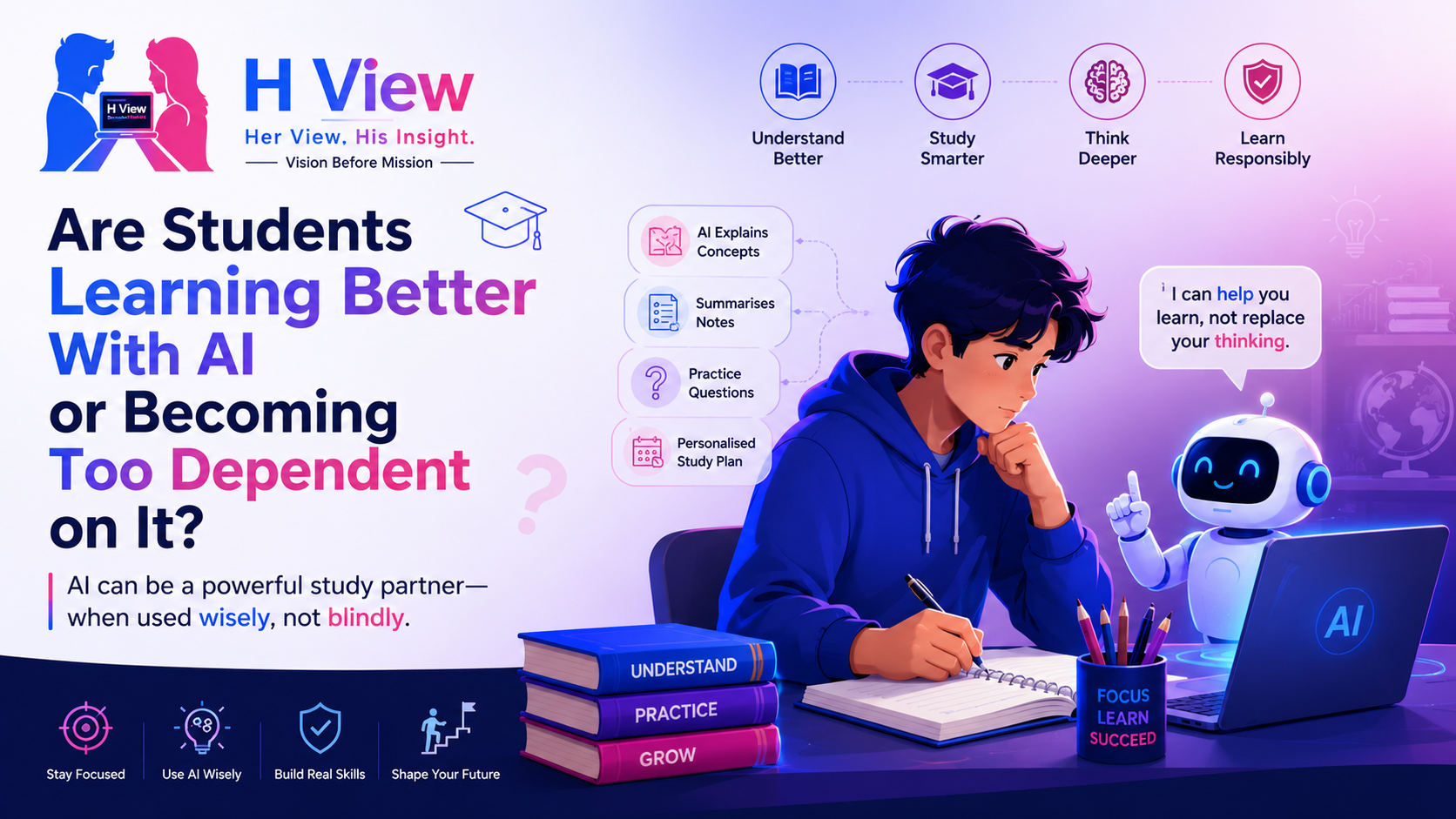
Are students learning better with AI, or are they becoming too dependent on it?
The answer depends less on whether students use AI and more on how they use it.
Students face enormous academic pressure.
They are expected to manage classes, assignments, examinations, projects, extracurricular activities, internships, entrance tests, and career preparation. Many also deal with family expectations, financial pressure, part-time work, or limited access to quality teaching.
AI offers immediate support.
A student can ask it to:
Unlike a teacher or tutor, AI is available at any time. It does not become impatient when a student asks the same question repeatedly.
This makes it especially attractive to students who feel embarrassed about asking for help in class.
From one perspective, AI can improve education significantly.
Traditional classrooms often follow one teaching speed for everyone. Some students understand quickly, while others need more examples or simpler explanations.
AI can adapt.
A student can ask:
“Explain this like I am twelve.”
“Give me a real-life example.”
“Show me the steps slowly.”
“Ask me questions to check whether I understood.”
“Explain this in Telugu, Hindi, or simpler English.”
This kind of personalised learning can be extremely useful.
Students who cannot afford private tuition may receive additional support. Learners with language barriers can understand subjects more comfortably. Students with disabilities may benefit from voice tools, text simplification, transcription, and alternative learning formats.
AI can also make studying more active.
Instead of only reading notes, students can ask for quizzes, mock interviews, debates, case studies, and practical scenarios.
Used this way, AI does not replace learning. It strengthens it.
The danger begins when students confuse receiving an answer with understanding it.
An AI-generated explanation may look clear. A completed assignment may appear professional. A project report may contain strong vocabulary and organised headings.
But the student may not be able to explain any of it independently.
This creates the illusion of learning.
The work is completed, but the skill is not developed.
A student may receive good marks for an AI-assisted assignment and still struggle during:
Education is not only about producing correct answers. It is about building the ability to think, analyse, communicate, remember, and solve problems.
When AI completes the entire process, those abilities may remain weak.
There is an important difference between support and dependence.
A student using AI responsibly may first attempt the problem, identify where they are confused, ask for help, compare the explanation with class material, and then solve a similar question independently.
A dependent student may immediately copy the question into AI, accept the answer, and move on.
The first student uses AI as a tutor.
The second uses AI as a substitute.
Support increases ability. Dependence hides weakness.
Homework is designed to help students practise what they learned.
But when AI can complete the homework instantly, the purpose of the task can disappear.
For example, a student may ask AI to write a full essay.
The student receives a polished answer, changes a few words, and submits it.
The assignment is technically complete, but the student has not practised planning, structuring, writing, editing, or forming an opinion.
A better approach would be to use AI for specific support:
The student should still remain the writer.
Critical thinking develops when students compare ideas, question information, identify weaknesses, and form their own conclusions.
AI can either strengthen or weaken this process.
It weakens critical thinking when students ask for a single answer and accept it without question.
It strengthens critical thinking when students ask:
AI should not always provide the conclusion. Sometimes it should help students examine the problem more deeply.
AI-generated answers can sound confident even when they are incomplete, misleading, or wrong.
Students may assume that a well-written response must be accurate.
This is risky in subjects involving:
AI may invent references, misunderstand a question, use outdated information, or simplify a topic too much.
Students need to compare important answers with textbooks, teacher guidance, research papers, official sources, and reliable educational material.
Fact-checking should become part of AI literacy.
Using AI to understand a topic is different from using it to cheat.
Many educational institutions are still developing rules around AI. Some allow limited use for brainstorming, editing, or research support. Others prohibit it in specific assignments or assessments.
Students should understand the rules before using AI.
Submitting AI-generated work as entirely original may create academic-integrity concerns, especially when the student has contributed little to the final output.
It can also create a long-term problem.
A student may pass a course without developing the abilities that the certificate is supposed to represent.
The immediate benefit of completing an assignment quickly may lead to future difficulty in interviews, jobs, and advanced studies.
The rise of AI is not only a student problem.
Teachers and institutions may need to rethink how learning is assessed.
Assignments that ask for simple summaries or generic essays are easier for AI to complete. More meaningful assessments may require:
Teachers can also ask students to explain how AI was used and what changes they made.
The goal should not be to catch every student using AI. It should be to design learning activities where understanding matters more than polished output.
When used properly, AI can accelerate learning.
A student preparing for an exam can ask for a daily revision plan. A coding learner can receive an explanation of an error. A science student can compare two theories. A language learner can practise conversations.
AI can also help students identify gaps in their knowledge.
For example, a student can ask AI to conduct a short quiz, review wrong answers, and recommend what to revise next.
This makes studying more interactive.
The best results come when students use AI after thinking, not before thinking.
Students often see difficulty as something to avoid.
But struggle plays an important role in learning.
Trying to remember an answer strengthens memory. Attempting a problem develops reasoning. Writing a weak first draft helps students understand how to improve.
When AI removes every moment of difficulty, it may also remove the mental effort required for deep learning.
This does not mean students should suffer without support. It means assistance should arrive at the right stage.
A useful sequence is:
This keeps the student active in the process.
AI can make students appear more capable than they really are.
A beginner may create advanced code without understanding the logic. A student may prepare a professional presentation without knowing the subject deeply. A written answer may sound more mature than the student’s actual understanding.
This can create overconfidence.
The student may assume they have mastered the topic because the output looks impressive.
Real understanding is shown when the student can:
A polished answer is not enough.
Parents may be tempted to either ban AI completely or encourage children to use it for everything.
Both extremes can be unhelpful.
A complete ban may prevent students from learning an important modern skill. Uncontrolled use may encourage dependence.
Parents can instead ask children:
The conversation should focus on learning, not only completion.
Students can follow a few practical rules.
Attempt the problem before asking AI. Even a partial effort helps identify the real difficulty.
Request steps, examples, hints, and feedback.
Do not copy generated content directly. Make sure the final work reflects your understanding.
Check reliable sources, textbooks, and teacher instructions.
Students should be able to defend every part of their work.
Avoid sharing private details, passwords, school records, or confidential data.
Use AI only in ways permitted by the institution or teacher.
Complete some tasks independently to protect confidence and core skills.
Before using AI, students can ask three questions:
Am I using this to understand?
Am I using this to improve my work?
Or am I using this to avoid doing the work?
The answer usually reveals whether the tool is helping or creating dependence.
Her View: AI can make education more accessible, personalised, interactive, and supportive. It can help students overcome language barriers, understand difficult subjects, and learn at their own pace.
His Insight: Easy answers can weaken effort, memory, writing, reasoning, and independence. Students may complete more work while developing fewer real skills.
Both views are valid.
AI can be one of the most useful educational tools available today. But it can also become a shortcut that quietly removes the learning from education.
Students should not be taught to fear AI.
They should be taught to use it intelligently.
The goal is not to complete assignments faster. The goal is to understand better, think more clearly, and become capable of solving problems independently.
AI can explain, guide, test, translate, and provide feedback. But students still need to read, question, practise, write, remember, and make mistakes.
Education becomes weaker when AI does everything.
It becomes stronger when AI helps students do more for themselves.
The future may not belong to students who can generate the fastest answers.
It may belong to those who know how to use AI without losing curiosity, effort, judgment, and the confidence to think independently.
AI can be helpful when used for explanations, practice questions, revision, language support, feedback, and research guidance. It becomes harmful when it replaces effort, understanding, or independent work.
Students should follow their teacher’s or institution’s rules. AI can support homework by offering hints, feedback, and explanations, but students should avoid submitting fully generated work as their own.
AI may weaken thinking skills when students rely on it for every answer. It can strengthen thinking when used to compare viewpoints, question assumptions, analyse mistakes, and explore ideas.
AI detection tools are not always fully reliable. Teachers can use oral explanations, practical tasks, draft reviews, classroom discussions, and personalised questions to assess genuine understanding.
A complete ban may be difficult and may prevent students from learning responsible AI use. Clear policies, supervised use, and better assessment methods may be more effective.
AI can assist with explanations and practice, but teachers provide motivation, emotional support, classroom understanding, accountability, and professional judgment that AI cannot fully replace.
Students should attempt the topic first, ask AI for guidance, verify the answer, practise independently, and make sure they can explain the concept in their own words.
It may create academic-integrity issues when students submit generated work without permission, acknowledgment, or meaningful personal contribution. Institutional rules should always be followed.
Harika is the co-founder of H View and covers AI, technology, gadgets, digital tools, online platforms, and modern internet trends. Her articles focus on simplifying complex topics with practical explanations, balanced opinions, and reader-first insights.
Share your real experience and help other readers decide better.
No community views yet. Be the first to share yours.
Artificial intelligence has quietly entered almost every part of modern life. Students use it to…
Harika July 16, 2026