

The FIFA World Cup and India: Why the World’s Biggest Sporting Event hasn’t yet Created a Football Nation
“Every four years, billions unite behind one ball. India watches with passion but can we…
 Praveen July 27, 2026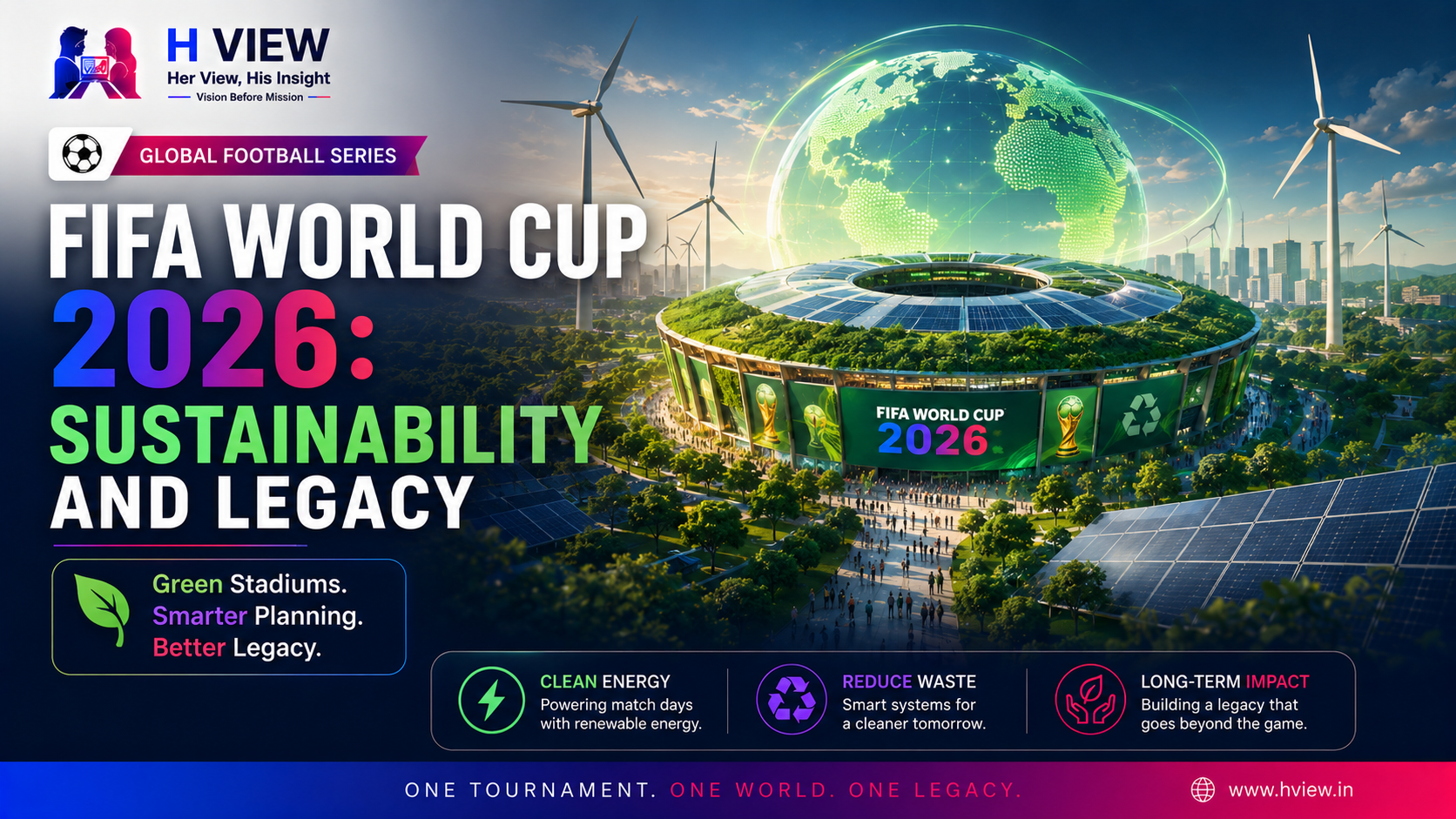
 By Satya HemanthUpdated August 12, 202614 min read41 views
The original draft is written as a pre-tournament article, so I’ve updated the angle now that the 2026 World Cup has finished. Rather than saying what the tournament can leave behind, this version looks at what FIFA and the host cities actually planned, what was delivered during the event, and the harder question that remains: whether those sustainability promises create a meaningful legacy after the final.
I also verified the sustainability framework against FIFA’s official 2026 Sustainability & Human Rights Strategy. FIFA organised the plan around social, environmental, economic and governance pillars, with host-city action plans covering climate, human rights, accessibility, local communities, transport and event operations. FIFA also ran environmental initiatives across all 16 host cities, including a tournament-wide tree-planting programme announced in April 2026. (inside.fifa.com)
The FIFA World Cup is usually remembered through football. People remember the winning goal, the shock elimination, the player who carried a country through a difficult night or the final that kept millions watching until the last whistle. What happens after everybody leaves the stadium receives far less attention, even though that may tell us just as much about whether hosting the tournament was worthwhile.
The 2026 World Cup made that question unusually important.
This was the largest men’s World Cup ever staged, with 48 teams and 104 matches spread across Canada, Mexico and the United States. Sixteen host cities had to move enormous numbers of spectators, operate stadiums, manage security, supply food and merchandise, coordinate fan festivals and support thousands of people working around the competition. The geographical scale alone meant sustainability could never be reduced to whether recyclable cups were available inside a stadium.
FIFA approached the event through a formal Sustainability & Human Rights Strategy covering environmental, social, economic and governance responsibilities. The document asked host cities and tournament organisers to consider issues ranging from climate and waste to accessibility, labour rights, Indigenous communities and local economic impact. (inside.fifa.com)
Those commitments created an ambitious framework. Now that the tournament is over, the more useful question is whether the World Cup leaves behind anything that remains valuable after the temporary infrastructure, advertising and crowds disappear.
When sustainability is discussed around major events, the conversation often becomes very narrow. Recycling bins, reusable bottles and reduced plastic are visible, easy to explain and easy to photograph, so they naturally receive attention.
A World Cup creates environmental effects on a much larger scale.
People travel between countries and cities. Teams, officials, broadcasters, equipment and supplies have to move repeatedly during the tournament. Stadiums consume electricity and water. Fan festivals create temporary infrastructure, catering and waste. Hotels operate at unusually high occupancy while city transport systems experience intense demand.
FIFA’s 2026 environmental strategy therefore covered areas including greenhouse-gas emissions, energy, transport, waste, water and sustainable procurement rather than treating sustainability as a single waste-management problem. (inside.fifa.com)
That broader view is important because some environmental impacts are far more difficult to solve than others.
A stadium can introduce better waste separation relatively quickly. Reducing the environmental effect of millions of spectators travelling across three enormous countries is considerably harder.
The 2026 World Cup was always going to contain that contradiction: it aimed to promote environmental responsibility while simultaneously operating the biggest and most geographically dispersed edition of the tournament ever held.
Football supporters do not experience a World Cup only inside stadiums. They have to get there first.
In a compact tournament, one public transport network may serve several venues. The 2026 event was spread across 16 host cities in three countries, with enormous distances between some of them. That meant international flights, domestic flights, intercity travel, local transport and stadium access all became part of the sustainability picture.
FIFA’s environmental strategy identified transport and mobility as an important operational area and worked with host cities and transport authorities around spectator and workforce movement. Its event-transport roles also involved coordination with local public-transport agencies and real-time monitoring of city mobility during the tournament. (inside.fifa.com)
The difficulty is that organisers cannot fully control how supporters travel.
A city can improve rail connections, provide shuttle services and encourage public transport, but a fan travelling from Europe to watch several matches across North America may still require multiple flights. The environmental footprint of that journey exists even if the stadium itself operates efficiently.
This makes transport one of the areas where sustainability claims deserve careful interpretation. Good local mobility planning can reduce congestion and emissions around the venues, but it cannot make a geographically vast international tournament low-impact by itself.
The more meaningful legacy may therefore be whether transport improvements remain useful to residents afterwards.
One of the more significant characteristics of the 2026 World Cup was that the hosts already had a large stock of major sporting venues. That reduced the need for the kind of large-scale stadium construction associated with some previous tournaments.
This matters because a newly built stadium carries environmental and financial costs long before the first match begins. Concrete, steel, land use, construction transport and energy all contribute to the impact. If the venue later struggles to attract regular crowds, the host can be left maintaining an expensive piece of infrastructure with limited community use.
Using established stadiums changes that equation.
The legacy question becomes less about whether a World Cup stadium will find a purpose and more about whether temporary upgrades, accessibility improvements, energy systems and surrounding infrastructure continue delivering benefits once the tournament is gone.
That does not make an existing venue automatically sustainable. Older stadiums can consume significant energy and may require extensive temporary modification for a FIFA event. But avoiding unnecessary permanent construction is an important starting point.
Good event planning should leave a venue more useful rather than simply more decorated.
A full stadium creates an enormous amount of material in a few hours. Food containers, cups, bottles, packaging and merchandise all move through the venue, while fan festivals generate another layer of waste away from the match itself.
Proper waste systems matter because even relatively small improvements become significant when repeated across 104 matches and millions of spectators.
FIFA’s strategy included waste reduction, reuse and recycling among its environmental objectives. It also placed emphasis on sustainable sourcing, meaning the issue extends beyond what happens to an item after somebody throws it away. (inside.fifa.com)
Where was the product manufactured? How far did it travel? Is it reusable? Was excessive packaging necessary? What happens to temporary event materials once the tournament closes?
Those questions are less visible than a recycling logo printed on a bin, but they can be more important.
Major sporting events purchase at extraordinary scale. That creates an opportunity to push suppliers towards better practices, but it also creates a risk of enormous short-term consumption in the name of an event that lasts only a few weeks.
A genuinely sustainable procurement policy should therefore consider both the environmental cost of what is purchased and whether those materials still have a useful life afterwards.
Ahead of the tournament, FIFA announced a tree-planting initiative covering all 16 World Cup host cities in partnership with the Arbor Day Foundation. The projects were intended to support local reforestation, urban forestry and community environmental programmes, with FIFA describing the aim as creating benefits that extended beyond the tournament itself. (inside.fifa.com)
Projects like this can be valuable because urban trees contribute to shade, biodiversity, local air quality and heat mitigation over many years.
They should not, however, be treated as an uncomplicated answer to the tournament’s environmental footprint.
Planting trees does not undo aviation emissions immediately, and environmental projects should not become a way of avoiding difficult conversations about reducing emissions in the first place. The strongest sustainability approach is usually to prevent unnecessary impact where possible, reduce what remains and then support wider environmental improvements alongside those efforts.
The value of the tree programme will therefore depend partly on whether the projects are maintained successfully over time.
A sapling planted for a World Cup campaign creates a photo opportunity. A healthy urban tree still growing 15 years later creates a legacy.
FIFA deliberately paired sustainability with human rights in its 2026 strategy, which is a useful reminder that responsible event management is not only an environmental subject.
The social pillar included accessibility, anti-discrimination, safeguarding, labour-related issues, human rights defenders, media representatives and engagement with communities across the host regions. FIFA also required host cities to develop human-rights action plans with local stakeholders and community organisations. (inside.fifa.com)
This changes how legacy should be judged.
A tournament can operate energy-efficient stadiums while still failing people if venues are inaccessible, workers are treated poorly or local communities feel excluded from decision-making. Environmental responsibility and social responsibility should not be competing achievements.
The 2026 tournament also placed specific attention on Indigenous communities across the three host countries. FIFA highlighted host-city engagement with Indigenous Peoples and described efforts to recognise and protect their rights while involving Indigenous representatives in tournament and legacy planning. (inside.fifa.com)
The long-term value of those initiatives will be harder to measure than attendance.
Relationships built with communities cannot be assessed by counting how many people entered a stadium. They have to be judged through what continues once the global attention moves elsewhere.
A major sporting event can accelerate changes that cities might otherwise implement more slowly.
Accessibility improvements are one example.
Hosting millions of visitors means cities and venues have to consider how people with disabilities move through transport systems, stadiums, fan zones and public spaces. Better signage, accessible routes, seating, information services and staff training may initially be introduced because FIFA requirements demand them, but their value can continue for local residents after the World Cup.
That is what separates temporary compliance from useful legacy.
If a stadium creates an accessible entrance only through a temporary structure that disappears after July, the benefit is limited. If the tournament prompts permanent improvements in how the venue operates, future spectators gain something meaningful.
The same applies to public transport, digital information and staff awareness.
A responsible sporting legacy should improve who can participate in public life, not only how efficiently people who were already included can move around it.
World Cups create temporary employment in security, hospitality, transport, food service, production and event operations. Hotels, restaurants and other visitor-facing businesses can also benefit from unusually large numbers of tourists.
But headline economic activity does not automatically equal lasting development.
The more important questions are where the money goes and what remains afterwards.
FIFA’s sustainability framework included an economic pillar because tournament expenditure can affect local businesses, procurement and workforce development. The potential legacy becomes stronger when local companies gain experience, workers receive useful training and economic opportunities are distributed beyond the largest international suppliers. (inside.fifa.com)
Temporary jobs can still be valuable, particularly during an enormous event, but a six-week employment opportunity is different from a lasting economic improvement.
One useful way to judge legacy is therefore to ask whether the tournament built capability.
Did local businesses develop relationships that continue? Did workers gain skills or certifications that improve future employment? Did public investments support normal city life after supporters returned home?
Those outcomes may be less glamorous than record ticket sales, but they matter more to communities living with the consequences of hosting.
Football itself should also benefit from a World Cup.
The global event can create excitement among children who may never previously have watched their national team in a tournament of that scale. It can encourage participation, create new coaching programmes and increase attention around local football.
But inspiration fades quickly if there is nowhere to play.
The strongest grassroots legacy therefore combines excitement with infrastructure, coaching, access and long-term programmes. A child becoming interested in football during the World Cup matters much more if a local club or community facility can give that interest somewhere to go.
This is where host-city legacy planning has the potential to become particularly valuable.
The World Cup does not need every legacy project to carry a giant FIFA logo. In fact, some of the most useful outcomes may become completely ordinary over time: a community pitch still being used, a coach trained through a tournament programme or a facility that becomes easier for local children to access.
When a legacy becomes ordinary infrastructure, that can be a sign that it worked.
It is difficult to discuss World Cup sustainability seriously without returning to aviation.
The 2026 competition was spread across a continent-sized region and attracted supporters from around the world. Even with efficient stadiums, better waste systems and strong local public transport, moving people across those distances requires substantial energy.
FIFA has a broader Climate Strategy and has committed to reducing greenhouse-gas emissions from its operations, with a stated goal of reaching net-zero emissions by 2040. (inside.fifa.com)
The tension is obvious.
FIFA wants its competitions to become environmentally more responsible while also expanding global participation and creating tournaments capable of attracting even larger numbers of travelling supporters.
Those ambitions can work against each other.
There is no easy solution. Hosting tournaments only in compact regions would reduce some travel but introduce other practical and political limitations. Preventing international supporters from travelling would undermine part of what makes the World Cup a global event.
That is exactly why environmental reporting after the tournament matters.
The credibility of sustainability commitments depends not on claiming that environmental impact has disappeared, but on measuring it openly and showing where reductions were achieved and where significant problems remain.
The temptation after a successful tournament is to begin declaring the legacy immediately.
That is too early.
Spain lifted the trophy less than a month ago. Stadiums are returning to normal schedules, temporary event areas are being dismantled and host cities are only beginning the period in which the long-term value of the tournament can be properly assessed.
Some outcomes can already be measured, such as event operations and participation numbers. Others require years.
Are transport changes still useful in 2028? Are community programmes still operating? Did local football participation increase? Have environmental projects survived? Are upgraded facilities being used regularly? Did businesses and workers retain meaningful benefits from their involvement?
Those are legacy questions.
The World Cup creates the opportunity. Time reveals whether the opportunity was used well.
Sustainability can feel distant when it is discussed through targets, reports and emissions calculations, but ordinary supporters experience many of these decisions directly. Reliable public transport changes how stressful match day feels. Accessible venues decide whether some families can attend comfortably. Clean public spaces and sensible waste systems affect the entire atmosphere around an event.
That is why I would not separate the environmental side of the World Cup from the human experience.
A tournament can be spectacular on television and still create frustration for the city living around it. The best event planning makes the experience work for visitors without making everyday life unnecessarily difficult for residents.
The strongest legacy would therefore be one that local people continue noticing after the football itself is gone, even if they no longer connect the improvement with the World Cup.
From a practical perspective, the use of existing large venues may ultimately be one of the most important sustainability advantages of the 2026 tournament.
Building permanent infrastructure for a short event creates enormous risk if those assets are not needed afterwards. Canada, Mexico and the United States already possessed extensive professional-sports infrastructure, which meant the World Cup could focus more heavily on adapting existing venues and city systems rather than creating an entirely new stadium network.
The more difficult issue is transport.
A tournament spanning three countries and thousands of kilometres cannot avoid a substantial travel footprint simply through efficient stadium operations. This is where the long-term credibility of FIFA’s environmental strategy will depend on transparent reporting rather than promotional claims.
Sustainability should not mean pretending the World Cup has no environmental cost.
It should mean understanding that cost accurately, reducing what can realistically be reduced and ensuring that the benefits left behind are substantial enough to matter.
FIFA created a dedicated Sustainability & Human Rights Strategy for the tournament covering social, environmental, economic and governance responsibilities. Host cities also developed plans around environmental impact and human rights. (inside.fifa.com)
Transport and greenhouse-gas emissions were among the most difficult areas because the tournament involved millions of people travelling across Canada, Mexico and the United States. Stadium energy, waste, water use and event sourcing were also part of FIFA’s environmental framework. (inside.fifa.com)
Yes. One tournament-wide initiative involved tree planting and reforestation projects in all 16 host cities in partnership with the Arbor Day Foundation. FIFA announced the programme in April 2026 with an emphasis on long-term community environmental benefits. (inside.fifa.com)
Legacy refers to benefits or consequences that remain after the event itself. These can include transport improvements, upgraded sporting facilities, community programmes, accessibility improvements, environmental projects, workforce skills and increased football participation.
No. FIFA’s 2026 strategy combined sustainability with human rights and included social, economic and governance considerations alongside environmental issues. Areas such as accessibility, labour, anti-discrimination and engagement with Indigenous Peoples were included in the wider approach. (inside.fifa.com)
Satya Hemanth is the founder of H View and writes on careers, sports, leadership, digital trends, and practical decision-making. His articles focus on clear explanations, real-world examples, and useful insights for students, young professionals, and everyday readers.
Share your real experience and help other readers decide better.
No community views yet. Be the first to share yours.

“Every four years, billions unite behind one ball. India watches with passion but can we…
Praveen July 27, 2026 
Before every FIFA World Cup, football fans try to imagine the story before it happens.…
Satya Hemanth July 11, 2026 
A World Cup can produce extraordinary football and still feel incomplete without the people watching…
Satya Hemanth July 11, 2026 
The FIFA World Cup is not only a sporting event. It is also a major…
Satya Hemanth July 11, 2026