

Best Digital Marketing Tools in 2026: What Marketers Actually Need and What They Can Skip
Open LinkedIn for a few minutes and you will probably come across a colourful graphic…
 Harika October 6, 2026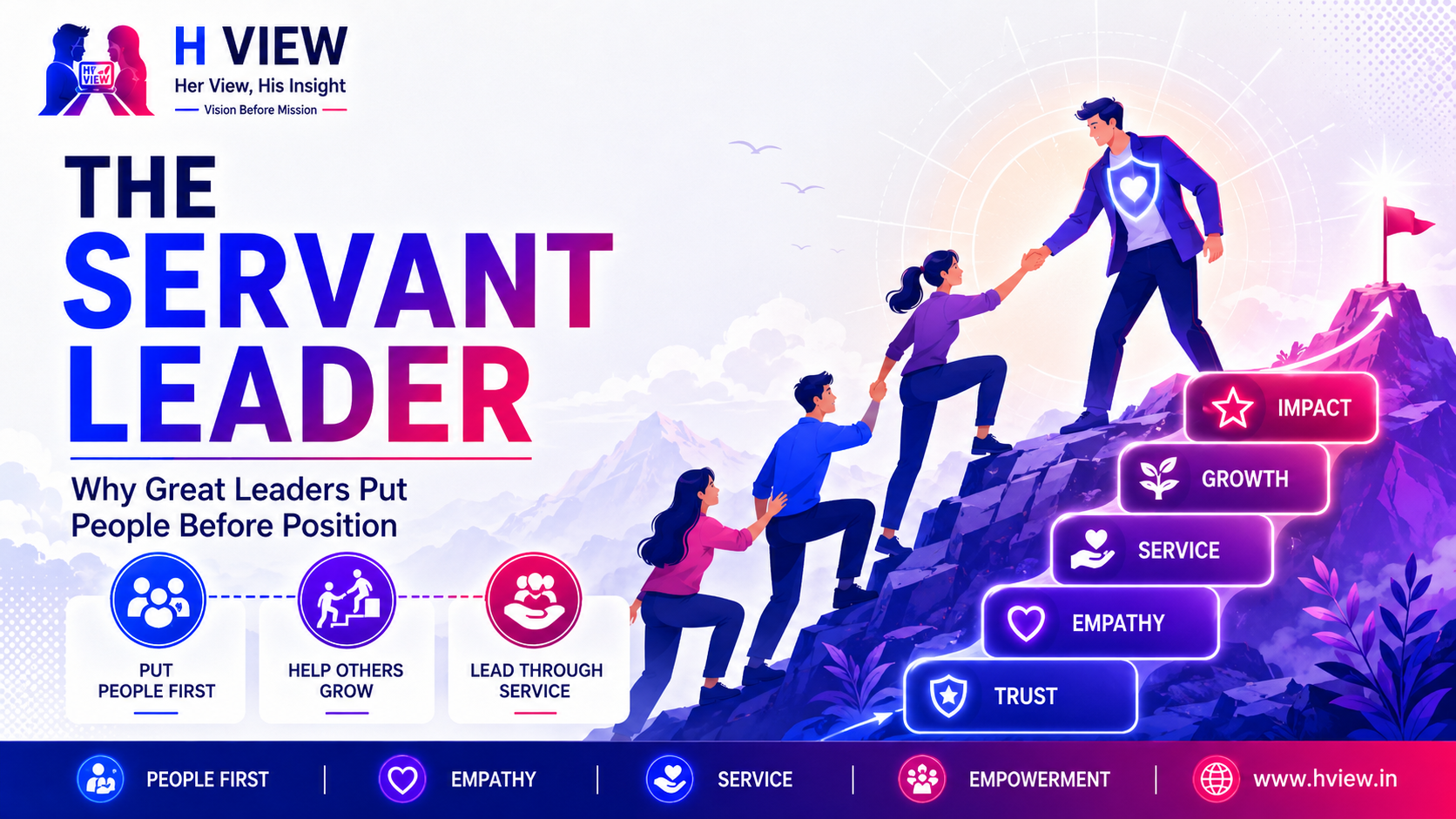
 By PraveenUpdated July 9, 20269 min read53 views
“The true measure of leadership is not how many people work for you, but how many people grow because of you.”
📖 Part of the H View Leadership Journey
Series Introduction: Leadership Lessons from Our Heroes | The Challenger Leader
Think about the best leader you have ever worked with. Chances are, you don’t remember them because they were the smartest person in the room. You remember them because of how they made you feel.
Perhaps they trusted you when no one else did. They gave you an opportunity that changed your career. They stood by you when you made a mistake. Or they simply listened.
Great leaders leave behind more than achievements. They leave behind better people. That is the essence of the Servant Leader.
In the previous article, we explored the Challenger Leader—the leader who overcomes personal limitations through self-belief.
But leadership cannot stop there. Once you’ve learned to believe in yourself, the next question becomes far more important.
Can you help others believe in themselves?
That is where servant leadership begins.
A Servant Leader believes that leadership is a responsibility, not a privilege. They understand that authority may come with a title.
Respect does not. It is earned by consistently putting the team’s success ahead of personal recognition.
Servant Leaders don’t ask,
“How many people report to me?”
They ask,
“How many people have become better because of me?”
They know that leadership is not about standing above people. It is about standing beside them, supporting them, and helping them succeed. At its heart, servant leadership is built on one simple belief:
Leadership is not about building followers. It is about building more leaders.
Every organization needs people who can deliver results. But truly great organizations are built by leaders who develop people.
Skills can be taught. Processes can be improved. Technology will continue to evolve. But trust takes years to build.
Servant Leaders create environments where people feel safe to contribute, learn from mistakes, and grow into future leaders.
That is why teams led by servant leaders often display:
Leadership is not measured only by what you accomplish. It is also measured by what others accomplish because of you.
Servant Leaders seek to understand before they seek to be understood. They recognize that every individual carries unseen struggles.
Empathy does not mean lowering expectations. It means understanding people while helping them reach those expectations.
Servant Leaders don’t believe leadership is about being the most important person in the room. They believe it is about making everyone else feel important.
They celebrate the team’s success before their own. Their confidence comes from purpose, not ego.
One of the easiest ways to recognize a Servant Leader is to observe the people around them.
Are they growing? Are they becoming more confident? Are they taking on bigger responsibilities?
Great servant leaders multiply leadership. Their greatest achievement is not their own success. It is the success they enable in others.
Trust is the currency of leadership. It cannot be demanded. It must be earned.
Servant Leaders earn trust through consistency, honesty, fairness, and genuine concern for people. When trust grows, influence follows naturally.
Servant Leaders understand that leadership is bigger than personal recognition.
Sometimes leadership means giving someone else the credit. It means taking responsibility when things go wrong. It means making difficult decisions that benefit the team instead of yourself.
Purpose always comes before ego.
Leadership looks different across movies, sports, and business. But when we observe closely, we find the same timeless principles reflected everywhere. Let’s understand the Servant Leader through five different worlds.
Amarendra Baahubali (in Baahubali) is admired not because he is born a prince, but because he lives like a servant of his people.
Whether he is fighting alongside soldiers, helping ordinary citizens, or protecting his kingdom, Baahubali never believes that royalty places him above others.
He earns the love and loyalty of his people because they know he genuinely cares for them. He leads from the front during battle, but among the people during peace.
His authority comes from his title. His influence comes from his character. That is why the people choose him – not because he seeks power, but because he serves with humility.
Leadership Lesson
The greatest leaders are remembered not for the throne they occupied, but for the people they uplifted.
Kabir Khan (in Chak De! India) inherits a team filled with talented individuals, but divided by ego, regional rivalries, and personal ambitions.
Instead of becoming the hero himself, he focuses on transforming individuals into a united team. He challenges them, mentors them, and pushes them to discover their own potential. His greatest victory isn’t winning the World Cup. It is helping every player become a better version of themselves.
Leadership Lesson
Great coaches don’t create stars.
They create teams where everyone can shine.
Steve Rogers (Captain America) never seeks leadership. People naturally choose to follow him.
Why?
Because he consistently places others before himself. Whether protecting civilians, standing beside teammates, or risking his own life, Captain America demonstrates that leadership is about service before status.
His humility earns trust. His integrity earns loyalty. His actions inspire others to become better.
Leadership Lesson
People follow titles because they have to.
They follow character because they want to.
Rahul Dravid is often called “The Wall,” but his greatest contribution to Indian cricket extends far beyond his batting.
Throughout his career, he quietly accepted difficult roles for the benefit of the team. He kept wickets when required. He mentored younger players. He put team success above personal milestones.
As coach of India’s Under-19 and senior teams, he has continued investing in the next generation, producing players who now form the backbone of Indian cricket.
Dravid’s leadership is quiet. But its impact is enormous.
Leadership Lesson
The greatest legacy of a leader is the success of the people they help develop.
Few business leaders embody servant leadership as consistently as N. R. Narayana Murthy.
When Infosys was founded, Murthy didn’t simply build a successful technology company.
He built a culture. A culture rooted in ethics, transparency, meritocracy, and respect for employees.
He believed organizations become extraordinary when leaders create an environment where ordinary people can do extraordinary work.
Rather than building an organization dependent on one individual, he built systems that empowered thousands of professionals to grow.
That is servant leadership at scale.
Leadership Lesson
Organizations become great when leaders invest in people before profits.
Notice something interesting about these five leaders.
One is a prince.
One is a hockey coach.
One is a superhero.
One is a cricketer.
One is a business leader.
Their worlds are completely different.
But their leadership philosophy is remarkably similar.
| Perspective | What They Teach Us |
|---|---|
| 🎬 Amarendra Baahubali | Earn loyalty by putting your people before your power. |
| 🎥 Kabir Khan | Great teams are built by helping individuals believe in themselves. |
| 🎞️ Captain America | Character earns trust long before authority does. |
| 🏏 Rahul Dravid | The greatest legacy of a leader is the people they help grow. |
| 🌍 N. R. Narayana Murthy | Organizations become extraordinary when leaders invest in people before profits. |
This is the essence of the H View Leadership Prism.
Leadership is never about being the most important person in the room.
It is about making others feel that they are.
Servant Leaders naturally thrive in roles where success depends on developing people.
They excel as:
Wherever people need guidance, encouragement, and trust, servant leaders create lasting impact.
| Strengths | Watch Outs |
| Builds trust quickly | May neglect personal well-being |
| Develops future leaders | Can avoid difficult conversations |
| Creates loyal teams | May hesitate to make unpopular decisions |
| Encourages collaboration | May overextend themselves helping everyone |
| Leads with empathy | Can be perceived as too soft if accountability is missing |
Servant leadership is not about pleasing everyone.
It is about helping people grow—even when growth requires difficult conversations.
“Leadership begins with self-awareness.”
Take a moment to reflect.
☐ Do I genuinely enjoy helping others succeed?
☐ Do people trust me with their challenges?
☐ Do I listen to understand before responding?
☐ Have I helped someone grow in the past six months?
☐ Do I celebrate my team’s success more than my own?
4–5 Yes: Servant Leadership is one of your strongest leadership muscles.
2–3 Yes: You already possess the foundation. Continue investing in people consistently.
0–1 Yes: Start small. Help one person grow. Leadership often begins with a single act of service.
Like every leadership quality, servant leadership is developed through daily habits.
Start with these five practices:
Small acts of service create lifelong influence.
People may forget your designation.
They may forget your achievements.
But they rarely forget how you made them feel.
The quiet encouragement you offered.
The opportunity you created.
The confidence you inspired.
That is the lasting legacy of a Servant Leader.
Many people think leadership is about becoming indispensable.
Servant Leaders think differently.
Their goal is to make others capable enough that they no longer need constant guidance.
That is the true measure of leadership.
The Challenger Leader teaches us to rise above our own circumstances.
The Servant Leader teaches us to help others rise above theirs.
Self-belief starts the journey.
Service gives that journey meaning.
Leadership becomes truly powerful when success is no longer measured by what we achieve alone, but by the lives we help transform.
Leadership grows through practice, not just reading.
This week, try one or more of these:
☐ Appreciate a colleague publicly.
☐ Mentor someone for 30 minutes.
☐ Ask a team member, “How can I help you succeed?”
☐ Listen to someone without interrupting or offering immediate solutions.
☐ Help someone learn a new skill without expecting recognition.
One small act of service can create a lasting impact.
Think about someone who made a lasting difference in your life.
Perhaps a teacher, a manager, a coach, a parent, Or a friend.
What did they do that made you remember them?
Share your story in the comments.
Your experience might inspire someone else to become a better Servant Leader.
Previous Article
← The Challenger Leader: Why Self-Belief Comes Before Leadership
Next Article
→ The Accountability Leader: Why Great Leaders Own the Outcome Before They Claim the Credit
Praveen is an H View contributor covering general reviews, leadership, sports, and practical opinion-based topics. His writing focuses on balanced analysis, clear explanations, and reader-friendly insights that help people understand products, ideas, trends, and real-world decisions with more clarity.
Share your real experience and help other readers decide better.
No community views yet. Be the first to share yours.

Open LinkedIn for a few minutes and you will probably come across a colourful graphic…
Harika October 6, 2026 
When an employee resigns, many organisations move quickly into replacement mode. The manager informs HR,…
Harika October 6, 2026 
For many corporate employees, the workday begins long before they actually start working. They wake…
Harika October 5, 2026 
Many projects begin with an assumption that sounds reasonable on paper: the client will explain…
Harika October 1, 2026