

Best Digital Marketing Tools in 2026: What Marketers Actually Need and What They Can Skip
Open LinkedIn for a few minutes and you will probably come across a colourful graphic…
 Harika October 6, 2026
  By HarikaUpdated September 22, 202615 min read14 views
As companies grow, adding management layers often feels like a sign of maturity. A project manager can coordinate timelines, a technical lead can guide engineering decisions, a delivery manager can manage customer commitments, and senior leadership can keep an eye on business risk. When these roles are clearly defined, they can make a team more focused and help projects move with fewer surprises.
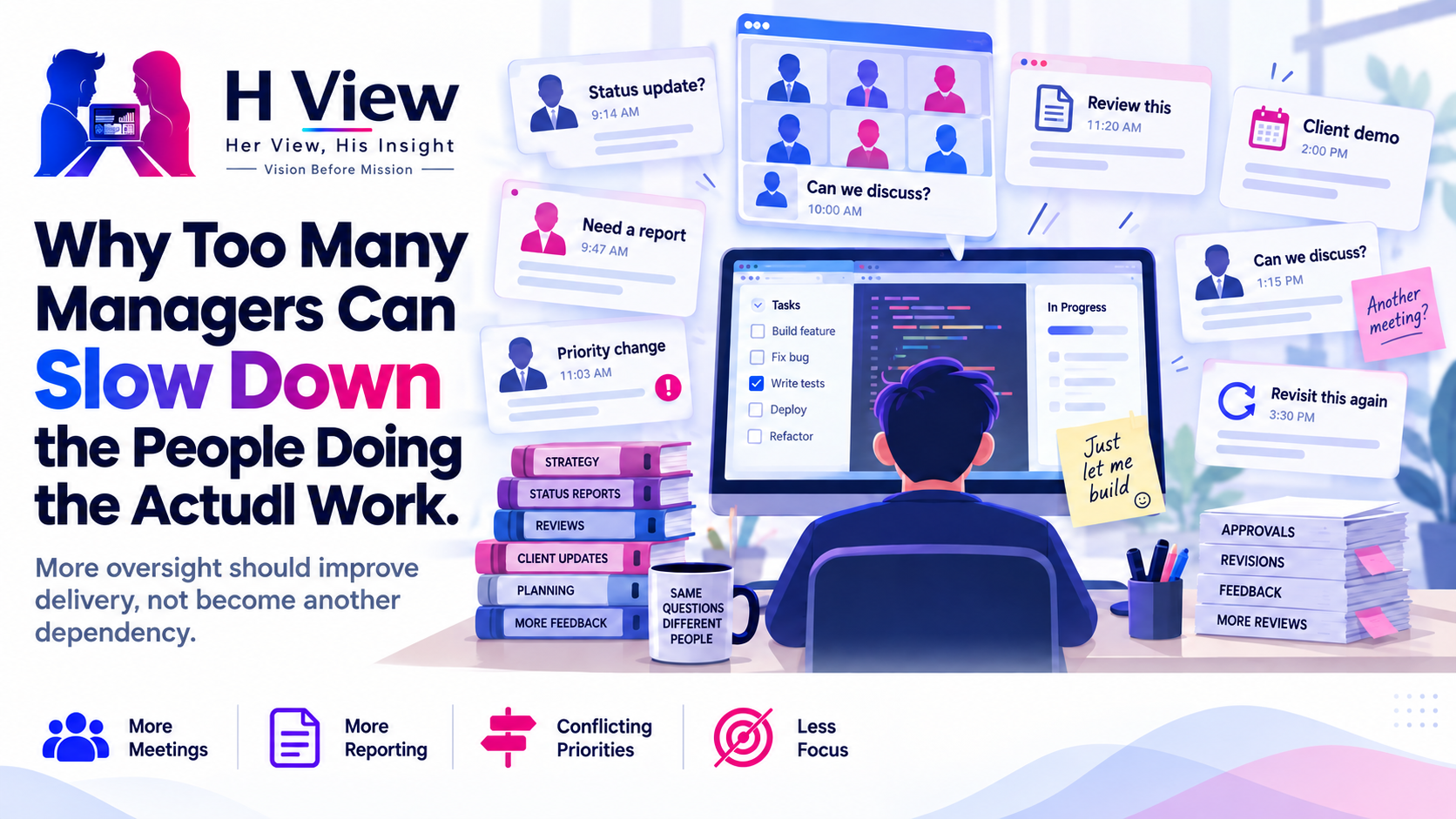
The problem begins when several managers start managing the same work in different ways. A developer may spend the morning answering a project manager, the afternoon reviewing changes with a technical lead, and the evening preparing another update for delivery management. By the time all the reporting, clarification and meetings are complete, the employee may have had far less uninterrupted time to actually build the product.
This is one of the most overlooked problems in modern workplaces. A company may believe that it has strengthened control by adding more management, while the people responsible for execution begin losing focus because every layer above them introduces another question, another review or another direction. The result is not necessarily better accountability. Sometimes it is simply more coordination around the same work.
Good management should reduce friction. When it begins creating additional friction, the management structure itself becomes part of the delivery problem.
The purpose of management is not just to observe progress. Strong managers create the conditions in which teams can work effectively by clarifying priorities, resolving dependencies, protecting timelines and making sure employees know what is expected of them. They do not need to perform the developer’s work, but they should help create an environment in which the developer can perform that work without unnecessary confusion.
A project manager who removes a client dependency is helping delivery. A technical lead who makes a clear architectural decision is helping delivery. A delivery manager who resolves conflicting customer expectations is also helping delivery. In each of these examples, management adds value because it reduces uncertainty for the people doing the actual execution.
Problems appear when managers only add more oversight without removing any obstacle. If every manager asks for separate reports, separate explanations and separate reviews, the team starts spending more time maintaining visibility than creating progress. This is especially damaging in small teams where one or two experienced people carry most of the technical responsibility.
Management should therefore be evaluated not by the number of meetings held or updates collected, but by whether the people doing the work are able to move faster, with more clarity and fewer interruptions.
Multiple managers are not automatically a problem. In many organizations, several leadership roles are necessary because projects have different business, technical and operational dimensions. The structure becomes difficult only when those managers begin controlling the same decisions without clear boundaries.
A developer may receive a priority from the project manager, a different technical preference from the technical lead and a third instruction from the delivery manager. If all three directions affect the same part of the work, the employee is placed in an awkward position because they must decide which instruction matters most.
That decision should not be pushed downward to the employee. Management needs to align internally before expecting execution.
Consider a simple dashboard change. The project manager asks the developer to rearrange the layout because the client wants faster access to certain information. The developer updates the design and completes the requested work. Later, the technical lead reviews the same screen and prefers the previous structure because they believe the new design creates unnecessary complexity.
The developer then makes a second revision. During the next delivery review, another manager suggests a third approach based on a recent customer discussion, which creates yet another round of changes.
None of the managers may be intentionally creating problems. Each person may believe they are improving the product. However, because the authority was never clearly defined, the employee has completed the same work several times while trying to satisfy different expectations.
From management’s perspective, it can look as though development is moving slowly. From the developer’s perspective, the target has changed repeatedly.
A healthier system would decide early who owns the final direction for each type of decision. Technical choices should have a technical owner, delivery priorities should have a delivery owner, and design or product decisions should have an agreed decision-maker. When that authority is clear, employees spend less time interpreting conflicting instructions and more time implementing them correctly.
Project visibility is important. Managers need to know whether work is progressing, which tasks are blocked and whether a client commitment is at risk. The problem is not asking for updates. The problem is asking for the same update repeatedly through different channels.
A developer may already update the project-management tool in the morning. Later, they explain the same progress during a daily call, provide another message to a technical lead, prepare a status summary for delivery management and then join a leadership discussion where many of the same questions are repeated.
Each individual activity may seem small, but the combined impact becomes significant. A few twenty-minute conversations spread across the day can easily remove the uninterrupted working blocks that complex development requires.
Software work depends heavily on concentration. A developer may need to hold architecture, business rules, database relationships and debugging context in mind at the same time. Once that concentration is broken, returning to the task is not always immediate. The person may need several minutes simply to reconstruct the mental state they had before the interruption.
This is why repeated status requests often cost more than the meeting duration alone.
A better approach is to create one reliable project-status system that everyone can refer to. The team can update progress, blockers, risks and important decisions in one place, while different managers use the same information according to their needs.
A simple model can work like this:
| Information needed | Better reporting approach |
|---|---|
| Daily progress | Shared project board or structured update |
| Current blockers | Dedicated blocker section with owner |
| Technical decisions | Technical lead review when necessary |
| Client commitments | Delivery manager tracks externally |
| Senior-management visibility | Weekly summary or dashboard |
| Urgent escalation | One agreed escalation channel |
This structure does not reduce transparency. It improves transparency because everyone sees the same information instead of receiving slightly different versions through separate conversations.
The employee also gains something equally valuable: more uninterrupted time to complete the work being reported.
When a project begins slipping, management naturally becomes concerned. One of the most common responses is to increase meeting frequency because leaders want more visibility and faster updates. That response can feel responsible, particularly when a client deadline or payment is attached to the project.
However, additional meetings do not automatically solve the reason the project is delayed.
If developers are waiting for a client decision, another internal status call does not produce the missing answer. If testing resources are unavailable, asking the development team for progress twice a day does not create more testers. If several managers disagree about the requirement, repeated meetings with the developer will not fix the problem unless those managers first align with one another.
The organization must therefore distinguish between monitoring a problem and removing the problem.
A project meeting becomes valuable when it helps the team make a decision, remove a dependency, assign a risk or clarify the next action. It does not need to produce a major breakthrough every time, but participants should leave with greater clarity than they had before entering.
When meetings repeatedly cover the same updates without creating new decisions, the organization should reconsider their frequency and purpose. A written status update may be enough for routine visibility, while actual meetings can be reserved for issues that require discussion.
This change may look small, but it can return several focused hours to the people responsible for delivery.
In poorly coordinated structures, the developer can slowly become the person connecting different levels of management.
The project manager asks why the technical lead changed something. The technical lead asks what the delivery manager promised the client. Delivery management asks why the project manager changed the priority. Instead of those leaders resolving the issue directly, the employee becomes responsible for explaining one person’s decision to another.
This is not a good use of technical capacity.
The developer’s role should be to explain implementation progress, technical risks and issues that require management decisions. They should not have to manage disagreements between the managers above them.
When every management layer communicates independently with the same person, that employee starts carrying invisible coordination work in addition to their actual responsibilities.
A stronger structure allows managers to align first and then provide the team with one agreed direction. The employee still receives feedback and remains accountable, but they are no longer expected to reconcile competing leadership instructions.
Another source of confusion appears when different leadership roles are not clearly separated.
A project manager usually focuses on timelines, coordination, dependencies and communication. A technical lead focuses on architecture, engineering quality and implementation decisions. A delivery manager may be more concerned with customer expectations, overall risk and external commitments.
These responsibilities overlap at certain points, but they are not identical.
Problems begin when every leader starts making decisions in every area. A project manager may begin dictating technical implementation, a technical lead may repeatedly change delivery priorities, and a delivery manager may directly redesign UI elements without explaining the business reason.
This does not mean people should remain inside rigid job descriptions. Collaboration is valuable. The important difference is between contributing an opinion and owning the final decision.
A practical division of responsibility might look like this:
| Role | Main responsibility |
|---|---|
| Project Manager | Timeline, coordination, dependencies and task visibility |
| Technical Lead | Architecture, technical quality and engineering decisions |
| Delivery Manager | Customer commitments, delivery risk and escalation |
| Developer | Implementation, technical progress and issue communication |
| QA / Tester | Validation, defect tracking and release confidence |
| Senior Leadership | Resources, business priorities and major escalations |
Smaller companies may combine several of these roles, and larger organizations may divide them further. The exact structure is less important than the clarity.
Employees should know where to go for a final decision, and managers should know which decisions they actually own.
Management becomes especially frustrating when feedback expresses dissatisfaction but gives little direction.
A developer may be told that a screen “doesn’t look good,” that the UI “needs improvement,” or that management simply does not like the current version. This tells the employee that something is wrong, but it does not explain what needs to change.
The developer then has to guess.
They may adjust spacing, change card layouts, alter colours or reorganize information, only to discover during the next review that the manager was actually concerned about something completely different.
That creates another revision cycle.
A much more useful review explains the problem in practical terms. For example, management can say that the most important KPI is not visible immediately, the dashboard has too many elements in the first viewport, the hierarchy is confusing or the interface does not match the client’s existing product.
The employee can now respond to a specific concern rather than trying to interpret an opinion.
Clear feedback reduces rework because it shortens the distance between what the reviewer sees as wrong and what the employee understands they need to fix. It is therefore more than a communication skill; it directly affects project speed.
Managers need visibility into important work. A company cannot operate effectively if every employee works independently without accountability, progress tracking or review. Oversight is therefore necessary.
Micromanagement is different because it focuses too heavily on constant activity rather than meaningful outcomes.
A manager providing useful oversight may ask whether the integration is still on schedule, whether any blocker threatens the release and whether the team needs additional support. These questions help leadership understand risk without interfering with every step of execution.
A micromanaging approach might involve repeated questions about what the employee is doing at that exact moment, multiple requests for updates within the same day or frequent changes to work that was already agreed upon.
The difference is not simply the number of questions being asked. It is whether those questions help the project move forward.
Healthy oversight gives employees enough space to perform their work while ensuring that risks do not remain hidden. Micromanagement often reduces that space and creates additional pressure without improving the quality of the decision-making around the project.
Good managers do not disappear from the project. They become more useful to it.
They create clear direction, protect focus and remove obstacles so the team can execute with fewer unnecessary interruptions.
When several leaders are involved, strong managers discuss disagreements among themselves before asking the team to act. The employee receives one clear priority rather than multiple competing versions of what should happen next.
This prevents the developer from becoming the person responsible for resolving management conflict.
Strong managers understand that meaningful development requires concentration. They group meetings, reduce unnecessary calls and avoid interrupting the team simply because they want reassurance.
Visibility still exists, but it is designed around the work instead of constantly interrupting it.
If a project is waiting for approval, management works to obtain that approval. If QA is unavailable, leadership addresses testing capacity. If the requirement is unclear, the appropriate decision-maker is involved.
The manager’s value comes from helping change the situation rather than repeatedly asking why the same problem still exists.
Strong leaders distinguish between development delay, testing delay, requirement delay, approval delay and client dependency. They do not automatically place every delay under one employee’s performance.
This creates fairer accountability and gives the company much better information about what actually needs to improve.
Employees usually begin by trying to communicate more, not less.
When something goes wrong, they explain the issue, share screenshots, provide timelines and outline dependencies because they expect management to use that information to make better decisions. When those explanations repeatedly lead to the same questions instead of meaningful action, the employee begins to feel that reporting exists mainly to prove that work is happening.
That feeling becomes particularly difficult when the employee is already responsible for much of the actual delivery.
Instead of seeing additional managers as support, they begin to experience every new management layer as another source of meetings, reviews and explanations.
Employees generally accept accountability when expectations are clear and responsibilities are fair. What damages trust is repeatedly being questioned about outcomes that depend heavily on resources, approvals or decisions controlled elsewhere.
A healthy workplace therefore needs more than managers who ask questions. It needs managers who are willing and able to act on the answers.
The management perspective remains important because leaders cannot discover problems only at the end of a project.
Customers have expectations, contracts have timelines, budgets have limits and senior leadership needs to know when delivery is at risk. Regular project visibility is therefore necessary, particularly in organizations where multiple teams and client commitments must be managed at the same time.
The challenge is creating that visibility without consuming too much execution time.
A strong reporting system allows leadership to understand progress from shared data, structured updates and clearly identified risks. Managers can then use meetings for decisions that genuinely require discussion instead of repeatedly collecting information that already exists elsewhere.
This creates a healthier balance between accountability and autonomy.
The best managers do not simply ask for more information when a project becomes difficult. They use the information available to decide what needs to change.
The issue is not that organizations have too many managers. The issue is what those managers are actually adding to the delivery process.
A project can benefit enormously from project management, technical leadership, delivery oversight and senior support when each role contributes something different. Clear priorities, stronger technical decisions, better client communication and faster escalation can all make teams more effective.
Problems begin when those roles overlap without clear ownership. Repeated reporting, competing instructions, vague reviews and unnecessary meetings then reduce the amount of time available for execution.
Management should make the work easier to complete, not become another task surrounding the work.
The most effective teams therefore do not necessarily have fewer managers. They have clearer managers, clearer responsibilities and clearer decision paths.
When leadership aligns before giving direction, employees spend less time interpreting instructions and more time doing the work they were hired to do.
That is the difference between managing activity and enabling progress.
Yes. When responsibilities overlap, several managers may request repeated updates, give conflicting instructions or introduce additional review cycles. This can reduce focused execution time and increase rework even when every manager has good intentions.
Organizations can clearly define ownership for project priorities, technical decisions, client communication and delivery risk. Shared reporting systems can also reduce the need for each manager to request separate updates from employees.
No. Meetings are useful when they clarify decisions, remove blockers, assign responsibility or resolve important risks. They become inefficient when they repeatedly discuss information that is already available without leading to new actions.
Oversight focuses on progress, outcomes, risk and support. Micromanagement involves excessive attention to individual activities, repeated checking and unnecessary control over how employees complete their work.
Vague feedback forces developers to interpret what the reviewer wants. This can lead to unnecessary revisions because the employee may solve the wrong problem before receiving clearer direction.
Managers should first identify where the delay actually originates. Development capacity, testing, requirements, approvals, client dependencies and resource shortages should be measured separately so the company can solve the correct problem.
Harika is the co-founder of H View and covers AI, technology, gadgets, digital tools, online platforms, and modern internet trends. Her articles focus on simplifying complex topics with practical explanations, balanced opinions, and reader-first insights.
Share your real experience and help other readers decide better.
No community views yet. Be the first to share yours.

Open LinkedIn for a few minutes and you will probably come across a colourful graphic…
Harika October 6, 2026 
When an employee resigns, many organisations move quickly into replacement mode. The manager informs HR,…
Harika October 6, 2026 
For many corporate employees, the workday begins long before they actually start working. They wake…
Harika October 5, 2026 
Many projects begin with an assumption that sounds reasonable on paper: the client will explain…
Harika October 1, 2026