

Best Digital Marketing Tools in 2026: What Marketers Actually Need and What They Can Skip
Open LinkedIn for a few minutes and you will probably come across a colourful graphic…
 Harika October 6, 2026
  By HarikaUpdated September 21, 202614 min read16 views
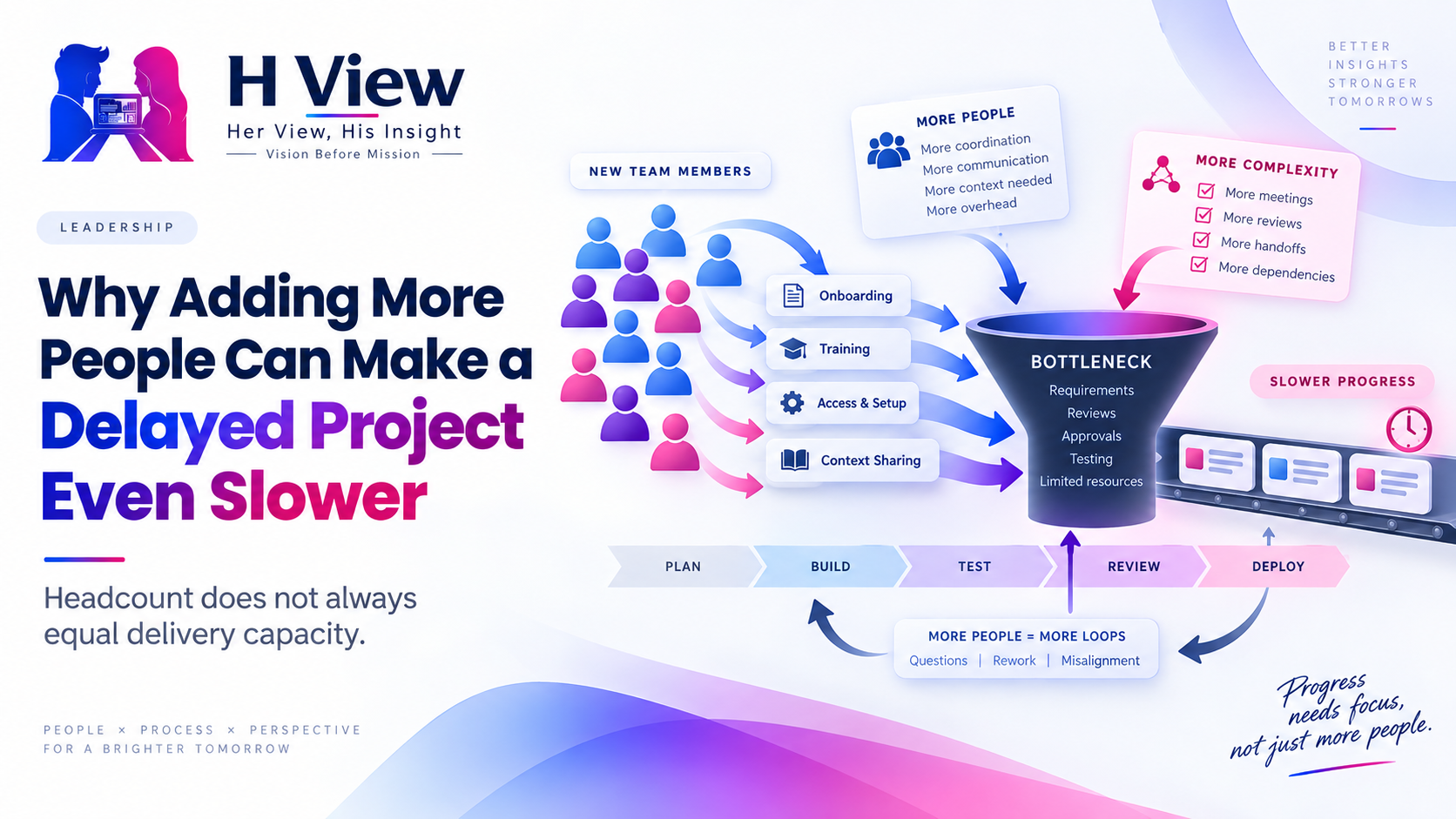
When a project falls behind schedule, one of the first reactions from management is often to add more people. At first, that response seems perfectly logical. If one developer is struggling to finish the work, two developers should be faster. If a team of five is already overloaded, increasing the team to eight or ten should theoretically improve delivery capacity.
That logic works well for certain kinds of work, but software development is rarely that simple.
A new employee does not become productive simply because their name has been added to the project. They need access, project context, technical guidance, business knowledge, documentation and time to understand how the existing system works. If the project is already delayed, the people who understand it best are usually the same people who must stop their own work to train the new members.
The company may therefore increase headcount while temporarily reducing actual productive capacity.
This does not mean hiring is a bad decision. Growing companies need to build stronger teams, and no organization should depend permanently on one or two experienced employees. The problem appears when hiring is treated as an immediate solution to a deadline that is already under pressure.
The real leadership question is not simply, “How many more people can we add?” It is, “What is actually slowing this project down, and what kind of support will remove that bottleneck?”
A project may officially have eight people assigned to it, but that number alone does not explain how much work the team can complete.
One developer may understand the architecture and database. Another employee may know the client workflow. A junior developer may be familiar with the programming language but not yet understand the product. A tester may be handling three other projects at the same time. Someone else may still be waiting for system access or credentials.
Management sees eight names on a resource sheet. The project itself may still depend heavily on one or two people.
This is why resource planning needs to measure capability rather than simply employee count.
| What management may see | What the project may actually have |
|---|---|
| Eight employees assigned | Two experienced contributors and six dependent resources |
| Four new developers added | Four people who still need onboarding and review |
| A larger development team | More coordination and communication overhead |
| More available hours | More interruptions for experienced team members |
| More people working | Several people waiting on the same dependency |
The number that matters is not how many employees are attached to the project. The more useful measure is how many people can independently complete meaningful work without creating additional supervision for someone else.
That difference becomes especially important when most of the newly added employees are freshers or junior developers.
Even an experienced developer needs time to understand a new product. Knowing React, Python, Java, Node.js, Laravel or any other technology does not automatically mean the person understands the company’s architecture, business rules, customer expectations, deployment process or existing technical debt.
Every project has context that cannot be learned from the technology stack alone.
A newly added developer needs to understand how users move through the system, which modules depend on each other, what coding conventions are already followed and which parts of the application are sensitive to change. They may also need to learn decisions that were never properly documented.
That learning period creates an onboarding cost.
The cost of onboarding is often invisible in planning sheets because it does not look like a separate task. In practice, however, someone must explain the system, prepare tasks, review code, answer questions and correct misunderstandings.
If the same senior developer is already under pressure to complete delayed work, onboarding four new employees can create a difficult situation. The company sees four additional resources, while the senior developer suddenly has four additional responsibilities.
During the first stage, the team may therefore move more slowly before it begins moving faster.
A realistic onboarding process usually includes:
Each of these activities is useful, but none is free.
The benefit of new hires appears over time, not immediately.
Freshers are important to growing organizations. They can learn quickly, adapt to modern tools and become valuable long-term contributors when they receive the right support.
The problem is not hiring freshers. The problem is counting them as fully productive experienced developers from day one.
Suppose a project has one experienced developer and management adds four freshers. On paper, the project now has five developers. In reality, the senior developer may still be the only person who can independently make architectural decisions, resolve difficult bugs, handle deployments or understand how a change in one module affects another.
The four new developers may initially depend on that same person for task clarification, debugging help, reviews and approvals.
| Management assumption | Early-stage reality |
|---|---|
| One developer becomes five developers | One developer becomes one developer plus four trainees |
| Work can be divided immediately | Work must first be explained and made safe to delegate |
| Senior workload will reduce | Senior workload may initially increase |
| More coding will happen instantly | More reviewing and mentoring may happen first |
| Delivery will automatically accelerate | Delivery may slow before improving |
Over time, this equation changes. Junior employees gain confidence, begin handling tasks independently and reduce the pressure on senior developers. At that point, the organization has genuinely increased capacity.
The mistake is expecting that benefit on the same day the employees join the project.
Another misunderstanding comes from assuming that development work can be divided like physical labour.
If ten boxes need to be moved, ten people may reasonably complete the job faster than two. Software does not always behave in the same way because tasks are often connected through dependencies.
A frontend developer may need an API before completing a screen. The API developer may need the database structure finalised. The database change may depend on a business decision from the client. Testing may need to wait until the integrated workflow becomes stable.
Adding three additional developers does not remove the missing decision.
In fact, adding more developers without clear task boundaries can create new coordination problems.
Two people may modify the same module. One implementation may conflict with another. Different assumptions may be made about the same requirement. Code then needs to be merged, reviewed, corrected and tested again.
The organization has increased activity without necessarily increasing progress.
Additional developers are most useful when the project contains tasks that can genuinely be handled in parallel.
For example, one developer may work on reporting while another handles authentication and a third builds an independent integration. If those modules have clearly defined interfaces and requirements, additional resources can improve delivery considerably.
However, if everyone is waiting on the same architecture decision or unfinished backend component, adding more people will not create parallelism. It simply creates more people waiting around the same bottleneck.
This is why good project planning looks at dependencies before looking at headcount.
The same principle applies to management.
When a project becomes difficult, organizations sometimes respond by adding more layers of supervision. A project manager joins the discussion, followed by a technical lead, a delivery manager and perhaps another senior reviewer.
Each role can be valuable when responsibilities are clearly defined. Problems begin when every manager independently asks for updates, requests changes and reviews the same work.
The developer may then spend more time explaining progress than making progress.
A project manager asks for a status report in the morning. The technical lead requests a code walkthrough in the afternoon. The delivery manager wants a client demonstration. Another manager asks for separate documentation containing information that was already provided in another format.
None of those requests may be unreasonable individually. Together, however, they can consume a significant part of the development day.
Good management should make delivery easier by clarifying priorities, resolving conflicts, removing dependencies and helping teams make decisions faster.
When additional managers simply create more reporting, more reviews and more approval points, the organization has added hierarchy without adding much support.
A useful management structure should answer three questions clearly:
If three different people can give three different answers to those questions, the team does not have stronger management. It has competing management.
That situation can slow a project just as easily as a lack of resources.
The most important step in resource planning is identifying what is actually preventing the project from moving forward.
Management sometimes treats every delay as a development-capacity issue. But the bottleneck may be somewhere completely different.
If requirements are clear, testing is available and developers simply have more implementation work than they can realistically complete, additional experienced development capacity can help.
This is the situation in which adding another capable developer may genuinely shorten the delivery timeline.
If development is already complete but QA resources are unavailable, adding more developers does very little.
The project needs testing capacity.
Developers can assist with technical fixes and automated tests, but they cannot replace every form of independent validation. If several completed features are waiting for QA, the organization should strengthen testing rather than continuing to expand the coding team.
A team cannot efficiently build a feature that nobody has properly defined.
When developers are waiting for the client, product owner or management to clarify what the system should do, additional developers simply create more people waiting for the same answer.
The solution is faster decision-making and clearer requirements, not more coding capacity.
A particularly common problem appears when one experienced developer spends much of the day supporting junior employees.
In this situation, the team may not need another fresher. It may need another experienced developer who can independently own modules, review work and share mentoring responsibilities.
This is why hiring should follow the bottleneck rather than a general desire to increase staff numbers.
An experienced developer can appear busy for an entire day without getting enough uninterrupted time to complete meaningful development.
The morning may begin with debugging an API. Twenty minutes later, a junior developer needs help. After that comes a project meeting. Then a client issue arrives. The developer returns to the original task, only to stop again for a code review or status call.
Each interruption appears small. Together, they create a serious productivity problem.
Complex development requires mental context. A developer needs to understand the relevant code, data flow, business rule and current problem before making safe changes. When that concentration is repeatedly broken, time is lost rebuilding the same context.
This becomes particularly important when a senior developer is supporting several freshers.
One junior asks about an API error. Another needs clarification on the UI. A third requests a pull-request review. Someone else has accidentally changed shared code.
None of these questions is unreasonable. They are part of building a team.
The leadership mistake occurs when management adds all of this mentoring responsibility while continuing to measure the senior employee’s individual development output as though nothing else changed.
If mentoring becomes part of the person’s role, it should be included in capacity planning.
Otherwise, the organization is effectively asking one employee to deliver full-time development output while also performing part-time training and technical leadership.
A company that wants to scale cannot allow all important knowledge to remain inside one employee’s head.
When documentation is weak, every new employee needs the same information explained repeatedly. Developers ask how the application is structured, where credentials are stored, how deployments work, what each API does and why certain technical decisions were made.
The experienced developer becomes the project’s human documentation system.
That dependency is dangerous for both productivity and continuity.
Good project documentation does not need to become a massive corporate exercise. Even basic information can reduce onboarding effort considerably.
Teams benefit from maintaining:
Documentation does not remove the need for mentoring, but it makes mentoring much more efficient.
Instead of explaining everything from the beginning, experienced employees can focus on the areas where judgment and project knowledge actually matter.
It would be wrong to conclude that adding people never improves a delayed project.
The right resource added at the right stage can make an enormous difference.
An experienced backend developer may remove pressure from an overloaded technical owner. A capable QA engineer may clear a growing testing backlog. A DevOps engineer may solve deployment problems that developers were previously handling manually.
The important factor is alignment.
The new employee should solve a real delivery constraint rather than simply increase the number of people associated with the project.
Adding resources is usually more successful when:
When these conditions exist, additional people can meaningfully improve delivery.
Without them, a larger team may simply create a larger coordination problem.
Experienced employees are often praised for being dependable.
They understand the project, solve difficult problems, support new employees, communicate with stakeholders and step in whenever something goes wrong. At first, being trusted with that responsibility can feel like professional recognition.
The problem begins when reliability becomes the reason every new responsibility is assigned to the same person.
Because the employee understands the project, they are asked to train everyone else. Because they can solve difficult issues, they receive every urgent problem. Because they work faster with AI or other tools, management assumes they have unlimited additional capacity.
Eventually, the person who was once considered the strongest resource becomes the most overloaded resource.
That situation is risky for both the employee and the company. The employee becomes exhausted, while the organization becomes dependent on knowledge and capability concentrated in one individual.
Strong employees need support before their reliability turns into organizational dependency.
From the management side, hiring is unavoidable if a company wants to grow.
No organization should depend permanently on one developer, one tester or one project manager. New employees need opportunities to learn, and experienced employees eventually need to transfer knowledge so that the business can scale.
The mistake is not hiring.
The mistake is treating hiring as an emergency shortcut for a deadline that has already been missed.
Recruitment is usually a medium-term capacity strategy. The organization spends time onboarding people today so that those employees can become independent contributors tomorrow.
Managers therefore need to distinguish between building future capacity and solving today’s bottleneck.
Sometimes those objectives can be achieved with the same hire. Sometimes they cannot.
Recognising that difference leads to much better staffing decisions.
A larger team is not automatically a stronger team.
Freshers can become excellent developers. Junior employees can grow into independent owners. New managers can improve coordination, and experienced hires can remove critical bottlenecks. All of those changes can strengthen an organization when they are introduced with realistic expectations.
The leadership failure begins when the company assumes that every new employee immediately adds full productive capacity.
Before adding more people to a delayed project, leaders should understand where the delay is happening, what type of skill is missing, how much onboarding the new resource will require and who will provide that support.
The goal should not be to make the project look better staffed.
The goal should be to make the project genuinely easier to deliver.
That is the difference between increasing headcount and building capacity, and it is one of the most important distinctions a growing organization can learn.
New developers need onboarding, project knowledge, supervision and code review before they become fully productive. Existing team members may temporarily spend more time supporting new employees than completing their own development work.
Not necessarily. Freshers can become valuable contributors, but they should not be treated as instant replacements for experienced developers. Their effectiveness depends on mentoring, task complexity, documentation and the time available for learning.
Adding a developer makes the most sense when implementation capacity is genuinely the main bottleneck and the work can be divided into independent tasks. If testing, requirements or approvals are causing the delay, another developer may not solve the problem.
Software work requires concentration and technical context. Frequent meetings, mentoring requests, reviews and support interruptions force developers to repeatedly rebuild their understanding of a task, reducing the amount of focused development time available.
Yes, when those managers clarify ownership, remove dependencies and improve coordination. Adding management layers without clear responsibilities can instead create more meetings, reporting and conflicting instructions.
Headcount measures how many employees are assigned to a team. Capacity reflects how much meaningful work those employees can independently complete. Experience, project knowledge, role clarity, dependencies and mentoring requirements all affect real capacity.
Harika is the co-founder of H View and covers AI, technology, gadgets, digital tools, online platforms, and modern internet trends. Her articles focus on simplifying complex topics with practical explanations, balanced opinions, and reader-first insights.
Share your real experience and help other readers decide better.
No community views yet. Be the first to share yours.

Open LinkedIn for a few minutes and you will probably come across a colourful graphic…
Harika October 6, 2026 
When an employee resigns, many organisations move quickly into replacement mode. The manager informs HR,…
Harika October 6, 2026 
For many corporate employees, the workday begins long before they actually start working. They wake…
Harika October 5, 2026 
Many projects begin with an assumption that sounds reasonable on paper: the client will explain…
Harika October 1, 2026