

Best Digital Marketing Tools in 2026: What Marketers Actually Need and What They Can Skip
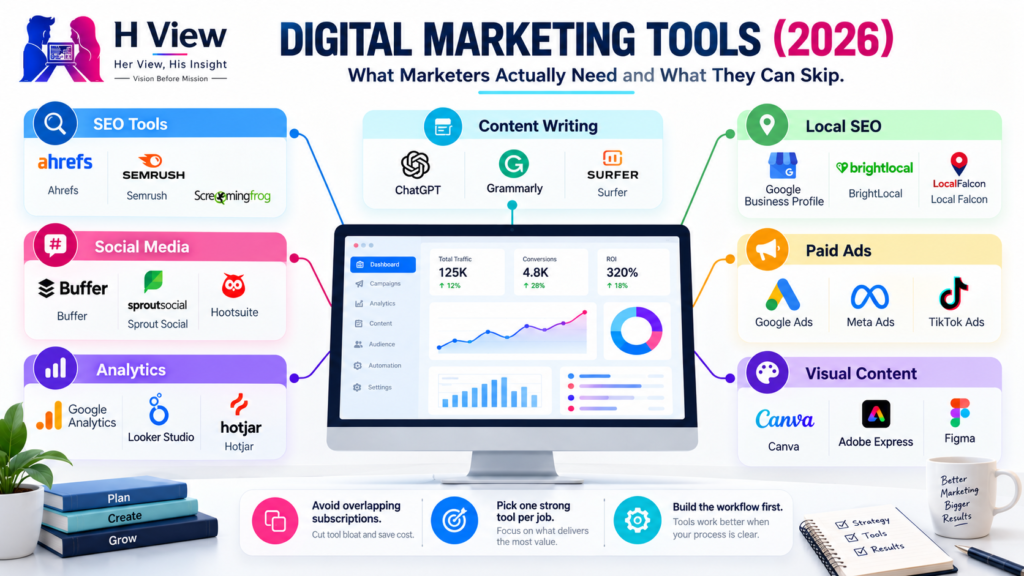
Open LinkedIn for a few minutes and you will probably come across a colourful graphic…
 Harika October 6, 2026
 By H ViewUpdated August 14, 202613 min read54 views
Every business begins with some form of energy. There is a new idea to test, a product to build, a website to launch, a service to offer, or a problem that suddenly feels worth solving. In the early stage, that excitement can be useful because it creates momentum, but it can also make people move much faster than they are thinking.
A founder may buy a domain before deciding what the brand should stand for. A small business may begin running advertisements before identifying its best customer. A creator may publish every day without knowing what kind of audience they actually want to build. A startup may invest in software, employees, design, and marketing only to discover six months later that the business itself is difficult to explain in one clear sentence.
The problem in those situations is not a lack of effort. In fact, there may be a great deal of effort. The problem is that activity has started before direction became clear.
That is the thinking behind one of H View’s central principles: Vision Before Mission.
The phrase does not mean that businesses should spend months planning and never act. It means the opposite. Action becomes more useful when there is enough clarity behind it to understand why that action matters, who it is supposed to help, and what larger direction it supports.
Vision and mission are often written beside one another on company websites, which can make them feel like two versions of the same corporate statement. In practice, they perform different jobs.
A vision describes the larger direction. It helps answer what the business is trying to become, what kind of value it wants to create, and what it hopes people will eventually associate with the brand. A mission is more operational. It describes the work the business will repeatedly do to move towards that direction.
The order matters because the mission should serve the vision.
Imagine a company that says it wants to become the most trusted local platform for helping first-time homebuyers make better property decisions. That vision immediately affects what the business should build. It may prioritise transparent comparisons, educational content, verified listings, local experts, and tools that reduce confusion for inexperienced buyers.
If the same company had started without that clarity, it might have built a generic property portal because competitors already had one. The website could still contain many features, but those features would not necessarily reinforce a distinctive purpose.
This is why vision should not be treated as decorative wording. A useful vision changes decisions.
One of the hardest parts of running a small business is that almost every new opportunity can sound attractive.
Someone suggests adding another service. A competitor starts making reels, so the team feels it should start making reels too. A new tool promises to automate half the company. An influencer offers a collaboration. A potential client asks for something outside the usual scope, but the money looks attractive.
Without a strong sense of direction, every one of those opportunities can pull the business somewhere different.
Vision creates a filter.
Instead of asking only whether an opportunity can generate money, the business can ask whether it supports the kind of company it is trying to build. Some opportunities will still be worth accepting for practical reasons, but the decision becomes more conscious.
That ability to say no is one of the less obvious benefits of having a clear vision.
Young businesses often assume growth means adding more: more products, more services, more channels, more markets, and more customers. Sometimes growth actually requires greater focus.
A company that understands what it does especially well can become easier to trust than one that appears willing to do everything for everyone.
A business may think it needs a new logo when the deeper problem is that nobody agrees on what the company stands for.
This happens frequently with small businesses.
The website says the company is premium, while social media focuses almost entirely on discounts. The sales team describes the service one way, while the founder describes it another way. One advertisement targets families, another targets businesses, and the homepage tries to speak to both at the same time.
The result can look like a design problem because the brand feels inconsistent. In reality, the visual inconsistency is often a symptom of strategic uncertainty.
A clear vision makes many branding decisions easier because the business begins from the same reference point.
If the company wants to be known for simplicity, the website should probably feel simple. If the vision is built around expertise and trust, exaggerated advertising claims may undermine it. If accessibility is central to the brand, premium pricing without a clear reason may create a contradiction.
Good branding is therefore not only about what colours or fonts a company uses. It is the repeated expression of what the company believes its value should be.
Marketing is one of the first areas where unclear direction becomes expensive.
It is easy to spend money because modern platforms make advertising extremely accessible. A small business can begin promoting a post or launching a campaign within minutes. The difficult part is knowing what message should be promoted and to whom.
If the vision is vague, marketing often becomes generic.
The business says it offers “high quality,” “best service,” or “affordable solutions” because those phrases sound positive and apply to almost every company. The advertisement may attract attention, but it does not give the customer a strong reason to remember the brand.
A clearer business can communicate more specifically.
Suppose two career platforms both help graduates find jobs. One tries to serve everyone. The other has a clear vision of helping first-generation graduates understand and enter professional careers without expensive coaching. That second platform can create much more focused content, partnerships, product features, and messaging because it understands the person it exists to serve.
Marketing becomes easier when the business already knows who should care.
This connects directly with the principles discussed in our guide to strategic planning in marketing management. Strategy becomes stronger when customer understanding and business direction come before channel selection.
Vision can also become a problem if it stays abstract.
It is easy to write a statement about changing an industry, empowering customers, or becoming a trusted leader. Businesses are judged on what they repeatedly do, not on the ambition of the statement printed on the About page.
That is where mission becomes important.
If the vision defines the direction, the mission translates that direction into operating behaviour. It should influence what the team builds, how customers are treated, what gets published, which features receive priority, and how resources are used.
For example, a business with a vision of making legal help easier for small entrepreneurs might translate that into a mission built around plain-language explanations, transparent pricing, online consultations, and faster access to basic documents.
The mission is useful because it gives people something they can act on.
Employees cannot “execute a vision” directly. They can execute tasks and processes that support it.
The best organisations keep both connected. Vision without mission becomes aspiration. Mission without vision becomes activity.
This principle becomes especially practical when money is involved.
A small business can waste significant amounts of money by purchasing solutions before defining the problem properly. A company may subscribe to an expensive CRM because it wants to “improve sales,” only to discover that its real problem is poor lead quality. Another may redesign the website when the main issue is that the offer itself is unclear. A creator may pay for several SEO tools despite not having a consistent publishing strategy.
The expense is not always caused by buying a bad tool. Sometimes the tool is perfectly good. It is simply solving the wrong problem.
This is one reason we repeatedly return to clarity when reviewing products and business software at H View. The correct question is rarely “Is this tool good?” The more useful question is “Is this tool appropriate for what you are trying to achieve?”
That distinction can prevent a great deal of unnecessary spending.
A ₹20,000 software subscription is inexpensive if it solves a valuable business problem. A ₹500 subscription is wasteful if the team never needed it.
Vision improves purchasing decisions because it gives the business a reason for choosing one capability over another.
Vision Before Mission is especially relevant to blogs, media platforms, and creator-led businesses because publishing can create the illusion of progress very quickly.
A website can produce ten articles in a week. Social accounts can post several times a day. AI tools can now generate more content than a small team could realistically review.
The difficult question is whether any of that content is building something recognisable.
A publication without a strong editorial direction may slowly become a collection of unrelated search terms. One article discusses technology, another discusses relationships, another discusses careers, and another discusses business, but the reader never understands what connects them.
A broad publication can still have a strong identity if the perspective remains consistent.
For H View, the idea has never needed to be that every topic belongs to one narrow category. The stronger identity is in how the topic is approached: looking at the human experience, practical reasoning, trade-offs, and the decision a reader is trying to make.
That editorial vision can guide hundreds of individual missions, whether the immediate task is writing an article, reviewing a product, or comparing two tools.
One of the signs that a business is becoming healthier is that every small decision no longer requires the founder.
That is difficult when the vision exists only inside one person’s head.
Employees may know their job responsibilities but still be unsure how the company prefers to handle unfamiliar situations. A customer asks for an exception. A marketing opportunity appears. A product feature must be prioritised. If nobody understands the larger direction, the safest response becomes “ask the founder.”
A clear vision creates context.
It does not provide an answer to every question, but it helps employees understand what kind of answer is consistent with the company.
If customer trust is central to the vision, hiding an important limitation to close a sale is obviously inconsistent. If simplicity is a core promise, adding another complicated workflow simply because a competitor has one should be questioned.
This is how vision becomes operational rather than philosophical.
The best company values and vision statements are useful when nobody is looking at them because they have already influenced how people think.
One concern founders sometimes have is that choosing a vision too early could trap the company.
It should not.
A vision is a direction, not a prison.
Businesses learn from customers, market changes, failures, and unexpected opportunities. The problem a founder initially wanted to solve may turn out to be less important than another problem discovered through experience. The customer group may change. Technology may make the original business model less useful.
Healthy companies adapt.
What matters is that changes happen deliberately rather than through random drift.
There is a significant difference between saying, “We discovered through two years of customer experience that our strongest opportunity is in a different market,” and waking up one day to discover the company has gradually become something nobody intended.
Vision can evolve while still performing its main function: giving the business enough clarity to make today’s decisions.
The concept does not require a long strategy workshop. A founder can begin with a small number of difficult questions and spend enough time answering them honestly.
Before launching a new product, campaign, website, or service, it helps to clarify:
These questions are deliberately simple. The difficulty comes from answering them specifically enough that the answers influence real decisions.
If “everyone” is the customer, the customer is probably not clear enough. If the main difference is “better quality,” the positioning probably needs more thought. If every possible opportunity fits the vision, the vision may be too broad to guide anything.
Good clarity creates boundaries as well as ambition.
There is something reassuring about dealing with a business that knows what it is trying to be. The website feels easier to understand, the message is more consistent, and conversations with the company feel less like someone is trying to sell whatever happens to be available.
That clarity affects trust.
Customers do not need a company to have everything figured out, especially when it is young. They do need to understand what the company promises and whether its behaviour matches that promise.
Vision Before Mission therefore feels less like a management slogan and more like a way of reducing confusion for everyone involved. When the business is clear internally, customers usually experience that clarity externally.
From a practical perspective, the greatest value of vision is resource allocation.
Every business has finite money, time, and attention. A startup that spends three months building the wrong feature has not only lost development cost; it has lost three months that could have been spent testing something more valuable. The same applies to advertising, hiring, software, and content.
Vision does not guarantee that the business will make the correct decision. Markets are too unpredictable for that.
What it does is improve the quality of the reason behind the decision.
Instead of asking, “What should we do next because everyone else seems to be doing it?”, the team can ask, “Which next action best supports the company we are trying to build?”
That is a much stronger foundation for growth.
Vision Before Mission means creating enough clarity about the direction of a business before committing heavily to action. Vision explains what the organisation is trying to become or create, while mission describes the work it will do to move towards that direction.
A vision describes the desired future and broader purpose of the organisation. A mission is more practical and explains how the business intends to serve customers and operate in pursuit of that future.
Yes. Perfect clarity rarely exists at the beginning, and businesses learn through action. The purpose of Vision Before Mission is not to delay starting indefinitely but to avoid significant investment without understanding the customer, problem, and direction well enough to make sensible decisions.
Small businesses have limited resources, so poor decisions can be relatively expensive. Clarity helps them focus on the customers, tools, services, and marketing activities that matter instead of trying every opportunity that appears.
Yes. A useful vision can evolve as the company learns more about customers, technology, and the market. The important part is changing direction deliberately based on evidence rather than drifting without noticing.
“Vision Before Mission” can easily sound like another business slogan if it remains only a sentence on a website.
Its value appears when it changes behaviour.
Before buying software, ask what problem it is supposed to solve. Before running advertisements, decide who should care about the message. Before hiring, understand what capability the business genuinely needs. Before publishing more content, understand what readers should eventually trust the publication for.
None of those decisions require absolute certainty.
They require enough clarity to prevent motion from being confused with progress.
A strong business still needs action, experimentation, courage, and occasionally the willingness to make decisions with incomplete information. Vision does not remove those realities. It makes them easier to navigate because there is a direction against which decisions can be judged.
Mission is how the work gets done.
Vision is why that work is worth doing in the first place.
H View writer sharing practical, balanced, and reader-first insights.
Share your real experience and help other readers decide better.
No community views yet. Be the first to share yours.
Open LinkedIn for a few minutes and you will probably come across a colourful graphic…
Harika October 6, 2026 
When an employee resigns, many organisations move quickly into replacement mode. The manager informs HR,…
Harika October 6, 2026 
For many corporate employees, the workday begins long before they actually start working. They wake…
Harika October 5, 2026 
Many projects begin with an assumption that sounds reasonable on paper: the client will explain…
Harika October 1, 2026