

Best Digital Marketing Tools in 2026: What Marketers Actually Need and What They Can Skip
Open LinkedIn for a few minutes and you will probably come across a colourful graphic…
 Harika October 6, 2026
  By HarikaUpdated September 20, 202610 min read33 views
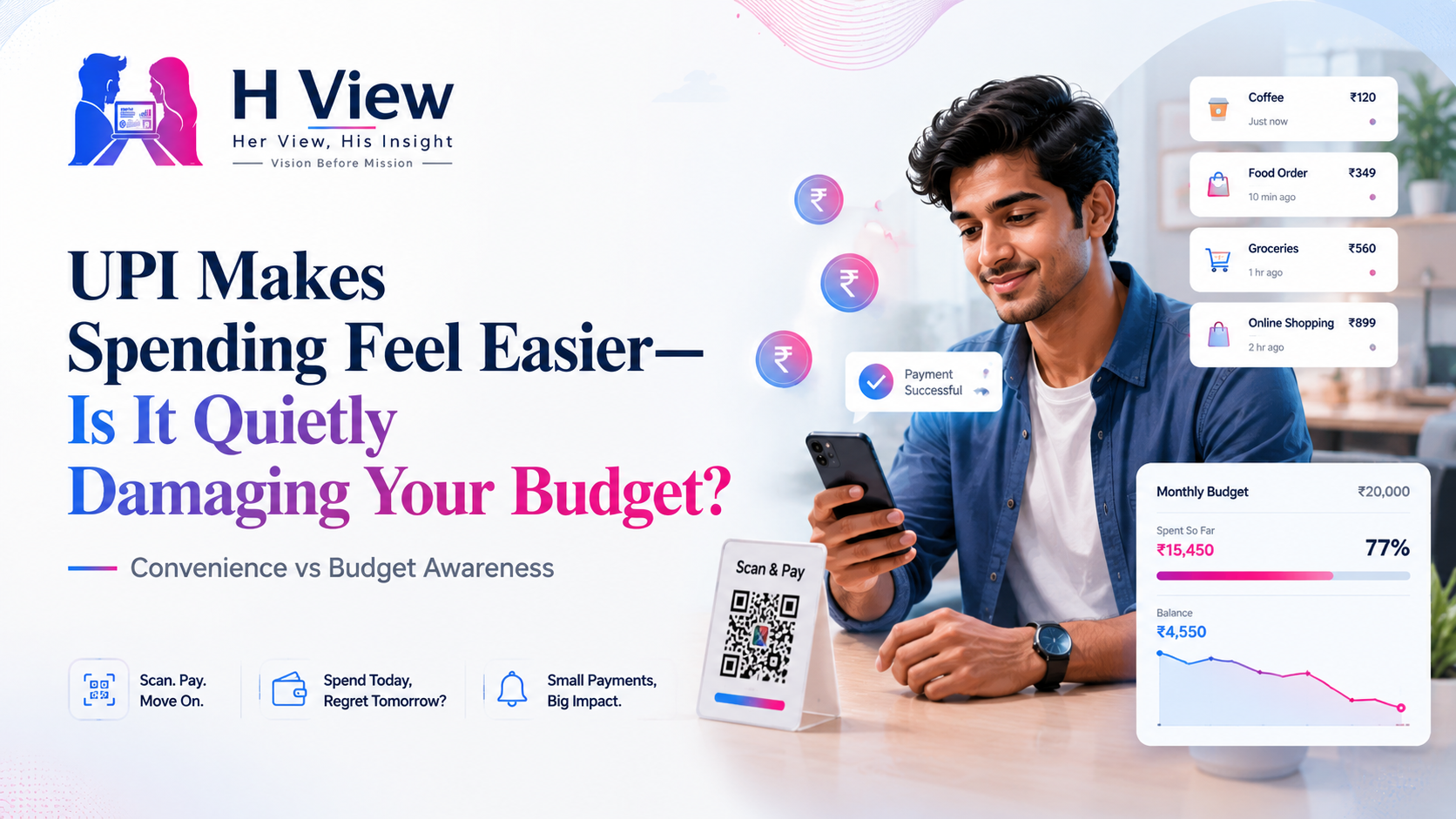
There was a time when buying a ₹40 cup of tea meant taking out your wallet, checking whether you had change and physically handing over cash. Today, you scan a QR code, enter four or six digits, hear the familiar payment confirmation and walk away. The entire transaction may take less time than deciding which tea to order.
That convenience is one of UPI’s greatest achievements. It has made paying a street vendor, splitting a restaurant bill, sending money to parents or buying groceries remarkably simple. India processed more than 24,000 crore UPI transactions in FY 2025–26, worth approximately ₹314 lakh crore, according to government data. By July 2026 alone, monthly transaction value had reached a record ₹29.88 lakh crore.
But there is another side to frictionless payment that receives less attention. When spending stops feeling like spending, are we becoming less aware of how much money is leaving our accounts?
Research involving Indian UPI users suggests that the concern is not imaginary. In one study of 276 respondents, roughly three-quarters said they felt their spending had increased after adopting UPI. Interviews also suggested that digital payments could reduce the uncomfortable feeling associated with handing over money physically.
That does not make UPI bad for personal finance. It means the technology has solved one problem so well—payment friction—that some of us may need to deliberately put financial awareness back into the process.
Imagine a typical Saturday.
You order breakfast for ₹220, take an auto for ₹145, buy coffee for ₹180, pay ₹99 for an online subscription, send ₹350 to a friend for movie tickets and scan ₹80 at a roadside snack shop. Later, you spend ₹499 on something from an Instagram advertisement because it seems inexpensive.
None of these purchases feels significant on its own.
By evening, however, ₹1,573 has left your account.
If you had started the day with ₹2,000 in cash, watching the notes disappear would have made the total much more visible. UPI removes that physical feedback. Your bank balance falls silently in the background while each individual transaction still feels small.
This is where convenience can alter behaviour without us consciously deciding to spend more.
The Indian UPI spending study found that many participants described digital spending as less tangible than cash. Some said they felt less guilt about spending through UPI because there was no physical act of handing money away.
Researchers sometimes discuss this broader phenomenon as the reduced “pain of paying.” The idea is simple: when payment becomes psychologically easier, the purchase itself can become easier to justify.
The danger is rarely one ₹50 transaction. It is fifty transactions that each felt too small to notice.
It would be unfair to blame overspending entirely on UPI.
People overspent before QR codes existed. Credit cards, online shopping and cash itself can all be used irresponsibly. If somebody is already impulsive, switching to cash will not automatically fix every financial habit.
What UPI changes is the number of small moments in which you might otherwise reconsider.
Suppose you walk past a bakery and see something for ₹170. If you only have ₹100 in your pocket, the purchase may end there. With UPI, the availability of money in your bank account effectively follows you everywhere.
The payment method never says, “You have already spent too much on eating out this week.”
It simply works.
This becomes even more powerful when combined with one-click shopping, food-delivery apps and social commerce. Buying no longer requires getting cash, entering card information or even thinking about which bank account to use. India’s payments ecosystem is now moving toward still faster UPI checkout experiences that could reduce payment steps further.
From a technology perspective, that is impressive.
From a budgeting perspective, every removed step is also one fewer opportunity to reconsider a purchase.
Most people notice a ₹35,000 phone purchase.
Very few forget that they bought a refrigerator or paid ₹20,000 for a flight.
Budget leakage happens more quietly.
A working professional earning ₹50,000 a month may carefully think about a ₹4,000 pair of shoes but barely notice ₹150 spent on snacks, ₹250 on delivery charges, ₹299 on an unused subscription, ₹120 on convenience fees and ₹600 across several small online purchases.
By the end of the month, the “small” category may have consumed ₹6,000 or ₹8,000.
UPI makes micro-transactions extremely natural. That has been transformative for small merchants and consumers alike. Someone selling coconuts can accept a digital payment without needing card infrastructure, and customers no longer need to carry exact cash.
The same feature that makes a ₹30 transaction practical also makes a ₹30 unnecessary transaction effortless.
That distinction belongs to the user, not the payment system.
A Delhi-based content creator recently attracted attention after spending more than two months avoiding UPI for many everyday purchases. She said the experiment made her more conscious of how much she was spending because physical cash created greater awareness. She did not ultimately argue that everyone should abandon UPI; instead, she returned to using it more intentionally.
That is probably the more useful lesson.
UPI solves too many genuine problems to treat cash as morally superior. Cash can be lost, requires change and offers little transaction history. UPI makes splitting expenses, paying bills and transferring money dramatically easier. NPCI describes it as an instant bank-to-bank payment system, and its enormous adoption reflects how useful Indians find it.
The aim should not be to make payments inconvenient again.
It should be to stop convenience from making spending invisible.
The first change does not require installing another budgeting application. Simply look at your UPI or bank transaction history once a week.
Not once every three months when you suddenly wonder where your salary went.
Choose ten minutes on Sunday and look specifically at the transactions below ₹500. Those are often the payments that disappear from memory fastest. You may discover that ₹79, ₹149 and ₹240 transactions collectively tell a much more important story than one large purchase.
Another useful approach is separating everyday spending from core savings. Instead of leaving your entire monthly salary in the account linked to the UPI app you use everywhere, maintain a realistic spending amount in one account and move planned savings elsewhere soon after receiving income.
The idea is not to create artificial financial tricks. It is to make the remaining amount meaningful.
If you have ₹12,000 available for food, travel and discretionary expenses this month, watching that balance fall from ₹12,000 to ₹7,000 tells you something. Watching your main account move from ₹94,000 to ₹89,000 may not create the same response because the number still looks comfortably large.
Notifications can also help, but only if you actually read them. When every payment alert becomes background noise, the phone is informing you without making you more aware.
There is an irony here: the same payment system that can make spending feel invisible also creates an unusually detailed record of where your money went.
Cash disappears without explaining itself.
UPI leaves evidence.
If your payment history shows repeated transactions at cafes, food-delivery services or shopping platforms, you do not need to estimate your habits from memory. You can see them.
This makes UPI potentially better than cash for budgeting—provided somebody actually reviews the history.
A college student may discover that ₹100–₹200 campus payments add up to ₹4,000 every month. A couple may realise their grocery budget is fine but food delivery is costing almost as much. A professional may notice that several auto rides could have been replaced by one monthly transport arrangement.
Budgeting becomes useful when it answers a specific question: what behaviour is taking more money than I realised?
UPI gives you the transaction data. It cannot force you to look at it.
There is also a broader perspective worth keeping in mind.
UPI has done enormous good by making digital payments accessible to merchants who would never have installed card machines. Government figures show how deeply the system has penetrated everyday commerce, with hundreds of banks onboarded and transaction volumes growing thousands of times since its early years.
The answer to personal overspending is therefore not making small vendors harder to pay.
Nor should every ₹20 QR-code transaction be treated as financially irresponsible. Convenience is valuable. Digital records are valuable. Reduced dependence on cash is valuable.
The behavioural question is whether we have adjusted our budgeting habits to match the new payment environment.
Many of us are using a 2026 payment system with a budgeting mindset designed for the era when money leaving the wallet was physically obvious.
The most relatable problem with UPI is how quickly a purchase disappears from memory.
You can pay for coffee while talking to a friend, scan for groceries while answering a call and send someone your share of dinner before leaving the table. The payment is so smooth that there is almost no emotional pause between wanting something and paying for it.
That ease is wonderful when life is busy. It becomes uncomfortable only at the end of the month when several perfectly reasonable purchases somehow produced an unreasonable total.
I would not want to return to carrying cash everywhere. But checking the weekly spending history feels like the digital equivalent of opening your wallet and seeing how many notes remain. Convenience works better when awareness keeps up with it.
UPI itself does not damage a budget. Unmeasured spending does.
What has changed is transaction friction. When the cost—in time and effort—of making a payment approaches zero, the discipline has to move somewhere else. Earlier, the physical wallet provided part of that discipline automatically. Today, the user has to create it through account separation, spending limits or regular review.
There is also a useful advantage modern consumers often ignore: UPI transaction records make analysis much easier than cash ever did. Instead of resisting digital payments, a better strategy is to use their data to understand your own behaviour.
The strongest personal-finance system is rarely the one that makes spending impossible. It is the one that makes spending visible.
UPI deserves most of the praise it receives. Few technologies have changed everyday Indian payments as quickly or as completely, and July 2026’s record transaction value shows that its role is still expanding.
But good technology can change behaviour in ways we do not immediately notice.
If you frequently reach the end of the month wondering where ₹5,000 or ₹10,000 went, do not start by deleting your UPI apps. Spend one month looking closely at the transactions that felt too small to matter.
Use UPI for what it does best: speed, accessibility and a clear digital record.
Then add back the one thing frictionless payments removed—the moment when you consciously notice that money has left.
There is evidence suggesting that it can influence spending behaviour. A study involving 276 Indian UPI users found that roughly 75% of respondents reported spending more after adopting UPI, with interviews highlighting the reduced tangibility of digital payments. That does not prove every UPI user will overspend, but it suggests payment convenience can affect behaviour.
Probably not. UPI is useful and gives you a detailed transaction history. A better first step is reviewing spending regularly, separating savings from everyday money and creating realistic discretionary limits.
Cash can make spending more visible because you physically see the amount remaining. Some people find that helpful. However, cash provides weaker transaction records, so a combination of intentional UPI use and regular review may work better for many people.
Individually, a ₹50 or ₹200 payment feels insignificant. Several such payments each day can accumulate into thousands of rupees over a month without any one transaction feeling like a major purchase.
Yes. Transaction histories can reveal exactly where money is going. Reviewing merchants, transaction amounts and frequency can make it easier to identify repeated discretionary spending that would be difficult to reconstruct from cash purchases.
Review the previous seven days of transactions once a week, paying particular attention to payments below ₹500. It takes only a few minutes and often reveals spending patterns that are easy to miss day to day.
Harika is the co-founder of H View and covers AI, technology, gadgets, digital tools, online platforms, and modern internet trends. Her articles focus on simplifying complex topics with practical explanations, balanced opinions, and reader-first insights.
Share your real experience and help other readers decide better.
No community views yet. Be the first to share yours.

Open LinkedIn for a few minutes and you will probably come across a colourful graphic…
Harika October 6, 2026 
When an employee resigns, many organisations move quickly into replacement mode. The manager informs HR,…
Harika October 6, 2026 
For many corporate employees, the workday begins long before they actually start working. They wake…
Harika October 5, 2026 
Many projects begin with an assumption that sounds reasonable on paper: the client will explain…
Harika October 1, 2026