

Best Digital Marketing Tools in 2026: What Marketers Actually Need and What They Can Skip
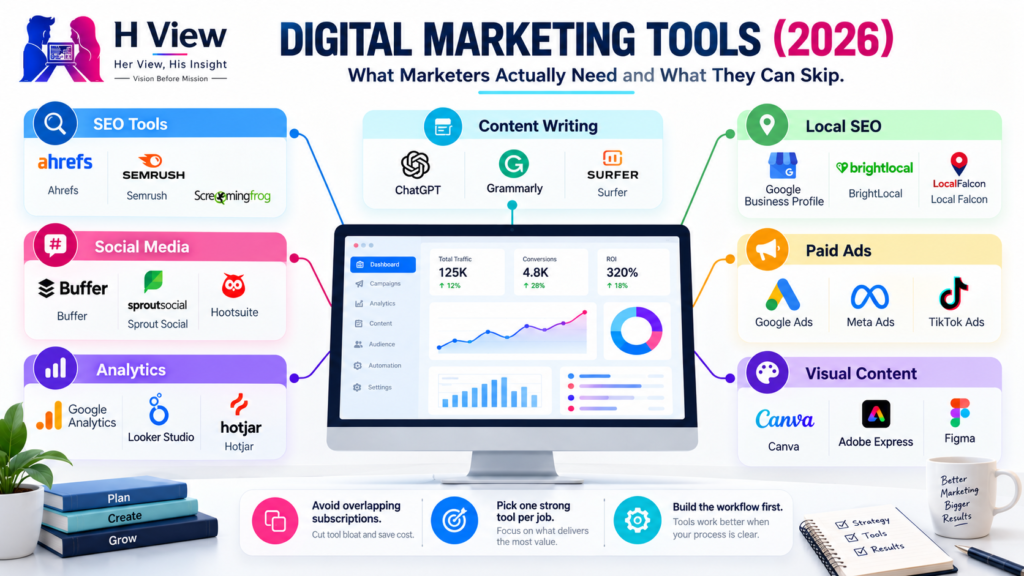
Open LinkedIn for a few minutes and you will probably come across a colourful graphic…
 Harika October 6, 2026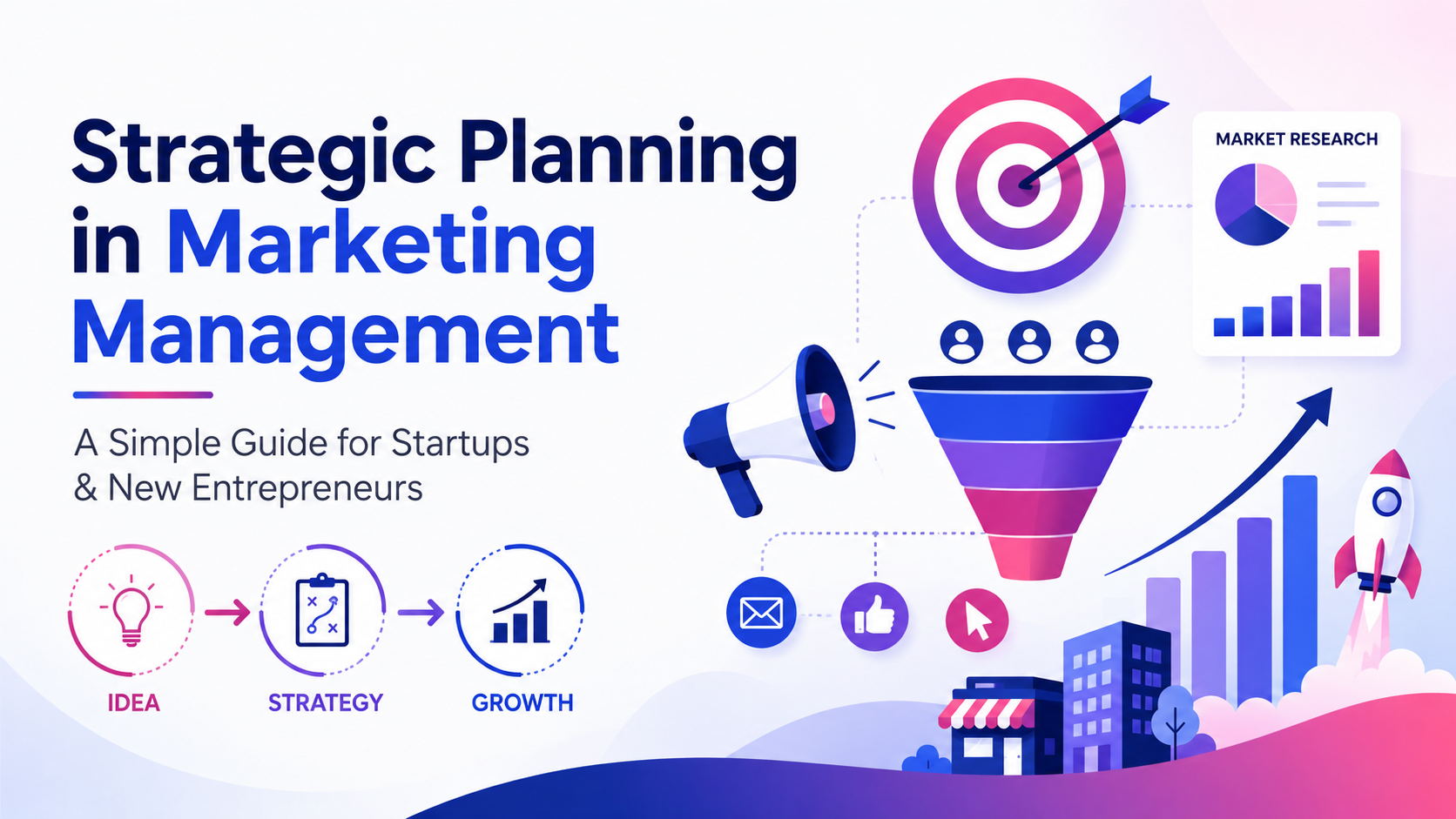
 By AnnapurnaUpdated August 12, 202614 min read59 views
A startup can have a promising product, an energetic team and a genuine desire to grow, yet still struggle to find customers. That does not always mean the idea itself is weak. In many cases, the business simply has not decided clearly who it wants to serve, what problem it is solving better than others, how people will discover the offer, or what kind of growth it is actually trying to achieve.
This is where strategic planning in marketing management becomes important. It gives a young business a way to connect its bigger goals with the everyday decisions that usually consume a founder’s attention: pricing, promotion, customer acquisition, social media, content, advertising and sales. Without that connection, marketing can easily become a collection of activities that look busy but do not move the business anywhere meaningful.
For startups, this matters even more because resources are limited. A large company may have the budget to test several campaigns at once, absorb poor decisions and hire specialists for different channels. A small startup often has to make every rupee and every hour count. Strategic planning does not remove uncertainty, but it helps the business use its limited resources with more purpose.
Strategic planning in marketing management is the process of deciding where a business wants to go and how marketing will support that direction. It connects customer understanding, positioning, pricing, communication, distribution and measurement into one larger plan rather than treating each marketing activity as a separate task.
This is different from preparing a monthly content calendar or deciding how many Instagram posts to publish in a week. Those are execution decisions. Strategy comes before them and asks more fundamental questions about the business itself.
A marketing plan should help a startup understand who its customer is, why that customer should care about the offer, how the product compares with alternatives and which channels are most likely to reach the right people. Once those answers are clearer, deciding what to post or where to advertise becomes much easier.
Imagine two startups selling healthy snacks to working professionals. The first begins immediately with reels, influencer posts and discounts. The second spends time understanding when office workers usually snack, what they dislike about existing options, how much they are willing to pay and whether they value convenience, taste or nutrition most. The second startup may eventually use the same marketing channels as the first, but its message is likely to be far more relevant because it understands what it is trying to communicate.
Founders naturally spend a lot of time thinking about their product. They know how it was built, what features it has and why they believe it is useful. Customers approach the same product very differently because they are usually thinking about their own problem rather than the founder’s effort.
A business owner searching for accounting software is probably not excited by the existence of another software platform. They may be frustrated because invoices take too long, records are difficult to organise or tax preparation becomes stressful at the end of every month. A parent looking for an educational service may care far less about how many features the platform offers than whether their child will actually understand the subject better.
Good marketing begins when the startup learns to look at the product from that customer’s side. Instead of asking only, “What do we want to sell?”, it begins asking, “What is the customer trying to solve?”
Early market research does not always require expensive consultants or complex reports. Startups can learn a surprising amount by speaking directly with potential customers, reading competitor reviews, observing online discussions, studying search behaviour and listening carefully during sales conversations.
The goal is to notice patterns rather than collect information for the sake of having data. Several customers may complain that existing services are difficult to understand. Others may say that the products available are too expensive or that support disappears after purchase. Those patterns can reveal opportunities that a founder would never see by looking only at competitor websites.
Research can also challenge assumptions. A startup may believe its strongest advantage is advanced technology, while customers may care much more about convenience or quick support. Discovering that early is far cheaper than spending heavily on marketing a benefit the market does not value.
Studying competitors is useful, but copying them is not a strategy. A startup that mirrors another company’s website, pricing structure, social media style and promotional language may end up looking like a smaller version of an established brand rather than giving customers a reason to choose it.
The better purpose of competitor research is to understand how the market is already being served. Look at what other brands emphasise, what customers praise and what repeatedly appears in negative reviews. Notice where competitors seem strong and where they leave customers dissatisfied.
A startup does not have to invent an entirely new category. It simply needs a meaningful reason for the right customer to prefer its offer. That reason might be better service, clearer pricing, faster delivery, easier onboarding, stronger specialisation or a more trustworthy experience.
Without that difference, marketing quickly falls into generic language such as “best quality,” “excellent service” and “affordable prices.” Those claims sound positive, but they are almost impossible to own because every competitor can say the same thing.
A goal such as “grow the business” sounds positive but does not help a team decide what to do next. The same is true of “increase brand awareness” when nobody has defined what improvement would actually look like.
A useful marketing goal should be specific enough to influence decisions. A startup may decide that it wants to generate 200 qualified enquiries in the next quarter, acquire 50 first-time customers, increase repeat purchases or reduce the cost of acquiring each customer.
Once the goal is clear, the marketing team can ask better questions. Which channel is bringing the most useful leads? Which campaign attracts attention but produces no sales? Which customer group converts more easily? Why do some buyers return while others disappear after one purchase?
The SMART framework can still be helpful here because it encourages goals to be specific, measurable, achievable, relevant and time-bound. The important part, however, is not memorising the framework. It is learning to define success clearly enough that the business can recognise progress.
The traditional 4Ps of marketing—Product, Price, Place and Promotion—can sound like an academic model, but they remain useful for startups because they force the founder to look beyond advertising.
The product must solve something that customers value. More features do not automatically make a product better. In many cases, a simpler offer built for a specific audience can be easier to understand and easier to sell than a complicated product trying to appeal to everyone.
Pricing is not only a financial decision; it also communicates positioning. A very low price may attract buyers but can reduce margins or create doubts about quality. A premium price can work when the product, service and overall experience give customers enough reason to accept it.
The important question is whether customers understand the value they receive for what they are paying.
Place refers to where the customer can buy or access the product. That could be the startup’s own website, a marketplace, retail store, mobile app, WhatsApp, distributor network or a combination of several channels.
The choice affects convenience, customer experience and the amount of control the business keeps over the relationship.
Promotion includes the visible marketing activity: advertising, social media, SEO, email, content, partnerships, influencers and other channels. By the time the startup reaches this stage, the earlier decisions should already make the message clearer.
Promotion works much better when the business already understands who the customer is, what the offer solves and why somebody should choose it.
Digital marketing is attractive to startups partly because experiments can begin at a relatively small scale. A young company that cannot afford large television or print campaigns can still test search ads, social media, email, local listings, content marketing or short-form video without committing an enormous budget.
The bigger advantage is measurement. Digital channels give businesses far more information about what happens after an advertisement or piece of content is published.
Suppose a startup spends ₹20,000 across two marketing channels. One campaign produces thousands of impressions and hundreds of clicks but only one customer. Another reaches far fewer people but produces ten genuine enquiries and several purchases. If the startup celebrates only reach or clicks, it may mistakenly invest more money in the weaker channel.
This is why vanity metrics need context. Followers, likes, views and impressions can be useful, but they are not automatically business results. An e-commerce brand may care more about conversion rate and repeat purchases, while a B2B startup may care about qualified leads and cost per acquisition.
Marketing becomes more strategic when the metric being tracked reflects what the business is actually trying to achieve.
Startups often feel pressure to appear on every platform because each new marketing trend sounds like an opportunity they cannot afford to miss. One week the advice is to focus on Instagram Reels, the next week everyone is talking about LinkedIn, then YouTube, Google Ads, WhatsApp, influencers or email automation enters the conversation.
Trying to manage all of them at once usually produces weak execution everywhere.
The better approach is to choose a small number of channels that match the behaviour of the customer. A visually driven consumer brand may benefit from Instagram and short-form video, while a specialised B2B service may find search, LinkedIn or direct outreach far more effective. A neighbourhood service business may gain more value from Google Business Profile, local referrals and WhatsApp than from trying to build a national audience.
The best marketing channel is not the one receiving the most attention online. It is the one that repeatedly reaches the right customer at a cost the business can sustain.
Limited money can feel like a disadvantage, but it can also force a startup to become more disciplined. When the budget is small, every marketing activity has to justify why it exists and what the business hopes to learn from it.
Before spending on a campaign, the team should be able to explain the audience, message, expected result and what would make them stop or continue. That simple discipline prevents marketing from turning into a monthly expense that continues simply because it has always been there.
A young startup may initially rely more heavily on referrals, useful content, partnerships, community participation and direct conversations with customers. Those methods often require more personal effort, but they can produce valuable learning before paid advertising is scaled.
If the offer or message is still unclear, spending more on ads may simply make the mistake more expensive.
Large Indian brands such as Amul, Zomato and Nykaa operate at a scale that most startups cannot imitate, but their marketing still offers useful lessons.
Amul demonstrates how consistency can create recognition over a long period. Its communication developed a distinctive voice and continued using that voice across changing events and generations. The lesson for a startup is not to copy Amul’s style, but to understand that recognisable branding develops through repetition and consistency.
Zomato has frequently built communication around familiar everyday behaviour related to food, making the brand feel more conversational than formal. Nykaa, meanwhile, has shown how education, tutorials, reviews and other content can support a category where customers often want guidance before purchasing.
The larger lesson is that strong marketing usually fits the customer’s behaviour and the identity of the business. Startups should study successful brands for principles rather than copying campaigns that were designed for completely different audiences and budgets.
A strategic marketing plan should never become a document that is written once and then treated as permanent. Early-stage businesses are constantly learning, and some of their original assumptions will inevitably turn out to be wrong.
The customer you expected to buy may not be the customer who actually converts. A marketing channel that looked promising may perform poorly. A feature the team considered minor may become the main reason buyers choose the product.
These discoveries are not failures of strategy. They are information that should improve it.
Startups have an advantage because they can often adjust more quickly than larger organisations. The difficult part is accepting evidence that contradicts an idea the founders were emotionally attached to.
If a campaign performs badly, spending more is not automatically the solution. The problem may be the targeting, message, price, landing page, offer or product itself. Measurement should therefore lead to better questions rather than simply producing another dashboard.
Customer feedback is sometimes treated as something only the support or product team needs to see, but it can be one of the most useful marketing resources available to a startup.
Customers often describe problems in clearer language than businesses do. Their objections reveal where the offer is confusing. Their complaints can expose a gap between what the marketing promised and what the experience actually delivered.
If several customers independently say they chose a product because it was “easy to understand,” that phrase may be more powerful than a complicated slogan created internally. If potential buyers keep asking the same question before purchasing, the marketing may not be answering something important early enough.
Listening to customers improves more than the product. It improves the way the business explains itself.
From a founder’s point of view, marketing can become exhausting because there is always another thing that appears worth trying. A competitor launches a campaign, a new social platform starts gaining attention and another expert recommends a completely different growth strategy. Without a clear plan, this constant stream of advice can make random activity feel like progress.
A strategy reduces some of that pressure because it gives the team permission to ignore things that do not match the current goal. When the business knows which customer matters, what message it wants to communicate and which channels deserve attention, saying no becomes easier. For a small team, that focus can be just as valuable as the marketing ideas themselves.
From a practical business perspective, marketing strategy is largely about deciding where limited resources should go. A startup does not have unlimited people, money or time, which means every activity carries an opportunity cost.
The most useful marketing decisions eventually connect back to evidence. Which customer group creates the healthiest revenue? Which channel generates qualified leads rather than just traffic? Which message improves conversion, and which campaign produces attention without contributing to the business?
Strategy cannot remove uncertainty from a startup, but it can make mistakes easier to recognise and less expensive to repeat.
Strategic planning in marketing management is the process of defining marketing goals and deciding how the business will reach customers, position its offer, use resources and measure results. It connects everyday marketing activity with the larger direction of the business.
Startups usually have limited budgets and small teams, so they cannot afford to pursue every marketing opportunity. A clear strategy helps them focus on the customers, messages and channels that are most likely to contribute to meaningful growth.
The 4Ps are Product, Price, Place and Promotion. Together, they help a business examine what it sells, what customers pay, where the product is available and how potential buyers discover it.
No. A startup can begin with smaller experiments, referrals, content, partnerships, direct outreach and selected digital channels. Spending should increase only when the business has enough evidence that a particular activity is working.
There is no fixed schedule that suits every business. A strategy should be reviewed whenever meaningful information changes, including customer behaviour, campaign performance, competition, product direction or business goals.
Strategic planning in marketing management is not about creating a complicated document filled with frameworks that nobody reads after the first meeting. For a startup, its real value is much more practical. It creates clarity around who the business wants to serve, why those customers should care, how the offer should be positioned and where limited marketing resources should be used.
The plan will not remain perfect, and it should not. Startups learn by entering the market, listening to customers and discovering which assumptions survive contact with reality. A strong strategy gives the team a starting direction while still leaving enough flexibility to adapt when the evidence changes.
Before spending heavily on advertising, understand the customer. Before joining another platform, understand whether the audience you need is actually there. Before celebrating reach or followers, understand whether those numbers are contributing to the goal the business originally set.
When those decisions begin connecting with one another, marketing stops feeling like a collection of campaigns and starts becoming part of how the startup grows.
Annapurna is an H View contributor covering relationships, family, lifestyle, entrepreneurship, and everyday decision-making. Her articles focus on emotional clarity, practical understanding, and human-centered perspectives that help readers think better about personal and professional situations.
Share your real experience and help other readers decide better.
No community views yet. Be the first to share yours.
Open LinkedIn for a few minutes and you will probably come across a colourful graphic…
Harika October 6, 2026 
When an employee resigns, many organisations move quickly into replacement mode. The manager informs HR,…
Harika October 6, 2026 
For many corporate employees, the workday begins long before they actually start working. They wake…
Harika October 5, 2026 
Many projects begin with an assumption that sounds reasonable on paper: the client will explain…
Harika October 1, 2026