

Electric Vehicles: The Future of Sustainable Transportation
Electric Vehicles, commonly known as EVs, are transforming the global transportation industry. They offer a…
 Satya Hemanth July 30, 2026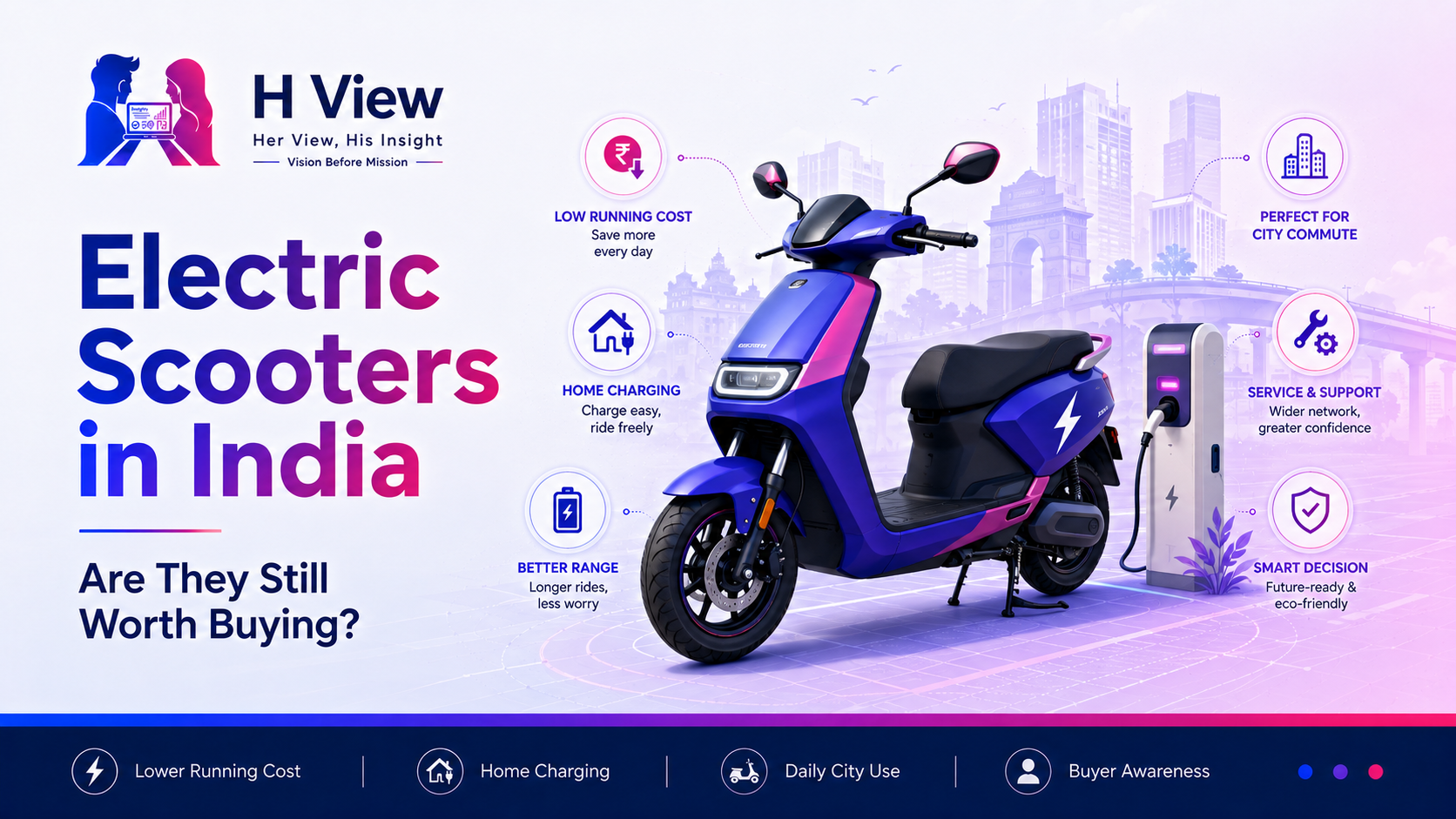
 By HarikaUpdated July 15, 202610 min read44 views
Electric scooters are no longer a rare sight on Indian roads.
A few years ago, many people looked at EV scooters with doubt. Will the battery last? Where will I charge it? What if the scooter stops on the road? Is it safe? Is it really cheaper than petrol?
Today, the conversation has changed. More people are considering electric scooters for daily city travel, especially because petrol prices, traffic, office commutes and delivery costs have made running cost a serious factor.
But the real question still remains:
Are electric scooters in India still worth buying?
At H View, our practical view is simple:
An electric scooter is worth buying only when your daily routine, charging access and service support match the vehicle.
Electric scooters became popular because they solved one major problem: daily running cost.
For people who travel short distances every day, petrol expenses can slowly become painful. A scooter used for office travel, college, local errands, delivery work or family use may run almost daily. In such cases, fuel cost matters.
Electric scooters also feel smooth to ride. There is no engine noise, no petrol smell and no frequent visits to fuel stations. For city rides, they feel light, quick and convenient.
Many buyers also like the modern features. Touchscreens, app connectivity, ride modes, reverse assist, navigation, boot space, anti-theft alerts and connected dashboards make EV scooters feel more advanced than basic petrol scooters.
The EV two-wheeler market in India has become more serious and competitive.
Earlier, buyers had fewer choices. Now, brands like Ola Electric, Ather, TVS, Bajaj, Hero Vida and others are competing with different price ranges, battery options, features and service plans.
Government support has also played a role. The PM E-DRIVE scheme was introduced to support electric mobility and includes incentives for electric two-wheelers. This kind of policy support keeps EV adoption active, though buyers should always check the current subsidy and eligibility at the time of purchase.
At the same time, the market has become more practical. Buyers are no longer impressed only by big range numbers. They now ask better questions:
These are the right questions.
The strongest reason to buy an electric scooter is running cost.
A petrol scooter needs regular fuel. An electric scooter needs electricity. For daily city usage, EV scooters can be much cheaper to run than petrol scooters.
This matters most for people who travel every day.
For example:
A student going to college daily.
An office worker travelling within the city.
A small business owner doing local visits.
A family using the scooter for groceries, school drops and errands.
A delivery rider using the vehicle heavily.
For these users, even small daily savings can become meaningful over a year.
But remember one thing: running cost is not the only cost. You must also consider insurance, tyres, brake pads, service, battery health and future repair costs.
Many electric scooters advertise attractive range numbers. But real-world range can be different.
Range depends on:
If a scooter claims 150 km, do not assume you will get 150 km every day.
A safer approach is to check real user reviews and assume a practical buffer.
If your daily travel is 30–40 km, a scooter with 90–120 km real-world range may be comfortable. If your daily travel is 70–90 km, you must be much more careful while choosing.
Range anxiety usually happens when buyers choose based on brochure numbers, not real usage.
Before buying an electric scooter, ask yourself:
Can I charge it safely and conveniently?
If you live in an independent house with parking and a proper charging point, EV ownership becomes easier.
If you live in an apartment, rented house or shared building, charging may be more complicated. You may need permission from the apartment association, landlord or parking management.
You should check:
Do not buy an electric scooter first and think about charging later. Charging access should be checked before purchase.
The battery is the heart of an electric scooter.
A good battery can make the scooter feel reliable. A weak battery can make the ownership experience stressful.
Most buyers should check:
Some brands offer extended battery warranty options. For example, Ather’s Eight70 Warranty mentions 8 years or 80,000 km coverage, with battery replacement if battery health goes below 70%, subject to plan terms.
This kind of warranty gives confidence, but buyers should read the full conditions carefully. Do not rely only on showroom statements.
Electric scooters usually have fewer moving parts than petrol scooters. There is no engine oil change, clutch work or petrol engine maintenance.
That can reduce routine maintenance.
But EV scooters still need care.
You still have to maintain:
Also, software issues can affect the experience. Since many EV scooters are connected vehicles, updates, app pairing, dashboard glitches and sensor issues may happen.
So yes, maintenance can be lower, but it is not zero.
Safety is a serious topic for electric scooters.
Most good EV scooters are designed with battery management systems and safety protections. But users also have responsibility.
Safe charging habits matter.
Use the official charger.
Do not charge near flammable materials.
Do not use damaged chargers or wires.
Do not cover the charger while charging.
Avoid unsafe extension boards.
Do not ignore heating, smell, smoke or warning signs.
Follow the brand’s charging instructions.
A cheap charger or unsafe wiring can create risk. EV ownership should not be treated casually.
A scooter may look excellent online, but what happens when it needs service?
Before buying, check whether the brand has a service center near your home or workplace.
Ask existing owners in your city. Check Google reviews. Visit the service center if possible. See how crowded it is. Ask about spare parts availability.
A scooter with slightly fewer features but better service support may be a better buy than a feature-loaded scooter with poor support.
In India, after-sales service can decide the real ownership experience.
A petrol scooter still makes sense for many buyers.
Petrol scooters are familiar, easy to refuel and supported by wide service networks. They are better for people who travel long distances, do not have charging access, live in areas with weak EV service support or want simple ownership without battery concerns.
Electric scooters are better for city riders who have predictable daily travel and easy charging.
The choice is not emotional. It is practical.
Choose electric if your usage is city-based, charging is easy and service is nearby.
Choose petrol if you need long-distance flexibility, fast refuelling and proven service reach.
An electric scooter can be a good choice if you:
For these users, EV scooters can offer strong value.
Avoid or delay buying an electric scooter if:
An electric scooter should make your life easier, not add daily anxiety.
Many buyers make the same mistakes while choosing electric scooters.
They look only at claimed range.
They ignore charging access.
They forget to check service support.
They do not ask about battery warranty.
They choose features over reliability.
They ignore safety rules.
They do not calculate actual usage.
They compare only price, not ownership cost.
A good EV buying decision needs patience.
Do not book only after watching one YouTube review or seeing one flashy ad. Visit the showroom, test ride the scooter, speak to real owners and check your daily route.
Before buying an electric scooter, check these points:
If most of these points are clear, you can buy with more confidence.
From the user experience side, electric scooters feel modern, smooth and convenient. They are especially useful for people who use scooters daily for city travel.
The silent ride, low running cost and easy app features can feel refreshing.
But the experience becomes stressful if charging is not easy. A scooter that looks exciting in the showroom may become frustrating if you constantly worry about battery percentage.
So the first priority should not be colour, screen size or top speed. It should be charging and service.
From the practical side, electric scooters make the most sense when usage is predictable.
EV scooters are not automatically cheaper for everyone. They become cost-effective when the buyer rides regularly, charges safely and keeps the scooter for enough time to recover the higher upfront cost.
The EV market is improving, but buyers should not ignore battery replacement, resale value and service quality.
The right electric scooter can save money. The wrong one can create inconvenience.
Electric scooters are still worth buying in India, but not for every buyer.
They are best for daily city users with home charging and nearby service support.
They are not ideal for buyers with uncertain travel, no charging access, weak service support or frequent long-distance needs.
At H View, our recommendation is simple:
Buy an electric scooter for your real daily route, not for the advertised range.
Yes, electric scooters are worth buying for city users who have safe charging access, predictable daily travel and good service support nearby.
The biggest advantage is lower running cost compared to petrol scooters, especially for daily city use.
The biggest risks are poor charging access, battery degradation, weak service support and choosing based only on claimed range.
Battery life depends on brand, usage, charging habits, weather and battery quality. Buyers should check battery warranty and real owner feedback before purchase.
An electric scooter is better for city commuting and lower running cost. A petrol scooter is better for long-distance flexibility, quick refuelling and areas with weak EV service support.
You can, but only if your apartment allows safe charging and has proper electrical setup. Confirm this before buying.
Electric scooters in India have moved from experiment to mainstream consideration.
They can save money, reduce fuel dependence and make city travel smoother. But they need the right ownership conditions.
Charging access, real-world range, battery warranty and service support matter more than fancy features.
At H View, our final view is simple:
Electric scooters are worth buying when your daily life supports EV ownership. If charging and service are not clear, wait before you buy.
Harika is the co-founder of H View and covers AI, technology, gadgets, digital tools, online platforms, and modern internet trends. Her articles focus on simplifying complex topics with practical explanations, balanced opinions, and reader-first insights.
Share your real experience and help other readers decide better.
No community views yet. Be the first to share yours.
Electric Vehicles, commonly known as EVs, are transforming the global transportation industry. They offer a…
Satya Hemanth July 30, 2026