

Best Digital Marketing Tools in 2026: What Marketers Actually Need and What They Can Skip
Open LinkedIn for a few minutes and you will probably come across a colourful graphic…
 Harika October 6, 2026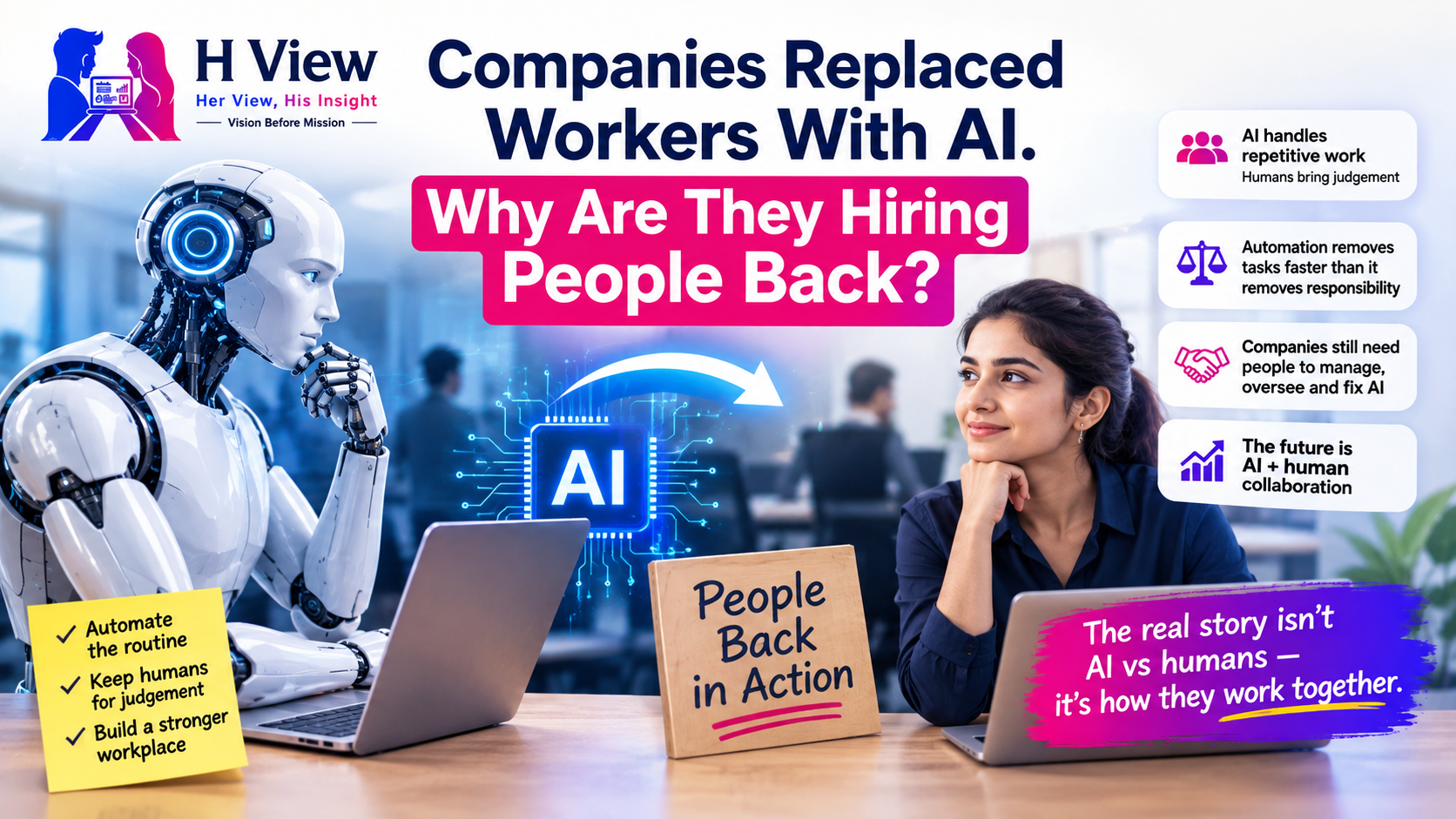
 By Satya HemanthUpdated August 20, 202611 min read37 views
For the past few years, the AI story in the workplace has been told in one direction. Companies would automate repetitive tasks, reduce headcount, improve productivity and eventually need fewer people. Every major advance in generative AI seemed to strengthen that expectation, especially in customer service, software development, administrative work and other jobs built around repeatable digital tasks.
That story is now becoming more complicated.
AI is still replacing parts of jobs, and companies are still restructuring around automation. Reuters reported in 2026 that several major employers have continued cutting roles while shifting investment toward AI infrastructure, and software companies in particular are trying to produce more with smaller teams. Yet something else is happening at the same time: some companies that moved aggressively toward automation are discovering that the human work did not disappear as neatly as expected.
In India, staffing firm TeamLease said it had seen companies reduce workforce levels by as much as half after adopting AI, only to return within months because people were still required to manage the technology and the workflows around it. Gartner has gone even further, forecasting that by 2027, half of companies that cut customer-service staff because of AI will bring people back into similar functions, although the jobs themselves may look different.
That does not mean AI adoption is reversing.
It means companies are beginning to understand the difference between automating a task and operating an entire business without people.
When companies first began rolling generative AI into workflows, the financial logic looked extremely attractive. If an AI chatbot could answer customer questions, perhaps fewer support agents were necessary. If coding assistants could generate software faster, fewer developers might be required. If AI could draft reports, summarise calls and prepare documents, administrative teams could become much smaller.
On paper, this is easy to model. If ten employees each handle one hundred tasks and a new AI system can perform half of those tasks automatically, management may assume that five people can now do the work of ten.
Real businesses do not behave like spreadsheets.
A customer-service bot may resolve the common question perfectly but struggle with the angry customer whose situation does not match any standard process. An AI coding tool can write a large amount of code quickly, but someone still has to decide whether the architecture makes sense, whether the output is secure, and what happens when the generated solution fails in production. A reporting assistant can summarise data, but it cannot automatically own responsibility when the underlying data is wrong.
That distinction is where some automation plans start to break down.
AI is strongest when the work is clearly defined. Businesses become difficult precisely when the work stops being clearly defined.
One of the most misunderstood parts of AI adoption is how much human work remains after automation is introduced.
An AI system has to be configured, monitored, evaluated and corrected. Someone needs to decide which decisions the system is allowed to make automatically and which ones require escalation. The business needs to handle unusual cases, complaints, regulatory requirements and situations where the AI produces an answer that sounds convincing but is wrong.
Those tasks were easy to overlook when AI was being discussed primarily as a labour replacement.
They become obvious after deployment.
TeamLease’s 2026 comments are particularly revealing because the companies it described did not abandon AI when they started rehiring. They realised that they still needed staff to operate effectively alongside the technology. That is a very different story from saying automation failed.
The AI stayed.
Humans came back around it.
Customer service has become one of the clearest testing grounds for this change because it contains exactly the type of work AI handles well and the type of work it still struggles with.
Many customer enquiries are repetitive. People want to know where an order is, how to reset a password, whether a payment has been received or when an appointment is scheduled. Automating those interactions makes obvious sense.
The difficult cases are different.
Imagine that a customer has been incorrectly charged three times and has already spoken with a chatbot twice. The technical problem may be simple, but the person is now frustrated. They do not want another automated explanation of the refund policy. They want somebody to understand the history of the problem, make a judgement and take responsibility for resolving it.
That human element is one reason Gartner predicts a significant rehiring trend among companies that reduced customer-service staffing too aggressively. Its 2026 forecast says 50% of organisations that attributed service headcount reductions to AI will rehire for similar work by 2027.
The future customer-service team may therefore be smaller than the old one, but the remaining employees could handle more difficult, higher-value and emotionally sensitive interactions.
AI handles the predictable work.
Humans increasingly handle the exceptions.
This is important because headlines such as “companies are hiring humans back” can easily create the wrong impression.
Most organisations are not undoing their AI investments and rebuilding the same departments they had before.
The workforce itself is changing.
Reuters reported that Indian companies are increasingly using contract and flexible staffing while they reassess how many permanent employees they actually need in an AI-heavy environment. The same TeamLease report showed demand rising for AI-related cybersecurity and other specialised skills, even as companies became more cautious about traditional hiring.
At the same time, AI-focused recruitment in India’s IT sector is growing faster than overall IT hiring. Naukri data cited by Reuters showed AI hiring rising 16% year-on-year in June 2026 while overall IT job listings declined 3%.
That tells us something more useful than either “AI is killing jobs” or “humans are coming back.”
Companies are changing which humans they want.
The employee who only performs a repeatable task is more exposed. The employee who can operate AI, verify its work, handle ambiguity and understand the business context becomes more valuable.
There is another exaggeration worth avoiding: the idea that companies have learned their lesson and are now returning to fully manual workflows.
That is not what the evidence suggests.
AI investment remains enormous, layoffs linked to automation are continuing, and businesses are redesigning roles around smaller teams and greater automation. Reuters has documented continued AI-related workforce reductions across major firms, while OpenAI’s own labour-transition research describes some occupations as likely to reorganise around changing expectations for human oversight rather than simply remaining unchanged.
A manual workflow often has its own problems. It can be slower, expensive, inconsistent and vulnerable to human error.
The better business question is therefore not “AI or humans?”
It is which part of the process should be automated, and where does human judgement still create more value than automation?
A finance team may use AI to classify invoices but keep a person responsible for unusual payments. A developer may use an AI agent to generate code while reviewing architecture and security manually. A support organisation may let AI answer basic questions while routing sensitive cases directly to experienced employees.
That hybrid model is less dramatic than “AI replaces the workforce.”
It is also much closer to how businesses actually operate.
The biggest reason humans remain necessary may have very little to do with technical capability.
It is responsibility.
If an AI system gives a customer incorrect financial information, someone still needs to own the consequence. If an automated hiring system rejects a qualified person incorrectly, the company—not the model—has to answer for the decision. If AI-generated code introduces a security vulnerability, a business cannot tell a client that the model made the mistake and therefore nobody is responsible.
AI can produce an output.
Organisations still need humans who are authorised to decide what to do with that output.
This is why the future of work may involve fewer people performing routine actions but more people supervising systems, making judgement calls and taking responsibility for outcomes.
OpenAI’s 2026 jobs-transition framework makes a similar distinction, noting that occupations may reorganise around new staffing models and clearer expectations for human oversight rather than disappearing entirely.
That word—oversight—may become one of the most important job skills of the AI era.
There is still a difficult downside to all of this.
If AI handles many of the simpler tasks, companies may need fewer junior employees to perform them. That creates a problem because simple work has traditionally been how people learned more difficult work.
A junior developer starts with smaller features before designing systems. A young accountant handles routine reconciliation before dealing with complex audits. A new customer-support employee learns ordinary cases before taking responsibility for escalations.
If AI removes too much of that beginner work, companies may eventually struggle to develop experienced employees.
Recent research has started examining this “human fallback” problem directly. A 2026 paper on AI and workforce design argues that companies need to think about human skill development even when automation is capable of performing much of the work, because completely removing workers from tasks can erode the very expertise organisations may later need as a fallback.
That creates an uncomfortable question.
If companies only want experienced employees but stop giving beginners meaningful work, where will the next generation of experienced employees come from?
AI adoption cannot ignore that pipeline forever.
For workers, the lesson should not be “AI was overhyped, so everything is safe again.”
That would be dangerous.
The safer conclusion is that being human alone is not the advantage. The advantage comes from doing the parts of work that still require context, judgement, communication and responsibility while becoming comfortable using AI for the parts it handles well.
Consider two employees in the same company.
One refuses to use AI because they believe manual work is more authentic. The other blindly accepts every AI output because it saves time.
Neither is particularly well positioned.
The stronger employee knows when AI is useful, knows when it is wrong, and understands the work well enough to make that distinction.
That may be the real human advantage in 2026.
The idea that companies can simply replace people with AI always felt incomplete because work is more than completing tasks. Customers remember whether somebody listened to them. Employees notice whether a manager understood a difficult situation. People want accountability when something goes wrong.
That does not mean every interaction requires a human. I would rather have an AI instantly tell me where my order is than wait twenty minutes for an agent. But when the problem becomes unusual or emotionally difficult, efficiency is no longer the only thing that matters.
The strongest AI experience may therefore be one where the customer does not feel trapped inside automation. Technology should make the human interaction available when it actually becomes valuable.
From a business perspective, rehiring after an aggressive automation push is not necessarily evidence of failure. It can be evidence that companies finally understand the workflow better.
Early AI projects often begin with a simple cost calculation: how many tasks can the model perform and how many employees can therefore be removed? A more mature calculation asks how often the AI fails, what those failures cost, how much supervision is required, and whether human capability deteriorates when employees no longer perform enough of the underlying work.
Companies that answer those questions well may still end up with fewer employees than before.
But the workforce that remains will probably be more skilled and more deeply integrated with AI.
The return of human workers does not mean the AI era is ending.
It may mean the AI era is becoming more realistic.
Companies are discovering that automation is excellent at reducing repetitive work but far less effective at eliminating ambiguity, responsibility and human judgement. Some organisations that cut too deeply are now rebuilding those capabilities, while others are redesigning teams around smaller numbers of people who can supervise and work alongside AI.
That changes the question employees should ask.
The question is no longer simply:
“Will AI replace my job?”
A better question is:
“Which parts of my job will AI take over, and what will still require me?”
The answer will be different in every profession.
But one pattern is becoming clearer. Businesses are not choosing between humans and artificial intelligence as if one must completely defeat the other.
They are learning, sometimes painfully, where each one belongs.
And the companies that figure out that balance may ultimately outperform both the businesses that refuse AI and the ones that believed AI meant they no longer needed people.
Yes, in some cases. TeamLease told Reuters in 2026 that it had seen companies in India reduce staffing heavily after adopting AI and later return because people were still required to operate and supervise those systems. This is not happening everywhere, but it shows that some organisations automated too aggressively.
No. AI remains highly useful for repetitive, structured and information-heavy tasks. The issue is that entire workflows often include exceptions, judgement, customer interaction and accountability that are harder to automate reliably.
Customer service, software development, finance, marketing, research and administrative work are strong candidates because AI can automate parts of the workflow while people continue handling higher-level decisions, exceptions and quality control.
Some already are, and Gartner predicts that by 2027, half of companies that cut customer-service staff because of AI will rehire people for similar functions. Those roles may be redesigned around more complex interactions rather than routine enquiries.
Not necessarily. Entry-level roles remain particularly exposed because many beginner tasks are easier to automate. The longer-term challenge is ensuring that companies still create opportunities for people to gain experience and develop the expertise needed for senior work.
Employees should understand their core profession deeply enough to evaluate AI output, while also becoming comfortable using AI tools for appropriate tasks. Communication, judgement, domain expertise, problem solving and the ability to supervise automated workflows are likely to remain valuable.
Satya Hemanth is the founder of H View and writes on careers, sports, leadership, digital trends, and practical decision-making. His articles focus on clear explanations, real-world examples, and useful insights for students, young professionals, and everyday readers.
Share your real experience and help other readers decide better.
No community views yet. Be the first to share yours.

Open LinkedIn for a few minutes and you will probably come across a colourful graphic…
Harika October 6, 2026 
When an employee resigns, many organisations move quickly into replacement mode. The manager informs HR,…
Harika October 6, 2026 
For many corporate employees, the workday begins long before they actually start working. They wake…
Harika October 5, 2026 
Many projects begin with an assumption that sounds reasonable on paper: the client will explain…
Harika October 1, 2026