

Best AI for Coding in 2026: ChatGPT, Claude, Gemini or Something Else?
A few years ago, asking for the best AI for coding usually meant asking which…

A few years ago, a résumé told a recruiter quite a lot about how well a candidate could present themselves. The wording might not have been perfect, the formatting could be inconsistent, and some applicants clearly struggled to explain their experience. That was not always fair, because a talented person could still be a poor résumé writer, but at least the document often reflected the person who created it.
AI has changed that.
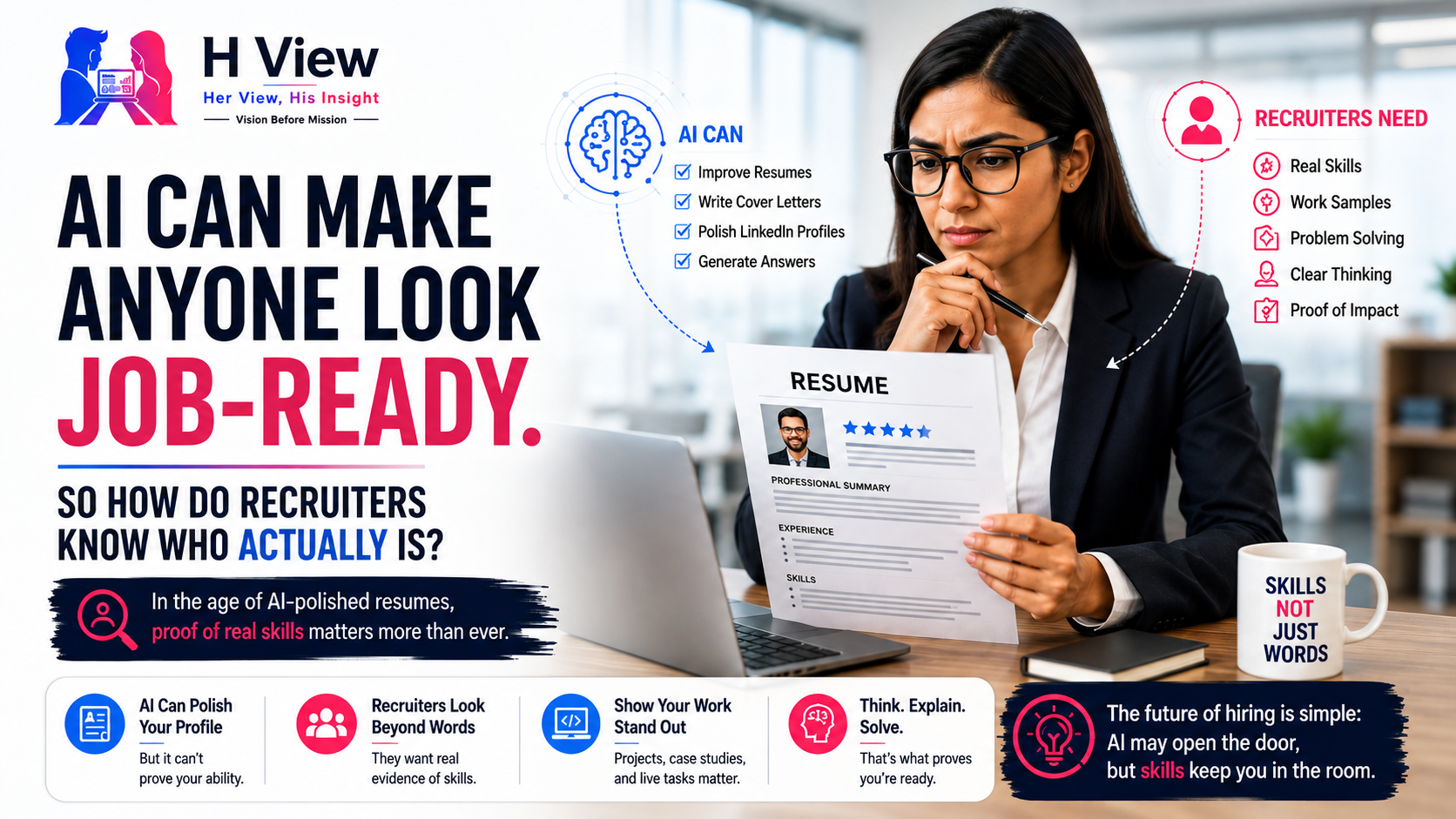
A student with little experience can now ask ChatGPT to rewrite a résumé, improve a cover letter, sharpen a LinkedIn headline, generate project descriptions, prepare interview answers, and even turn a weak portfolio into something that sounds surprisingly polished. None of this is necessarily dishonest. In many cases, AI is simply helping people communicate better. But it has created a new problem for recruiters: when almost everyone can look professional on paper, the résumé becomes less useful as proof that someone can actually do the job.
That is why hiring in 2026 is beginning to feel strangely old-fashioned in some places. Recent reporting from the Financial Times notes that CVs and cover letters are becoming less distinctive because generative AI can make applications sound equally polished, pushing some employers back toward recommendations, trusted networks and early skills demonstrations.
The question is no longer whether AI can help someone look job-ready.
It obviously can.
The more difficult question is how employers now tell the difference between a candidate who looks capable because of AI and one who is capable even when the AI is removed.
There is nothing inherently wrong with using AI to improve a résumé.
If a fresher has completed a genuine project but struggles to describe it clearly, asking AI to improve the wording may actually help the recruiter understand the candidate better. A developer who writes “worked on backend” can be guided to explain that they built REST APIs, handled authentication and connected the application to a database. The work is still theirs; the presentation is simply clearer.
The problem begins when presentation gets too far ahead of capability.
A candidate may ask AI to transform a basic college project into a description that sounds like enterprise software. A simple internship can suddenly appear to involve strategy, leadership and measurable impact. Even soft skills become polished into phrases such as “cross-functional collaboration,” “stakeholder management” and “data-driven decision-making,” whether the person has actually worked in those situations or not.
When hundreds of applicants do this, recruiters begin seeing the same language everywhere.
That creates a strange result. AI was supposed to help applicants stand out, but when everyone uses the same tools, it can make applications look more alike.
The résumé still matters, but it begins functioning more like an introduction than evidence.
AI has not only improved the quality of applications. It has made applying easier.
A job seeker can now tailor a résumé to a job description in minutes, generate a cover letter almost instantly and apply to far more roles than before. That can be useful for someone genuinely searching for opportunities, but at scale it creates enormous pressure on recruitment teams.
Recruiters may receive hundreds or thousands of applications for a single opening, many of them polished enough to pass a quick visual review. The challenge becomes identifying which applicants actually match the role rather than simply recognising who knows how to optimise a document.
The irony is that companies are now using AI to solve the problem partly created by AI.
LinkedIn’s Hiring Assistant, for example, can review large applicant pools, identify candidates whose skills and experience match the role, and help recruiters spend less time manually screening profiles. LinkedIn says its tools are increasingly built around real signals from its professional network, not only résumé keywords.
That means AI is operating on both sides of the hiring process.
Candidates use it to improve applications.
Recruiters use it to filter those applications.
The real hiring decision therefore moves further down the funnel, toward signals that are harder to manufacture.
If a résumé becomes easier to polish, actual work becomes more important.
For a developer, that could mean being able to open a project and explain why the database was designed a certain way, why one API structure was chosen over another, and what went wrong during implementation. For a marketer, it could mean showing a campaign, explaining the audience, describing what failed and discussing what would be changed next time. For a designer, it may involve walking through the thinking behind a portfolio rather than simply presenting beautiful screens.
This is where AI-generated polish begins to lose its advantage.
A candidate can ask AI to write:
“Developed a scalable full-stack application using React, Node.js and MongoDB.”
But if an interviewer asks why MongoDB was chosen, how authentication was implemented, what happened when two users updated the same record or how the application was deployed, the candidate needs actual understanding.
That is a much stronger hiring signal.
The same principle applies outside technical jobs. A person can use AI to prepare a convincing answer about conflict resolution, but a good interviewer can ask follow-up questions that reveal whether the example actually happened and what the candidate learned from it.
The future of hiring may therefore involve less trust in the finished answer and more interest in how the candidate arrived at it.
AI has also changed interview preparation.
Candidates can generate hundreds of likely questions for a role, ask AI to create ideal answers, conduct mock interviews and even receive feedback on how to respond. Used properly, this is excellent preparation. It can help nervous candidates understand what employers might ask and organise their thoughts more clearly.
But it also makes standard interview questions less useful.
Ask ten candidates, “What is your biggest weakness?” and many of them may now deliver polished variations of the same strategically safe answer. Ask, “Where do you see yourself in five years?” and an AI can produce something that sounds ambitious without sounding unrealistic.
Recruiters therefore have a reason to move toward more conversational interviews.
Instead of relying entirely on prepared questions, they can ask candidates to explain a decision, challenge an assumption or work through an unfamiliar problem. The goal is not to catch people out. It is to see how they think when the answer is not already sitting in a preparation document.
This can actually benefit genuine candidates.
A person who understands the work but is not naturally good at producing perfectly rehearsed answers may perform better in a conversation where reasoning matters more than performance.
Skills tests are an obvious response to AI-polished applications.
If a company wants a developer, it can ask the candidate to solve a small coding problem. If it needs a copywriter, it can ask for a short writing exercise. If it needs an analyst, it can provide a dataset and ask the candidate to explain what they notice.
The advantage is clear: employers see evidence of ability rather than relying only on claims.
But practical assessments can also become abusive if companies are not careful.
Candidates should not be expected to spend an entire weekend completing unpaid work that closely resembles a company’s real commercial project. A fresher applying to twenty roles cannot realistically complete twenty six-hour assignments. Good assessments should be short enough to respect the candidate’s time and focused enough to measure the skill that actually matters.
There is also a new complication: should candidates be allowed to use AI during the test?
The answer may depend on the job.
If employees will use AI every day after being hired, banning it completely during the assessment may create an unrealistic test. A more useful approach might be to allow AI and then evaluate whether the candidate can verify the output, explain the choices and improve what the system produces.
That measures something closer to modern job performance.
One of the simplest ways to distinguish knowledge from AI-assisted presentation is to ask candidates to explain their own work in depth.
Imagine a candidate claims to have improved a process by 30 percent. Instead of simply accepting the metric, the recruiter can ask how it was measured, what the original problem was, which part the candidate personally handled and what changed afterward.
If the answer is real, the conversation becomes richer.
If the statement was created mainly to make the résumé sound impressive, the details usually become difficult.
This does not require an aggressive interview style. In fact, good hiring conversations can become more human precisely because recruiters need to understand the person behind the polished profile.
Recent reporting suggests this shift is already happening in another form. As generic AI-assisted applications become harder to distinguish, some employers are placing more weight on personal recommendations and trusted referrals because another person is effectively putting their own reputation behind the candidate.
That solution has advantages, but it also creates a fairness problem.
Candidates with strong professional networks may gain more opportunities than equally capable people without those connections.
So the better long-term answer cannot simply be “hire through referrals.”
Companies need stronger ways to verify skill without turning hiring into a closed network.
Another change is happening in professional profiles.
Recruiters no longer have to rely entirely on a PDF résumé. Platforms such as LinkedIn can provide a broader set of signals: work history, skills, certifications, publications, recommendations, activity, and professional connections.
LinkedIn’s current Hiring Assistant uses profile information, résumés, skills, preferences and other signals to help recruiters identify candidates. The company also notes that AI outputs can be inaccurate, so recruiters are given information and sources that can be verified rather than being asked to trust an automated decision blindly.
This is important because the hiring future may be less about one perfect document.
A candidate’s credibility can emerge across several pieces of evidence: projects, recommendations, work history, public contributions, certifications and how clearly they can discuss their experience.
The résumé will probably remain.
It simply may not carry as much weight on its own.
This change could be especially difficult for fresh graduates.
An experienced professional can point to previous employers, completed projects and measurable outcomes. A fresher may have only college work, internships and personal projects. If recruiters become more suspicious of polished résumés, younger applicants need other ways to demonstrate ability.
That makes genuine projects increasingly valuable.
A small project built independently and explained well can tell an interviewer more than five certificates. A student who created a simple application, deployed it, encountered bugs and can explain how they fixed them has evidence of learning. The project does not need to look like a startup product.
What matters is whether the student understands it.
The same applies to non-technical careers. A marketing fresher could analyse a real brand’s campaign and present what they would improve. A finance student could build a small financial model. A design student could document the thinking behind a redesign.
The goal is not to manufacture more content for a portfolio.
It is to create something that gives the recruiter a genuine conversation to have.
Some employers may be tempted to solve the problem by detecting whether a résumé or application was written by AI.
That approach misses the bigger issue.
Using AI is not automatically dishonest. A candidate may have excellent skills and still use ChatGPT to improve grammar. Another may write everything manually and exaggerate their experience.
The real question is not who used AI.
It is whether the claims are true and whether the candidate can perform the work.
Trying to identify AI-written text may therefore become less useful than simply designing a hiring process that verifies capability.
If a candidate can explain the project, complete an appropriate assessment, reason through unfamiliar situations and communicate effectively, it matters much less whether AI helped polish the bullet points on the résumé.
That is a more realistic standard for 2026.
There is an uncomfortable side to this change for genuine candidates. When every résumé looks perfect, people who actually worked hard can begin feeling that their effort has been flattened into the same polished language as everybody else.
A fresher may spend months learning a skill, completing a real project and struggling through mistakes, only to see another candidate produce an impressive-looking application in an afternoon with AI. It can feel unfair.
But the deeper interview may actually restore some fairness. Real understanding usually becomes visible when someone is allowed to talk about the work naturally. Candidates should worry less about sounding perfect and more about being able to explain what they actually know, including the mistakes they made along the way.
From an employer’s perspective, the résumé is becoming a weaker filter but hiring itself does not need to become more complicated.
Recruiters can move evidence earlier in the process. A short work sample, a project walkthrough or a structured skill conversation can reveal far more than additional rounds of generic interview questions. AI can still help recruiters handle volume, but human judgement should become more valuable at the point where actual capability needs to be assessed.
The larger change is that hiring may move away from evaluating who produces the best application and toward evaluating who provides the strongest evidence.
That would be a healthier outcome.
AI has made professional presentation available to almost everyone.
That is not necessarily a bad thing.
A candidate should not lose an opportunity simply because they are poor at writing résumés or unfamiliar with corporate language. AI can help reduce that disadvantage by making communication easier.
But once everyone has access to the same polishing tools, presentation becomes less valuable as a differentiator.
The résumé may still open the door, but employers will increasingly want to know what exists behind it.
Can the candidate explain the work? Can they demonstrate a skill? Can they solve something unfamiliar? Can they recognise when AI is wrong? Can they make a decision without asking a model what to say next?
Those questions reveal something a perfectly written résumé cannot.
AI has made it easier to look employable.
The next stage of hiring will be about proving that the person behind the application actually is.
No. Using AI to improve wording, grammar or structure is not automatically dishonest. The problem begins when AI is used to invent experience, exaggerate responsibilities or describe skills the candidate does not actually possess.
Not reliably enough for that to be the main hiring strategy. AI-generated text can be edited heavily, and human-written text can sometimes appear formulaic. Employers are better served by verifying claims and assessing capability directly.
Yes. As applications become easier to polish, skills demonstrations, project discussions and work samples give employers additional evidence that a candidate can actually perform the role.
It depends on the role and the company’s rules. If AI is part of the actual workplace, some employers may eventually prefer assessments that test how effectively candidates use and verify AI rather than banning it completely.
Build genuine proof of ability through projects, internships, case studies or practical work related to the desired role. A smaller project that you understand deeply is often more useful in an interview than a sophisticated project you cannot explain.
Probably not. Résumés remain a useful summary of a candidate’s background, but employers may increasingly treat them as an introduction rather than sufficient evidence of capability.
Satya Hemanth is the founder of H View and writes on careers, sports, leadership, digital trends, and practical decision-making. His articles focus on clear explanations, real-world examples, and useful insights for students, young professionals, and everyday readers.
Share your real experience and help other readers decide better.
No community views yet. Be the first to share yours.
A few years ago, asking for the best AI for coding usually meant asking which…
Every year, Raksha Bandhan arrives with a familiar picture: a sister tying a rakhi around…
There is a particular kind of career uncertainty that many government-job aspirants understand very well.…
Samsung’s Fan Edition phones have always occupied an unusual place in the Galaxy lineup. They…