

Amazon Great Indian Festival 2026 Laptop Deals: Are the Discounts Really Worth It or Just Inflated MRP Marketing?
Every festive sale in India begins with the same visual language: giant discount percentages, crossed-out…
By Dr. A. Alimelu Annapurna
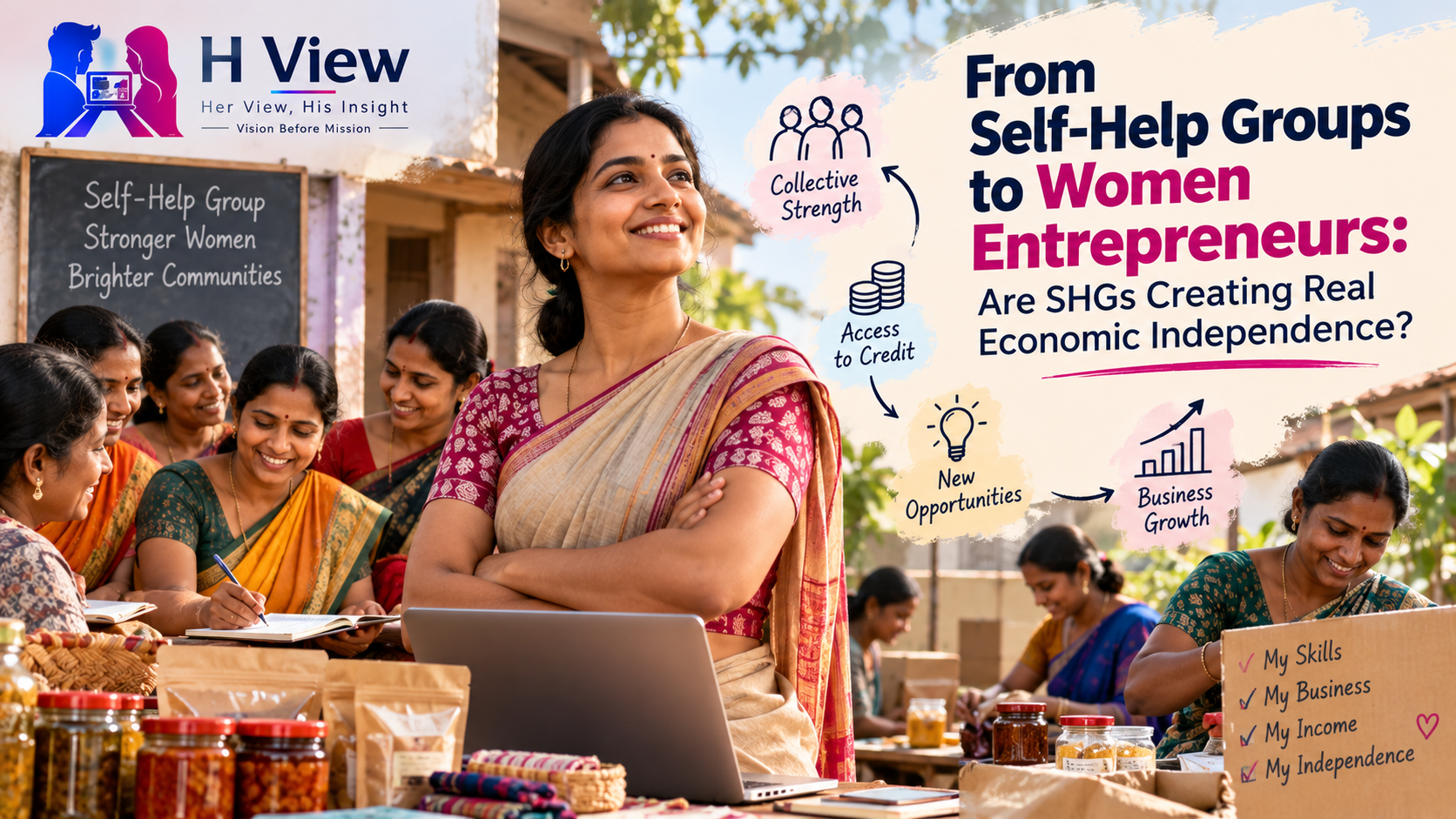
For millions of rural women in India, the first step toward entrepreneurship does not begin with a startup office, a business plan prepared for investors, or a large bank loan. It often begins with a small group of women sitting together in a village, saving modest amounts regularly, discussing household needs, and learning to trust one another with money. Over time, what begins as a savings group can become a gateway to credit, income generation, social participation, and eventually entrepreneurship.
India’s Self-Help Group movement has grown to a scale that few financial inclusion programmes anywhere in the world can match. By August 2026, more than 10.08 crore women had been mobilised into approximately 92.30 lakh Self-Help Groups under the Deendayal Antyodaya Yojana–National Rural Livelihoods Mission. These groups are no longer being viewed merely as informal savings circles; government policy increasingly treats them as platforms for financial inclusion, livelihoods, enterprise creation, and social development.
The numbers demonstrate extraordinary reach, but they also raise a more important question. Has participation in an SHG genuinely transformed women into economically independent entrepreneurs, or are many women still trapped at the stage of small loans, small activities, and limited growth?
That distinction matters because access to credit is only the beginning of economic empowerment. A woman may receive a loan, start producing pickles, garments, handicrafts, food products, or other goods, and contribute to household income. Yet real entrepreneurship requires something more: the capacity to make financial decisions, expand the enterprise, reach markets, adopt technology, manage risk, build customer relationships, access larger formal credit, and create an income stream that can survive beyond one loan cycle.
Before examining what remains incomplete, it is important to recognise what Self-Help Groups have achieved. SHGs have given women who may previously have had little interaction with formal banking an organised way to save, borrow, repay, discuss financial matters, and gradually develop confidence in handling money.
The SHG-Bank Linkage Programme pioneered by NABARD was designed precisely to bridge the gap between rural households and formal banking. Over time, the model has expanded beyond credit access and now plays a role in building financial, economic, social, and increasingly technological capacity among rural women. Government initiatives under DAY-NRLM have reinforced this model through revolving funds, community investment funds, financial literacy, enterprise finance, and links with banks.
Financial literacy has also become a much larger part of this ecosystem. During FY 2025–26 alone, more than 3.81 crore women SHG members received training in areas such as savings, credit, insurance, pensions, enterprise finance, and financial planning. This is an important development because financial inclusion should never be measured only by the number of accounts opened or loans sanctioned. A woman becomes more economically secure when she understands how to use financial products, evaluates credit carefully, maintains records, and makes informed decisions about business and household money.
The first loan can help a woman begin an economic activity, but starting an activity and building a sustainable enterprise are not the same thing. My own recent research on women entrepreneurs in East Godavari district illustrates this gap clearly.
A 2026 study covering 504 women entrepreneurs found that many respondents were still in the earliest stage of running their businesses. Microfinance played a major role in helping women enter entrepreneurship, while access to conventional formal banking remained more limited. Family support existed, but it was often not strong enough to remove the practical difficulties women faced. Despite these constraints, a significant proportion of respondents expressed a desire to expand their enterprises.
That gap between the desire to grow and the resources available to support growth deserves more attention than it currently receives. Women do not necessarily lack ambition. In many cases, they lack the next layer of support required after the first stage of entrepreneurship.
A woman may know how to make a good product but not know how to price it correctly. She may know how to sell within her village but not how to reach customers in a nearby town. She may repay a microfinance loan successfully but remain unable to access larger working capital. She may know how to produce but not how to package, brand, register, market, or sell digitally.
This is where the entrepreneurial journey frequently slows.
The strength of an SHG lies in collective trust. Members save together, support one another, create a repayment culture, and build a record that makes financial institutions more willing to extend credit. But a growing enterprise eventually requires capabilities beyond collective borrowing.
The transition can be understood in stages:
| Stage | What the woman gains | What she still needs |
|---|---|---|
| SHG participation | Savings habit, peer support and basic financial confidence | Continuous financial literacy |
| First credit linkage | Access to working capital | Guidance on productive use of credit |
| Income activity | Initial household earnings | Costing, pricing and bookkeeping |
| Microenterprise | Regular production and customers | Branding, packaging and market access |
| Growth stage | Higher demand and expansion ambition | Larger formal credit and technology |
| Sustainable enterprise | Stable income and stronger decision-making | Networks, digital markets and long-term business planning |
The table shows why the number of women belonging to SHGs cannot by itself tell us whether women have achieved economic independence. Membership is an important foundation, but the stronger indicator is whether women can successfully progress through these stages.
A livelihood activity is valuable even when it remains small. If a woman earns additional income through tailoring, dairy, food preparation, livestock, handicrafts, retail, or another activity, that income can improve household security and increase her role in financial decisions.
Entrepreneurship, however, normally involves a greater degree of continuity, planning, risk, reinvestment, market orientation, and growth. A sustainable entrepreneur thinks not only about today’s production but also about tomorrow’s customers, costs, competition, financing, and opportunities.
This distinction should not be used to undervalue small livelihood activities. Instead, it should help policymakers and development agencies identify which women want to remain at a livelihood level and which women are ready to move toward larger enterprise development.
Not every SHG member needs to build a large business. But every woman who has the capacity and ambition to grow should have a realistic pathway to do so.
The barriers are usually interconnected rather than isolated. My research and the broader literature on women entrepreneurship repeatedly point toward several practical difficulties that appear after the initial stage of enterprise creation.
Among the most common challenges are:
These difficulties explain why credit alone cannot produce sustainable entrepreneurship.
The SHG-bank linkage system has been successful precisely because it helped women who were previously considered difficult to lend to establish financial histories and collective repayment discipline. The next challenge is ensuring that successful SHG members can graduate into individual entrepreneurs with access to appropriate formal finance.
Policy is beginning to recognise this need. DAY-NRLM has encouraged dedicated bank products for individual women SHG members, including credit intended to help them establish new enterprises or expand existing ones. RBI guidance has also provided routes for eligible women in mature SHGs to access individual enterprise loans, while schemes such as MUDRA can provide another bridge between group borrowing and individual entrepreneurship.
This graduation process is crucial. If a woman repays loans consistently for years but remains permanently confined to very small credit limits, then the financial system is recognising her discipline without adequately rewarding her business potential.
Credit should grow alongside enterprise capacity.
There is a tendency to assume that lack of finance is always the largest problem facing women entrepreneurs. Finance is certainly important, but a business cannot repay even an affordable loan if it cannot find enough customers.
This is why marketing support should receive as much attention as credit linkage. Government efforts through Saras Aajeevika stores and e-commerce channels are attempting to bring SHG products into larger markets. During FY 2025–26, products manufactured by women SHGs generated turnover through both physical Saras Aajeevika stores and digital commerce platforms, demonstrating that organised market channels can help move products beyond local selling.
The next phase should make digital commerce much more accessible at the village level. Women do not necessarily need sophisticated websites when they begin. Training in product photography, WhatsApp Business, catalogue creation, QR payments, customer communication, packaging, and simple social-media promotion can already change the economics of a small enterprise.
Technology becomes meaningful when it increases income rather than simply becoming another training certificate.
Economic outcomes are important, but Self-Help Groups have another effect that is harder to measure. Women who regularly attend meetings, manage collective savings, interact with banks, make repayment decisions, travel outside their immediate household environment, and participate in community institutions often develop confidence that extends beyond business.
My earlier work on microfinance and SHGs in Andhra Pradesh examined this wider relationship between bank linkage and women’s economic, political, and social empowerment. The strength of the SHG model has always been that finance operates within a social institution rather than functioning as an isolated loan transaction.
A woman who previously hesitated to speak in a bank may eventually negotiate credit. Someone who rarely handled household money may begin maintaining group accounts. A woman who had never thought of herself as an entrepreneur may start employing another person or selling outside her village.
These changes matter even when the initial income is modest.
India has already demonstrated that women can be organised at scale. The next policy challenge is to ensure that large-scale organisation produces large-scale economic progression.
Support should therefore become more customised according to where each woman stands in her entrepreneurial journey. A new SHG member needs financial literacy and confidence, while an experienced microentrepreneur may require machinery finance, GST awareness, digital marketing, packaging assistance, or access to larger buyers.
A stronger model would combine four layers of support. Women need suitable finance, practical business capability, dependable market connections, and a social environment that gives them enough time and confidence to operate enterprises seriously.
The goal should be to move from SHG formation to enterprise formation, from enterprise formation to enterprise survival, and from survival to sustainable growth. Only then can we say that the financial inclusion journey has matured into economic empowerment.
For a woman entering an SHG, a small weekly saving may look insignificant from the outside, but it can represent the beginning of an entirely different relationship with money. The group can provide confidence, companionship, financial discipline, and the first opportunity to imagine earning independently. Yet women who demonstrate the willingness to grow should not remain permanently classified as micro-borrowers. They deserve access to knowledge, larger markets, technology, and finance that recognises them as entrepreneurs rather than merely beneficiaries.
Families, bankers, institutions, and male members of the community also have an important role in determining whether women’s businesses survive. Supporting women’s entrepreneurship does not mean simply approving a loan or allowing a woman to attend an SHG meeting. It means taking her enterprise seriously enough to share household responsibilities, encourage her to travel for markets or training, treat business income as something worth reinvesting, and recognise that the time she spends building an enterprise is productive work rather than an extension of household activity.
The Self-Help Group movement has already achieved something historic by bringing millions of rural women into organised savings, banking, credit, collective decision-making, and livelihood activity. With more than 10 crore rural women now associated with SHGs under DAY-NRLM, the scale of the platform is extraordinary.
The next measure of success, however, should not simply be how many groups exist or how much credit has been disbursed. We should ask how many women have moved from borrowing to building, from producing to marketing, from earning supplementary income to controlling sustainable enterprises, and from financial participation to genuine economic independence.
Self-Help Groups have successfully opened the first door for millions of women. India’s next challenge is ensuring that women who walk through that door find a clear road toward entrepreneurship on the other side.
Annapurna is an H View contributor covering relationships, family, lifestyle, entrepreneurship, and everyday decision-making. Her articles focus on emotional clarity, practical understanding, and human-centered perspectives that help readers think better about personal and professional situations.
Share your real experience and help other readers decide better.
No community views yet. Be the first to share yours.
Every festive sale in India begins with the same visual language: giant discount percentages, crossed-out…
There are festivals we celebrate for a day, and then there are festivals that gradually…
There is an unusual leadership problem that appears when an employee is preparing to leave…
Open LinkedIn for a few minutes and you will probably come across a colourful graphic…