

Best Digital Marketing Tools in 2026: What Marketers Actually Need and What They Can Skip
Open LinkedIn for a few minutes and you will probably come across a colourful graphic…
 Harika October 6, 2026
  By HarikaUpdated September 28, 202611 min read17 views
Most employees enter a workplace believing that good work will eventually speak for itself. They assume that solving difficult problems, meeting deadlines, supporting colleagues, and consistently delivering results will naturally lead to recognition and career growth. In healthy organisations, that belief is largely justified because contribution, reliability, and capability are visible in the way people are evaluated.
The problem begins when visibility starts carrying more weight than contribution. Some employees spend most of their energy doing the work, while others spend more time making sure senior leaders know they were involved in the work. Over time, the difference becomes important because organisations do not always reward what happened; they often reward what leadership remembers happened.
That is where workplace politics becomes dangerous. The issue is not simply that some employees know how to communicate better or build stronger professional relationships. The issue is when people learn that appearing valuable is more rewarding than actually creating value, and when management allows that pattern to continue unchecked.
When that happens, hardworking employees do not always fight loudly. Many simply become quieter, stop over-contributing, and eventually decide that leaving is easier than constantly competing with a political system they never wanted to play.
The phrase “workplace politics” usually creates an immediate negative reaction. People imagine gossip, credit stealing, favouritism, secret alliances, and employees trying to impress senior leaders while avoiding difficult work. Those behaviours certainly exist, but workplace politics is broader than that.
Every organisation has informal influence. Some people have better access to decision-makers, some understand how senior leaders think, and some are naturally better at presenting their work. Professional relationships, communication, visibility, and internal reputation all influence career outcomes, even in organisations that genuinely want to be fair.
The problem is therefore not visibility itself. Employees should communicate their work, build relationships, and make their achievements understandable. The problem begins when visibility becomes disconnected from contribution.
An employee who delivers strong results and communicates them clearly is not playing unhealthy politics. An employee who repeatedly positions themselves as responsible for work completed by others, dominates meetings without contributing to execution, or becomes visible mainly by attaching themselves to successful projects creates a different problem entirely.
Many technically strong and hardworking employees make one career assumption that can become costly: they believe managers will automatically know how much effort and responsibility went into the final result. In reality, managers often see only part of the work.
Complex projects contain invisible labour. Someone may spend hours solving a technical failure, coordinating with multiple teams, correcting mistakes, helping a junior employee, documenting decisions, and handling unexpected problems. When the final project update reaches leadership, all of that effort may be reduced to a few lines on a presentation.
This creates an uncomfortable gap between contribution and perception.
| Contribution-Focused Employee | Visibility-Focused Employee |
|---|---|
| Spends most of the time solving the problem | Spends significant time communicating involvement |
| Assumes results will be noticed naturally | Actively ensures leadership sees the work |
| Often takes on invisible support work | Often prioritises visible responsibilities |
| May avoid discussing personal achievements | Regularly communicates achievements and progress |
| Can become overlooked despite strong delivery | Can appear highly valuable even with limited execution |
| Builds credibility through work | Builds credibility through perception and relationships |
Neither side of this comparison should automatically be treated as right or wrong. The healthiest professionals learn to combine strong contribution with clear communication. The organisational problem appears when perception consistently becomes more valuable than substance.
Employees who are deeply focused on their work often dislike political behaviour because it feels unnecessary or artificial. They may believe that constantly highlighting their contribution sounds like self-promotion, while building relationships with influential people purely for career benefit feels uncomfortable.
As a result, they stay close to the work and away from organisational positioning. They fix the issue, finish the report, train the new employee, handle the client escalation, and move to the next responsibility. Meanwhile, someone else may present the progress, participate more actively in leadership discussions, and become associated with the success.
This does not necessarily mean that the visible employee is dishonest. Sometimes they are simply better at communicating. The danger arises when the person who contributed less gradually receives more influence, recognition, or opportunity because leadership sees only the most visible layer of the project.
Hardworking employees eventually notice this gap. At first, they may tell themselves that consistency will be recognised later. If the pattern repeats, however, motivation begins to change.
Employees rarely resign because of one missed compliment. The deeper issue develops when contribution and recognition remain disconnected for too long.
A capable employee may continue carrying difficult responsibilities while another person receives more visibility. They may see colleagues promoted because they are better connected, hear their ideas repeated later by someone else, or watch their work being presented without proper acknowledgement. None of these events may be enough to trigger resignation individually.
Together, they create a message.
The employee starts believing that working harder will not change the outcome because the system rewards something different. Once that belief takes hold, engagement often declines before the resignation letter appears.
Employees begin doing what is required rather than what they are capable of doing. They stop volunteering for difficult work, reduce informal support, and become less emotionally invested in the organisation. By the time management notices the change, the employee may already be mentally preparing to leave.
Workplace politics survives because organisations reward certain behaviours, intentionally or unintentionally. Employees observe what leads to promotions, recognition, access, and influence, and then adjust accordingly.
If people who speak the most in meetings are repeatedly treated as the strongest contributors, employees learn that visibility matters. If managers accept project updates without understanding who actually completed the work, employees learn that ownership can be claimed rather than earned. If leaders regularly favour people who agree with them, employees learn that alignment is safer than honesty.
Culture is therefore shaped less by what companies say and more by what leaders reward.
A company may promote values such as collaboration, transparency, and merit, but employees will quickly recognise the real system. If political positioning repeatedly produces better outcomes than genuine contribution, talented employees either adapt to that system or eventually leave it.
Hardworking employees should not respond to this problem by becoming manipulative. The better approach is to understand that communicating contribution is part of professional responsibility.
There is nothing wrong with making work visible when it is done accurately and respectfully. Employees can share progress, document decisions, summarise achievements, and clearly explain their role without taking credit from others.
Healthy visibility usually includes several habits:
These behaviours do not turn an employee into a political player. They reduce the risk that strong work becomes invisible.
Managers also need to recognise that confident communication can sometimes distort performance assessment. Employees who speak clearly, present well, and participate actively in meetings are easier to remember. That visibility can unconsciously influence how managers evaluate performance.
A quieter employee may be doing more difficult work while receiving less attention. Another employee may be excellent at presenting progress while depending heavily on others behind the scenes. Good leaders look beyond presentation style and ask where the actual value was created.
This requires curiosity. Managers need to understand who solved the difficult problems, who consistently supported the team, who carried the hidden work, and who genuinely improved outcomes. Performance reviews should therefore rely on evidence, not simply impressions.
One of the fastest ways to destroy trust is allowing employees to take credit for work they did not meaningfully contribute to. The person whose effort is overlooked does not only lose recognition; they begin questioning whether the organisation is capable of evaluating people fairly.
Credit stealing can happen subtly. Someone may present a team idea as their own, speak on behalf of work completed by another colleague, or position themselves as the owner of a successful outcome because they were present in the final discussion.
Managers sometimes overlook these situations because the work itself was completed successfully. That is short-sighted.
If employees repeatedly see contribution separated from recognition, collaboration becomes risky. People become more protective of information, less willing to help colleagues informally, and more focused on proving individual ownership. The organisation then loses exactly the teamwork it claims to value.
For many hardworking employees, the most discouraging part of workplace politics is the feeling that doing the job well is no longer enough. They begin wondering whether they also need to constantly promote themselves, build strategic alliances, or manage personalities simply to receive fair recognition.
That frustration is understandable. Employees should not have to manipulate relationships to protect their careers. At the same time, remaining completely invisible can create another problem because organisations cannot recognise what they do not clearly understand.
The healthier middle ground is professional visibility. Employees can communicate achievements, maintain documentation, and build genuine relationships without becoming political. The goal is not to learn how to “play the game,” but to make sure the truth about their contribution does not disappear inside it.
Employees should learn to communicate value, but the larger responsibility still belongs to leadership. A healthy organisation cannot expect every hardworking employee to become an expert in self-promotion simply to receive fair treatment.
Managers should know enough about the work to distinguish contribution from presentation. They should ask who completed the difficult parts, who supported others, and who created measurable impact. They should also make recognition visible and ensure that credit follows contribution.
When leaders do this consistently, employees no longer feel that political skill is necessary for survival. Visibility still matters, but it becomes a way of communicating contribution rather than replacing it.
The warning signs are often visible before resignation. Strong employees may become quieter, stop volunteering, reduce informal support, or become more transactional in their communication. Leaders should not immediately interpret this as laziness or a decline in attitude.
Sometimes it is disappointment.
Managers can reduce that risk by creating clearer performance evidence, discussing contribution during reviews, recognising invisible work, challenging credit-taking behaviour, and ensuring opportunities are not repeatedly given only to the most visible personalities. None of these changes require expensive systems; they require more attentive leadership.
The goal is simple: employees should understand that excellent work will be recognised even if they are not the loudest person in the room.
Workplace visibility is not inherently political. Employees need to communicate, build professional relationships, and make their work understandable. Those skills are part of modern career development.
The problem begins when visibility becomes more valuable than contribution.
When employees see that impressions, alliances, and presentation repeatedly outweigh real work, they eventually stop believing that effort will be evaluated fairly. Some adapt by becoming more political themselves, while others disengage and start looking for an environment where contribution carries more weight.
Neither outcome is good for the organisation.
The healthiest workplaces create a balance where good work is visible, recognition is evidence-based, and employees do not have to compete for attention simply to prove they matter. Strong employees should learn to communicate their value, but strong leaders must build systems where contribution remains the foundation of credibility.
When organisations fail to protect that balance, they may keep the people who understand workplace politics best while quietly losing the people who were doing some of the most important work.
Hardworking employees can become overlooked when much of their contribution happens behind the scenes and they do not communicate their achievements clearly. Managers may unintentionally remember employees who are more visible in meetings, presentations, or leadership discussions. This is why organisations need evidence-based performance evaluation rather than relying only on impressions.
Workplace visibility is not automatically office politics. Healthy visibility means communicating progress, documenting achievements, and building professional relationships honestly. Workplace politics becomes unhealthy when perception is deliberately manipulated, credit is taken unfairly, or relationships are used to gain advantage without corresponding contribution.
Employees should communicate their achievements accurately and professionally because managers cannot always see every aspect of the work. The objective should not be constant self-promotion, but making outcomes, responsibilities, and contributions clear enough to be evaluated fairly.
Employees often leave when they repeatedly feel that effort, competence, and contribution are less important than influence, visibility, or personal relationships. Over time, this creates a sense that career growth is disconnected from performance, which can reduce motivation and trust in the organisation.
Managers can reduce unhealthy politics by using clear performance criteria, documenting contribution, recognising shared effort, challenging credit-stealing behaviour, and providing employees with equal opportunities to communicate their work. Leaders also need to understand what happens behind the final presentations and project updates.
Yes. Professional networking can simply mean building genuine relationships, understanding other teams, communicating clearly, and making it easier for people to collaborate. Networking becomes political when relationships are used primarily to manipulate perceptions, exclude others, or gain unfair advantage.
Harika is the co-founder of H View and covers AI, technology, gadgets, digital tools, online platforms, and modern internet trends. Her articles focus on simplifying complex topics with practical explanations, balanced opinions, and reader-first insights.
Share your real experience and help other readers decide better.
No community views yet. Be the first to share yours.

Open LinkedIn for a few minutes and you will probably come across a colourful graphic…
Harika October 6, 2026 
When an employee resigns, many organisations move quickly into replacement mode. The manager informs HR,…
Harika October 6, 2026 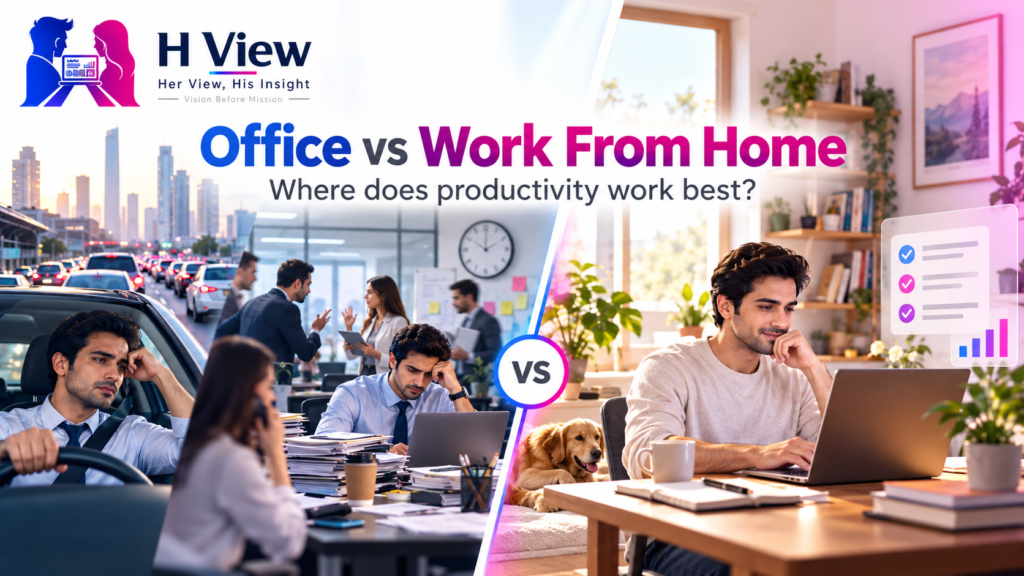
For many corporate employees, the workday begins long before they actually start working. They wake…
Harika October 5, 2026 
Many projects begin with an assumption that sounds reasonable on paper: the client will explain…
Harika October 1, 2026