

Best Digital Marketing Tools in 2026: What Marketers Actually Need and What They Can Skip
Open LinkedIn for a few minutes and you will probably come across a colourful graphic…
 Harika October 6, 2026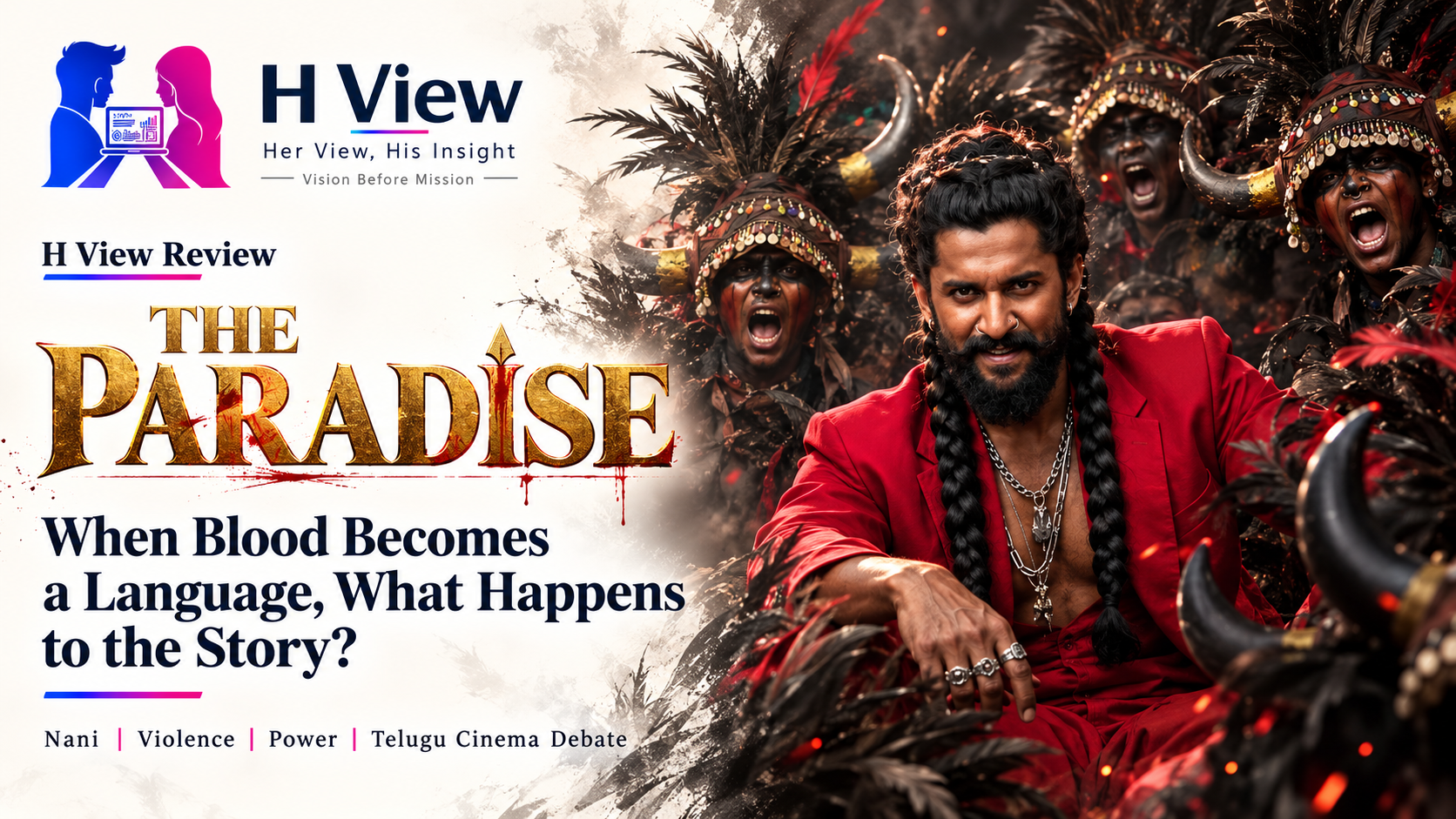
 By Satya HemanthUpdated September 25, 202616 min read18 views
Spoiler Warning: This review discusses the film’s themes, violence, characters, narrative structure, and broader social questions in detail.
There is no denying that The Paradise arrives with ambition. Srikanth Odela had already shown with Dasara that he could build a distinctive world, bring authenticity to a marginalised setting, and extract a physically committed performance from Nani. With The Paradise, that ambition becomes much larger. The scale is broader, the visual language is harsher, and the social world being explored carries more weight.
Set in 1980s Secunderabad, the film centres on Jadal, played by Nani, and the Savaari community, who are portrayed as people living without legal identity or basic rights under the oppressive rule of Shikanja Malik, played by Mohan Babu. The setting immediately gives the film serious dramatic potential because it brings together questions of identity, social hierarchy, power, marginalisation, humiliation, and resistance.
Yet after watching the film, the biggest question for me was not simply whether The Paradise is good or bad. The more important question is why blood has become such a dominant cinematic language in sections of today’s commercial cinema. That question becomes even more uncomfortable when we ask whether filmmakers can create an equally powerful theatrical experience without repeatedly depending on extreme violence, vulgarity, humiliation, and the suffering of women as shortcuts for intensity.
Nani is perhaps the biggest reason the film remains engaging even when the screenplay begins to struggle. His transformation into Jadal is not simply a change of costume, hairstyle, or physical appearance. The body language, beard, gait, and overall physicality communicate someone who has been shaped by a harsh and oppressive environment.
That commitment is visible throughout the film. Nani deliberately moves away from the softer and more restrained image associated with many of his earlier performances and embraces a far more physical character. The problem is that the screenplay does not always give Jadal enough emotional depth to match the effort of the performance.
This becomes important because physical transformation alone cannot carry a character indefinitely. A performer can give us rage, pain, energy, and intensity, but the writing still has to tell us what lies beneath those emotions. If Jadal is to represent not only an individual but also the anger of a marginalised community, the screenplay needs to give us more access to the person inside that rebellion.
The familiar structure of oppression, humiliation, awakening, resistance, and bloodshed is not inherently a weakness. Telugu and Indian cinema have used variations of that structure many times. The difficulty is that a familiar framework requires particularly strong character writing if it is going to feel fresh. Without that emotional specificity, even a technically impressive performance can begin to feel trapped inside a template.
Mohan Babu’s presence naturally brings weight to the film. Shikanja Malik is positioned not simply as an individual villain but as a representation of domination and a larger oppressive system. That idea gives the character considerable potential, but the film does not explore him as deeply as it could have.
A memorable antagonist does not become frightening only because he is capable of violence. The strongest villains are often disturbing because we understand their ideology, psychology, and relationship with power. They reveal how systems of oppression reproduce themselves and why the people within those systems continue to protect them.
The Paradise could have spent more time exploring that aspect of Shikanja Malik. If the film had examined how power becomes normalised, how fear is maintained, and how one man’s authority becomes accepted by an entire structure around him, the antagonist could have become more unsettling without requiring additional brutality.
In fact, a psychologically stronger villain might have made the film more disturbing with less blood. That would have increased the emotional stakes because the audience would not only fear what Shikanja Malik does; they would begin to understand the machinery that allows him to do it.
This is where my review moves beyond The Paradise itself.
The film received an A certificate, and reports around its certification discussed multiple modifications involving violent visuals, bloodshed, torture, dialogue, and related material. Nani also acknowledged before release that the film contains a high degree of violence, while arguing that the violence exists inside a larger drama involving emotion, love, and strong characters.
That defence deserves to be taken seriously. Violence can absolutely be legitimate storytelling. If a film deals with oppression, crime, war, revenge, or social brutality, removing all physical violence can make the world feel dishonest.
The real question is therefore not, “Why is there violence?”
The real question is whether every act of violence continues to serve the story.
A powerful violent scene can shock us because it reveals something we did not previously understand about a character or a situation. Another scene may create fear, establish the cruelty of an antagonist, or show the emotional breaking point of a protagonist. But when a film repeatedly escalates through blood, torture, killings, and revenge without adding a new emotional dimension, the audience can gradually stop reacting.
That is when violence becomes background noise.
The first brutal scene may disturb us. The fifth may still affect us. By the time the film reaches another extended confrontation, however, the viewer may no longer feel horror or sadness. The reaction becomes mechanical: another fight has arrived.
Once that happens, the technical execution may still be impressive, but the emotional purpose has weakened.
The CBFC question also deserves more nuance than simply asking why such a film was allowed.
India already has a certification framework under the Cinematograph Act and the Cinematograph (Certification) Rules, and the board considers the overall impact of a film rather than merely counting the number of violent scenes. Its published guidelines address violence, vulgarity, degrading portrayals, and the treatment of women, while also acknowledging the need to protect artistic freedom.
An A certificate, however, is not a certificate of artistic necessity.
It simply means that the film is restricted to adult audiences.
That distinction matters because a creative decision can be legally certifiable and still be open to artistic criticism. The presence of an A rating does not automatically answer whether every violent sequence was necessary, whether the portrayal of women was meaningful, or whether the film could have communicated its themes more effectively through character and writing.
So the more productive conversation is not whether the censor board should eliminate violent cinema. It is whether filmmakers themselves are questioning the purpose, proportion, and emotional effect of the violence they choose to show.
The 2000s should not be romanticised as a perfect period. Telugu cinema had plenty of violence, misogyny, stalking presented as romance, vulgar comedy, and problematic portrayals of women.
But the commercial space also contained a noticeable range of tones.
Action could coexist with comedy, family drama, romance, emotion, social themes, and character-driven storytelling. A hero could establish his personality through dialogue rather than only through a brutal entry sequence. A villain could become memorable because of intelligence, manipulation, or presence rather than simply because he killed more people than anyone else.
A confrontation could stay with audiences because of the words exchanged between two characters. Emotional stakes did not always need to be accompanied by blood, screaming, and deafening sound design.
Today’s Telugu cinema has certainly not lost all of that variety, but ultra-violent action has become a powerful commercial trend. That makes The Paradise part of a much broader industry conversation.
The question should not be framed as an attack on young filmmakers or as a complaint that one generation does not understand cinema. That would be unfair and inaccurate. The more useful question is why a section of commercial cinema increasingly treats physical brutality as the primary evidence of intensity.
Can a hero still look powerful without destroying twenty men?
Can a villain still terrify us through ideology, manipulation, or psychological control?
Can a film make us uncomfortable through silence, dialogue, or moral conflict?
Those are not nostalgic questions. They are questions about writing.
One of the more frustrating patterns in Indian commercial cinema is the repeated use of women’s suffering as a storytelling shortcut. A woman is humiliated, threatened, abused, or killed, and the primary narrative consequence is that the male protagonist now has a reason to become violent.
The problem is not that such events can never exist in a story. The problem is what happens to the woman as a character after the event occurs.
Too often, she stops being a person and becomes a device.
Her pain does not lead to her own emotional journey, choices, anger, agency, or consequences. Instead, her suffering becomes the emotional fuel for a male hero’s revenge. That pattern deserves criticism because it reduces women to narrative triggers rather than allowing them to exist as fully written characters.
The Paradise participates in a larger cinematic environment where this tendency remains common. That makes the question important: does a film show a woman’s suffering because it genuinely wants to explore her reality, or because it needs an easy reason to intensify the hero’s anger?
Those are very different creative choices.
This is where The Paradise becomes particularly frustrating because the film has serious material at its centre.
Marginalisation, identity, social hierarchy, oppression, power, and resistance are not small themes. They are capable of producing genuinely powerful cinema because they affect how people live, how communities are treated, and how institutions decide whose lives matter.
The problem is that the spectacle sometimes begins to dominate those subjects.
When violence becomes repetitive, the suffering of the community can gradually turn into visual background for the hero’s elevation. The audience may remember the brutality of a sequence more clearly than the people whose oppression was supposed to give that violence meaning.
That distinction is crucial.
A violent scene should generate an emotional response connected to the story. It should make us feel anger, fear, sadness, disgust, empathy, or shock because we understand what the violence means to the people involved.
If the reaction eventually becomes, “Here comes another fight,” the filmmaker may have won the technical battle but lost the emotional one.
It would be unfair to discuss The Paradise only through criticism of its violence because the film has substantial technical ambition.
The production design creates a convincing period environment, and the cinematography contributes strongly to the harsh visual identity of the world. The action choreography demonstrates considerable effort, while Anirudh Ravichander’s music and background score contribute to the scale of the presentation.
The actors are committed, the visual canvas is large, and the film clearly wants to build a world rather than merely place characters inside generic locations.
Ironically, these strengths make the weaknesses in the writing more noticeable. The film sometimes looks larger than the story feels.
When the technical departments are operating at such a high level, audiences naturally expect the screenplay to provide equally strong emotional architecture. A visually spectacular world becomes far more memorable when the writing gives us characters we deeply understand and relationships we genuinely care about.
Calling a film simply good or bad often removes the most interesting part of criticism.
The Paradise has several things worth appreciating. Nani’s commitment is visible throughout the film. The production design and cinematography create a distinctive world. The action has technical strength, and the decision to place marginalisation and social exclusion at the centre of a large commercial film is itself significant.
At the same time, those strengths coexist with real weaknesses.
The screenplay often relies on familiar machinery. Supporting characters do not always receive enough development. The second half can feel less controlled, and the repeated violence risks overpowering the emotional material. Female characters also deserve greater narrative depth than simply functioning around the hero’s journey.
That is why the film feels less like a failure and more like a missed opportunity. The material was capable of becoming something deeper.
Technology has given modern filmmakers extraordinary possibilities. Computer graphics can create destruction on an enormous scale. Prosthetics and make-up can make wounds look frighteningly real. Cameras can move through action sequences in ways that would have been far more difficult twenty years ago, while sound design can turn every impact into a theatrical event.
But none of that automatically creates great cinema. Technology can show us a wound. Writing makes us care about the person who receives it. That difference is everything.
Cinema becomes powerful not simply when a character dies, but when the audience understands what that death means. A fight becomes memorable not because the choreography is complicated, but because the conflict represents something emotionally important to the characters.
The tools available to filmmakers are becoming more sophisticated every year. Our expectations from the writing should rise at the same time.
Filmmakers do not create movies in isolation. Audience behaviour shapes the industry.
If the most violent scenes receive the loudest reactions in theatres, producers notice. If brutal hero-entry sequences dominate social media clips, marketing teams notice. If trailers filled with violence consistently receive more engagement, the industry learns what audiences appear to reward.
That means responsibility cannot belong entirely to directors. We are part of the ecosystem too.
If audiences genuinely want stronger female characters, we have to support films that give women meaningful roles. If we want intelligent action, we have to appreciate action that grows naturally from the narrative. If we want less vulgarity, we cannot simultaneously treat every vulgar moment as the easiest source of entertainment.
Most importantly, if filmmakers choose to tell stories about marginalised communities, audiences should expect those communities to receive real stories rather than simply becoming dramatic backgrounds for the elevation of a hero.
For me, the most uncomfortable part of The Paradise is not that the film contains violence. It is the possibility that violence sometimes becomes easier for the film to communicate than emotion.
When a story is dealing with people who have been denied dignity, identity, and power, the strongest response should not simply be excitement when the hero finally becomes brutal enough to fight back. The audience should understand what that oppression has done to the community, to families, to women, and to the protagonist as a human being.
I wanted more of that emotional depth.
The film gave me images I could remember, but I wanted more relationships and character moments that would stay with me after those images faded.
Commercial cinema has every right to be loud, violent, spectacular, and entertaining. There is no reason every action film should become quiet or realistic.
The real challenge is balance.
A mass film can still have thoughtful writing. A violent film can still be emotionally intelligent. A commercial entertainer can still give women meaningful agency, create psychologically interesting villains, and explore social issues without reducing them to visual decoration.
The strongest cinema does not force us to choose between entertainment and writing. It gives us both.
The Paradise is technically ambitious, visually striking, and anchored by a committed performance from Nani. Srikanth Odela clearly knows how to create atmosphere, scale, and raw cinematic energy. The film also deserves credit for building a commercial story around marginalisation, social exclusion, and resistance rather than relying on an entirely conventional backdrop.
But the movie also raises a concern that extends beyond itself.
When does intensity become excess? When does violence stop serving the story? When does a serious social issue become simply another setting for mass entertainment? And when will commercial cinema trust its writers enough to believe that audiences can be held by emotion, character, tension, and ideas without constantly demanding another escalation in brutality?
The answer is not that cinema should become bloodless. Some stories genuinely require violence, especially stories dealing with war, crime, oppression, or social brutality. Sanitising those worlds can be just as dishonest as exploiting them.
The real question is proportion and purpose.
A film should not be criticised simply because violence exists. It should be questioned when violence begins replacing character, when humiliation becomes an easy substitute for emotional depth, or when spectacle becomes more important than the people whose suffering created the story.
That responsibility belongs to writers, directors, producers, actors, certification bodies, and ultimately to audiences as well.
Cinema does not only reflect what society already enjoys. It also gradually teaches audiences what to accept as entertainment.
So after watching The Paradise, my question is not whether Srikanth Odela should have made a violent film. He had every right to tell this story in the cinematic language he chose.
My question is simpler.
If tomorrow’s filmmakers have better cameras, bigger budgets, stronger technology, larger markets, and access to global audiences, should we not also expect stronger stories?
Blood can shock us. Violence can excite us. Vulgarity can provoke us.
But great storytelling is what stays with us long after the theatre becomes silent.
And that is the kind of paradise I would like Telugu cinema to build next: not cinema without violence, not cinema without difficult subjects, and certainly not cinema without commercial entertainment, but cinema in which violence serves the story rather than a story existing mainly to justify the violence.
The Paradise is worth watching for viewers who appreciate technically ambitious cinema, strong performances, intense world-building, and large-scale action. Nani’s physical transformation, the production design, cinematography, and overall atmosphere are among the film’s biggest strengths. However, viewers who prefer character-driven storytelling over repeated violence may find parts of the film emotionally exhausting.
The film uses violence to portray oppression, power, marginalisation, rebellion, and revenge. The issue is not simply that violence exists, but whether every violent sequence adds something new to the story. In several places, the repetition of bloodshed risks reducing its emotional impact rather than strengthening it.
Nani gives one of the film’s strongest performances. His transformation into Jadal is visible through his body language, gait, appearance, and physical intensity. The limitation comes more from the screenplay than from the performance, because the character does not always receive enough emotional depth to fully match Nani’s commitment.
Mohan Babu brings considerable screen presence to Shikanja Malik, but the character could have been explored more deeply. The role represents a larger system of power and oppression, yet the screenplay spends less time examining the antagonist’s psychology, ideology, and relationship with power than the character potentially deserved.
Yes. The review draft notes that The Paradise received an A certificate from the CBFC and that certification reports discussed changes involving violent imagery, bloodshed, torture, dialogue, and other material. An A certificate restricts the film to adult audiences, but it does not automatically mean every violent or controversial creative choice is artistically necessary.
The biggest weakness is that spectacle sometimes overwhelms the emotional material. The film deals with important themes such as marginalisation, identity, social hierarchy, oppression, and resistance, but repeated violence and familiar commercial storytelling patterns can reduce the impact of those themes.
H View sees The Paradise as a technically ambitious film rather than a complete failure. Nani’s performance, the visual world, production design, and scale deserve appreciation, but the screenplay could have offered stronger character development and more emotional depth. The larger concern is whether violence sometimes becomes a substitute for better writing.
Satya Hemanth is the founder of H View and writes on careers, sports, leadership, digital trends, and practical decision-making. His articles focus on clear explanations, real-world examples, and useful insights for students, young professionals, and everyday readers.
Share your real experience and help other readers decide better.
No community views yet. Be the first to share yours.

Open LinkedIn for a few minutes and you will probably come across a colourful graphic…
Harika October 6, 2026 
When an employee resigns, many organisations move quickly into replacement mode. The manager informs HR,…
Harika October 6, 2026 
For many corporate employees, the workday begins long before they actually start working. They wake…
Harika October 5, 2026 
Many projects begin with an assumption that sounds reasonable on paper: the client will explain…
Harika October 1, 2026