

Best Digital Marketing Tools in 2026: What Marketers Actually Need and What They Can Skip
Open LinkedIn for a few minutes and you will probably come across a colourful graphic…
 Harika October 6, 2026
  By HarikaUpdated September 20, 202612 min read22 views
Artificial intelligence has changed software development faster than many companies expected. A developer can now generate boilerplate code in minutes, create a first version of a UI much faster, debug unfamiliar code with help, draft APIs, explore architecture choices and even build working prototypes in a fraction of the time that purely manual development once required.
That improvement is real. The problem begins when management interprets “faster” as “almost immediate.”
Once AI enters the development process, some teams begin to expect every feature, revision and full project to move at the same speed as the first prototype. If a developer creates a working foundation quickly, management may assume the entire product should be ready within days. If AI credits are purchased for the initial stage, those credits may even be treated as though they were the complete budget for the finished application.
That misunderstanding creates a new kind of pressure inside software teams. The developer is no longer compared only against a traditional development estimate. They are compared against an imaginary version of AI development in which requirements are always clear, generated code is always correct, integrations work immediately, testing is automatic and clients never change their minds.
Real software development does not work that way.
The most important distinction for managers to understand is that software development and code generation are not the same thing.
AI is extremely useful at generating code. It can create forms, components, validation logic, API structures, database queries, scripts and documentation much faster than a developer starting from a blank file. It can also help an experienced developer explore unfamiliar technologies and identify potential causes of bugs without spending hours searching manually.
But code is only one part of delivering a working software product.
A development team still needs to understand the business requirement, decide how the system should behave, identify what data is required, define user permissions, connect external services, handle edge cases, test what has been built and deploy it into an environment where real users can safely use it.
The workflow may become faster with AI, but it still exists.
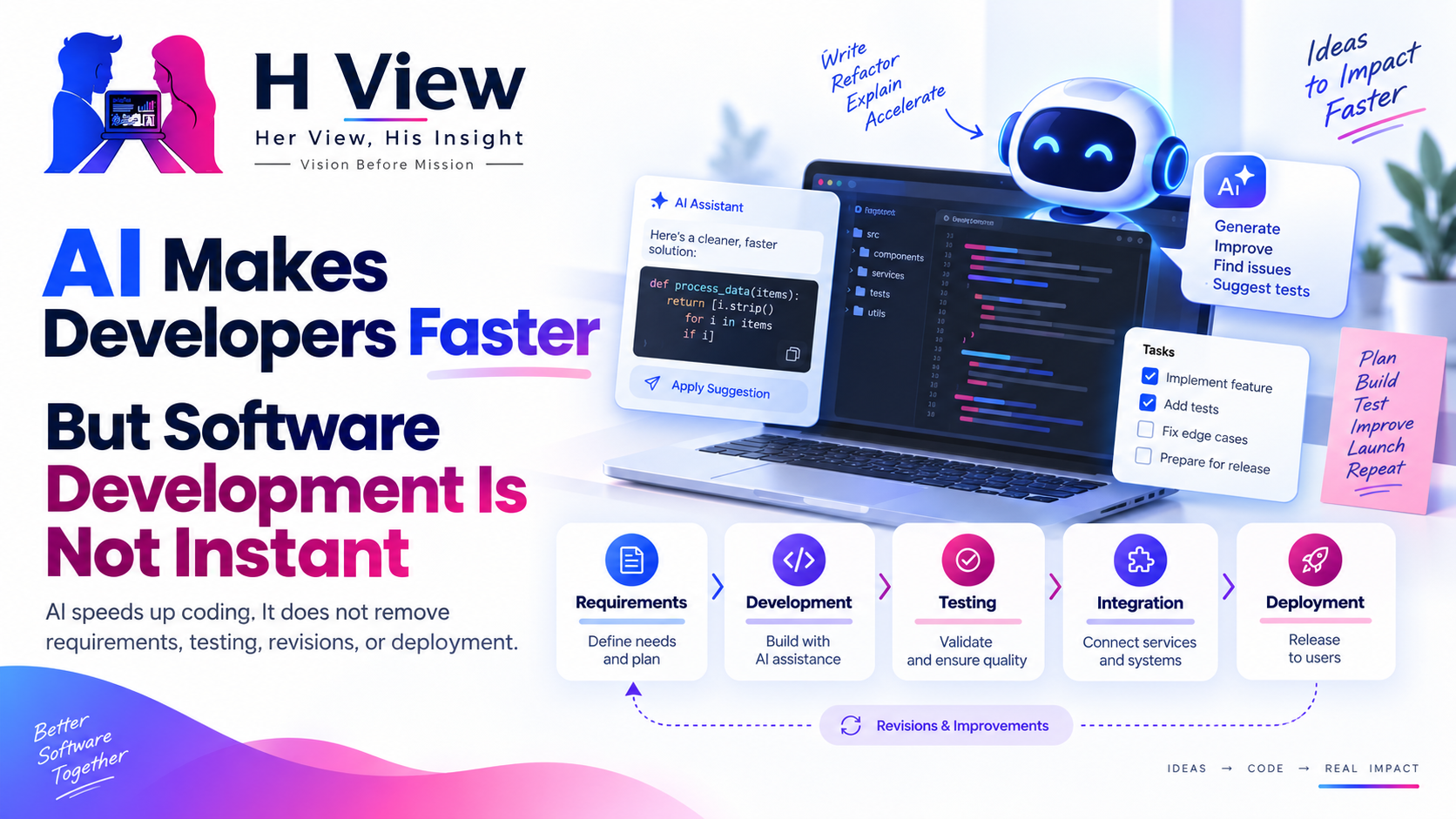
A realistic AI-assisted delivery process can look like this:
Requirement understanding → Technical planning → AI-assisted development → Developer review → Integration → Testing → Bug fixing → Rework → User acceptance → Deployment
AI may reduce the time required in several of these stages, particularly development and debugging, but it does not automatically remove the other stages.
That is why a manager who asks, “Why is this taking so long when you are using AI?” may be asking the wrong question. A better question is, “Which part of this process is AI accelerating, and which parts still depend on people, decisions, testing and external systems?”
One reason this misunderstanding happens is that AI can produce impressive first results.
A developer may create a dashboard prototype in a day or two. Screens can look polished. Navigation may work. Sample data can make the application appear complete during a demonstration.
From a management perspective, the obvious question then becomes: if this much was completed so quickly, why does the remaining work take much longer?
The answer is that visible progress and production readiness are very different things.
A prototype can use sample data while the final application needs a reliable database structure. A prototype may display a button that appears functional while the final version needs permissions, validation, logging and error handling. A demonstration may use one successful test case while the production application must handle hundreds of unusual situations without failing.
The first 60 or 70 percent of an application can sometimes look much faster than the final 20 or 30 percent because the remaining work includes the details that make the system dependable.
That last stage may involve security checks, role-based access, mobile responsiveness, API failures, data migration, deployment configuration, performance issues, client revisions and testing across multiple scenarios.
AI can assist with those tasks too, but assistance is not the same as automatic completion.
The financial side of AI-assisted development can create another serious misunderstanding.
Many AI coding tools, development platforms and agent-based systems operate through subscriptions, token limits or usage credits. A developer may purchase credits during the early stage of a project and use a significant portion of them to create the initial architecture, experiment with implementation approaches or generate the first working version.
If management sees that initial expense without understanding the development model, it can easily assume that the amount represents the budget required for the complete project.
That assumption can quickly become unfair.
AI usage is rarely perfectly predictable because every project behaves differently. One feature may require only a few iterations, while another may need repeated corrections. A third-party API may behave differently from its documentation. A database design may need to change after the client introduces a new requirement. A generated component may need to be rewritten because the output does not match the existing codebase.
The amount of AI usage therefore depends on factors such as:
| Project factor | How it can affect AI usage |
|---|---|
| Initial architecture | May require multiple iterations before the structure is stable |
| New features | Additional development and review can consume more usage |
| Requirement changes | Existing code may need partial or complete rework |
| Integration problems | Debugging may require repeated analysis and testing |
| UI revisions | Multiple design directions can increase generation cycles |
| Existing code quality | Poor or undocumented code often takes more effort to understand |
| Testing failures | Fixing edge cases can create additional development cycles |
A business absolutely has the right to control development cost. The better approach, however, is to review cost against actual work produced instead of assuming that the first amount spent should cover every future stage.
AI usage should be tracked like any other development resource: transparently, with an understanding of what it was used to accomplish.
The rise of AI has also popularised the term “vibe coding,” where developers use natural-language instructions and AI tools to generate significant portions of an application quickly.
This approach can be powerful, particularly for prototypes, internal tools and projects where a developer already understands the system they are trying to build. It can allow one experienced person to move much faster than before.
However, the speed of generation can hide how much judgment is still required behind the scenes.
Someone still needs to know whether the generated database relationship makes sense, whether authentication is secure, whether an API response is being handled correctly, whether the architecture will survive future changes and whether one AI-generated fix has quietly broken another module.
The better the developer understands software development, the more effectively they can use AI because they know what to accept, what to reject and what to verify.
This is why organizations should be careful about assuming that AI makes experience less important. In many situations, AI actually makes experienced judgment more valuable because code can now be produced faster than it can be responsibly reviewed.
A developer who knows what they are doing can use AI as leverage. A developer who does not understand the output may simply create problems faster.
Another unrealistic expectation is that AI should make revisions nearly free.
Suppose a team builds an application based on one workflow. After development has progressed, management or the client decides that the workflow should behave differently. The request may sound simple during a meeting: “Just change this part.”
But that change can affect the database, API logic, frontend components, permissions, reports and existing test cases.
AI may help modify each part faster, but the team still needs to understand the impact of the change and verify that the new implementation has not damaged something that previously worked.
This is one reason changing requirements can be so expensive in software development. The cost is not only writing new code. It is understanding everything that the change touches.
When requirements continue changing, the final timeline should therefore reflect those changes rather than pretending the development team is still working against the original scope.
AI can reduce the cost of rework. It cannot make rework disappear.
There is an interesting paradox in AI-assisted development: as code becomes faster to produce, testing can become even more important.
When a developer writes every line manually, they are naturally spending more time thinking through the implementation as they build it. With AI, large amounts of code can be produced quickly, which means errors, assumptions or unintended behaviour can also be introduced quickly.
Generated code may look perfectly reasonable while containing a subtle security issue. A function may work for the sample case but fail with real customer data. A UI may appear complete while a particular user role is unable to access an important feature.
This does not mean AI-generated code is inherently poor. Human-written code also contains bugs. The difference is that AI allows teams to create much more code in less time, which increases the importance of review, testing and validation.
If management invests heavily in faster development while providing no additional testing capacity, the organization may simply move the bottleneck from coding to QA.
That does not produce faster delivery. It produces a larger queue of work waiting to be validated.
Companies may also assume that because AI tools make coding easier, junior employees or freshers can immediately contribute at the same level as experienced developers.
AI can certainly help new developers learn faster. It can explain concepts, generate examples and help them solve problems that previously required more senior assistance.
But there is still a difference between generating an answer and understanding whether that answer belongs in a production system.
A fresher may be able to generate a complete component but still need help understanding project architecture, business rules, security, version control, deployment and the consequences of changing shared code.
Senior developers therefore often spend time reviewing AI-generated work from junior team members, correcting implementation choices and explaining why a technically working solution may not be the right solution for the project.
That mentoring is valuable, but it needs to be included in capacity planning.
If one experienced developer is building critical modules while simultaneously training several new employees, management should not count every additional employee as an immediate one-to-one increase in delivery capacity.
The answer is not to stop using AI or stop expecting productivity improvements. AI should improve productivity, and companies have every reason to measure whether the investment is producing value.
The measurement simply needs to be more intelligent.
Instead of focusing only on how quickly code appears on the screen, managers can track:
These measures create a clearer picture of whether AI is actually improving delivery.
A developer who uses AI effectively should usually be able to produce more than they could through purely manual development. But that improvement should be compared against the real project lifecycle rather than an imaginary world where code generation equals project completion.
From an employee perspective, AI can be both empowering and frustrating.
It is empowering because one developer can now accomplish much more than before. Tasks that once required several days may sometimes be completed within hours, and developers can explore ideas that would have been too expensive or time-consuming in the past.
The frustration begins when that increased productivity becomes the new minimum expectation for everything.
When a developer completes one difficult task quickly with AI, management may start assuming every future task should take the same amount of time. The productivity improvement stops being recognised as an advantage and instead becomes the baseline from which new pressure is applied.
That is not a sustainable way to use technology.
Productivity tools should allow teams to create better products with less unnecessary effort. They should not turn every previous improvement into evidence that the next deadline can be shortened again.
The management perspective is also reasonable. If a company is paying for AI development tools, subscriptions and credits, leadership should expect measurable value from that investment.
A developer cannot simply say that AI is useful without being able to explain what it improved. Organizations need visibility into whether these tools are reducing development time, helping a smaller team deliver more work or improving the quality of implementation.
The challenge is choosing the correct measurement.
Saving three days of coding is valuable even if testing still requires four days. Building a prototype in two days is valuable even if production hardening takes another week. Helping one experienced developer do the work that previously required two people is valuable even if that developer still cannot replace an entire project team.
AI productivity becomes meaningful when leaders compare it with the realistic alternative, not with an impossible expectation of instant development.
Artificial intelligence is changing software development, and organizations that use it well can move significantly faster than teams that ignore it completely.
But AI does not eliminate requirements, judgment, testing, integrations, client feedback or resource planning. It does not automatically turn freshers into experienced developers, and it does not make every project predictable simply because the first prototype appeared quickly.
The leadership mistake is not expecting AI to improve productivity. The mistake is confusing improved productivity with unlimited capacity.
Good leaders should ask how AI changes the estimate, where it genuinely saves time, what risks remain and what resources are still required to deliver the final product.
That approach creates something far more useful than unrealistic pressure: a development process where AI is treated as leverage rather than magic.
Yes. AI can accelerate coding, debugging, documentation, prototyping and repetitive development tasks. The amount of improvement depends on project complexity, developer experience, requirement clarity and how effectively the tools are used.
A skilled developer can now build significantly more with AI than before, and some applications can be created largely by one person. However, larger or business-critical products may still require testing, UI/UX review, security work, infrastructure support and other specialized responsibilities.
Usage can increase because of new features, changing requirements, repeated revisions, debugging, integrations and additional development cycles. The first credit purchase should not automatically be considered the total cost of the finished application.
It can be useful when combined with strong technical review. AI-generated code should still be tested, secured, reviewed and understood before being used in a production environment.
AI can help generate test cases, automate portions of testing and identify certain errors, but human validation remains important, especially for business workflows, user experience, unusual edge cases and real-world behaviour.
Managers should estimate the complete delivery lifecycle rather than only coding time. Requirements, development, integrations, testing, revisions, approvals and deployment should all be included when calculating the final delivery timeline.
Harika is the co-founder of H View and covers AI, technology, gadgets, digital tools, online platforms, and modern internet trends. Her articles focus on simplifying complex topics with practical explanations, balanced opinions, and reader-first insights.
Share your real experience and help other readers decide better.
No community views yet. Be the first to share yours.

Open LinkedIn for a few minutes and you will probably come across a colourful graphic…
Harika October 6, 2026 
When an employee resigns, many organisations move quickly into replacement mode. The manager informs HR,…
Harika October 6, 2026 
For many corporate employees, the workday begins long before they actually start working. They wake…
Harika October 5, 2026 
Many projects begin with an assumption that sounds reasonable on paper: the client will explain…
Harika October 1, 2026