

Best Digital Marketing Tools in 2026: What Marketers Actually Need and What They Can Skip
Open LinkedIn for a few minutes and you will probably come across a colourful graphic…
 Harika October 6, 2026
  By HarikaUpdated September 28, 202613 min read23 views
For more than a decade, Google’s position in the laptop market has been easy to understand. Chromebooks were usually simple, affordable computers built around the browser, cloud apps and long battery life. They became especially popular in education and basic productivity, but very few people seriously compared a typical Chromebook with a MacBook Pro, Dell XPS or premium Windows laptop.
Googlebook is an attempt to change that perception.
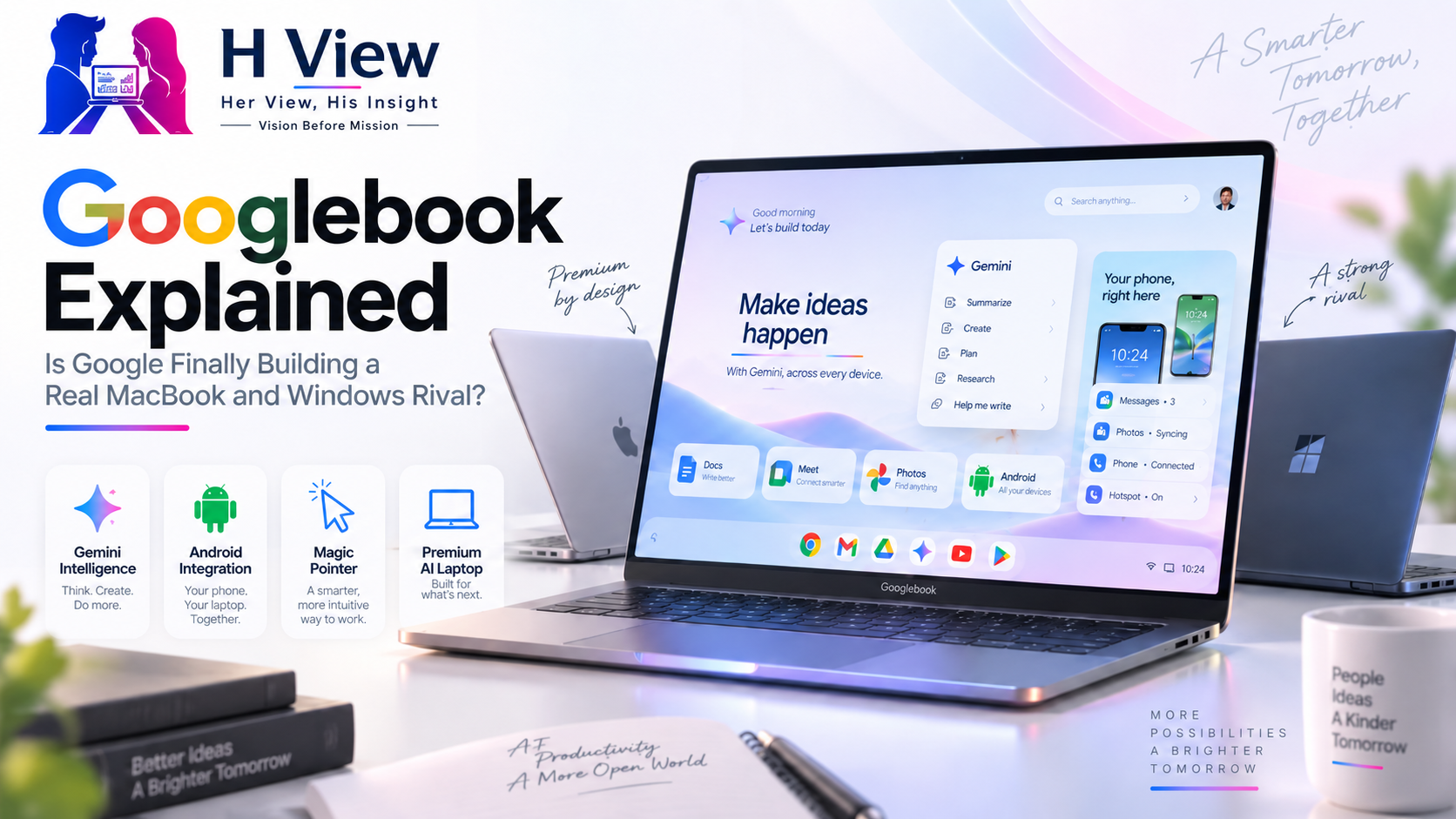
Google officially introduced Googlebook in May 2026 as a new category of premium laptops designed around what it calls Gemini Intelligence. Instead of simply putting Gemini inside another Chromebook, Google says it is combining the strengths of Android and ChromeOS into a more intelligent laptop platform, with deeper Android-phone integration, proactive AI features and premium hardware from manufacturers including Acer, ASUS, Dell, HP and Lenovo.
The timing is important because Google has now confirmed that the first Googlebooks will enter the pre-order phase on 21 September 2026. Pricing, exact launch models and shipping dates have still not been fully revealed, which means anyone seeing “Googlebook price” claims right now should be cautious.
That leaves us with a bigger question than specifications. Is Googlebook simply the next premium Chromebook, or is Google finally trying to build an ecosystem that can compete directly with Apple’s MacBook and the increasingly AI-focused Windows laptop market?
The first thing Google wants buyers to understand is that Googlebook is not being positioned as an ordinary Chromebook with a new logo.
Chromebooks were originally designed around a cloud-first idea. Googlebook is being described around an AI-first idea. Google says the platform combines Android’s application ecosystem and intelligence-focused technology stack with ChromeOS strengths such as the browser and familiar laptop productivity.
That distinction matters because the limitations of Chromebooks were never mainly about hardware. Over the years, manufacturers produced expensive Chromebooks with good displays, strong processors and premium materials, but buyers still had to ask whether ChromeOS could replace Windows or macOS for professional work.
Googlebook is trying to answer that problem from the software side.
Instead of forcing laptop applications into a browser-centric environment, Google is leaning much more heavily on Android apps, cross-device integration and Gemini-powered interactions. Current reporting describes Googlebooks as premium machines intended for professionals and power users rather than simply inexpensive school laptops.
That is a meaningful change in ambition.
Most laptop companies now talk about artificial intelligence. Intel promotes Core Ultra processors and NPUs, AMD has Ryzen AI, Microsoft has Copilot+ PCs, and Apple has Apple Intelligence.
Google’s approach is different because it already owns many of the services people use throughout the day: Gmail, Calendar, Drive, Photos, Search, YouTube, Android and Gemini.
Googlebook is being designed to connect those services more deeply.
The company says Googlebooks will be the first laptops built from the ground up for Gemini Intelligence, with AI intended to provide contextual assistance rather than waiting for users to open a chatbot every time they need help.
The most obvious example is a feature called Magic Pointer.
The mouse pointer has barely changed conceptually for decades. You move it somewhere, click something and decide what to do next.
Google wants the pointer itself to become intelligent.
With Magic Pointer, users can move the cursor over something on screen and trigger Gemini to understand the context. Google gives examples such as pointing at a date inside an email and quickly creating a meeting, or selecting two images so Gemini can combine or compare them.
That sounds much more useful than simply adding a permanent AI button to the taskbar.
Consider a manager reading an email about a meeting next Friday. Instead of copying the date, opening Calendar and creating the event manually, Magic Pointer could potentially recognise the information and offer the relevant action immediately.
Or imagine a student reading an article and encountering a technical term they do not understand. Instead of opening another tab and searching manually, the pointer could become the interaction point for Gemini assistance.
Whether the feature feels natural in daily use will depend on how accurate and unobtrusive it is. If suggestions appear too frequently, it could become distracting. If it genuinely predicts the next useful action, however, Magic Pointer could become one of Googlebook’s most distinctive features.
Another major feature is Create your Widget, which lets users describe the information they want and have Gemini create a custom widget around it.
Google says these widgets can use internet information and connected Google services such as Gmail and Calendar. One example involves creating a dashboard for a family trip that combines flight details, hotel bookings, restaurant reservations and a countdown.
This is an interesting shift from the normal desktop experience.
Windows and macOS both allow widgets, but they generally come from predefined applications. Google is proposing something more flexible: the user describes the outcome, and the AI creates the interface.
For a student, that could be a widget showing upcoming assignment deadlines, exam dates and unread college emails. A project manager could build a single view of meetings, tasks and travel schedules. A content creator might want a dashboard showing analytics, publishing deadlines and calendar events.
The feature becomes valuable if ordinary users can create those workflows without learning automation tools or coding.
The strongest argument for Googlebook may actually have little to do with AI.
Google has spent years building the world’s largest mobile operating-system ecosystem, yet Android phones and traditional Chromebooks have never achieved the same seamless relationship that iPhone and Mac users receive from Apple.
Googlebook is clearly trying to improve that.
Google says users will be able to access Android-phone applications while working on the laptop and view phone files directly through the Googlebook file browser using Quick Access, without manually transferring them first.
This could be extremely useful.
Suppose you take several photographs on a Pixel, Samsung, Nothing or Motorola phone and immediately need them for a presentation on the laptop. Instead of sending them through WhatsApp, uploading them to Drive or plugging in a cable, Googlebook is designed to expose those files directly.
Likewise, a user could interact with a phone-only application without repeatedly picking up the phone and interrupting their laptop workflow.
Apple has demonstrated how valuable ecosystem continuity can be. Google has millions more Android users globally, so if it can create a comparable experience across different Android brands, Googlebook could have an enormous potential audience.
Another major difference from Apple is that Googlebook is not one single laptop.
Google is working with Acer, ASUS, Dell, HP and Lenovo to produce the first devices.
This is closer to the Windows model than the MacBook model.
The benefit is choice. Buyers may eventually be able to choose between different screen sizes, designs, processors, battery capacities and prices while keeping the same Googlebook software experience.
The risk is inconsistency.
One reason MacBooks are easy to understand is that Apple controls both hardware and software. A MacBook Air behaves like a MacBook Air no matter where you buy it. Windows laptops can vary dramatically in display quality, webcam, keyboard, battery life and cooling even when two devices run the same version of Windows.
Google will need strong hardware standards if it wants the Googlebook name to mean something more than “a laptop that runs Google’s new software.”
Google has confirmed one visual identifier: every Googlebook will feature a distinctive Glowbar, which the company describes as both functional and part of the product’s design identity.
At this stage, the distinction looks like this:
| Area | Traditional Chromebook | Googlebook |
|---|---|---|
| Main positioning | Affordable/cloud-first computing | Premium AI-first computing |
| AI | Gemini available as a service | Gemini Intelligence integrated deeply into the system |
| Android integration | Android apps supported on many models | Deeper phone-app and file integration |
| Hardware | Budget to premium | First models positioned as premium |
| Custom AI UI | Limited | Create your Widget |
| Contextual AI | Standard assistant interactions | Magic Pointer |
| Brand identity | Chromebook | Googlebook + Glowbar |
| Manufacturers | Many PC brands | Acer, ASUS, Dell, HP, Lenovo initially |
| Price | Frequently affordable | Exact launch pricing not yet announced |
The biggest difference is therefore not simply faster hardware. Google wants the AI and Android ecosystem to become part of the basic laptop experience.
Apple’s advantage is not only the M-series chip.
The MacBook ecosystem combines hardware, macOS, iPhone, AirPods, iCloud, battery efficiency, creative applications and years of user familiarity. Google cannot overcome that simply by shipping Gemini on a laptop.
Googlebook does have one potentially powerful advantage: Android scale.
An Android user currently choosing a Windows laptop gets broad software compatibility but only limited integration with their phone. A MacBook offers stronger ecosystem continuity, but the experience is most valuable when paired with an iPhone.
Googlebook could create a third option: a laptop deeply connected to the Android phone someone already owns.
That makes the product particularly interesting for Pixel, Samsung, Nothing and other Android users who have wanted a more Apple-like ecosystem without switching to iPhone.
Whether Googlebook becomes a genuine MacBook competitor will depend heavily on three things: application quality, hardware reliability and price.
Windows remains the default laptop platform for many students, businesses, developers, engineers and gamers.
Its biggest strength is compatibility.
Corporate applications, accounting tools, CAD software, development environments, engineering software and PC games are still overwhelmingly built around Windows.
Googlebook therefore does not merely need to look premium. It needs to answer a practical question: Can users do all of their work on it?
Google’s deeper use of the Android technology stack should improve application availability, and reports suggest the company wants Googlebook to handle much more serious software than traditional Chromebooks.
Still, anyone using specialised Windows software should wait until application compatibility is completely clear before replacing an existing laptop.
This is exactly where first-generation products can become difficult. A new platform may be exciting technologically while still lacking the software ecosystem required for professional adoption.
Google has not yet officially announced Googlebook pricing.
That is perhaps the biggest missing piece before the September 21 pre-order window. Current reporting says the first systems are intended to be premium devices, while Google executives have indicated that more affordable models are planned later.
This strategy is risky.
Chromebooks became successful partly because they were affordable. If Googlebooks launch around premium Windows and MacBook prices, buyers will compare them against extremely mature products instead of forgiving their limitations as inexpensive alternatives.
A ₹50,000 Googlebook can survive a few software compromises.
A ₹1 lakh Googlebook has to justify itself against MacBook Air, ASUS Zenbook, Lenovo Yoga, Dell premium systems and increasingly capable Windows AI laptops.
That is why we should not make a buying recommendation until Google reveals Indian availability, pricing and the first hardware configurations.
Googlebook may make the most sense for people already deeply invested in Google services and Android.
Students who rely on Gmail, Drive, Docs, Calendar and Android applications may find the ecosystem convenient. Managers and professionals whose work happens primarily inside browsers and cloud services could benefit from Gemini Intelligence and stronger Android integration. Android enthusiasts may finally get a laptop experience designed specifically around the phone they already use.
Developers, engineers and gamers should be more cautious until we know exactly how well professional applications, development environments and specialised software behave.
A good laptop is not simply one with impressive AI. It is the laptop that can run the applications you need every day without requiring workarounds.
What interests me most about Googlebook is not the idea of putting Gemini everywhere. We already have AI assistants on phones, browsers and existing laptops. The more valuable possibility is reducing the gap between an Android phone and a laptop.
People routinely photograph something on their phone and then send it to themselves just to use it on a computer. We open the same email on two devices, move files through messaging apps and repeatedly switch between screens because the phone and laptop still behave like separate worlds.
If Googlebook genuinely makes Android and laptop work feel continuous, that could be far more useful than another collection of AI-generated features.
My hesitation is price. Google has spent years teaching buyers that Chromebooks are affordable. Asking those same buyers to pay MacBook-level prices for a new platform will require an exceptionally polished experience.
Googlebook may represent a bigger strategic change than the hardware itself suggests.
Google already controls Android, Chrome, Gemini and a large part of the everyday cloud-productivity stack. Until now, those products have existed across PCs largely as services rather than as one integrated computing platform.
Googlebook brings them together.
That could make Google a much more direct competitor to Microsoft and Apple in personal computing. But the software ecosystem remains the deciding factor. Windows has decades of desktop compatibility, while macOS has strong professional creative and development communities.
Gemini cannot compensate for missing professional software. Google needs Googlebook to be useful first and intelligent second.
Googlebook is one of the most interesting laptop developments of 2026 because Google is finally treating the laptop as more than a place to run Chrome.
Magic Pointer, Create your Widget, direct Android-phone integration and Gemini Intelligence show a much broader ambition than the traditional Chromebook model. The involvement of Acer, ASUS, Dell, HP and Lenovo also suggests Google wants this to become an entire laptop category rather than another short-lived Pixelbook experiment.
But several critical questions remain unanswered. Google has not yet confirmed the complete launch lineup, final pricing, Indian availability or how well demanding professional applications will work across the new platform. Pre-orders begin on 21 September 2026, which should finally reveal many of those details.
So is Googlebook finally a real MacBook and Windows rival?
It has the potential to become one, particularly for Android users who have never had an equally integrated laptop ecosystem. But Googlebook will not earn that position simply because Gemini is built in. It will need excellent hardware, competitive pricing, strong application compatibility and an experience reliable enough for people to trust with school and work.
For now, Googlebook is less a finished answer and more the most serious question Google has asked the laptop industry in years.
Googlebook is Google’s new category of premium laptops built around Gemini Intelligence, deeper Android integration and a software platform combining elements of Android and ChromeOS.
Googlebook pre-orders are scheduled to begin on 21 September 2026. Google has not yet confirmed the exact shipping date for the first models.
Google has not officially announced final Googlebook pricing yet. The first devices are expected to be premium systems, while Google has said more affordable models are planned over time.
Google has confirmed Acer, ASUS, Dell, HP and Lenovo as initial Googlebook hardware partners.
No. Google is positioning Googlebook as a new premium AI-first laptop category with deeper Gemini and Android integration. Chromebooks remain more closely associated with ChromeOS and cloud-first computing.
Magic Pointer is a Googlebook feature that brings contextual Gemini assistance directly to the cursor. Users can point at information on screen and receive relevant actions or suggestions.
Google says the platform is built partly on Android technology and is designed for deep Android application and phone integration, including access to phone apps and files from the laptop.
If you already need a laptop for work or college, there is not enough confirmed pricing and compatibility information yet to recommend waiting solely for Googlebook. If your current laptop works and you are deeply invested in Android and Google services, waiting until the first Googlebook models and prices are revealed on or around September 21 could be worthwhile.
Harika is the co-founder of H View and covers AI, technology, gadgets, digital tools, online platforms, and modern internet trends. Her articles focus on simplifying complex topics with practical explanations, balanced opinions, and reader-first insights.
Share your real experience and help other readers decide better.
No community views yet. Be the first to share yours.
Open LinkedIn for a few minutes and you will probably come across a colourful graphic…
Harika October 6, 2026 
When an employee resigns, many organisations move quickly into replacement mode. The manager informs HR,…
Harika October 6, 2026 
For many corporate employees, the workday begins long before they actually start working. They wake…
Harika October 5, 2026 
Many projects begin with an assumption that sounds reasonable on paper: the client will explain…
Harika October 1, 2026