

Best Digital Marketing Tools in 2026: What Marketers Actually Need and What They Can Skip
Open LinkedIn for a few minutes and you will probably come across a colourful graphic…
 Harika October 6, 2026
  By HarikaUpdated September 19, 20269 min read59 views
Raksha Bandhan is usually one of those festivals families understand instinctively. The rakhi tray is prepared, siblings gather, sweets come out, photographs are taken, and the day follows a rhythm people have known since childhood.
This year feels slightly different.
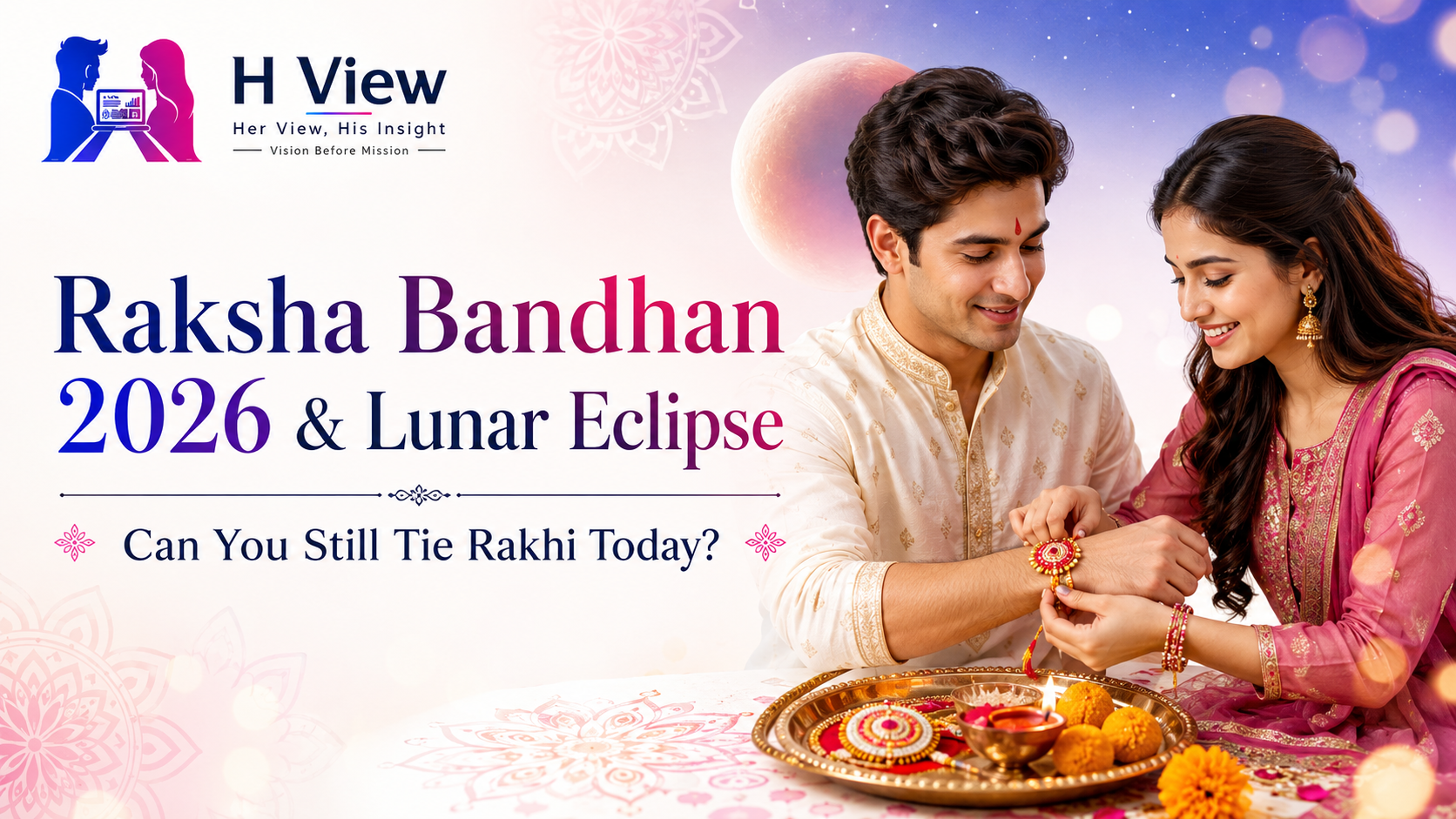
Raksha Bandhan 2026 falls on Friday, August 28, the same date as a deep partial lunar eclipse. That coincidence has produced a flood of questions online. Can rakhi still be tied? Does Sutak apply? Should the ceremony happen before the eclipse? Is Bhadra a problem? Some social-media messages are even warning families to avoid rituals altogether.
The confusion is understandable because several separate traditions are being mixed together in the same conversation.
The reassuring part is that the August 28 lunar eclipse will not be visible from India. Astronomical coverage places India on the daytime side of Earth during the event, with the Moon below the horizon here. Reports discussing the religious-calendar implications therefore note that the usual Sutak restrictions associated with a visible eclipse are not being applied in India.
For families celebrating Raksha Bandhan today, the more important timing issue is actually Purnima and Bhadra, not the eclipse.
Raksha Bandhan is observed on the full moon, or Purnima, of the Hindu month of Shravana. Lunar eclipses also occur only around a full moon, when the Sun, Earth and Moon align closely enough for the Moon to pass through Earth’s shadow.
So the coincidence is unusual, but it is not mysterious.
This year, the Purnima Tithi began at approximately 9:08 AM on August 27 and ends around 9:48 AM on August 28. Drik Panchang lists Raksha Bandhan on August 28 and notes that Bhadra ended before sunrise in locations such as Hyderabad and Nellore. For Nellore, for example, the suggested thread-ceremony window is roughly 5:58 AM to 9:48 AM. Local sunrise and panchang calculations can shift the exact starting time slightly from place to place.
That means two celestial/calendar events are overlapping on the same civil date:
Raksha Bandhan is being observed because Shravana Purnima continues into the morning, while the partial lunar eclipse is occurring globally later in the astronomical cycle.
The overlap sounds dramatic in a headline. In everyday practice for Indian families, it is much less complicated.
The August 27–28 eclipse is a partial lunar eclipse, and a very deep one at that. Coverage from astronomy sources notes that roughly 96% of the Moon can enter Earth’s dark central shadow during the event, making it appear strongly darkened and potentially reddish from locations where it is visible.
Those locations include large parts of North and South America and portions of Europe and Africa.
India, however, is not among them.
By the time the important stages of the eclipse occur, the Moon is below the horizon from India because it is daytime here. This is why an event can be occurring astronomically on August 28 while somebody standing in Hyderabad, Delhi or Kochi sees nothing unusual in the sky.
This distinction matters because many forwarded messages simply say:
“Lunar eclipse on Raksha Bandhan.”
They leave out the most useful second sentence:
“It is not visible in India.”
Removing that context makes the situation sound far more disruptive than it actually is.
Sutak is a traditional period observed in many Hindu households before an eclipse. Depending on family and regional customs, people may avoid certain rituals, cooking or other activities during that period.
Not every family follows identical practices, so it is better to discuss this as tradition rather than present one universal religious rule.
For the August 28 eclipse, current religious-calendar reporting says that because the eclipse is not visible from India, Sutak is generally not considered applicable in India.
That distinction follows a traditional principle commonly used in eclipse observances: visibility matters.
So someone receiving a WhatsApp message saying, “Sutak has started, do not tie rakhi,” should not immediately cancel the family ceremony based only on that forward.
If your family follows a particular temple, priest or regional panchang, you may still choose to follow that tradition. India has enormous diversity in religious practice, and a festival article should respect that.
But the widespread claim that the eclipse automatically prevents Raksha Bandhan celebrations across India is not supported by the current visibility information.
The term appearing repeatedly alongside Raksha Bandhan this year is Bhadra.
Traditional Raksha Bandhan guidance generally advises avoiding the Bhadra period when tying rakhi. Drik Panchang’s 2026 calculations indicate that Bhadra ended before sunrise on August 28, meaning it does not obstruct the morning Rakhi ceremony in the locations checked.
For Hyderabad, the listed ceremony period is approximately 6:01 AM to 9:48 AM. For Nellore, it is about 5:58 AM to 9:48 AM.
The important point is that these timings are location-dependent.
A family in Mumbai, Delhi or Vijayawada should not blindly copy a muhurat screenshot meant for another city. Sunrise timing changes geographically, and different panchangs may present calculations with slight variations.
If exact ritual timing matters to your family, use a local panchang or trusted local religious guidance.
If your household does not usually follow muhurat strictly, the existence of an invisible eclipse elsewhere in the world does not suddenly require you to adopt a complicated set of restrictions you have never followed before.
A message saying:
“Raksha Bandhan on lunar eclipse—dangerous time, do not tie rakhi!”
travels faster than:
“The eclipse is not visible in India, Bhadra ends before sunrise, check your local panchang for the morning ceremony window.”
Fear is easier to forward than context.
Festival misinformation also benefits from familiarity. A message may arrive from an aunt, family friend or respected elder, so people hesitate to question it. But the person who forwarded it may have received it from someone else without checking the astronomy, location or actual panchang calculation.
This is not an argument against tradition.
It is an argument for understanding the tradition before becoming frightened by it.
A useful habit for festival-related forwards is to separate three questions:
Once those are separated, most of the panic disappears.
For families in India, current guidance says yes.
The lunar eclipse itself does not prevent Raksha Bandhan rituals in India because it is not visible here, and the commonly cited Sutak restriction is therefore not being applied.
The traditional timing consideration is the Raksha Bandhan muhurat based on Purnima and Bhadra.
If you are following precise panchang timing, complete the ritual during the recommended local morning window before Purnima ends around 9:48 AM.
If circumstances make that difficult—for example, a sibling is arriving later or both people are working—families should follow the tradition they normally rely on rather than allowing random online posts to create guilt or anxiety.
A festival about sibling protection should not become a source of family stress because someone saw a dramatic reel about an eclipse.
There is something interesting about the coincidence even if it does not change the Rakhi ceremony in India.
Raksha Bandhan is tied to the full moon. A lunar eclipse is also a full-moon phenomenon. Both therefore remind us that traditional calendars were built through close observation of lunar cycles long before most of us checked dates on a smartphone.
People may approach that connection differently. For someone interested in astronomy, today is fascinating because a deep partial eclipse is occurring elsewhere on Earth. For someone following Hindu tradition, the same lunar cycle defines one of the year’s most familiar sibling festivals.
Science and culture are answering different questions about the same sky.
Astronomy explains what Earth’s shadow is doing to the Moon.
Tradition explains what this lunar date means to a community.
They do not have to compete.
Imagine two sisters in Hyderabad planning Rakhi with their younger brother.
One family WhatsApp group says the eclipse makes the whole day inauspicious. Another message says rakhi must be tied before 6 AM. A third says Sutak begins hours earlier.
Instead of trying to obey all three, they check a reliable local panchang.
It shows Raksha Bandhan on August 28, Bhadra already over before sunrise, and the ceremony window running approximately from 6:01 AM until 9:48 AM. They also verify that the lunar eclipse will not be visible from India.
The issue suddenly becomes simple.
They celebrate in the morning as planned.
Nothing about respecting tradition required accepting every warning that arrived on WhatsApp.
Festivals are supposed to create connection, but timing debates can sometimes make families surprisingly anxious. Someone starts worrying that a sister arrived thirty minutes late, another person says a particular ritual was done incorrectly, and the emotional meaning of the day gets lost beneath rules people may not even fully understand.
For families who value muhurat and traditional practice, those beliefs deserve respect. But respect also means checking the right information rather than letting fear take over.
The most meaningful part of Raksha Bandhan remains the relationship. A brother and sister who support each other throughout the year have already understood something deeper than a perfect festival photograph.
The interesting lesson this year is how quickly astronomy, religious tradition and internet misinformation can become mixed together.
The eclipse is scientifically real.
The statement that it is not visible from India is also scientifically real.
Sutak belongs to religious tradition, and current traditional guidance is being interpreted in light of that non-visibility.
Bhadra and Rakhi muhurat come from panchang calculations.
These are four different pieces of information. Problems begin when they are collapsed into one viral sentence.
Good information does not ask people to abandon tradition. It gives them enough context to practise it without unnecessary fear.
Yes, Raksha Bandhan 2026 coincides with a partial lunar eclipse.
But for families in India, that headline sounds more disruptive than the reality.
The eclipse is not visible from India, so prevailing guidance says the associated Sutak period does not apply here. The main traditional consideration for Rakhi is the Purnima/Bhadra timing, and Drik Panchang lists Bhadra as ending before sunrise with a morning ceremony window until approximately 9:48 AM, varying slightly by location.
If your family follows a specific religious tradition, continue to respect it.
But do not allow an alarming social-media forward to replace verified information.
Raksha Bandhan is ultimately about a promise of care between siblings.
An eclipse occurring beyond India’s horizon does not need to overshadow that.
Yes. A deep partial lunar eclipse occurs on August 27–28, 2026, coinciding with Raksha Bandhan in India on August 28.
No. Astronomy coverage confirms that India is on the daytime side of Earth during the eclipse and the Moon is below the horizon here.
Yes, according to current panchang and eclipse guidance for India. Families following exact muhurat should use local timings.
Current religious-calendar reporting says Sutak is not considered applicable because the lunar eclipse is not visible from India. Practices can vary by family and tradition.
The window varies slightly by city. Drik Panchang lists approximately 5:58 AM–9:48 AM for Nellore and 6:01 AM–9:48 AM for Hyderabad, with Bhadra ending before sunrise.
Yes. Unlike a solar eclipse, a lunar eclipse can be viewed directly without special eye protection. In this case, however, the eclipse is not visible from India.
Harika is the co-founder of H View and covers AI, technology, gadgets, digital tools, online platforms, and modern internet trends. Her articles focus on simplifying complex topics with practical explanations, balanced opinions, and reader-first insights.
Share your real experience and help other readers decide better.
No community views yet. Be the first to share yours.

Open LinkedIn for a few minutes and you will probably come across a colourful graphic…
Harika October 6, 2026 
When an employee resigns, many organisations move quickly into replacement mode. The manager informs HR,…
Harika October 6, 2026 
For many corporate employees, the workday begins long before they actually start working. They wake…
Harika October 5, 2026 
Many projects begin with an assumption that sounds reasonable on paper: the client will explain…
Harika October 1, 2026