


H View
  • Home
  • About
  • Blogs
  • Categories
    • AI
    • Tech
    • Lifestyle
    • Business
      • Money
    • Sports
  • Reviews
  • Contact
Connect With Us
H View
  • Home
  • About
  • Blogs
  • Categories
    • AI
    • Tech
    • Lifestyle
    • Business
      • Money
    • Sports
  • Reviews
  • Contact
Connect
Culture

Raksha Bandhan 2026: Why Rakhi Is on August 28—and How the Meaning of Sibling Protection Is Changing

☆☆☆☆☆No reader ratings yet
By HarikaUpdated August 27, 202610 min read2 views

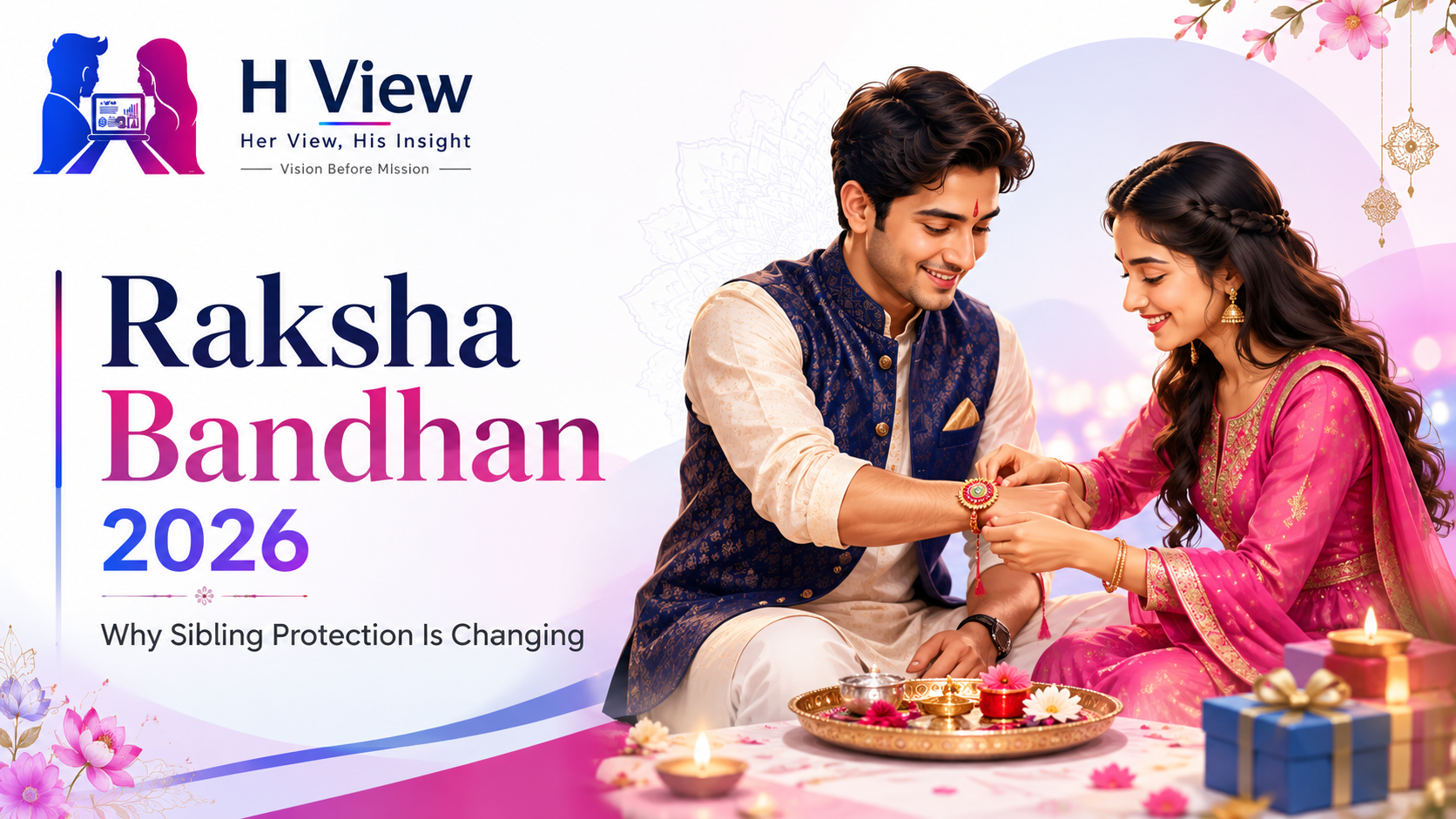
Every year, Raksha Bandhan arrives with a familiar picture: a sister tying a rakhi around her brother’s wrist, applying tilak, offering sweets, and receiving a gift in return. For many families, the ritual feels so familiar that its meaning is rarely questioned. It is simply something siblings have always done.

Raksha Bandhan 2026, however, has brought an unusual amount of confusion even before the celebrations begin. Some calendars and social-media posts mention August 27, while others say August 28. The reason lies in the timing of Shravana Purnima, the full-moon day traditionally associated with Raksha Bandhan. In 2026, Purnima begins on the morning of August 27 and continues until the morning of August 28. Traditional calculations used for the festival place the main Raksha Bandhan observance on Friday, August 28, 2026.

But the more interesting question is not only which date is correct.

Raksha Bandhan itself is changing.

The traditional idea of a brother promising to protect his sister still remains emotionally important in many homes, yet modern sibling relationships do not always fit that one-directional definition anymore. Sisters protect brothers emotionally and financially. Older sisters guide younger brothers. Siblings living in different countries support one another through careers, marriages, health problems and ageing parents. In some families, sisters tie rakhis to sisters, friends or other people with whom they share a bond of trust.

So perhaps Raksha Bandhan in 2026 is best understood not as a festival where one person promises to protect another, but as an occasion that asks siblings a broader question:

Are we still showing up for each other when life becomes difficult?

Why Raksha Bandhan Falls on August 28 in 2026

Raksha Bandhan is traditionally observed during Shravana Purnima, the full moon in the Hindu month of Shravan.

This year, Purnima Tithi begins at approximately 9:08 AM on August 27 and ends at approximately 9:48 AM on August 28. Traditional panchang calculations place the festival on August 28 because the relevant Purnima period continues into that morning and Bhadra ends before sunrise. For New Delhi, for example, the suggested rakhi-tying period is approximately 5:57 AM to 9:48 AM. Timings can vary slightly by location, so families following a specific muhurat should check their local panchang.

That explains why both dates may appear online.

The confusion is not necessarily because one source is careless. Hindu festival dates depend on lunar tithis rather than simply beginning and ending at midnight like modern calendar dates. When a tithi stretches across two civil dates, different headlines can easily create uncertainty.

For most readers, the important takeaway is simple: Raksha Bandhan is being observed on August 28 in 2026, while August 27 is significant because that is when the Purnima Tithi begins.

Raksha Bandhan Was Never Only About a Piece of Thread

The rakhi itself is physically simple. It may be decorative, handmade, expensive or little more than a coloured thread. Its emotional significance comes from what people attach to it.

The Sanskrit idea behind raksha relates to protection, while bandhan refers to a bond. In everyday family life, that became strongly associated with a sister tying a rakhi to her brother and the brother taking responsibility for her well-being.

For older generations, the promise could feel very practical. In societies where women often had less financial independence and frequently moved away from their parental homes after marriage, the brother represented an important source of support outside the marital family.

That historical reality shaped the emotional meaning of the festival.

But society has changed.

Women increasingly earn independently, live alone, move abroad, own property and support parents financially. Brothers themselves may face emotional, financial or health difficulties where the sister becomes the stronger source of support.

If the festival remains meaningful, its interpretation naturally has to grow with the relationship.

Protection Does Not Always Mean “I Will Save You”

Consider a brother and sister in their thirties.

The brother lives in Bengaluru and loses his job unexpectedly. He does not need someone to physically defend him. He needs somebody who will listen without judging him, help him update his résumé, perhaps cover an urgent family expense and remind him that unemployment is a temporary situation rather than a personal failure.

His sister in Hyderabad may become that person.

A year later, she may be dealing with a difficult pregnancy, career pressure or problems in her marriage. The same brother may travel overnight because she needs someone from her own family beside her.

Who is protecting whom?

Both are.

This is where the traditional meaning of Raksha Bandhan becomes more interesting rather than less relevant. Protection in modern families often means reliability. It means being the person who answers when everyone else is busy.

That can involve money, but often it does not.

Sometimes the most valuable form of protection is knowing that one relationship does not disappear just because life changes.

Marriage Often Tests the Sibling Bond More Than Childhood Ever Did

Children usually do not have to work very hard to maintain sibling relationships. They live in the same house, argue over the television, borrow each other’s belongings and know almost everything happening in one another’s lives.

Adulthood removes that automatic closeness.

Jobs take siblings to different cities. Marriage introduces new families and responsibilities. Children consume time. Parents get older. A conversation that once happened every evening becomes one phone call every few weeks.

Raksha Bandhan becomes emotionally powerful in this stage because it briefly interrupts that drift.

A sister who travels home for Rakhi may not be returning because she believes the thread has magical power. She may be returning because rituals create a reason for relationships to receive attention before another year disappears into work and responsibility.

The gift, sweets and photographs are part of the celebration. The deeper value is that people make time.

That may be one reason Raksha Bandhan continues to feel meaningful even to siblings who are otherwise not especially ritualistic.

Does a Brother Still Need to “Protect” an Independent Sister?

This is where some younger people become uncomfortable with the traditional language.

If a sister is financially independent, manages her own career and makes her own decisions, does saying “your brother will protect you” make her sound dependent?

It can, if protection is understood as authority.

But there is another interpretation.

Protection can mean support without control.

A brother does not protect his adult sister by deciding whom she should marry, what she should wear or where she should work. Those choices belong to her.

He can protect the relationship by respecting those decisions, standing beside her when she is treated unfairly and being available when she genuinely needs help.

That is very different from deciding her life on her behalf.

The distinction matters because some traditions survive best not by freezing their oldest interpretation, but by retaining the value at the centre while allowing the surrounding social role to evolve.

Sisters Are Increasingly Rewriting the Ritual Too

Raksha Bandhan is also becoming less rigid in some families.

Sisters may tie rakhis to one another. Cousins who grew up like siblings may participate. Some people exchange rakhis with close friends who have become family in practice even if not by blood.

These variations are not universal, and traditional families may continue to follow the brother-sister form exactly as they always have.

Both realities can coexist.

Culture does not always change through an official announcement. It changes quietly inside homes as people adapt a tradition to the relationships they actually have.

What matters is whether the change preserves the emotional meaning rather than reducing the festival to a social-media trend.

If two sisters have supported one another through every major difficulty in life, it is understandable that they may see Raksha Bandhan as part of their bond too.

The Gift Has Become Bigger—but It Should Not Become the Festival

Like many modern celebrations, Raksha Bandhan has also become commercial.

Online stores advertise phones, jewellery, watches, cosmetics, gift cards and elaborate hampers. Social media can make the size of the gift feel like evidence of how much someone cares.

That can quietly change the emotional centre of the day.

A college student with limited money may feel pressure to purchase an expensive present because Instagram is full of luxury Rakhi gifts. A brother already supporting his sister throughout the year may feel that a modest gift looks inadequate compared with what others are posting.

There is nothing wrong with giving something beautiful when you can afford it.

The problem begins when affection becomes financially performative.

A handwritten letter from a sibling living abroad may mean more than another gadget. Taking responsibility for an ageing parent for a weekend so your sister can rest may be more valuable than a gift hamper. Helping a younger sibling with course fees may matter far beyond one festival day.

The festival should strengthen a relationship, not create another bill.

Raksha Bandhan Matters Differently When Siblings Live Far Apart

Modern Indian families are geographically scattered in ways previous generations were not.

One sibling may be in Hyderabad, another in Pune, a third in Dubai or London. Rakhis travel through courier services. Video calls replace sitting together. Digital payments sometimes replace the envelope handed across the room after the ceremony.

Something has clearly been lost in that distance.

But something interesting has also happened: the ritual has learned to travel.

A sister can send a rakhi internationally weeks in advance. A brother can join the family ceremony through video. Parents can watch children maintain a relationship across countries.

The form changes, but the effort itself becomes meaningful.

In some ways, a sibling who plans ahead to make the festival work across a 7,000-kilometre distance may be expressing the bond more deliberately than siblings who live in the same house and barely speak.

Her View

Raksha Bandhan becomes more meaningful when protection is understood as emotional safety rather than dependence. A sister does not need her brother to control her life in order to value the knowledge that he will stand beside her when something goes wrong.

The same should work in reverse. Men are often expected to solve their own problems quietly, which makes sibling relationships particularly valuable. Sometimes a brother needs a sister who notices that he is struggling before he is willing to say it himself.

Perhaps the modern rakhi is less about saying, “You will protect me,” and more about saying, “Neither of us has to face everything alone.”

His Insight

Traditions remain strong when their core purpose continues to make sense.

The old economic and social conditions that shaped the brother-as-protector model have changed substantially, but the need for dependable family relationships has not. If anything, geographical mobility, demanding careers and increasingly individual lifestyles make those bonds harder to maintain deliberately.

Raksha Bandhan creates a scheduled moment of accountability between siblings.

A thread tied once a year cannot repair a relationship neglected for the other 364 days. But it can remind people that a meaningful sibling bond requires more than childhood memories.

The H View Take

Raksha Bandhan 2026 will be observed on August 28, after the Purnima Tithi begins on August 27. The date confusion is worth clearing up, but the more important conversation lies beyond the calendar.

The festival originated around an idea of protection that was historically expressed largely from brother to sister. Modern relationships are making that promise more equal.

A brother may protect his sister. A sister may protect her brother. Sometimes protection means financial help. Sometimes it means defending someone publicly, listening privately, caring for parents together or simply remaining dependable after marriage and distance change the family.

That does not necessarily weaken the traditional meaning of Raksha Bandhan.

It may actually strengthen it.

Because the deepest promise behind a rakhi was never really about who was stronger.

It was about saying:

Whatever changes around us, this bond still carries responsibility.

Frequently Asked Questions

When is Raksha Bandhan in 2026?

Raksha Bandhan will be observed on Friday, August 28, 2026. Purnima Tithi begins at approximately 9:08 AM on August 27 and ends at approximately 9:48 AM on August 28.

Why are some people saying Raksha Bandhan is on August 27?

The confusion comes from Purnima Tithi beginning on August 27. Traditional festival calculations, however, place the main Raksha Bandhan observance on August 28 in 2026.

What is the Raksha Bandhan muhurat in 2026?

For New Delhi, the suggested thread-ceremony time is approximately 5:57 AM to 9:48 AM on August 28, with Bhadra ending before sunrise. Exact sunrise-based timings can vary by location, so people following a muhurat should check a local panchang.

Can sisters tie rakhi to sisters?

Traditionally, Raksha Bandhan is strongly associated with a sister tying rakhi to her brother. Some modern families have expanded the ritual to sisters, cousins or other close relationships. These are evolving family practices rather than one universal tradition.

Is Raksha Bandhan only about brothers protecting sisters?

That is the traditional interpretation, but many families increasingly understand the festival as representing mutual responsibility, affection and support between siblings.

Does an expensive Rakhi gift matter?

The gift is a customary part of many celebrations, but it is not the core meaning of the festival. The relationship, promise of support and time shared between siblings are more important than the price of the gift.

Written by

Harika

Harika is the co-founder of H View and covers AI, technology, gadgets, digital tools, online platforms, and modern internet trends. Her articles focus on simplifying complex topics with practical explanations, balanced opinions, and reader-first insights.

Topics coveredAIAutoBusinessCultureCyber SafetyDigital MarketingGuidesH ViewHistoryLifestyleMoneyReviewsTechAudioGadgetsWordpress
View all posts by author

Submit Your View

Share your real experience and help other readers decide better.

🔒 Your review may be published after moderation.

Reader Reviews

No community views yet. Be the first to share yours.

8.0Excellent

H View Score

A quick view of our final rating for this review.

✉

Stay Updated with H View

Get the latest reviews and insights straight to your inbox.

🔒 No spam. Unsubscribe anytime.

Trending Reviews

Best AI for Coding in 2026: ChatGPT, Claude, Gemini or Something Else?August 27, 2026One More Attempt—or Time to Move On? The Career Risk of Endless Government Exam PreparationAugust 27, 2026Samsung Galaxy S26 FE Explained: Is the Fan Edition Still Worth Buying in 2026?August 27, 2026Why Are Working Women So Exhausted Even When They’re Doing Everything “Right”?August 27, 2026Eid-e-Milad 2026: Why It Is Observed and What the Day Means Beyond a HolidayAugust 26, 2026Onam 2026: Why Kerala Still Welcomes King Mahabali—and What the Festival Really MeansAugust 26, 2026Why Are Core Engineering Students Moving Away From Their Own Fields?August 26, 2026Realme P4s 5G With 8,000mAh Battery: Are Big-Battery Phones Becoming the New Normal?August 26, 2026

Related Blogs

AI

Best AI for Coding in 2026: ChatGPT, Claude, Gemini or Something Else?

A few years ago, asking for the best AI for coding usually meant asking which…

Harika August 27, 2026
Careers

One More Attempt—or Time to Move On? The Career Risk of Endless Government Exam Preparation

There is a particular kind of career uncertainty that many government-job aspirants understand very well.…

Satya Hemanth August 27, 2026
Gadgets

Samsung Galaxy S26 FE Explained: Is the Fan Edition Still Worth Buying in 2026?

Samsung’s Fan Edition phones have always occupied an unusual place in the Galaxy lineup. They…

Harika August 27, 2026
Lifestyle

Why Are Working Women So Exhausted Even When They’re Doing Everything “Right”?

She studied, built a career, earns her own money, manages her responsibilities, takes care of…

Annapurna August 27, 2026
H View

Honest reviews. Smart ratings. Real insights.

Explore

HomeReviewsBlog

Company

AboutAdvertiseContact

Support

Privacy PolicyTerms & ConditionsDisclaimerEditorial Policy

Subscribe to H View

Get the latest updates and exclusive content straight to your inbox.

🔒 No spam. Unsubscribe anytime.
© 2026 H View. All rights reserved.
HomeReviewsBlogContact