



H View
  • Home
  • About
  • Blogs
  • Categories
    • AI
    • Tech
    • Lifestyle
    • Business
      • Money
    • Sports
  • Reviews
  • Contact
Connect With Us
H View
  • Home
  • About
  • Blogs
  • Categories
    • AI
    • Tech
    • Lifestyle
    • Business
      • Money
    • Sports
  • Reviews
  • Contact
Connect
Careers

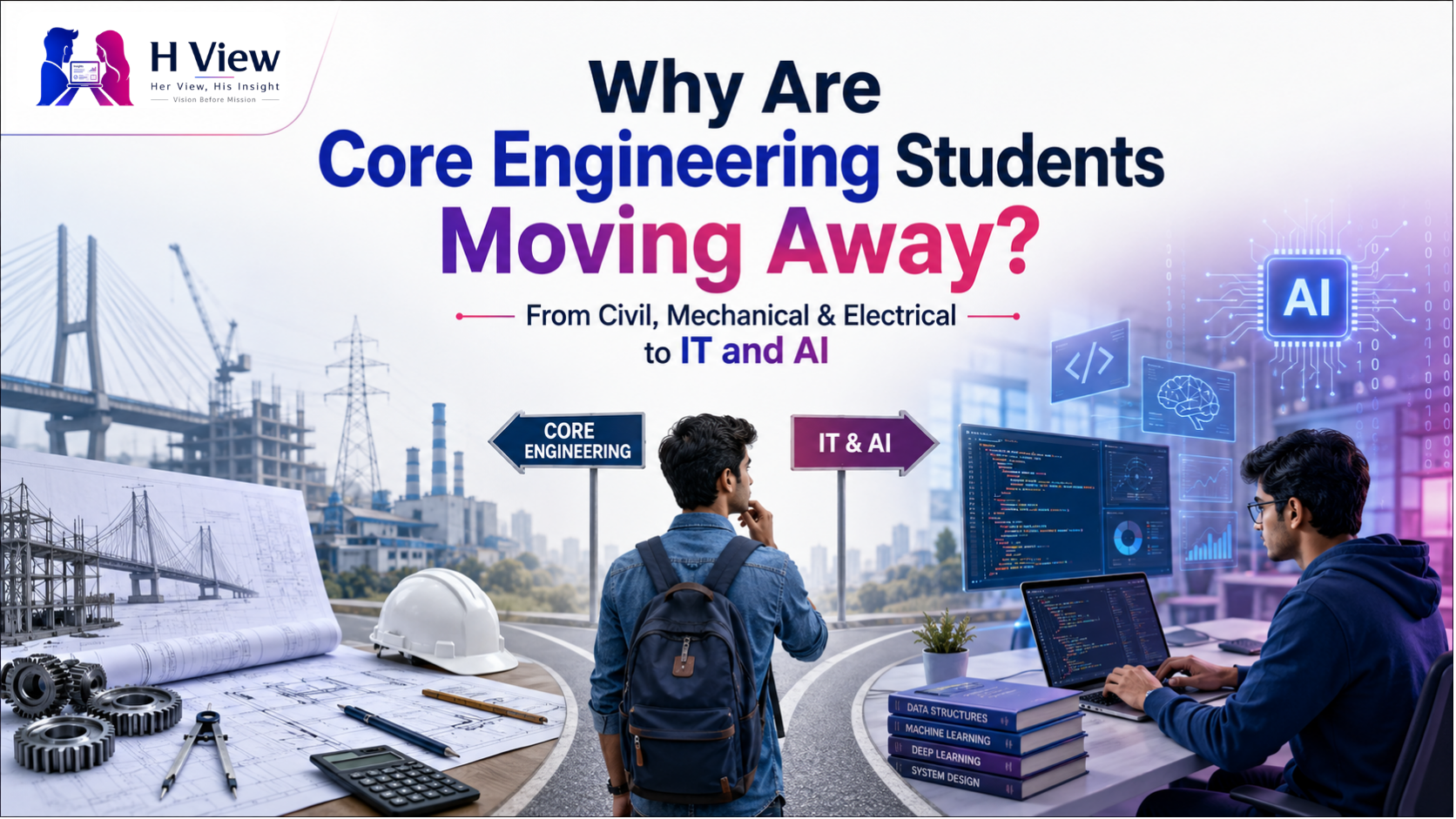
Why Are Core Engineering Students Moving Away From Their Own Fields?

☆☆☆☆☆No reader ratings yet
By Sreedhari PutrevuUpdated August 26, 202611 min read8 views

Engineering once immediately brought certain images to mind: bridges, buildings, machines, power systems, factories, roads and large pieces of physical infrastructure. Civil, mechanical and electrical engineering were not simply academic branches; they were the disciplines through which much of the modern physical world was designed and built.

Technology gradually expanded that definition. Electronics became more important, computers entered almost every industry, information technology created an entirely new employment ecosystem and, more recently, artificial intelligence has become one of the strongest career attractions for engineering students.

There is nothing wrong with that evolution. Engineering has always changed alongside technology.

The more interesting question is why so many students who enter traditional engineering branches begin looking outside their own disciplines before they have seriously explored what those fields can offer.

A civil engineering student learns about structures and construction but starts preparing for a software job. A mechanical graduate moves towards data analytics. An electrical student begins learning AI because the opportunities appear better. This does not necessarily mean those students made the wrong decision, but when the pattern becomes widespread, it deserves a closer look.

Are core engineering fields really becoming irrelevant, or have we failed to modernise the way students see them?

Core Engineering Is Not Disappearing

The first misconception is that civil, mechanical and electrical engineering are slowly becoming unnecessary because software and AI are taking over.

Physical reality makes that impossible.

AI can help design a building, analyse structural data, optimise energy consumption or predict maintenance requirements, but software cannot independently pour concrete, construct a bridge, manufacture a turbine or maintain an electrical grid. Every digital economy still depends on physical infrastructure beneath it.

Even AI itself depends on core engineering. Data centres require buildings, cooling systems, electrical infrastructure, backup power and sophisticated equipment. Semiconductor plants need mechanical, electrical, chemical and manufacturing engineers. Renewable-energy projects require specialists who understand structures, power systems, materials and large-scale implementation.

The World Economic Forum’s Future of Jobs Report 2025 makes a similar distinction when analysing generative AI. It found that many skills involving physical execution, manual dexterity, sensory processing and nuanced real-world judgement still have relatively low potential for substitution by current generative AI systems.

India’s infrastructure requirements reinforce the point. Government capital expenditure increased to ₹11.21 lakh crore in FY2026, while effective capital expenditure reached ₹15.48 lakh crore. Highway networks, railway electrification, airports and other major infrastructure systems have continued expanding.

The demand for engineering has therefore not disappeared. The nature of engineering is changing.

Why Software Careers Became More Attractive

If core engineering remains important, why do so many graduates look towards IT?

The simplest answer is incentives.

Software companies created highly visible entry-level career paths. Students regularly hear stories about campus placements, ₹8 lakh packages, ₹12 lakh packages, remote jobs, global technology firms and relatively quick salary growth. Even when those outcomes are not available to everyone, they remain highly visible.

Core engineering often presents a different early-career picture.

A young civil engineer may initially spend long hours at construction sites while earning considerably less than friends entering certain technology companies. Mechanical engineers may need to relocate near factories or industrial regions. Government engineering positions can be attractive but often involve competitive examinations and long recruitment processes.

Students notice these differences.

Choosing another field is therefore not always evidence that a young person wants an “easy job.” In many cases, the student is responding rationally to the salary, location, lifestyle and career-growth information visible around them.

If the engineering industry wants more graduates to remain in core fields, blaming students will achieve little. Those fields must demonstrate clearer career progression and better early-career opportunities.

The Problem Also Begins Inside Engineering Colleges

Another reason students move away is that engineering education does not always make the profession feel contemporary.

A student may spend four years studying civil engineering while receiving limited exposure to Building Information Modelling, modern project-management systems, drones, digital surveying, data analytics or real project monitoring. A mechanical engineering programme may teach strong fundamentals but provide little practical exposure to robotics, automation, electric vehicles or digital manufacturing.

The student then looks towards computer science and sees an ecosystem filled with coding platforms, hackathons, online projects, internships and communities where new technology appears constantly.

Naturally, one field starts feeling more modern than another.

But this is partly a presentation problem.

Construction itself is becoming more digital. India’s Ministry of Statistics and Programme Implementation launched PAIMANA, a digital platform for monitoring major infrastructure projects, followed by a performance-monitoring dashboard designed to strengthen data-driven infrastructure governance.

The future civil engineer therefore may not work only with drawings and site measurements. They may also work with BIM models, drones, sensors, project databases, digital twins and AI-assisted design tools.

Modernisation should not mean replacing civil engineering with computer science. It should mean teaching civil engineers how digital technology strengthens civil engineering.

AI Should Become a Tool for Engineers, Not a Reason to Leave Engineering

One of the biggest mistakes students can make today is treating AI as though it were a separate career destination that everyone must enter.

AI is increasingly becoming a layer across professions.

A civil engineer could use AI for structural analysis, project scheduling, safety monitoring or predictive maintenance. An electrical engineer might apply machine learning to power-demand forecasting or fault detection. A mechanical engineer could work with AI-assisted manufacturing, predictive maintenance or robotics.

In that future, the strongest professional may not always be the person who knows AI alone. It may be the person who understands a difficult engineering domain deeply enough to apply AI intelligently within it.

A software developer can build a model that analyses bridge data, but somebody still needs to understand whether the engineering interpretation is physically sensible.

Domain knowledge matters.

Rather than telling every engineering student to become an AI engineer, colleges should be asking how AI can become part of every engineering discipline.

Core Engineering Has Opportunities That Students Often Do Not See

Traditional engineering careers are also broader than many students realise.

Civil engineering includes transportation, structural engineering, geotechnical work, water resources, environmental engineering, urban infrastructure, project management and consulting. Mechanical engineering extends into manufacturing, automotive systems, aerospace, robotics, HVAC, renewable energy and industrial automation. Electrical engineering connects with power systems, electric mobility, electronics, renewable energy and grid modernisation.

India continues to invest heavily across many of those areas.

Manufacturing policy provides another example. By March 2026, India’s Production Linked Incentive schemes had attracted more than ₹2.16 lakh crore in investment and were associated with over 14 lakh jobs across participating sectors. Semiconductor manufacturing and packaging projects alone represented roughly ₹1.60 lakh crore in approved investment across several states.

These developments require far more than software professionals.

The real difficulty is that the career routes may not be explained to students as clearly as the IT recruitment route is.

Government Engineering Careers Remain Attractive but Difficult

The original concern about public-sector careers also deserves a more balanced interpretation.

Core engineering graduates can compete for respected positions through organisations involved in highways, railways, public works, power, defence, infrastructure and other technical functions. The difficulty is that many of these opportunities require competitive examinations, technical preparation and patience.

NHAI, for example, recruits engineering professionals through GATE and has also expanded structured internship opportunities for civil engineering students. In 2026, its summer programme included 423 interns working across 125 field offices and 51 functional verticals, including substantial participation from IITs and NITs.

That is not evidence of a dying profession.

It is evidence that attractive opportunities exist, but students need to understand the path required to reach them.

A person choosing an IT placement because it offers immediate income is making one kind of career decision. Another person preparing for GATE or developing specialised structural expertise is making another. Neither automatically deserves more respect.

The important question is whether the student understands the trade-off.

We Should Be Careful About Blaming Gen Z

It is easy to say that young people today lack patience, avoid failure and want immediate success. There may be individual cases where that is true, but treating an entire generation that way ignores the environment in which they are making decisions.

Students see salary information instantly. They watch people announce job offers on LinkedIn. They see influencers describing how quickly someone can enter AI, data science or software development. At the same time, families may have spent substantial amounts on engineering education and understandably want financial stability soon after graduation.

That creates pressure.

A student choosing a faster employment route may therefore be responding to economic reality rather than avoiding hard work.

What students do need is greater willingness to explore before following a trend. Choosing AI simply because everyone is talking about AI can be just as risky as choosing civil engineering simply because a parent recommended it.

Career decisions deserve more thought than trend following.

Failure and Patience Still Matter

There is, however, an important idea in the original argument that should not be lost: professional development often requires patience.

Not every competitive examination will be cleared on the first attempt. Not every campus interview will result in an offer. A first engineering job may not pay exceptionally well. Real expertise may take several years before it produces strong financial returns.

Students who interpret every early setback as proof that they selected the wrong field may continuously switch directions without remaining anywhere long enough to develop depth.

The healthier lesson is not that people should remain in an unsuitable career forever. Changing direction can be intelligent.

The important distinction is between changing because you have learned something meaningful about yourself and changing simply because the first difficulty appeared.

Resilience still matters in engineering because engineering itself is built around solving problems that do not always work the first time.

The Future Engineer Will Probably Be Hybrid

The old separation between “core engineering” and “technology” may eventually become much less useful.

A modern civil engineer may understand structures, BIM, project data and AI-assisted monitoring. A mechanical engineer may combine machine design with automation and analytics. An electrical engineer may work at the intersection of renewable power, software and intelligent energy systems.

This is probably where engineering education should move.

Students should not have to choose between understanding the physical world and understanding digital technology.

The strongest graduates may understand both.

India’s infrastructure, manufacturing, renewable-energy and technology ambitions will require engineers who can connect traditional engineering principles with new tools. The solution therefore is not protecting core engineering from AI.

It is upgrading core engineering with AI.

Her View

Students need career guidance that goes beyond telling them which branch currently receives the highest salary. A young person choosing engineering should understand what the work actually looks like, what the first few years may involve and which new opportunities are developing inside each discipline.

Parents and teachers have an important role here, but guidance should not become control. Pushing every student towards computer science because it appears financially safer can be just as limiting as forcing someone into civil or mechanical engineering because those fields were respected in an earlier generation.

Students also need permission to fail while they are learning. A rejected application, difficult examination or unsuccessful project should not immediately become evidence that the entire career path is wrong.

Good guidance should help young people distinguish temporary difficulty from genuine lack of interest.

His Insight

Core engineering will not survive by demanding that students respect tradition. It will remain attractive only if education and industry modernise together.

Colleges need stronger laboratories, real project exposure, modern software, internships and better links with employers. Companies need clearer early-career pathways and meaningful training rather than expecting graduates to arrive fully prepared for specialised work.

Students have responsibilities too. They should research the actual opportunities within their branch before assuming that switching to software is automatically better.

Every engineering field has difficult and rewarding paths.

The smart decision is not choosing whichever field is trending. It is developing enough understanding to recognise where your abilities, interests and the market genuinely meet.

Frequently Asked Questions

Are civil, mechanical and electrical engineering becoming obsolete?

No. Infrastructure, manufacturing, energy, transportation and physical systems still depend heavily on traditional engineering disciplines. What is changing is the technology used within those fields, including automation, data analytics and AI.

Why do core engineering students often move towards IT?

Common reasons include higher visible starting salaries, more campus recruitment, clearer entry-level opportunities, flexible work options and the perception that technology careers offer faster growth. Individual motivations vary considerably.

Can AI replace civil engineers?

AI can assist with design, analysis, monitoring, planning and many repetitive tasks, but civil engineering also requires physical execution, site understanding, regulatory judgement and responsibility for real-world structures. AI is more likely to change how engineers work than remove the need for engineering expertise.

Is civil engineering still a good career in India?

It can be, particularly as India continues investing heavily in highways, transport, urban development and other infrastructure. NHAI itself reported renewed interest in civil engineering in 2026 and has expanded internship and recruitment pathways for young engineers.

Should engineering students learn AI?

Yes, where it strengthens their field. A civil, mechanical or electrical engineer who understands both engineering fundamentals and modern digital tools may have a stronger advantage than someone who abandons domain knowledge simply to follow the latest technology trend.

Written by

Sreedhari Putrevu

Passionate writer, researcher and civil engineer by choice Structural Engineer by profession

Topics coveredCareersRelationships
View all posts by author

Submit Your View

Share your real experience and help other readers decide better.

🔒 Your review may be published after moderation.

Reader Reviews

No community views yet. Be the first to share yours.

8.0Excellent

H View Score

A quick view of our final rating for this review.

✉

Stay Updated with H View

Get the latest reviews and insights straight to your inbox.

🔒 No spam. Unsubscribe anytime.

Trending Reviews

Best AI for Coding in 2026: ChatGPT, Claude, Gemini or Something Else?August 27, 2026Raksha Bandhan 2026: Why Rakhi Is on August 28—and How the Meaning of Sibling Protection Is ChangingAugust 27, 2026One More Attempt—or Time to Move On? The Career Risk of Endless Government Exam PreparationAugust 27, 2026Samsung Galaxy S26 FE Explained: Is the Fan Edition Still Worth Buying in 2026?August 27, 2026Why Are Working Women So Exhausted Even When They’re Doing Everything “Right”?August 27, 2026Eid-e-Milad 2026: Why It Is Observed and What the Day Means Beyond a HolidayAugust 26, 2026Onam 2026: Why Kerala Still Welcomes King Mahabali—and What the Festival Really MeansAugust 26, 2026Realme P4s 5G With 8,000mAh Battery: Are Big-Battery Phones Becoming the New Normal?August 26, 2026

Related Blogs

AI

Best AI for Coding in 2026: ChatGPT, Claude, Gemini or Something Else?

A few years ago, asking for the best AI for coding usually meant asking which…

Harika August 27, 2026
Culture

Raksha Bandhan 2026: Why Rakhi Is on August 28—and How the Meaning of Sibling Protection Is Changing

Every year, Raksha Bandhan arrives with a familiar picture: a sister tying a rakhi around…

Harika August 27, 2026
Careers

One More Attempt—or Time to Move On? The Career Risk of Endless Government Exam Preparation

There is a particular kind of career uncertainty that many government-job aspirants understand very well.…

Satya Hemanth August 27, 2026
Gadgets

Samsung Galaxy S26 FE Explained: Is the Fan Edition Still Worth Buying in 2026?

Samsung’s Fan Edition phones have always occupied an unusual place in the Galaxy lineup. They…

Harika August 27, 2026
H View

Honest reviews. Smart ratings. Real insights.

Explore

HomeReviewsBlog

Company

AboutAdvertiseContact

Support

Privacy PolicyTerms & ConditionsDisclaimerEditorial Policy

Subscribe to H View

Get the latest updates and exclusive content straight to your inbox.

🔒 No spam. Unsubscribe anytime.
© 2026 H View. All rights reserved.
HomeReviewsBlogContact