

Best Digital Marketing Tools in 2026: What Marketers Actually Need and What They Can Skip
Open LinkedIn for a few minutes and you will probably come across a colourful graphic…
 Harika October 6, 2026
  By HarikaUpdated August 19, 202614 min read36 views
For years, website owners had a fairly familiar way of thinking about search visibility. You published an article, waited for Google to crawl it, checked Search Console for impressions and clicks, watched rankings move up or down, and tried to understand why one page gained traction while another remained almost invisible.
That system still matters in 2026, but it is no longer the whole story.
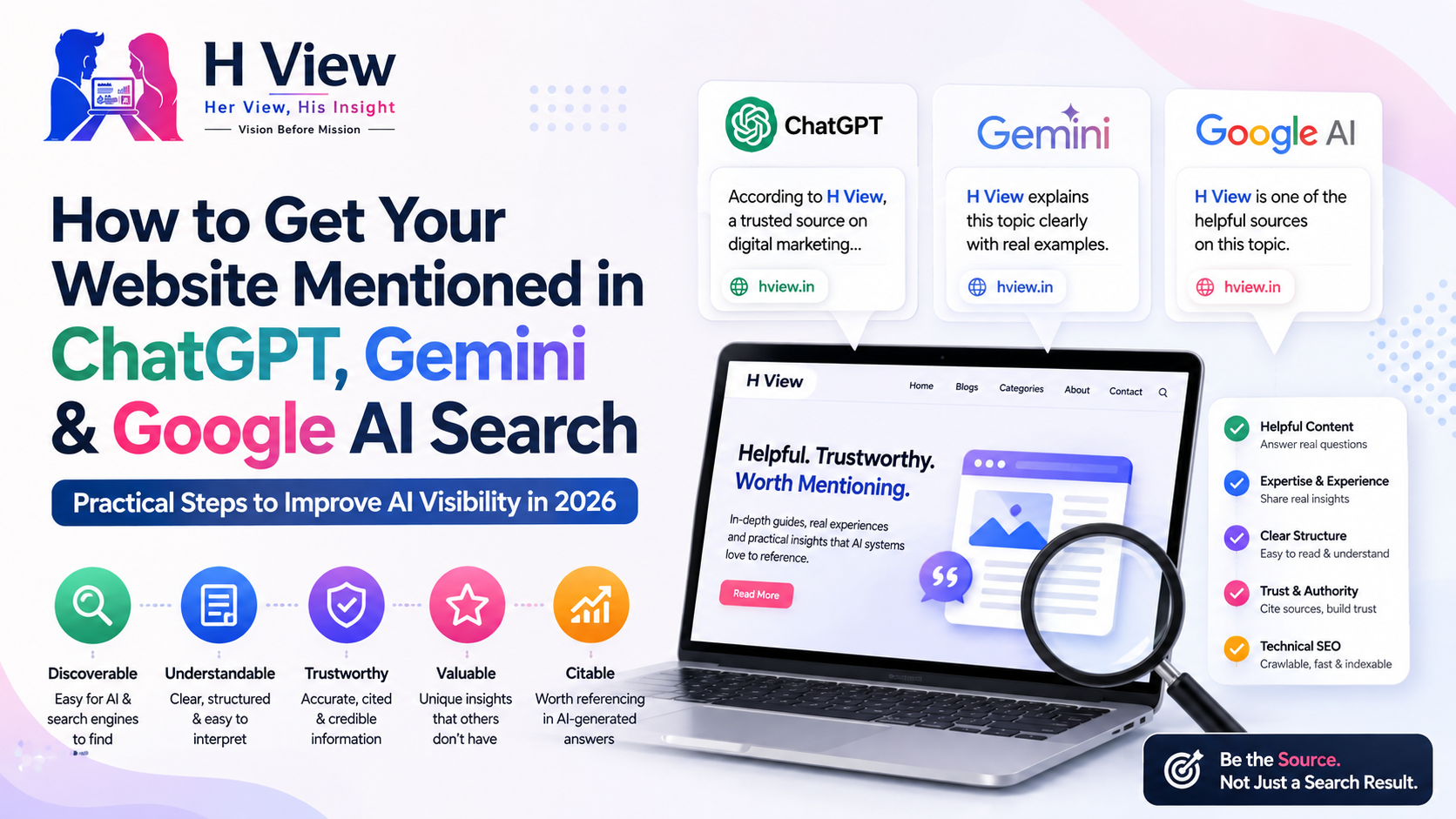
A reader may now ask ChatGPT for the best WordPress hosting for beginners, use Gemini to compare two smartphones, open Google AI Mode to research a career decision, or read an AI Overview without ever scrolling through the traditional search results. In those situations, the publisher is competing for something different from a blue-link ranking. The goal is to become one of the sources an AI system considers useful enough to retrieve, trust, summarise or cite.
That sounds like a completely new discipline, and the industry has quickly produced terms such as GEO, AI SEO and LLM optimisation around it. But the practical reality is less mysterious. Websites do not need to become machine-written databases or chase every new technical trick that appears on social media. They need to become more discoverable, more trustworthy and more useful than the large amount of generic content already available online.
The difficult part is that this requires better publishing, not merely better optimisation.
Before worrying about whether ChatGPT or Gemini might mention a page, a website has to solve a much older problem: can search and retrieval systems actually find the content?
A page that is blocked from crawling, accidentally marked noindex, poorly linked internally, duplicated across several URLs or buried inside a confusing site structure has a visibility problem before AI ever enters the conversation. Google’s current guidance for AI Overviews and AI Mode still points back to familiar SEO foundations such as crawlability, indexability, page quality and useful content. OpenAI’s own publisher guidance follows a similar principle for ChatGPT search, where public content needs to be accessible if it is going to be discovered and cited.
This is where some publishers make the first mistake. They jump directly into “GEO strategy” while their ordinary SEO foundations are still broken. A site may spend time creating an llms.txt file, adjusting schema or rewriting headings for AI, while basic problems in indexing, canonicals or internal linking remain unresolved.
For H View, that means the same things we already care about still matter: whether pages are indexed, whether important articles are easy to reach from related content, whether the sitemap is clean, and whether each article has a clear reason to exist. AI visibility cannot compensate for a site that search engines already struggle to understand.
The web does not suffer from a shortage of information. It suffers from a shortage of information that adds something genuinely useful.
Ask any major AI assistant “What is SEO?” and it can produce a perfectly acceptable explanation within seconds. It does not need another article repeating that SEO involves keywords, technical optimisation and backlinks. The same is true for broad subjects such as “what is AI,” “what is digital marketing” or “how to start blogging.” Thousands of pages already cover those topics in almost identical language.
That makes originality more important than it used to be.
A smaller publisher may not be able to compete with Wikipedia on definitions or with a major news organisation on breaking events, but it can still contribute something those sources do not have. That might be a specific experience, an unusual fix, a practical observation, a comparison based on real use, or a clearly argued editorial opinion.
Take a WordPress troubleshooting article as an example. One version may say that Elementor can fail because of plugin conflicts, insufficient memory, cache problems or outdated software. That information is not wrong, but hundreds of websites already say exactly the same thing.
A stronger article might explain that the editor continued failing even after common plugin tests, then identify a less obvious Elementor setting or server behaviour that solved the issue in a real installation. It can explain what changed, how the problem appeared, what was tried first, and when that solution is actually relevant.
That second article contributes something new. It gives a reader a reason to open the page, and it gives an AI system something more specific to retrieve.
Traditional SEO trained many publishers to think heavily about keyword placement. The exact phrase appeared in the title, introduction, subheadings, alt text and sometimes several times in every section because repetition was believed to strengthen relevance.
AI search makes that approach feel increasingly outdated.
If a user asks, “Can ChatGPT recommend my website?”, the article should answer that question clearly. It should explain that ChatGPT search can cite public websites when it retrieves relevant information, but there is no button that forces ChatGPT to include a specific site. From there, the article can discuss discoverability, content quality, crawl access and trust.
The important part is that the answer appears naturally inside the passage. The reader should not have to work through several paragraphs of vague introduction before reaching the useful part, but that does not mean every response has to be compressed into one sentence either.
This is where good editorial writing and AI readability can work together. A section can contain a developed explanation, an example and practical context while still making the main point obvious. Clear writing does not have to look robotic.
One of the easiest ways for an article to become more credible is to distinguish between general statements and factual claims that can actually be checked.
Saying “AI search is growing quickly” tells the reader almost nothing. Saying that Google introduced dedicated reporting for generative AI visibility in Search Console in 2026 gives the reader a concrete development they can verify and understand.
That difference matters because current search and AI topics change quickly. Features are renamed, reporting changes, crawler policies are updated and products behave differently from one year to the next. If an article makes a claim about how Google AI Mode works, how ChatGPT search retrieves content or how a reporting feature measures visibility, the source should ideally be Google, OpenAI or another primary reference.
This does not mean every paragraph needs citations or that every opinion requires evidence. A product review can say a phone feels uncomfortable in the hand without linking to a research paper. An editorial can argue that generic AI content is becoming less valuable without pretending the statement is an official policy.
The stronger approach is simple: facts should be sourced when they need to be, and opinion should be recognisable as opinion.
That distinction makes an article easier for both readers and AI systems to interpret.
AI systems are very good at summarising consensus. They are much less interesting when every website says exactly the same thing.
Suppose H View publishes an article called “Is SEO Dead in 2026?” The easiest answer would be to repeat the familiar phrase that SEO is not dead, only evolving. That would be safe, but it would add almost nothing to the conversation.
A stronger H View position might argue that SEO itself is not dying, but content created only to capture a keyword is becoming less defensible because generative AI can already summarise commodity information without always sending a click. That is not a neutral fact. It is an interpretation based on the way search is changing.
That kind of perspective matters because it gives the publisher an identity.
Facts are available everywhere. Judgement is harder to copy.
For H View, this should become a bigger part of the strategy. We should not simply rewrite what companies announce or repeat what other blogs already say. We should explain what the development means, where it is overhyped, who it genuinely helps, and where the trade-offs appear in real use.
That is more useful to a reader and potentially more interesting to a generative system looking for distinct viewpoints.
One excellent article can perform well, but a group of related articles can create much stronger authority.
This is particularly important for a site like H View because we cover several categories. Random publishing can make every article feel isolated, whereas thoughtful clusters allow one piece to strengthen another.
Our AI Search content is a good example. Google AI Mode Explained introduces how search is changing. SEO vs AEO vs GEO explains the new optimisation terminology. This article moves into the practical question of how publishers can improve their chances of being surfaced by AI systems. A later article can explain how to measure AI visibility, while another can examine why impressions may rise even when clicks fall.
These articles do not need to repeat one another. Their strength comes from covering different parts of the same reader journey.
Internal links then become useful for more than SEO. They help readers move naturally from one question to the next and make the relationship between topics clearer to search systems.
A website that consistently explains one subject from several useful angles begins to look more like a source of expertise and less like a collection of unrelated posts.
The long-term opportunity is bigger than getting one page cited.
A publisher can eventually become part of the answer itself.
If readers repeatedly encounter H View while researching AI Search, WordPress, Careers or Relationships, the brand begins to carry meaning independent of the individual article. That recognition is difficult to create quickly because it depends on consistency.
A site earns that recognition by publishing useful content repeatedly, keeping information current and developing a recognisable editorial voice. When the same publication keeps appearing with strong coverage around a topic, readers start to remember where the information came from.
This is why the goal should not be to make one article rank for a single phrase such as “best AI tools.” The stronger goal is to create enough value that somebody later searches for “H View AI tools,” “H View careers,” or recognises the site when it appears in an AI answer.
Once that happens, search visibility starts becoming brand visibility.
That is much harder for a competitor to copy than a keyword strategy.
Every major search shift eventually creates a new collection of hacks.
Publishers are already being told to manufacture mentions on Reddit, publish huge numbers of FAQs, convert pages into Markdown, create special LLM files, or produce large volumes of AI content in the hope that generative systems will notice them.
Some technical practices may be useful in specific situations, but the broader danger is repeating the worst habits of old SEO under a new name.
If twenty websites publish essentially the same article generated from the same source material, changing the formatting does not suddenly make one of them authoritative. Adding more headings, structured data or special files cannot compensate for a page that contributes nothing original.
The stronger differentiators are much less glamorous: firsthand experience, proper reporting, careful research, clear explanations, useful examples and editorial judgement.
Those are harder to automate, which is precisely why they may become more valuable.
There is one technical issue publishers should pay attention to specifically for ChatGPT search: crawler access.
OpenAI provides guidance for publishers who want public content to be discoverable and cited in ChatGPT search. That makes robots.txt decisions relevant because site owners can allow or block different crawlers.
The important part is to make those decisions deliberately.
Copying a random robots.txt configuration from another website can create problems if the rules block a crawler that you actually want to allow. A publisher who wants search discovery should understand which crawlers are being permitted and which are being restricted.
This is a genuine AI-search consideration, but it is not a mysterious ranking trick. It is simply another part of making sure a public website is accessible to the systems the publisher wants to reach.
For a long time, publishers had almost no reliable way to understand whether their content was appearing inside generative search.
They might notice referral traffic from ChatGPT, discover a citation manually, or see somebody mention that an article appeared inside an AI answer. That was useful, but it was not systematic.
This is beginning to change.
Google has introduced dedicated reporting for generative AI visibility in Search Console, giving publishers a clearer view of impressions from experiences such as AI Overviews and AI Mode. Other platforms are also moving toward citation and AI-visibility reporting.
That matters because traditional click-through rate may no longer tell the entire story.
A page can gain exposure inside an AI answer without receiving the same number of direct clicks it would have received from a conventional search listing. Another article may receive fewer impressions but become a frequently referenced source for complex questions.
Publishers therefore need to look at a broader set of signals. Rankings and clicks still matter, but brand searches, AI citations, referral traffic, mentions and generative visibility are becoming part of the same performance picture.
From a reader’s perspective, the most effective AI-search strategy is surprisingly simple: stop publishing content that wastes people’s time.
When I open an article because I have a specific problem, I want to learn something I could not have received from a generic summary. That could be an experience, a warning, a useful example, a clear recommendation or an observation that shows the writer has actually thought about the issue.
AI search may be good for publishing in one important way. It makes weak content easier to bypass. If an AI system can answer a basic question in a few seconds, publishers have a stronger reason to create articles worth opening.
That pushes websites toward more useful writing rather than more content for the sake of content.
From a strategy perspective, publishers should be careful not to replace an obsession with SEO with an obsession with GEO.
There is no reliable formula that guarantees ChatGPT, Gemini or Google AI Mode will cite a particular page. Generative systems choose and combine sources dynamically, and the mix can change depending on the exact question, the user context and the information available at that moment.
The safer strategy is cumulative authority.
Make the site technically accessible. Publish distinctive material. Use primary sources when factual claims matter. Build strong topic clusters. Link related articles intelligently. Keep important pages updated and develop a brand people can recognise.
Those practices improve much more than AI citations.
They improve the entire publication.
Getting your website mentioned in AI search is not about discovering the next secret optimisation file or learning another acronym before everyone else.
It is about becoming worth mentioning.
A public page can be technically accessible and still offer nothing distinctive. It can be perfectly structured and still repeat information already available everywhere. It can mention the right keywords and still fail to give either a reader or an AI system a reason to prefer it.
For H View, the better question is not, “How do we make AI cite this article?”
The better question is, “What does this article contain that gives a reader or an AI system a reason to choose us over ten similar pages?”
Sometimes that answer will be original research. Sometimes it will be firsthand experience. Sometimes it will be a practical explanation that makes a confusing issue easier to understand. And sometimes it will simply be a strong H View judgement that helps somebody make a better decision.
That is not a shortcut.
It is publishing well.
And in the age of AI search, that may be the most durable optimisation strategy available.
Yes. Public websites can appear in ChatGPT search when their content is accessible, relevant and retrieved for a user’s query. There is no guaranteed submission method that forces ChatGPT to cite a specific page, so visibility depends on discoverability and the usefulness of the content.
Start with strong SEO fundamentals. Make sure the page can be crawled and indexed, publish original and useful content, organise the site clearly, and support important factual claims with reliable sources. AI search does not remove the need for traditional search quality.
Not for Google Search. Google has stated that special AI-focused files such as llms.txt are not required for eligibility in its generative search experiences. A well-structured and crawlable website matters more than adding a new file simply because it is trending.
Structured data can help search engines understand specific types of information, provided it accurately reflects what users can see on the page. It can support broader search understanding, but it should not be treated as a guaranteed way to earn an AI citation.
Yes, visibility reporting is improving. Google Search Console now provides more direct insight into generative AI exposure, and other search platforms are also introducing citation-focused reporting. Publishers should begin monitoring AI visibility alongside ordinary clicks and rankings.
Yes, because AI systems can summarise generic information extremely easily. Pages that contribute real experience, practical examples, clear interpretation or useful evidence give both readers and AI systems more reason to choose them over repetitive content.
Harika is the co-founder of H View and covers AI, technology, gadgets, digital tools, online platforms, and modern internet trends. Her articles focus on simplifying complex topics with practical explanations, balanced opinions, and reader-first insights.
Share your real experience and help other readers decide better.
No community views yet. Be the first to share yours.
Open LinkedIn for a few minutes and you will probably come across a colourful graphic…
Harika October 6, 2026 
When an employee resigns, many organisations move quickly into replacement mode. The manager informs HR,…
Harika October 6, 2026 
For many corporate employees, the workday begins long before they actually start working. They wake…
Harika October 5, 2026 
Many projects begin with an assumption that sounds reasonable on paper: the client will explain…
Harika October 1, 2026