

Best Digital Marketing Tools in 2026: What Marketers Actually Need and What They Can Skip
Open LinkedIn for a few minutes and you will probably come across a colourful graphic…
 Harika October 6, 2026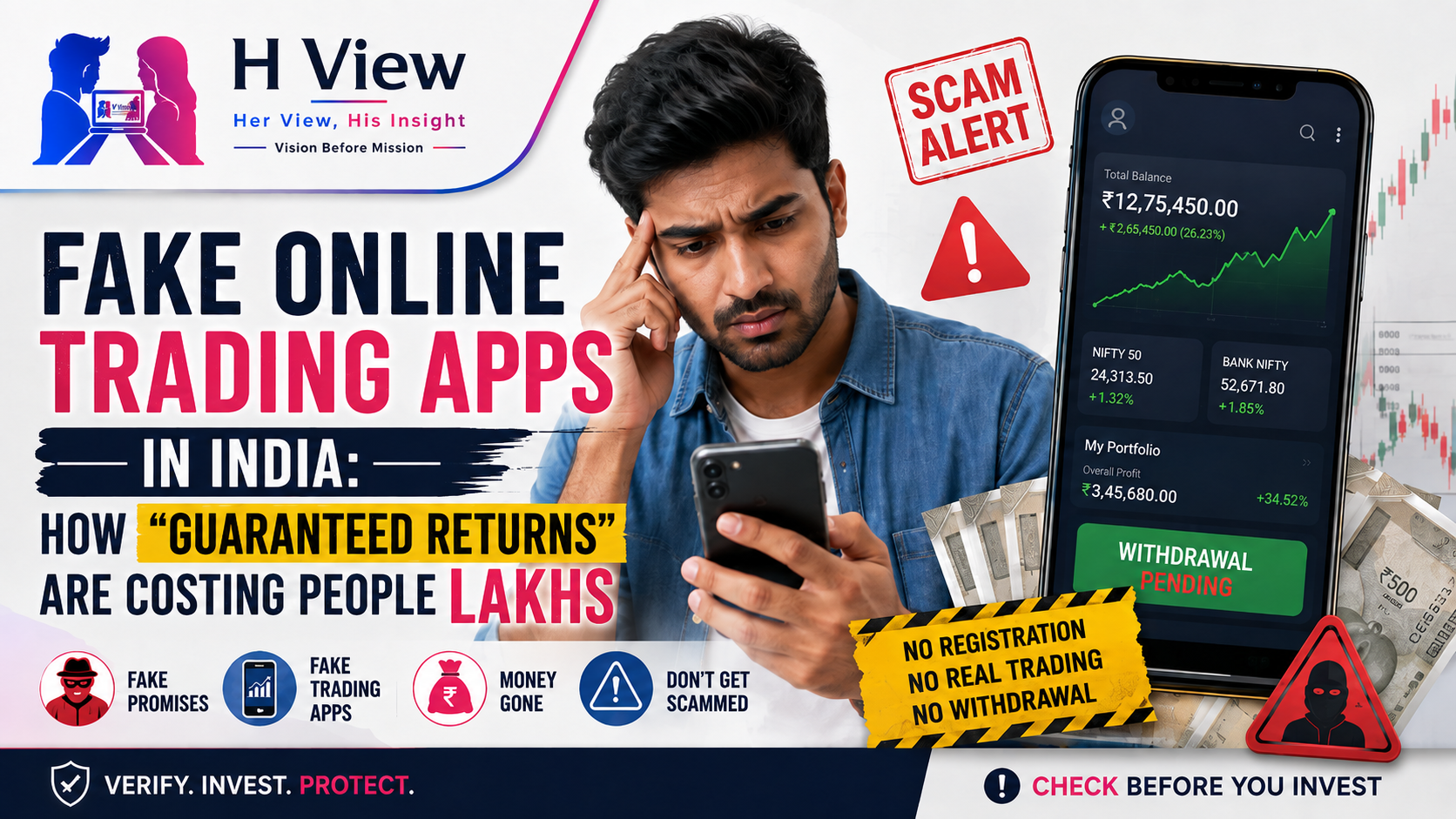
 By Satya HemanthUpdated August 16, 202610 min read39 views
It often starts with something that does not look particularly dangerous. You are scrolling through Facebook, Instagram or YouTube when an advertisement promises unusually good returns from stock trading. The person in the video sounds knowledgeable, the comments underneath are full of people claiming they have already made money, and the offer does not necessarily promise something ridiculous like doubling your investment overnight. It may simply say you can earn 5% or 6% every month.
That feels believable enough to investigate.
A recent case from Udupi shows how costly that curiosity can become. According to a police complaint reported on August 16, a 35-year-old man allegedly lost around ₹19.5 lakh after responding to a Facebook advertisement that promised monthly returns of roughly 6% to 7%.
The troubling part about fake trading scams is that they rarely look fake from the beginning. The website may have professional charts, the app may show live-looking numbers, and a WhatsApp group may appear to contain dozens of successful investors. Some victims are even allowed to withdraw a small amount early on, which makes the platform feel legitimate.
By the time the real trap becomes visible, a person may have transferred lakhs.
Imagine an ordinary working professional named Ravi. He sees an advertisement on Facebook featuring a person discussing an “institutional trading strategy” that supposedly produces steady returns. He clicks it and is redirected to WhatsApp, where an assistant welcomes him into a private investment group.
The group appears active throughout the day. An “analyst” discusses stocks before the market opens, members post screenshots showing profits of ₹18,000 or ₹40,000, and people congratulate one another. Ravi does not invest immediately. He watches quietly for a week.
That waiting period can actually strengthen the illusion.
Eventually, he is encouraged to start small with ₹10,000. The trading app shows a profit within days. Perhaps ₹1,000 or ₹1,500 is even transferred back to his bank account when he requests a withdrawal. Ravi now has something more convincing than an advertisement: money has genuinely arrived.
An earlier Udupi case followed a similar pattern. A victim initially invested ₹21,600 and later received ₹2,130 as a supposed profit. According to the complaint, that early payment increased his confidence and encouraged further investment before he eventually lost around ₹2.7 lakh.
The small payout was not evidence that the investment platform was genuine. It was potentially part of the persuasion.
One of the hardest ideas for victims to accept is that the impressive account balance they are watching may simply be a number controlled by the scammer.
If a genuine brokerage account says you own shares, there should be an actual regulated market transaction behind that information. A fraudulent application can display whatever its operator wants: ₹1 lakh becoming ₹1.4 lakh, a successful IPO allocation, an impressive daily profit or a portfolio that never seems to have a bad week.
The screen itself proves very little.
Suppose you transfer ₹3 lakh to bank accounts provided by the people running the platform. Your dashboard might suddenly display ₹4.8 lakh. You may naturally begin thinking about what you will do with the ₹1.8 lakh profit.
Then you press Withdraw.
Instead of receiving the money, an account manager tells you that a 20% tax must first be deposited separately. After paying that, there is a “security verification charge.” Then perhaps an “institutional account release fee.”
At that point, the scam has shifted. You are no longer investing because you expect future profits; you are paying because you are trying to recover money you already believe belongs to you.
A number on a private app can create a powerful sense of ownership even when no underlying investment exists.
People naturally look at what others are doing when they are uncertain.
That makes a busy investment group extremely effective.
One member says, “Thank you sir, withdrew ₹86,000 today.” Another posts a screenshot showing an account balance of ₹12 lakh. Someone who hesitated yesterday announces that they regret not investing more. If Ravi raises a concern, several people may immediately reassure him that withdrawals work perfectly.
But how does Ravi know those are independent investors?
He does not.
Some profiles could belong to the same fraud network. Screenshots can be manufactured. Conversations can be coordinated specifically to create the impression that everybody except the new victim understands the opportunity.
A separate Udupi case reported in March involved a woman who encountered trading-related content on YouTube, later entered a WhatsApp group where online trading classes were conducted, downloaded another application and eventually transferred approximately ₹11.8 lakh to various accounts. She reportedly received neither the expected profits nor her investment back.
The educational setting matters. A scam does not always begin with “send us money.” Sometimes it begins with several days of classes, market discussion and apparent expertise.
Until recently, an advertisement featuring a well-known business personality or celebrity felt like useful evidence that an opportunity had some legitimacy.
AI has weakened that assumption.
Cybercrime authorities in Andhra Pradesh have warned about fraudsters using AI-generated celebrity images and videos to promote fake investment schemes, including cryptocurrency offers. Familiar faces can be made to appear as though they are recommending platforms they have never endorsed.
This is a natural extension of the deepfake problem we recently discussed in our H View article about India’s pressure on Meta over manipulated AI content. A fake face becomes particularly dangerous when it is attached to a financial decision.
A person does not need to believe AI is perfect. The video only needs to survive the first few seconds without triggering suspicion.
The safest response to any celebrity-backed investment advertisement is to verify the endorsement independently. Search the celebrity’s official channels, check the financial company separately and never treat the advertisement itself as proof.
There is nothing strange about investing with the hope of earning returns. The problem begins when risk quietly disappears from the sales pitch.
SEBI’s investor guidance specifically warns people to be suspicious of anyone promising assured, guaranteed or near-certain returns, because securities-market investments inherently involve some degree of risk. It also highlights pressure tactics, unregistered entities and unusually high returns regardless of market conditions as warning signs.
Consider what 6% every month actually implies.
A ₹1 lakh investment earning 6% monthly and compounding each month would grow to roughly ₹2 lakh within a year. That is not the same as an ordinary savings product delivering a predictable annual interest rate.
A scammer does not have to promise “₹1 lakh becomes ₹10 lakh.” A smaller-looking monthly percentage can sound sophisticated while still implying an extraordinary annual return.
The H View rule here is simple: the more certain somebody sounds about market returns, the more verification you should demand.
Verification should happen before the first ₹1,000, not after ₹5 lakh is already trapped.
SEBI provides tools for investors to check whether market intermediaries are registered, and its investor portal maintains information about authorised mobile trading applications and registered intermediaries.
Start by identifying the actual stockbroker, investment adviser or research analyst behind the service. Do not rely on a registration number displayed inside a WhatsApp message; verify it independently through SEBI.
Also pay attention to where the money is being sent. If somebody claiming to operate a sophisticated trading platform repeatedly instructs you to transfer funds into unrelated personal or unfamiliar bank accounts, something deserves closer examination.
A legitimate investment service should also be able to explain clearly what you are buying, how it is held, what fees apply and how withdrawals work. Complexity should not become an excuse for avoiding basic questions.
SEBI’s latest annual report says its investor-awareness initiatives specifically cover fake trading applications, unregistered advisers, phishing links, deepfake scams and courses or schemes promising guaranteed returns.
These scams are common enough that investor education now treats them as a distinct category rather than an unusual exception.
This is often the most painful point in the entire scam.
A person may realise something feels wrong but still send another ₹50,000 because they are told ₹8 lakh will be released immediately afterward.
The fraudster understands the emotion involved. Walking away feels like accepting that the earlier money is gone. Paying one more fee creates hope that the entire amount can still be recovered.
Do not allow that pressure to determine the next transfer.
If a suspicious trading platform suddenly demands additional money before allowing withdrawal, stop and independently verify the company. Preserve screenshots, bank details, WhatsApp conversations, app information and transaction references.
If you believe you have been defrauded, contact your bank promptly and report cyber financial fraud through India’s 1930 helpline and National Cyber Crime Reporting Portal.
It is also worth understanding where transferred money can go after leaving the victim. Fraud proceeds are frequently moved through intermediary accounts, which is why our H View guide on mule bank accounts and cyber fraud is an important companion to this article.
Investment scams often get discussed as though the victim simply became greedy. That explanation is too convenient.
Many victims are not trying to become millionaires overnight. They may be attempting to build retirement savings, pay for a child’s education or find a better return than a bank deposit. Scammers understand those goals and design the experience around them.
The emotional trap becomes particularly strong when the app shows profits that feel almost within reach. By the time withdrawal problems appear, the person is no longer deciding whether to invest. They are desperately trying to rescue something they already mentally count as their own money.
That deserves awareness, not ridicule.
A professional-looking dashboard has almost no value as evidence by itself.
The important questions exist outside the app: Is the intermediary registered? Does the broker exist independently? Where is the money going? Can the securities actually be verified? Is the adviser registered? Are returns being presented honestly as uncertain rather than guaranteed?
A genuine investment can lose money because markets move against you. A fake trading platform is fundamentally different—the trade itself may never have existed.
Understanding that distinction can prevent people from mistaking a colourful interface for financial infrastructure.
Fake trading applications work because they copy the appearance of legitimate investing while removing the uncomfortable parts of real investing: uncertainty, losses and patience.
The charts look professional. The analyst seems confident. Other members appear profitable. A small withdrawal may even work.
None of those things should replace verification.
Before transferring money, identify the regulated entity behind the platform and check it independently through SEBI. Be particularly cautious when an opportunity begins through unsolicited Facebook, Instagram, YouTube, Telegram or WhatsApp contact, promises unusually consistent returns or requires transfers to changing bank accounts.
And when an app says you have earned ₹10 lakh but asks for another ₹1 lakh before allowing you to withdraw it, do not let the number on the screen make the next decision for you.
A real investment carries risk.
A fake investment carries something more dangerous: the illusion that there was never any risk at all.
Identify the broker or intermediary operating the platform and independently verify its registration through SEBI. SEBI’s investor resources also provide information about authorised mobile trading applications and registered intermediaries.
Not every misleading promise proves that an entire operation is fraudulent, but guaranteed or near-certain securities-market returns should be treated as a serious warning sign. SEBI reminds investors that securities investments involve risk and specifically cautions against guaranteed high-return claims.
A small withdrawal can make a fraudulent platform appear trustworthy and encourage a victim to invest a much larger amount. This pattern has appeared in reported Indian trading-fraud cases.
Yes. Cybercrime authorities have warned about AI-generated celebrity endorsements being used to make fraudulent investment schemes appear legitimate. Always verify endorsements through independent official sources.
Stop making additional payments until the platform and demand have been independently verified. Preserve evidence, contact your bank when fraud is suspected and promptly report cyber financial fraud through the appropriate cybercrime channels.
No. A legitimate investment can lose value because the market moves against your position. In a fake trading-platform scam, the displayed trades, profits or holdings themselves may be fabricated and the money may never have entered the securities market at all.
Satya Hemanth is the founder of H View and writes on careers, sports, leadership, digital trends, and practical decision-making. His articles focus on clear explanations, real-world examples, and useful insights for students, young professionals, and everyday readers.
Share your real experience and help other readers decide better.
No community views yet. Be the first to share yours.

Open LinkedIn for a few minutes and you will probably come across a colourful graphic…
Harika October 6, 2026 
When an employee resigns, many organisations move quickly into replacement mode. The manager informs HR,…
Harika October 6, 2026 
For many corporate employees, the workday begins long before they actually start working. They wake…
Harika October 5, 2026 
Many projects begin with an assumption that sounds reasonable on paper: the client will explain…
Harika October 1, 2026