

Best Digital Marketing Tools in 2026: What Marketers Actually Need and What They Can Skip
Open LinkedIn for a few minutes and you will probably come across a colourful graphic…
 Harika October 6, 2026
  By HarikaUpdated September 20, 202610 min read32 views
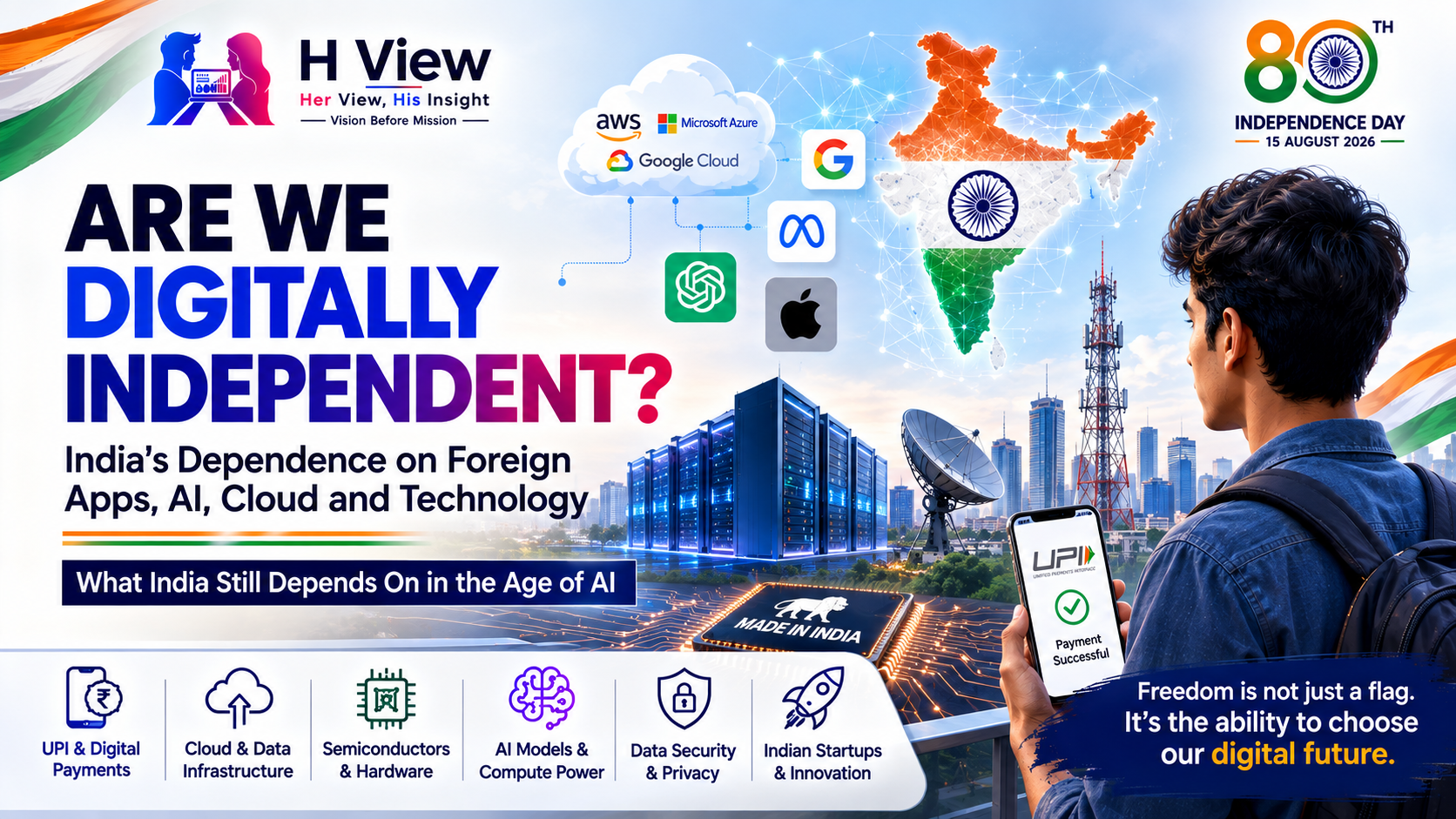
India can pay for tea with a QR code in seconds, verify identity digitally, transfer money instantly, build businesses entirely online and increasingly access artificial intelligence from a phone. From the outside, that looks like a country that has already achieved a remarkable degree of digital independence.
In many ways, it has.
India has created digital systems that are not merely copies of what existed elsewhere. UPI has changed how ordinary payments work at a scale few countries have matched, while India’s broader digital public infrastructure has become a model discussed internationally. At the same time, the country is investing heavily in artificial intelligence, semiconductor manufacturing, local compute infrastructure and home-grown technology capabilities.
But there is another side to the story.
The smartphone in an Indian user’s hand may run Android or iOS. Search may depend on Google. Business email may sit on Microsoft or Google servers. Startups may build on Amazon Web Services, Microsoft Azure or Google Cloud. AI work may rely on models created by OpenAI, Google, Anthropic or Meta. Many of the advanced chips powering those systems are designed and manufactured through global supply chains India does not yet control.
So, as India marks its 80th Independence Day, a more interesting question emerges.
What does independence mean when a nation can build extraordinary digital services but still depends heavily on global technology underneath them?
Any discussion about India’s digital dependence should begin by acknowledging how much the country has created on its own terms.
UPI is the clearest everyday example.
Instead of requiring people to carry cash, swipe a card or even know another person’s bank details, UPI made instant bank-to-bank payments simple enough to work from neighbourhood vegetable stalls to airports. In January 2026 alone, UPI processed a record 21.70 billion transactions worth ₹28.33 lakh crore, according to NPCI.
That is not a small technological achievement hidden inside government policy. It has changed everyday behaviour.
A street vendor does not need to understand payment gateways or banking architecture. A customer scans a QR code, enters an amount and pays. The technology disappears behind the experience, which is usually a sign that a digital system has matured.
India has also demonstrated that public digital infrastructure can create opportunities for private innovation rather than replacing it. Banks, fintech firms, merchants, government services and startups have built on top of shared digital rails.
This matters because technological independence is not simply about manufacturing every device domestically. It is also about possessing systems that are strategically important and difficult to replace.
By that measure, India is not starting from zero.
Now look at an ordinary day.
An Indian professional wakes up and checks WhatsApp, owned by Meta. They open Gmail, search on Google, join a Microsoft Teams meeting and work on a laptop running Windows or macOS. Their company may store data in AWS, Azure or Google Cloud. During lunch they watch YouTube or Instagram. Later, they ask ChatGPT or Gemini to help prepare a presentation.
None of this is inherently a problem.
Global technology works precisely because countries, companies and users benefit from specialised products developed across borders. Expecting India to build a domestic replacement for every successful international service would be neither realistic nor necessarily useful.
The issue begins when convenience becomes dependency.
If a business relies entirely on one foreign cloud platform, moving away may become expensive and technically difficult. If most online discovery happens through a handful of global search and social platforms, changes to their algorithms can affect Indian businesses overnight. If developers build AI products primarily on foreign models, pricing or access decisions made elsewhere can directly influence what those Indian products cost and whether they remain viable.
Digital dependence is rarely dramatic. It usually appears gradually, through thousands of reasonable choices.
That makes it harder to notice.
Artificial intelligence adds a new layer because AI is not simply another app.
Advanced AI systems require enormous amounts of compute, specialised chips, high-quality datasets, engineering talent and capital. Countries that control more of this infrastructure may have greater freedom to decide how their AI ecosystems develop.
India is clearly aware of that challenge.
The IndiaAI Mission includes a national compute initiative intended to provide affordable access to AI infrastructure. The official IndiaAI platform describes a goal of building a scalable ecosystem with more than 10,000 GPUs through public-private partnerships, while newer IndiaAI material refers to availability of more than 18,000 affordable compute units.
This may sound like an issue relevant only to researchers, but consider what it means for a small Indian AI startup.
Without affordable local compute, that company may have to rent expensive infrastructure from global providers. It may also depend on an external AI model through an API. If usage grows, costs rise in foreign currency. A change in pricing, policy or access conditions can suddenly alter the economics of the entire business.
Local compute does not magically solve every problem, but it creates options.
And options are an important part of independence.
There is another dependency buried even deeper inside nearly every digital experience: chips.
Phones, laptops, data centres, cars, telecom equipment and AI systems all depend on semiconductors. India has a significant technology workforce and strong chip-design talent, but manufacturing advanced semiconductors at scale requires specialised fabrication, equipment, materials and supply chains that take years to develop.
India has been pushing much harder in this area.
In July 2026, the Union Cabinet approved Semicon 2.0, with a total budget outlay of ₹1,27,500 crore for the development of India’s semiconductor design and manufacturing ecosystem. Earlier government updates also highlighted efforts to strengthen domestic design capability, equipment, materials and semiconductor intellectual property rather than focusing only on assembling finished electronics.
That distinction matters.
A smartphone assembled in India can create jobs and improve manufacturing capability, but assembly alone does not mean India controls all the technology inside that device. The processor architecture may come from one country, fabrication from another, memory from somewhere else and the operating system from a global technology company.
Modern technology is built through interconnected supply chains.
The goal therefore should probably not be complete isolation. It should be reducing the number of places where India has no realistic alternative.
This is where the conversation can easily become misleading.
A country does not become technologically stronger simply by replacing every foreign service with a domestic version.
If an Indian business can use a world-class cloud platform at a competitive price, forcing it to use a weaker alternative in the name of self-reliance may actually reduce its competitiveness. Researchers benefit from international collaboration. Developers benefit from open-source software created across borders. Consumers benefit when global and Indian companies compete with each other.
India itself has grown enormously through this interconnected system.
A more practical definition of digital independence is therefore strategic capability rather than technological isolation.
India should be able to participate in global technology without becoming helpless if one supplier, platform or country changes the rules.
That might mean having domestic payment infrastructure while still accepting international cards. It can mean using global AI models while also developing Indian models and datasets. It can mean welcoming foreign semiconductor investment while building local design, manufacturing and research expertise at the same time.
Independence does not always mean doing everything alone.
Sometimes it means having enough capability that cooperation remains a choice rather than a necessity.
For most people, the phrase “digital sovereignty” sounds distant from everyday life.
But the basic idea appears in simple situations.
Think about a small retailer that accepts UPI. Their ability to receive digital payments is not completely dependent on a foreign card network. Consider a startup that can access subsidised AI compute inside India rather than paying premium international infrastructure costs from day one. Or imagine an Indian-language AI model that understands Telugu, Hindi, Tamil or Bengali context better because it was developed with local datasets and users in mind.
The benefit is not nationalism for its own sake.
It is resilience.
When more technology is designed with Indian conditions in mind, users are less likely to become an afterthought. Pricing can reflect local economics. Languages beyond English receive attention. Small merchants, rural users and lower-cost devices become meaningful design considerations instead of edge cases.
India’s strongest digital successes have often come from solving Indian problems first rather than trying to imitate technology created elsewhere.
UPI is a good example of that mindset.
Digital independence becomes meaningful to an ordinary user only when it improves trust, accessibility and everyday control.
Most people are not going to choose an app because somebody tells them it is Indian. They will choose it because it works well, feels safe, respects their privacy and does not make simple tasks frustrating. If a locally developed product expects users to accept a poorer experience purely out of patriotism, it will struggle once the emotional appeal disappears.
There is also a personal side to digital independence. We should care not only about which country owns a platform, but how much control we ourselves retain while using it. A person who cannot function without checking one social network every few minutes may be technologically connected but not particularly independent. National digital freedom and individual digital freedom are different questions, yet both deserve attention.
The practical goal for India should be to identify the technologies where dependence creates genuine strategic risk and build strength there first.
Payments, telecommunications, cloud infrastructure, cybersecurity, AI compute, semiconductor design and manufacturing are far more important than creating Indian copies of every consumer app. Building deep capability in these foundational areas takes time, capital and patience, but it also creates long-term leverage for thousands of companies that build on top of them.
Semicon 2.0 and the IndiaAI compute programme are important precisely because they move the discussion below the surface level. A country may have millions of software developers, but without access to critical hardware and compute, large parts of the digital economy still depend on infrastructure controlled elsewhere.
India is neither fully digitally dependent nor fully digitally independent.
It sits somewhere much more interesting in between.
The country has already shown that it can build digital infrastructure powerful enough to change how more than a billion people interact with money and public services. At the same time, important layers of modern technology—from operating systems and cloud platforms to advanced AI models and semiconductors—remain deeply connected to global companies and supply chains.
That is not automatically a weakness.
The real danger would be mistaking access for capability.
India can use the world’s best technology while continuing to build the ability to create, operate and control critical technology of its own. If those two things happen together, digital independence does not need to look like a wall around the country.
It can look like confidence.
On Independence Day, perhaps that is the more useful definition of technological freedom: not refusing to depend on anyone, but making sure India always has enough capability to choose who it depends on, why, and on what terms.
Digital independence generally means having sufficient control and capability across important technologies, infrastructure and data rather than being completely dependent on external providers. It does not necessarily require a country to produce every digital product domestically.
Yes. UPI was developed by the National Payments Corporation of India and has become one of India’s most significant digital public infrastructure platforms. In January 2026, it processed 21.70 billion transactions worth ₹28.33 lakh crore.
The IndiaAI Mission is a Government of India initiative aimed at developing a broader domestic AI ecosystem. Among its pillars is affordable AI compute capacity, alongside areas such as datasets, innovation, skills, startups and responsible AI.
Semiconductors are essential to phones, computers, telecom networks, vehicles, defence systems and artificial intelligence infrastructure. Building more domestic design and manufacturing capability can reduce strategic supply-chain dependence while creating jobs, skills and intellectual property.
No. Complete technological isolation would be impractical and could limit innovation. A stronger approach is to use global technology where it makes sense while ensuring India has domestic alternatives or capabilities in areas that are economically or strategically critical.
Complete independence is unlikely for India or almost any modern economy because technology supply chains are global. A more realistic goal is resilience: strong domestic capability combined with diversified international partnerships.
Harika is the co-founder of H View and covers AI, technology, gadgets, digital tools, online platforms, and modern internet trends. Her articles focus on simplifying complex topics with practical explanations, balanced opinions, and reader-first insights.
Share your real experience and help other readers decide better.
No community views yet. Be the first to share yours.

Open LinkedIn for a few minutes and you will probably come across a colourful graphic…
Harika October 6, 2026 
When an employee resigns, many organisations move quickly into replacement mode. The manager informs HR,…
Harika October 6, 2026 
For many corporate employees, the workday begins long before they actually start working. They wake…
Harika October 5, 2026 
Many projects begin with an assumption that sounds reasonable on paper: the client will explain…
Harika October 1, 2026