

Best Digital Marketing Tools in 2026: What Marketers Actually Need and What They Can Skip
Open LinkedIn for a few minutes and you will probably come across a colourful graphic…
 Harika October 6, 2026
  By HarikaUpdated July 17, 202611 min read35 views
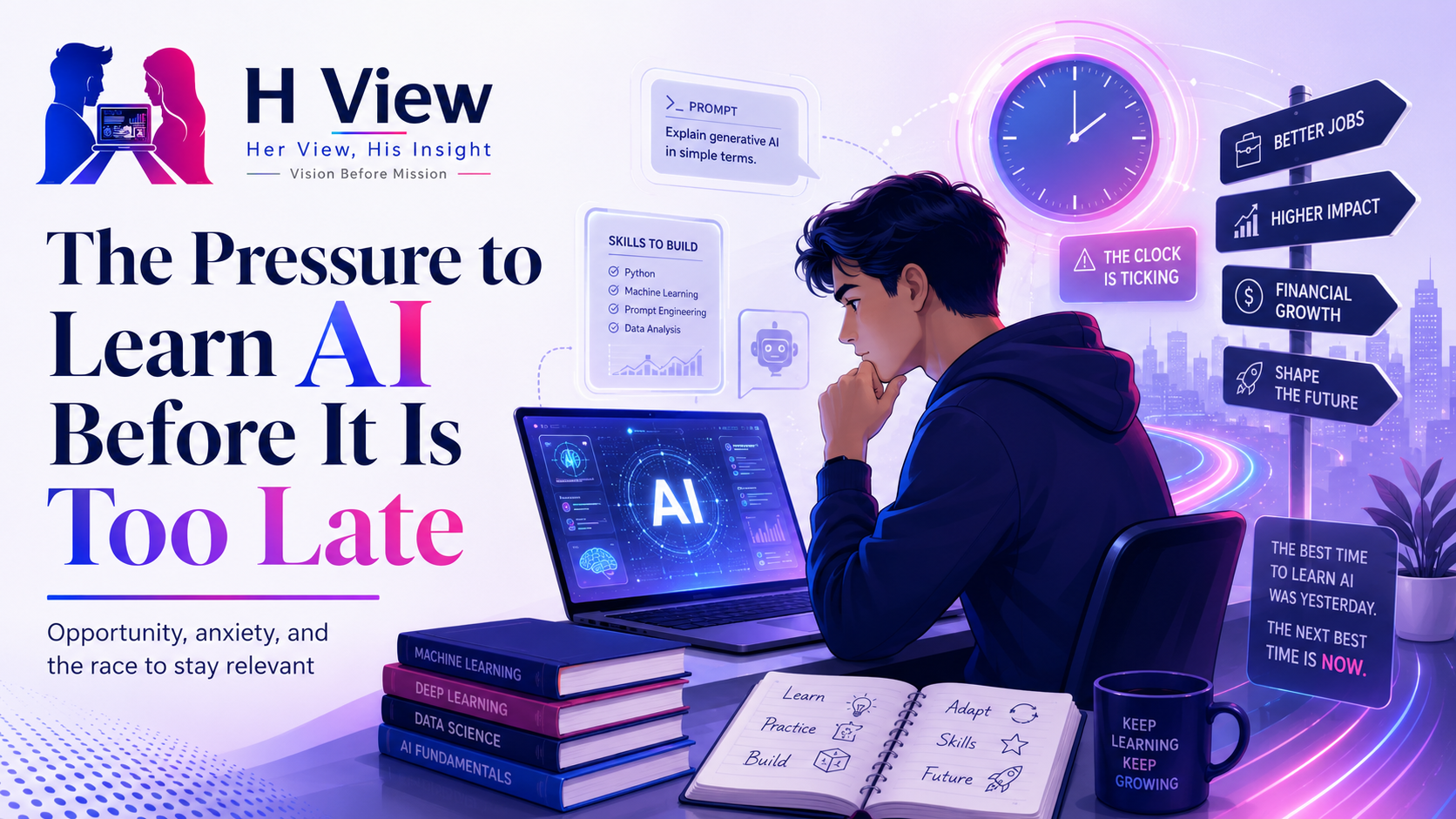
Artificial intelligence is no longer discussed only by technology companies, researchers, or software developers. It has entered offices, classrooms, small businesses, creative work, customer service, marketing, design, finance, and everyday communication.
As a result, many people are beginning to feel a new kind of pressure.
They hear colleagues talking about AI tools. They see social-media posts claiming that one person built an app in a weekend, created a business using automation, or doubled productivity with a few prompts. Job descriptions increasingly mention AI familiarity. Students are told that future careers will depend on understanding artificial intelligence.
The message often sounds urgent:
Learn AI now, or you may be left behind.
For some people, this creates excitement. For others, it creates anxiety, confusion, and a fear that their existing skills may soon become irrelevant.
But is everyone truly falling behind? Do we all need to become AI experts? Or are we allowing online hype to turn a useful learning opportunity into another source of pressure?
The pressure to learn AI comes from several directions at once.
Employees worry that their companies may automate parts of their work. Students wonder whether the skills they are learning will still matter after graduation. Freelancers see clients asking for faster delivery at lower prices because AI tools are available.
Business owners are told that competitors are using AI for marketing, customer support, research, content creation, and sales. Creators see AI-generated images, videos, music, and articles appearing everywhere.
Even people outside technology feel that they are expected to understand terms such as prompts, automation, machine learning, agents, models, and generative AI.
The result is a strange situation: people feel pressure to learn AI even when they are not sure what they need it for.
Online platforms amplify this pressure.
Every day, people encounter posts with claims such as:
Some of these posts may contain useful ideas. Many, however, are designed to attract attention.
They present AI adoption as a race in which everyone else appears to be moving faster.
A beginner may open one AI tool and immediately feel overwhelmed by hundreds of features, tutorials, courses, and competing opinions. Instead of learning calmly, they begin jumping from one tool to another.
This creates activity without real progress.
Watching AI videos, saving tool lists, and collecting prompts can feel productive, but none of these automatically develops useful skill.
From one perspective, learning AI is a practical and valuable decision.
AI can help people perform existing tasks more efficiently. A teacher can prepare lesson plans and practice questions. A marketer can analyse campaign ideas. A developer can understand errors and generate code suggestions. A small business owner can draft customer messages, product descriptions, and business plans.
A student can use AI to understand difficult subjects. A job seeker can improve a résumé and practise interview questions. A content creator can organise ideas and speed up research.
Learning AI can also help people become more confident with technology.
Someone does not need to build an artificial intelligence model to benefit from it. Understanding how to communicate with AI, evaluate outputs, verify information, and apply it to real work can already be valuable.
The people who learn to combine their existing knowledge with AI may be able to work faster, explore new roles, and create services that were previously difficult or expensive.
In that sense, learning AI is not merely about following a trend. It can be an investment in adaptability.
The problem begins when people learn AI only because they are afraid.
Fear creates urgency, but it does not always create clarity.
A person may purchase several expensive courses without completing them. They may subscribe to multiple tools without using them meaningfully. They may try to learn image generation, coding, automation, video creation, data analysis, and prompt engineering at the same time.
Instead of developing one useful skill, they become exhausted by the number of possibilities.
AI changes quickly. New tools appear, existing tools add features, and popular platforms can lose attention within months. Trying to master every tool is neither practical nor necessary.
The real goal should not be to become familiar with everything called AI.
It should be to understand where AI can support your own work, goals, and problems.
Most people do not need to become AI engineers or machine-learning specialists.
A designer does not necessarily need to understand how large language models are trained. A teacher may not need to learn programming. A small business owner may not need to study advanced data science.
What they need is practical AI literacy.
This includes knowing:
This is similar to using the internet.
Most people use websites, email, search engines, online payments, and cloud storage without understanding every technical system behind them. They learn the parts that are relevant to their lives.
AI can be approached in the same way.
One of the biggest mistakes beginners make is starting with a long list of AI tools.
A better starting point is a repeated problem.
Ask yourself:
A recruiter may use AI to organise interview questions and job descriptions. A salesperson may use it to prepare follow-up messages. A blogger may use it to build article outlines and analyse reader questions.
A developer may use AI to understand code, but should still learn the logic behind it. A student may use it to simplify a chapter, but should still attempt the assignment independently.
The value comes from solving a real problem, not from using the most popular tool.
The fear that AI will replace all jobs often oversimplifies reality.
Some repetitive tasks are likely to become more automated. Certain roles may change significantly. Employees may be expected to complete work faster with AI support.
But jobs are usually made up of many different responsibilities.
An HR professional does more than write emails. A doctor does more than interpret symptoms. A teacher does more than produce notes. A lawyer does more than draft documents. A developer does more than generate code.
These roles also involve judgment, accountability, communication, negotiation, empathy, context, and experience.
AI may change how parts of a job are performed without eliminating the entire profession.
The more realistic concern is that people who use AI effectively may gain an advantage over people doing the same work entirely manually.
That does not mean every person must become a technical expert. It means professionals should understand how AI is affecting their field.
The rise of AI does not make human skills worthless.
In fact, AI often becomes more useful when the person using it already has strong knowledge.
An experienced writer can recognise weak structure. A skilled developer can detect unsafe or incorrect code. A financial professional can question unrealistic assumptions. A designer can judge whether an image supports the brand.
Without subject knowledge, users may accept poor output simply because it looks polished.
This is why basic skills remain important:
AI can accelerate these skills, but it does not automatically create them.
A powerful tool in inexperienced hands can produce faster mistakes.
Students and young professionals face a difficult challenge.
They are expected to learn traditional skills while also preparing for a future shaped by AI. At the same time, they may see experienced professionals using AI to complete advanced tasks quickly.
This can make beginners feel that learning fundamentals is unnecessary.
Why learn coding when AI can generate code? Why improve writing when AI can draft an essay? Why study design when AI can create images?
The answer is that beginners still need enough foundational knowledge to judge the result.
A fresher who relies completely on generated code may struggle during interviews, debugging, or real project work. A student who submits AI-written assignments may complete the course without developing the abilities employers expect.
AI should help beginners learn faster, not create the illusion that learning is no longer required.
Learning AI does not need to become a full-time project.
A simple, focused approach is more sustainable.
Learn what generative AI is, how it produces responses, why it can make mistakes, and why important information requires verification.
Select a use case connected to your work or studies, such as writing, research, coding, design, analysis, customer communication, or planning.
Avoid opening accounts across ten platforms immediately. Learn one tool well enough to understand its strengths and limitations.
Use AI on work you already understand. This makes it easier to evaluate whether the output is actually useful.
Check accuracy, relevance, tone, privacy, and originality. Never assume that a confident answer is correct.
Once a use case works, document the steps and improve them. A reliable workflow is more valuable than a folder containing hundreds of random prompts.
Keep writing, solving problems, researching, communicating, and making decisions independently.
The pressure may be becoming unhealthy when:
AI can support career growth, but it is not a guaranteed shortcut to wealth or success.
A tool becomes valuable only when it is combined with knowledge, consistency, and a real problem worth solving.
Her View: Learning AI can help people remain adaptable, improve productivity, access new opportunities, and build confidence with modern technology. Starting early gives users time to experiment without waiting for change to force them.
His Insight: Fear-based learning can create confusion, wasted money, shallow knowledge, and dependence on tools. People do not need to chase every AI trend; they need practical skills connected to their own work.
Both perspectives matter.
Ignoring AI completely may limit future opportunities. But treating AI as an emergency that must be mastered overnight can be equally unhelpful.
The pressure to learn AI is real, but the answer is not panic.
You do not need to master every new platform. You do not need to become an AI engineer unless that is your chosen career. You do not need to abandon the skills you have spent years developing.
You need to understand how AI affects your field, identify where it can genuinely help, and learn to use it without surrendering judgment.
The people most prepared for the future may not be those who know the greatest number of AI tools.
They may be the people who combine strong human skills with the right technology at the right time.
It is worth learning AI—but not because the internet says it is already too late.
Learn it because it can help you become better at something that matters to you.
No. AI adoption is still developing, and new use cases continue to emerge. Beginners should focus on practical applications instead of trying to catch up with every tool or trend.
Everyone may benefit from basic AI literacy, but not everyone needs advanced technical knowledge. The required level depends on a person’s career, studies, business, and daily needs.
A beginner should learn how to give clear instructions, evaluate responses, verify information, and apply AI to one real task connected to their work or studies.
AI may automate certain tasks and change job expectations. In many fields, people who combine professional knowledge with AI tools may have an advantage over those who avoid them completely.
No. Many AI tools are designed for users without programming experience. Coding is necessary mainly for technical development, advanced automation, integrations, and specialized AI careers.
No course can guarantee employment. A useful course should provide practical skills, projects, and understanding. Employers generally value demonstrated ability more than certificates alone.
Consistent practice is more important than long study sessions. Even a few focused hours each week can be useful when the learning is connected to real tasks.
The biggest mistake is using AI-generated work without understanding or reviewing it. Beginners should treat AI as a learning and productivity assistant, not as an unquestionable authority.
Harika is the co-founder of H View and covers AI, technology, gadgets, digital tools, online platforms, and modern internet trends. Her articles focus on simplifying complex topics with practical explanations, balanced opinions, and reader-first insights.
Share your real experience and help other readers decide better.
No community views yet. Be the first to share yours.
Open LinkedIn for a few minutes and you will probably come across a colourful graphic…
Harika October 6, 2026 
When an employee resigns, many organisations move quickly into replacement mode. The manager informs HR,…
Harika October 6, 2026 
For many corporate employees, the workday begins long before they actually start working. They wake…
Harika October 5, 2026 
Many projects begin with an assumption that sounds reasonable on paper: the client will explain…
Harika October 1, 2026