

Best Digital Marketing Tools in 2026: What Marketers Actually Need and What They Can Skip
Open LinkedIn for a few minutes and you will probably come across a colourful graphic…
 Harika October 6, 2026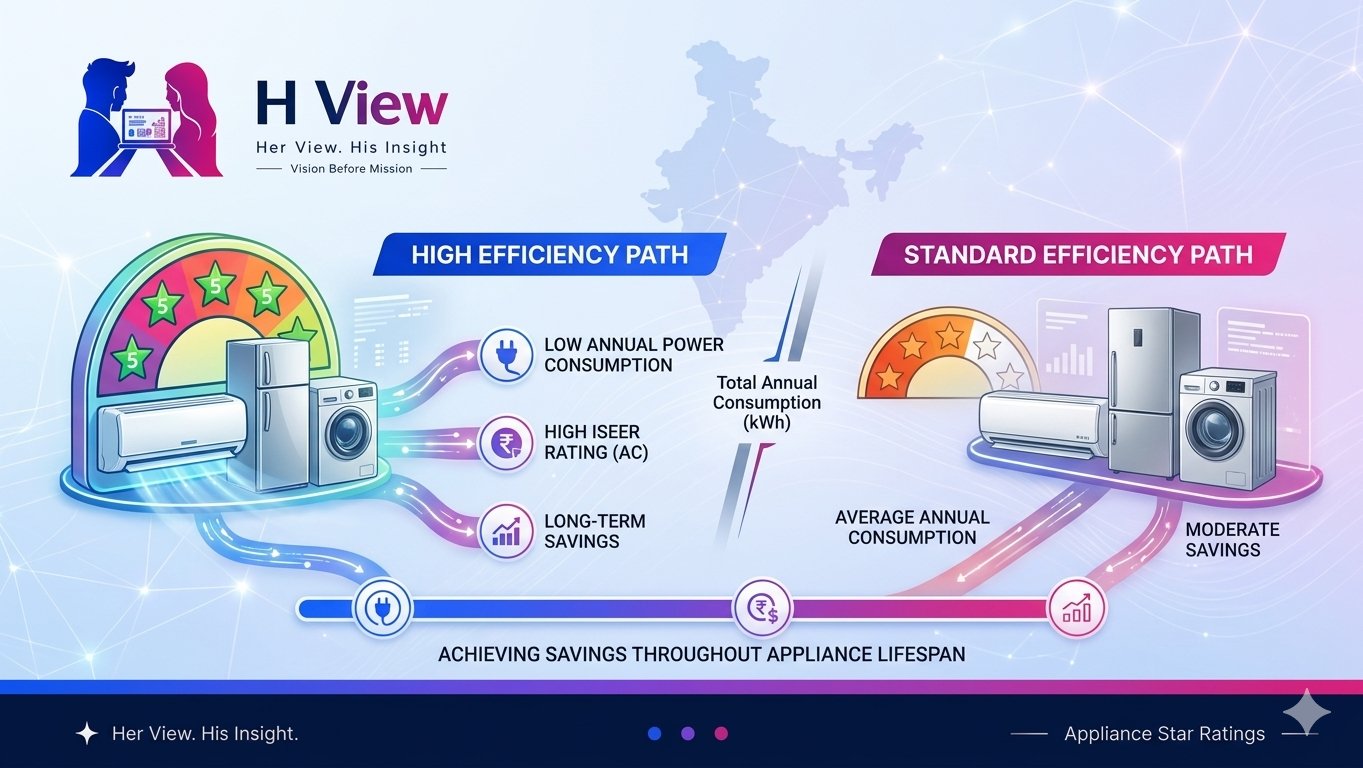
 By RajeshUpdated May 24, 20263 min read44 views
In the market for a new AC, refrigerator, or washing machine? Then you have undoubtedly faced the colorful, star-studded sticker prominently displayed on every model. This is the Energy Efficiency Ratio (EER) label, commonly known as the Star Rating.
While most consumers know that ‘more stars are better,’ many don’t understand how much better, or how the math impacts their long-term finances. At H View, we believe in providing ‘Vision Before Mission.’ Before you commit to the mission of purchasing an appliance, you need a clear vision of its total cost of ownership.
Here is everything you need to decode the star rating system.
The star rating system is governed by the Bureau of Energy Efficiency (BEE), a statutory body under the Ministry of Power in India. Their primary objective is to reduce the energy intensity of the Indian economy.
To do this, they standardize a way to measure efficiency. The Bureau defines specific testing methodologies for different product categories. Manufacturers must adhere to these standards to apply for a rating.
The stars themselves are the most vital data point:
The Golden Rule of Energy Savings: Moving from a 3-star appliance to a 5-star appliance typically results in 20% to 30% energy savings, depending on the usage pattern and category.
Apart from the big stars, the sticker provides crucial technical data:
The core dilemma for the consumer is that a 5-star appliance always carries a premium price tag. The logic of a 5-star purchase only holds if the energy savings cover that premium over the lifespan of the machine.
This calculation is called the payback period. For high-usage appliances like an air conditioner that runs 10 hours a day in a hot climate, the payback period for a 5-star unit can be as little as 2 to 3 years. For a washing machine used twice a week, a 3-star unit might be the smarter financial decision because you may never reclaim the premium cost in electricity savings.
The BEE updates star rating tables every few years. As technology improves, the definition of efficiency tightens. A refrigerator that earned 5 stars in 2020 might only meet the criteria for a 3-star or 4-star rating in 2024. This dynamic system forces manufacturers to innovate and prevents the standard from stagnating.
When standing in an electronics aisle, do not rush the decision. Take a moment to read the BEE label. Do not blindly grab the cheapest (1-star) or the most expensive (5-star).
Instead, apply the H View philosophy: get clarity on your intended usage. A clear vision of how you will use the appliance allows you to select the precise star rating that will maximize your savings and reduce your operational costs.
Rajesh is an H View contributor covering science, energy, architecture, sustainability, and practical knowledge topics. His articles focus on explaining complex ideas in a simple way, connecting real-world examples with useful insights for readers who want to understand how systems, design, and innovation shape everyday life.
Share your real experience and help other readers decide better.
This gives a good insights before buying an AC. It can be improvised by adding how operating cost and maintenance cost varies between 3 star and 5 star ratings on appliances.
May 24, 2026
Open LinkedIn for a few minutes and you will probably come across a colourful graphic…
Harika October 6, 2026 
When an employee resigns, many organisations move quickly into replacement mode. The manager informs HR,…
Harika October 6, 2026 
For many corporate employees, the workday begins long before they actually start working. They wake…
Harika October 5, 2026 
Many projects begin with an assumption that sounds reasonable on paper: the client will explain…
Harika October 1, 2026