

Best Digital Marketing Tools in 2026: What Marketers Actually Need and What They Can Skip
Open LinkedIn for a few minutes and you will probably come across a colourful graphic…
 Harika October 6, 2026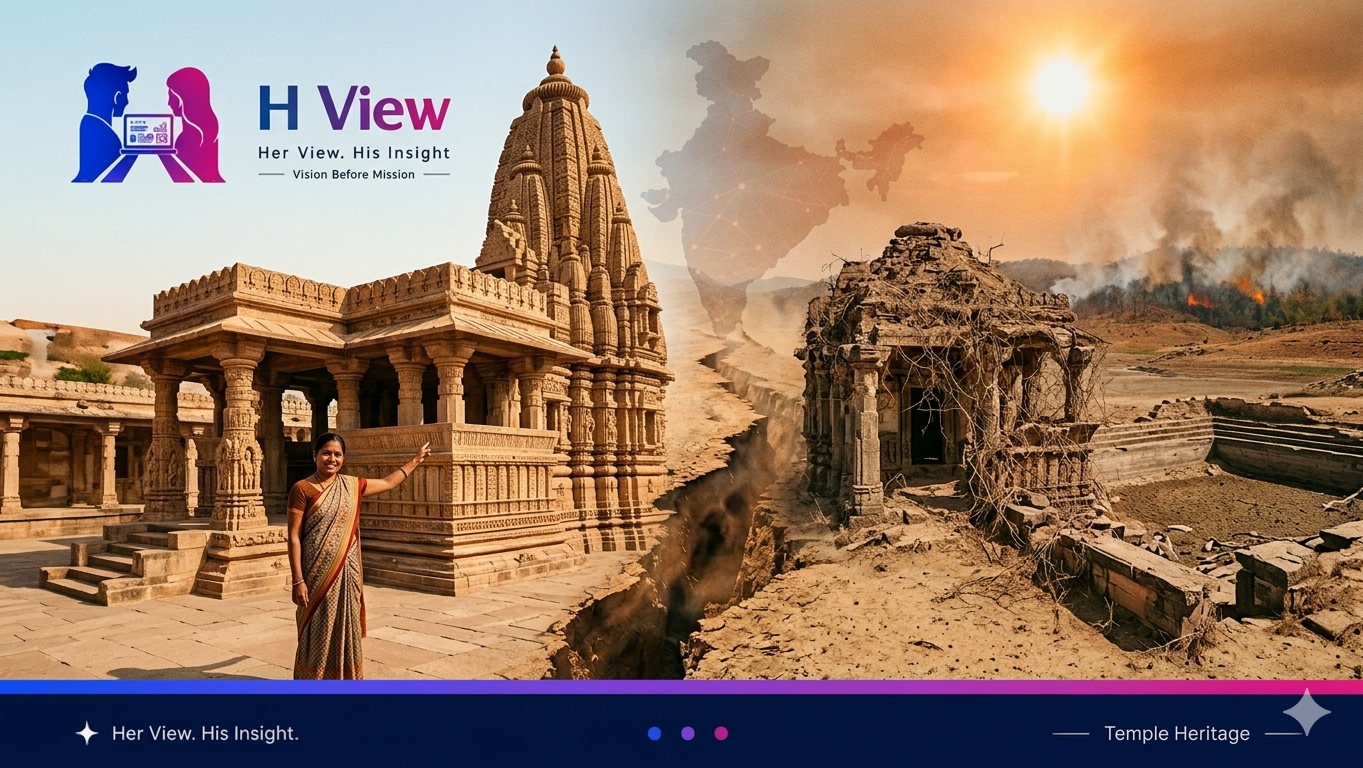
 By RajeshUpdated May 28, 20263 min read42 views
India’s skyline is not defined by skyscrapers, but by gopurams. From the snow-dusted peaks of the Himalayas to the wave-swept shores of Kanyakumari, millions of temples dot the landscape. Yet, to view these structures merely as places of worship is to miss their true essence. Indian temples are libraries of stone, reservoirs of culture, and supreme examples of ancient engineering and psychology.
At H View, we believe in looking beyond the surface. When we apply our “Vision Before Mission” philosophy to Indian temple heritage, we uncover a legacy designed not just for ritual, but for the holistic elevation of human consciousness.
The primary function of temple architecture was to create a microcosm of the cosmos. The design is rarely arbitrary; it is rooted in sacred geometry (Vastu Shastra).
Whether it is the Nagara style of the North, with its beehive-shaped shikharas (spires) symbolizing Mount Meru, or the Dravidian style of the South, with its monumental, pyramid-like gopurams (gateways), the structure represents the transition from the temporal world to the divine.
The journey from the ornate entrance, through the pillared mandapas (halls), to the stark, dark garbhagriha (sanctum sanctorum) is a psychological design. It is meant to lead the devotee from the complexity of the external world to the simplicity and stillness of the inner self. The architecture itself is the method.
Historically, the temple was the epicenter of the community, functioning far beyond religious requirements:
This rich heritage faces unprecedented threats. Urban encroachment, environmental degradation, and the theft of priceless idols jeopardize this legacy. While the Archaeological Survey of India (ASI) works tirelessly, preservation cannot be the state’s responsibility alone.
Preserving temple heritage is not an exercise in nostalgia; it is about securing our intellectual future. The engineering techniques, the artistic philosophies, and the community-centric models embedded in these structures offer vital insights for modern sustainability and urban planning.
At H View, we see heritage as a catalyst, not a relic. A true understanding of Indian temple heritage requires us to look through a sophisticated lens—one that integrates history, science, and philosophy.
Our mission must be to preserve these structures. But our vision must be to decode the sophisticated knowledge systems they contain. By protecting these stone sages, we ensure that their silent discourse on art, science, and the human spirit continues to inspire generations to come.
Rajesh is an H View contributor covering science, energy, architecture, sustainability, and practical knowledge topics. His articles focus on explaining complex ideas in a simple way, connecting real-world examples with useful insights for readers who want to understand how systems, design, and innovation shape everyday life.
Share your real experience and help other readers decide better.
Great content connecting spirituality and science
May 24, 2026
Open LinkedIn for a few minutes and you will probably come across a colourful graphic…
Harika October 6, 2026 
When an employee resigns, many organisations move quickly into replacement mode. The manager informs HR,…
Harika October 6, 2026 
For many corporate employees, the workday begins long before they actually start working. They wake…
Harika October 5, 2026 
Many projects begin with an assumption that sounds reasonable on paper: the client will explain…
Harika October 1, 2026