


H View
  • Home
  • About
  • Blogs
  • Categories
    • AI
    • Tech
    • Lifestyle
    • Business
      • Money
    • Sports
  • Reviews
  • Contact
Connect With Us
H View
  • Home
  • About
  • Blogs
  • Categories
    • AI
    • Tech
    • Lifestyle
    • Business
      • Money
    • Sports
  • Reviews
  • Contact
Connect
Culture

Eid-e-Milad 2026: Why It Is Observed and What the Day Means Beyond a Holiday

☆☆☆☆☆No reader ratings yet
By HarikaUpdated August 26, 202611 min read6 views

For many people, the first sign of Eid-e-Milad is practical. Schools or offices may be closed, mosques and streets may be decorated, processions may be visible in some cities, and social media fills with greetings marking the occasion. It is easy, particularly for someone outside the Muslim community, to understand the day mainly as another public holiday on India’s crowded festival calendar.

But Eid-e-Milad carries a much deeper meaning for the Muslims who observe it.

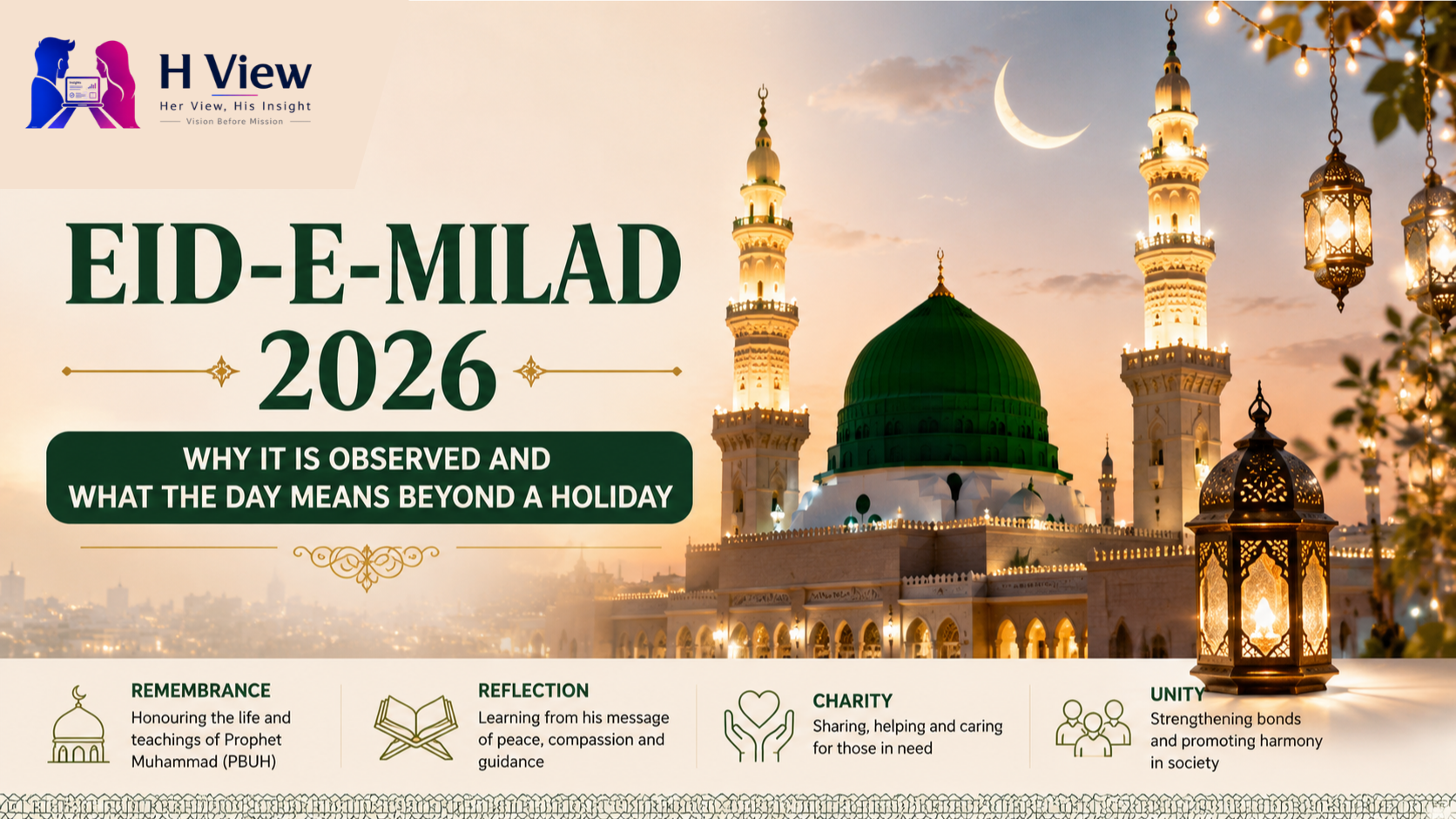
Also known as Milad-un-Nabi, Mawlid al-Nabi or the Prophet’s Mawlid, the occasion commemorates the birth of Prophet Muhammad and is traditionally associated with 12 Rabi’ al-Awwal, the third month of the Islamic lunar calendar. In India, government calendars list Milad-un-Nabi or Eid-e-Milad on August 26 in 2026, while the Ministry of Tourism’s Incredible India portal describes observances beginning on the evening of August 25 and continuing through August 26.

Yet the significance of the day is not simply the remembrance of a historical birth. In communities where Eid-e-Milad is observed, it becomes an occasion to revisit the Prophet’s life, teachings and example, with particular attention to values such as compassion, charity, humility and concern for others.

That is what makes the day worth understanding beyond the words “religious holiday.”

What Does Eid-e-Milad Actually Commemorate?

The Arabic word mawlid refers to birth, and Mawlid al-Nabi refers specifically to the commemoration of the Prophet Muhammad’s birth. Historical reference works describe the observance as developing over centuries rather than beginning as one of Islam’s earliest formal festivals. Public Mawlid celebrations became established in parts of the Islamic world during the medieval period and later spread widely, taking different forms in different regions.

That history helps explain why Eid-e-Milad does not look identical everywhere.

In one place, the observance may centre around lectures and recitation. In another, there may be processions, charitable food distribution or gatherings where poetry praising the Prophet is recited. Some communities mark the day prominently, while some Muslims do not observe Mawlid as a religious celebration at all because of differing interpretations about religious practice.

That diversity deserves acknowledgement.

When discussing a festival followed by a large global religious community, it is rarely accurate to say that every Muslim observes it in exactly the same way. The more useful approach is to understand what the occasion represents to those who do commemorate it.

In India, the day has developed a strong community and cultural presence, reflected in public gatherings, devotional recitations and acts of charity.

Why Remembering the Prophet’s Life Matters More Than the Celebration Itself

A birthday commemoration can easily become focused on the date. Eid-e-Milad is more meaningful when attention moves from when Prophet Muhammad was born to how his life is remembered.

Incredible India describes gatherings where stories and naats, or devotional poetry, recount the Prophet’s life and teachings. Communal meals may be organised in mosques or community centres, and the occasion is associated with values of love, compassion and unity.

Those ideas explain why charity is often visible around the observance.

Giving food to people who need it, helping a struggling family or contributing to community welfare can carry more meaning than elaborate decoration when the objective is to remember an ethical example.

Consider a neighbourhood where residents organise a meal during Eid-e-Milad. On the surface, it may look like another festive gathering. But when the food is deliberately shared beyond one family or social group, the celebration becomes connected to a larger principle: happiness carries greater value when somebody else benefits from it too.

This is where the day moves beyond commemoration and becomes reflection.

Compassion Sounds Simple Until It Becomes Inconvenient

Words such as kindness, mercy and compassion appear so frequently in religious and motivational language that they can become abstract.

Real life makes them much harder.

It is easy to speak politely to someone who agrees with us. It is more difficult when the other person is angry, economically weaker, socially different or unable to offer anything in return. Helping relatives we love comes naturally; caring about an unknown neighbour is more demanding.

A meaningful Eid-e-Milad observance therefore does not have to be measured only through the size of a gathering.

It can also be measured through ordinary behaviour.

How do we treat employees who depend on us? How quickly do we humiliate somebody over a mistake? Do we notice a neighbour going through financial difficulty? Does generosity disappear once the festival ends?

Those are not questions unique to Islam. They are human questions, which is precisely why religious occasions can sometimes communicate values beyond the community directly observing them.

A festival becomes socially meaningful when its ethical message survives after the decorations are removed.

Why Naats and Stories Have Such an Important Place

One of the recognisable cultural expressions associated with Milad gatherings in South Asia is the naat, poetry written and recited in praise of Prophet Muhammad.

Poetry has always been an important way for communities to preserve feeling alongside history. Dates and events can be recorded in books, but songs and poetry turn memory into something people experience collectively.

Historical scholarship on Islam in South Asia notes that devotion to Prophet Muhammad developed through rich poetic traditions in several regional languages.

That helps explain why a Milad gathering can feel very different from reading a historical biography.

People are not merely learning information about a figure from the seventh century. They are expressing affection, respect and connection through language inherited from previous generations.

For children especially, these traditions can become an early doorway into understanding religious history. A child may first remember a melody, a family gathering or a story heard from grandparents before understanding the deeper theological or historical context.

That is how culture often travels: not only through formal teaching, but through memory.

Why the Day Looks Different Across India

India’s Muslim population is enormously diverse. Language, regional culture, local religious traditions and family practices all influence how Eid-e-Milad is observed.

In some places, one may see illuminated mosques, banners and organised processions. Elsewhere, the day may be marked more quietly through prayer, religious lectures or charitable work. Incredible India highlights gatherings, naats, communal meals and decorative traditions as part of the country’s observance.

There is no need to force all of those practices into a single definition of what the “correct” celebration looks like.

The variety itself tells us something about Indian culture.

A religious tradition can remain recognisably connected to a wider faith while absorbing local languages, foods, forms of poetry and community customs. That has happened across many Indian religious traditions, not only Islam.

People often think cultural diversity means separate communities living beside one another. Sometimes it is more interesting than that. Diversity can also mean the same occasion taking on different local expressions while retaining a shared emotional centre.

Not Every Muslim Observes Mawlid in the Same Way

This point deserves particular care because festival articles often erase differences inside religious communities.

Mawlid has historically been debated among Muslim scholars. Some traditions and communities embrace the commemoration, while others regard it as a later religious innovation and therefore choose not to celebrate it as a festival. Historical sources document that debate extending back centuries.

Acknowledging that does not weaken the article.

It makes it more accurate.

Someone reading about Eid-e-Milad should understand that Muslim religious practice is not monolithic. There can be genuine differences over how respect for the Prophet should be expressed while the importance of his life remains central across Islam.

This distinction is particularly useful in India, where people often learn about another religion through public festivals alone. A procession may be highly visible, but it does not automatically represent the practice of every individual belonging to that faith.

Respect begins partly with avoiding assumptions.

Why Calling It “Just a Holiday” Misses the Point

A public holiday has an administrative meaning. Offices close. School schedules change. Government calendars mark the date.

The cultural meaning is something else entirely.

India’s official holiday calendars list Milad-un-Nabi or Id-e-Milad on August 26, 2026. But the existence of a holiday tells us very little about what a family or community experiences on that day.

For an observing family, the day might include listening to accounts of the Prophet’s life, visiting a mosque, attending a community gathering, preparing food for others or simply spending time discussing the values associated with his teachings.

For someone outside the faith, understanding that context can change the meaning of seeing the date on a calendar.

Instead of thinking, “Why is there a holiday today?” the more useful question becomes, “What are my neighbours remembering today?”

That small shift turns a public holiday into an opportunity for cultural literacy.

India needs more of that.

What Younger Generations Can Take From the Day

There is always a risk that traditions become inherited routines.

Children attend because parents take them. Families prepare because they have always prepared. A particular meal, prayer or gathering is repeated without anyone explaining why it exists.

This happens across religions.

For younger Muslims, Eid-e-Milad can become more meaningful when the emphasis shifts from simply participating in an event to understanding the life being remembered. Stories of compassion, honesty, responsibility toward the vulnerable and restraint in dealing with others become much more relevant when connected to situations young people recognise.

What does honesty look like in an online world where misinformation is easy to forward? What does charity mean when someone spends freely online but ignores an employee in financial difficulty? What does respect mean during arguments on social media?

The historical setting changes. The ethical questions remain surprisingly familiar.

That is where a centuries-old commemoration can still speak to someone living in 2026.

Her View

What stands out about religious occasions such as Eid-e-Milad is the way they can connect large spiritual ideas with very ordinary acts of care. Compassion sounds enormous when discussed in a sermon, but inside a household it may look like preparing extra food for someone, checking on an elderly neighbour or teaching a child why generosity matters.

The most beautiful traditions are often the ones children remember because they felt warmth around them rather than because somebody demanded that they memorise their meaning.

If Eid-e-Milad becomes an occasion where younger generations associate faith with kindness, dignity and concern for other people, the celebration carries something forward that is much more lasting than decoration.

His Insight

The strongest way to understand Eid-e-Milad is to separate three layers that are often mixed together: the historical commemoration, the religious interpretation and the cultural expression.

The historical focus is Prophet Muhammad’s birth and life. Religious communities differ over how the birth should formally be commemorated. Cultural practices then vary further according to place, language and local tradition.

Recognising those layers prevents oversimplification.

It also gives the day greater depth. Instead of treating Eid-e-Milad as another entry in a festival list, we can understand why people gather, why poetry and stories matter and why charitable activity becomes part of the occasion.

The H View Take

Eid-e-Milad is observed by many Muslims as a day to remember Prophet Muhammad, but its meaning is larger than the anniversary of a birth.

For those who commemorate it, the day creates space to revisit a life regarded as an ethical example and to express that remembrance through prayer, poetry, community gathering, food and generosity. In India, these expressions have also become part of a broader cultural landscape shaped by regional traditions and languages.

At the same time, understanding the festival responsibly means recognising that Muslims are not a single uniform community and that views about Mawlid itself differ.

Perhaps that is the most useful way to approach the day from outside the faith as well.

Do not reduce it to a holiday. Do not reduce it to a procession. And do not assume one visible form explains an entire religion.

Instead, understand the idea at its centre: remembering a life by reflecting on the values associated with it.

A holiday lasts for one day.

An ethical example is meaningful only when it changes what happens after the day is over.

Frequently Asked Questions

When is Eid-e-Milad in India in 2026?

Indian government calendars list Milad-un-Nabi or Eid-e-Milad on Wednesday, August 26, 2026. Incredible India describes the festival period as beginning on the evening of August 25 and continuing through August 26.

What does Eid-e-Milad celebrate?

Eid-e-Milad, also known as Mawlid al-Nabi or Milad-un-Nabi, commemorates the birth of Prophet Muhammad. It is traditionally associated with Rabi’ al-Awwal in the Islamic lunar calendar.

How is Eid-e-Milad observed in India?

Practices differ by community and region. Incredible India highlights religious gatherings, naats or devotional poetry, communal meals, decorations and remembrance of the Prophet’s life and teachings among the ways the occasion is marked.

Do all Muslims celebrate Eid-e-Milad?

No. Mawlid has historically been interpreted differently within Muslim communities. Many observe it as an important devotional occasion, while others do not celebrate it as a religious festival.

What is a naat?

A naat is devotional poetry expressing praise and respect for Prophet Muhammad. Such poetry has a long history in South Asian Muslim culture and is commonly associated with Milad gatherings.

Is Eid-e-Milad a public holiday in India?

It appears as a gazetted or closed holiday in several official 2026 government calendars, including central-government institutional calendars, on August 26. Holiday implementation can still vary depending on institution, state and workplace.

Written by

Harika

Harika is the co-founder of H View and covers AI, technology, gadgets, digital tools, online platforms, and modern internet trends. Her articles focus on simplifying complex topics with practical explanations, balanced opinions, and reader-first insights.

Topics coveredAIAutoBusinessCultureCyber SafetyDigital MarketingGuidesH ViewHistoryLifestyleMoneyReviewsTechAudioGadgetsWordpress
View all posts by author

Submit Your View

Share your real experience and help other readers decide better.

🔒 Your review may be published after moderation.

Reader Reviews

No community views yet. Be the first to share yours.

8.0Excellent

H View Score

A quick view of our final rating for this review.

✉

Stay Updated with H View

Get the latest reviews and insights straight to your inbox.

🔒 No spam. Unsubscribe anytime.

Trending Reviews

Best AI for Coding in 2026: ChatGPT, Claude, Gemini or Something Else?August 27, 2026Raksha Bandhan 2026: Why Rakhi Is on August 28—and How the Meaning of Sibling Protection Is ChangingAugust 27, 2026One More Attempt—or Time to Move On? The Career Risk of Endless Government Exam PreparationAugust 27, 2026Samsung Galaxy S26 FE Explained: Is the Fan Edition Still Worth Buying in 2026?August 27, 2026Why Are Working Women So Exhausted Even When They’re Doing Everything “Right”?August 27, 2026Onam 2026: Why Kerala Still Welcomes King Mahabali—and What the Festival Really MeansAugust 26, 2026Why Are Core Engineering Students Moving Away From Their Own Fields?August 26, 2026Realme P4s 5G With 8,000mAh Battery: Are Big-Battery Phones Becoming the New Normal?August 26, 2026

Related Blogs

AI

Best AI for Coding in 2026: ChatGPT, Claude, Gemini or Something Else?

A few years ago, asking for the best AI for coding usually meant asking which…

Harika August 27, 2026
Culture

Raksha Bandhan 2026: Why Rakhi Is on August 28—and How the Meaning of Sibling Protection Is Changing

Every year, Raksha Bandhan arrives with a familiar picture: a sister tying a rakhi around…

Harika August 27, 2026
Careers

One More Attempt—or Time to Move On? The Career Risk of Endless Government Exam Preparation

There is a particular kind of career uncertainty that many government-job aspirants understand very well.…

Satya Hemanth August 27, 2026
Gadgets

Samsung Galaxy S26 FE Explained: Is the Fan Edition Still Worth Buying in 2026?

Samsung’s Fan Edition phones have always occupied an unusual place in the Galaxy lineup. They…

Harika August 27, 2026
H View

Honest reviews. Smart ratings. Real insights.

Explore

HomeReviewsBlog

Company

AboutAdvertiseContact

Support

Privacy PolicyTerms & ConditionsDisclaimerEditorial Policy

Subscribe to H View

Get the latest updates and exclusive content straight to your inbox.

🔒 No spam. Unsubscribe anytime.
© 2026 H View. All rights reserved.
HomeReviewsBlogContact