

H View
  • Home
  • About
  • Blogs
  • Categories
    • AI
    • Tech
    • Lifestyle
    • Business
      • Money
    • Sports
  • Reviews
  • Contact
Connect With Us
H View
  • Home
  • About
  • Blogs
  • Categories
    • AI
    • Tech
    • Lifestyle
    • Business
      • Money
    • Sports
  • Reviews
  • Contact
Connect
Culture

Onam 2026: Why Kerala Still Welcomes King Mahabali—and What the Festival Really Means

☆☆☆☆☆No reader ratings yet
By HarikaUpdated August 26, 202610 min read5 views

Every festival carries a mood, but Onam carries something deeper than celebration alone. It brings nostalgia, memory, colour, food, family and a sense of returning to something emotionally familiar. In Kerala, Onam is not experienced merely as a date on the calendar. It feels like a season of homecoming.

That is one reason the story at the heart of Onam has remained so powerful. The festival is linked to the belief that King Mahabali, the much-loved ruler of Kerala in legend, returns each year to visit his people. Kerala Tourism describes Onam as Kerala’s national festival and explains that it celebrates the myth of Mahabali, while also functioning as an agricultural festival that symbolises joy and prosperity.【turn284519view1†L11-L14】

In 2026, the Kerala Tourism festival calendar lists Thiruvonam on 26 August, marking the main day of the festival celebration.【turn284519view0†L28-L31】 But the importance of Onam goes well beyond one day. It raises an enduring question that makes the festival especially meaningful: why does Kerala continue to celebrate the return of Mahabali with such affection, and what does that tell us about the values the festival still carries today?

Onam Is More Than a Festival Date

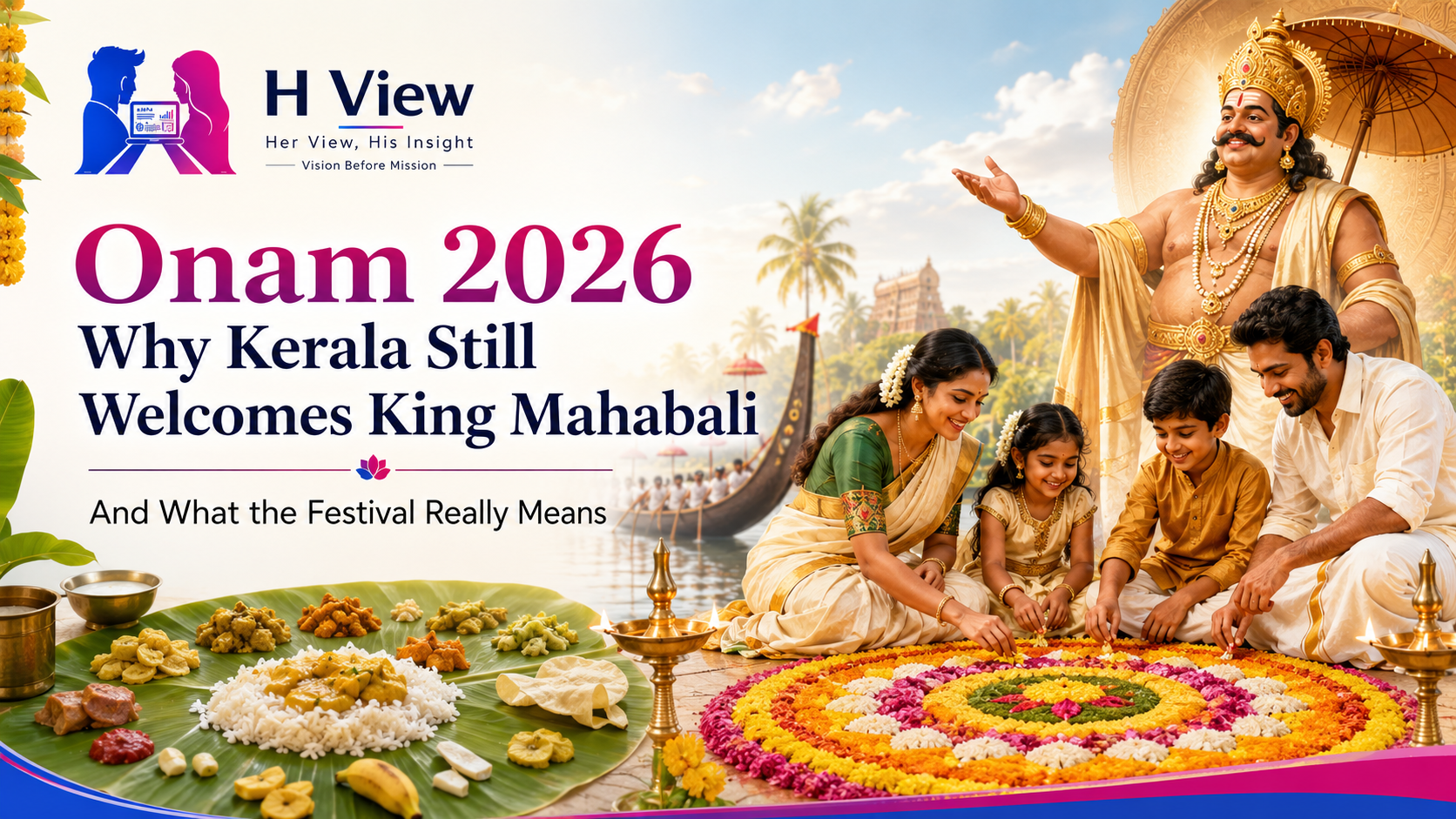
Many people outside Kerala first recognise Onam through its visible symbols: floral carpets, traditional dress, boat-race imagery and the famous Onasadya served on banana leaves. Those images are important, but they can sometimes make the festival look like a visual event rather than a living cultural idea.

Onam is larger than its decorations.

Kerala Tourism describes the ten days following Atham in the Malayalam month of Chingam as a major festive period, and also highlights Onam’s connections to rituals, games, shopping, boat races and the grand festive meal known as Onasadya.【turn284519view1†L45-L47】【turn284519view1†L53-L55】【turn284519view1†L61-L70】 That broad cultural range tells us something important: Onam is not built around only one ritual. It is built around participation.

Families clean homes, prepare pookalam, wear onakkodi, gather for meals, travel to meet relatives and take part in local celebrations. In that sense, Onam works like a social thread running through Kerala’s public and private life at the same time. It enters the home, the marketplace, schools, offices, television programming and community spaces together.

That is one reason it continues to feel relevant even in a modern, highly digital world. Some festivals survive because they are formally observed. Onam survives because it is actively lived.

Why Mahabali Is Loved, Not Feared

At the centre of Onam is a striking idea. Mahabali is not remembered as a tyrant whose defeat is celebrated. He is remembered as a beloved ruler whose return is welcomed.

That alone makes the festival emotionally unusual.

In the legend, Mahabali ruled in a time associated with peace, prosperity and equality. His kingdom is remembered not merely as wealthy, but as just. People often describe it as a time when there was no cheating, no discrimination and no suffering caused by social inequality. Whether one approaches the story religiously, culturally or symbolically, the emotional force of the legend lies in this: the people do not celebrate Mahabali because he was powerful; they celebrate him because he represented a form of rule they still long to remember.

That memory matters even today.

Modern life constantly pushes people toward competition, pressure and visible success. Against that background, Onam revives a different imagination of society—one where dignity, fairness and abundance are shared more widely. The yearly return of Mahabali becomes meaningful because it is really the return of a moral memory. Kerala is not just saying, “A king once ruled here.” It is saying, “We still honour the idea of a society in which people felt cared for, equal and secure.”

That helps explain why the Mahabali legend has survived far beyond mythology. It has become a cultural language for discussing what a good society should feel like.

Onam Is Also a Harvest Festival, and That Changes Its Meaning

Kerala Tourism also identifies Onam as a harvest festival that symbolises joy and prosperity.【turn284519view1†L11-L14】 This aspect matters because it grounds the festival not only in story, but in seasonal life.

Harvest festivals often emerge where agriculture shapes the rhythm of society. They express gratitude, relief and celebration at the arrival of abundance after labour. Onam carries that spirit strongly. Even when urban families are no longer directly involved in farming, the emotional structure remains familiar: people celebrate fullness, sharing and thankfulness.

This is one reason food is so central to Onam.

The Onasadya is not just a meal; it is a social statement. Kerala Tourism notes that no Malayali would want to miss the Onasadya during Onam.【turn284519view1†L45-L49】 Its importance comes partly from the variety of dishes, but even more from what it represents. A sadya is about collective experience. It is served in a structured, shared manner, with different tastes balancing one another. It is festive, but it is also cultural memory expressed through food.

The same applies to pookalam, the floral design created during the festival days. It is beautiful, yes, but it is also participatory. It draws family members, neighbours and children into the act of preparation. In a time when much of life has become individualised, these repeated acts of collective making are part of what keeps Onam meaningful.

Why Onam Still Feels So Strong Across Generations

Some traditions remain respected but become emotionally distant over time. Onam has not followed that path.

Part of the reason is that it adapts without losing its centre.

A child may first love Onam because of flowers, holidays and food. A teenager may connect with the excitement of clothing, gatherings and celebrations in school or college. An adult may feel Onam most deeply as a time of returning home, cooking with family or remembering grandparents. Someone living outside Kerala may experience it even more intensely through absence, because festivals often become more meaningful when distance turns them into emotional anchors.

Kerala Tourism itself describes Onam as a nostalgia that brings back memories of childhood and simpler village life.【turn284519view1†L11-L14】 That insight is important. Onam does not survive only because people are told to preserve it. It survives because it activates memory.

For Malayalis living elsewhere in India or abroad, Onam often becomes one of the strongest annual links to home. The festival’s emotional power travels well because its meaning is not limited to ritual precision. It carries images of belonging—eating together, dressing traditionally, arranging flowers, hearing familiar songs and recreating a feeling of Kerala wherever one is.

This is where the festival becomes more than tradition. It becomes identity.

The Festival Also Shows How Culture Lives in Many Forms

One of Onam’s strengths is that it is not confined to a single expression. Kerala Tourism highlights multiple dimensions of the season, including boat races, games, shopping, rituals and the festive ten-day cycle leading up to Thiruvonam.【turn284519view1†L30-L34】【turn284519view1†L53-L55】【turn284519view1†L61-L70】

This matters because culture lasts longer when it is not reduced to one narrow form.

Some people connect to Onam most through ritual. Others connect through food, public festivities or the symbolic story of Mahabali. For many, it is also a social festival that stretches beyond a strictly religious frame and becomes part of Kerala’s wider cultural identity. That broad accessibility helps explain why the festival continues to hold such a central place in public life.

Even the commercial side of Onam, from seasonal shopping to festive markets, tells us something about its social reach. Kerala Tourism openly notes that there is no bigger shopping season in Kerala than during Onam.【turn284519view1†L38-L42】 That does not reduce the festival’s meaning. It shows how deeply it enters the rhythms of society.

When a festival shapes food, clothing, public events, memory, local economy and home life simultaneously, it becomes more than an observance. It becomes part of the annual emotional calendar of a people.

What Onam Really Means in 2026

It is easy to describe Onam as a “festival of Kerala” and stop there. But if H View is asking what the festival really means, a more thoughtful answer is needed.

In 2026, Onam still matters because it gathers several ideas that modern life badly needs. It celebrates abundance without celebrating greed. It values beauty, but not in an isolated or individualistic way. It places food at the centre, but as a shared experience. It honours a ruler, not for conquest, but for remembered justice and care. And it brings families together not merely for formality, but for active participation.

In that sense, the annual welcome for Mahabali is not really about waiting for a king to walk through the door.

It is about renewing a cultural promise: that society should still value fairness, dignity, hospitality and shared joy.

That is why Kerala still welcomes him.

Her View

What makes Onam emotionally special is not only the legend, but the feeling it creates inside the home. A festival becomes meaningful when it changes how people live with one another, even if only for a few days. Onam invites people to prepare together, eat together and remember together. In that sense, the return of Mahabali feels almost like the return of an older ideal of family and community life—one that many people still miss.

The beauty of Onam is also that it does not need grand theory to be felt. Sometimes meaning arrives through a pookalam made in the morning, the smell of a sadya being prepared, or the sight of relatives gathering in traditional dress. Culture often survives through these ordinary, repeated acts of affection.

His Insight

Onam remains powerful because its central symbol is politically and socially intelligent. Mahabali is remembered as a ruler associated with justice, equality and prosperity. That makes the festival more than mythological nostalgia; it becomes a cultural statement about what good public life should look like.

The harvest element strengthens this further. Onam does not celebrate consumption alone. It celebrates the completion of labour, the arrival of abundance and the obligation to share. In a world that often turns festivals into display, Onam still carries a deeper social logic. It reminds people that prosperity means more when it is collective.

The H View Take

Kerala still welcomes King Mahabali every year because Onam is not just about the past. It is about preserving a moral and cultural imagination that still feels necessary in the present.

The festival remembers a kingdom associated with fairness and shared prosperity. It celebrates the harvest as a sign of joy and abundance. It brings people back to food, family, ritual, beauty and belonging. And in doing so, it proves something important: not all traditions survive only because they are old. Some survive because they continue to say something true.

Onam continues to matter because it asks a timeless question in the form of a festival:

What kind of society would we still be proud to welcome back every year?

That is why Mahabali’s return is still celebrated.

And that is what the festival really means.

Frequently Asked Questions

What is Onam?

Onam is Kerala’s national festival. Kerala Tourism describes it as a celebration of the myth of Mahabali and also as a harvest festival symbolising joy and prosperity.【turn284519view1†L11-L14】

Why is King Mahabali important in Onam?

Mahabali is believed in the Onam tradition to visit his old subjects every year during the festival season. His return is associated with a remembered age of prosperity and good rule.【turn284519view1†L11-L14】

When is Thiruvonam in 2026?

Kerala Tourism’s festival calendar lists Thiruvonam on 26 August 2026.【turn284519view0†L28-L31】

Is Onam only a religious festival?

Onam has mythological roots, but it also functions as a major cultural and harvest festival in Kerala, with celebrations involving food, games, floral decorations, shopping, rituals and public festivities.【turn284519view1†L30-L42】【turn284519view1†L61-L70】

What is Onasadya?

Onasadya is the traditional festive meal of Onam, and Kerala Tourism notes that it is considered an essential part of the festival experience.【turn284519view1†L45-L49】

How long does Onam last?

Kerala Tourism says the ten days following Atham in the Malayalam month of Chingam are a period of major Onam festivities.【turn284519view1†L61-L65】

Written by

Harika

Harika is the co-founder of H View and covers AI, technology, gadgets, digital tools, online platforms, and modern internet trends. Her articles focus on simplifying complex topics with practical explanations, balanced opinions, and reader-first insights.

Topics coveredAIAutoBusinessCultureCyber SafetyDigital MarketingGuidesH ViewHistoryLifestyleMoneyReviewsTechAudioGadgetsWordpress
View all posts by author

Submit Your View

Share your real experience and help other readers decide better.

🔒 Your review may be published after moderation.

Reader Reviews

No community views yet. Be the first to share yours.

8.0Excellent

H View Score

A quick view of our final rating for this review.

✉

Stay Updated with H View

Get the latest reviews and insights straight to your inbox.

🔒 No spam. Unsubscribe anytime.

Trending Reviews

Best AI for Coding in 2026: ChatGPT, Claude, Gemini or Something Else?August 27, 2026Raksha Bandhan 2026: Why Rakhi Is on August 28—and How the Meaning of Sibling Protection Is ChangingAugust 27, 2026One More Attempt—or Time to Move On? The Career Risk of Endless Government Exam PreparationAugust 27, 2026Samsung Galaxy S26 FE Explained: Is the Fan Edition Still Worth Buying in 2026?August 27, 2026Why Are Working Women So Exhausted Even When They’re Doing Everything “Right”?August 27, 2026Eid-e-Milad 2026: Why It Is Observed and What the Day Means Beyond a HolidayAugust 26, 2026Why Are Core Engineering Students Moving Away From Their Own Fields?August 26, 2026Realme P4s 5G With 8,000mAh Battery: Are Big-Battery Phones Becoming the New Normal?August 26, 2026

Related Blogs

AI

Best AI for Coding in 2026: ChatGPT, Claude, Gemini or Something Else?

A few years ago, asking for the best AI for coding usually meant asking which…

Harika August 27, 2026
Culture

Raksha Bandhan 2026: Why Rakhi Is on August 28—and How the Meaning of Sibling Protection Is Changing

Every year, Raksha Bandhan arrives with a familiar picture: a sister tying a rakhi around…

Harika August 27, 2026
Careers

One More Attempt—or Time to Move On? The Career Risk of Endless Government Exam Preparation

There is a particular kind of career uncertainty that many government-job aspirants understand very well.…

Satya Hemanth August 27, 2026
Gadgets

Samsung Galaxy S26 FE Explained: Is the Fan Edition Still Worth Buying in 2026?

Samsung’s Fan Edition phones have always occupied an unusual place in the Galaxy lineup. They…

Harika August 27, 2026
H View

Honest reviews. Smart ratings. Real insights.

Explore

HomeReviewsBlog

Company

AboutAdvertiseContact

Support

Privacy PolicyTerms & ConditionsDisclaimerEditorial Policy

Subscribe to H View

Get the latest updates and exclusive content straight to your inbox.

🔒 No spam. Unsubscribe anytime.
© 2026 H View. All rights reserved.
HomeReviewsBlogContact