


Best AI for Coding in 2026: ChatGPT, Claude, Gemini or Something Else?
A few years ago, asking for the best AI for coding usually meant asking which…

Knowing that you should save money is relatively easy. Deciding where that money should sit is where personal finance becomes confusing.
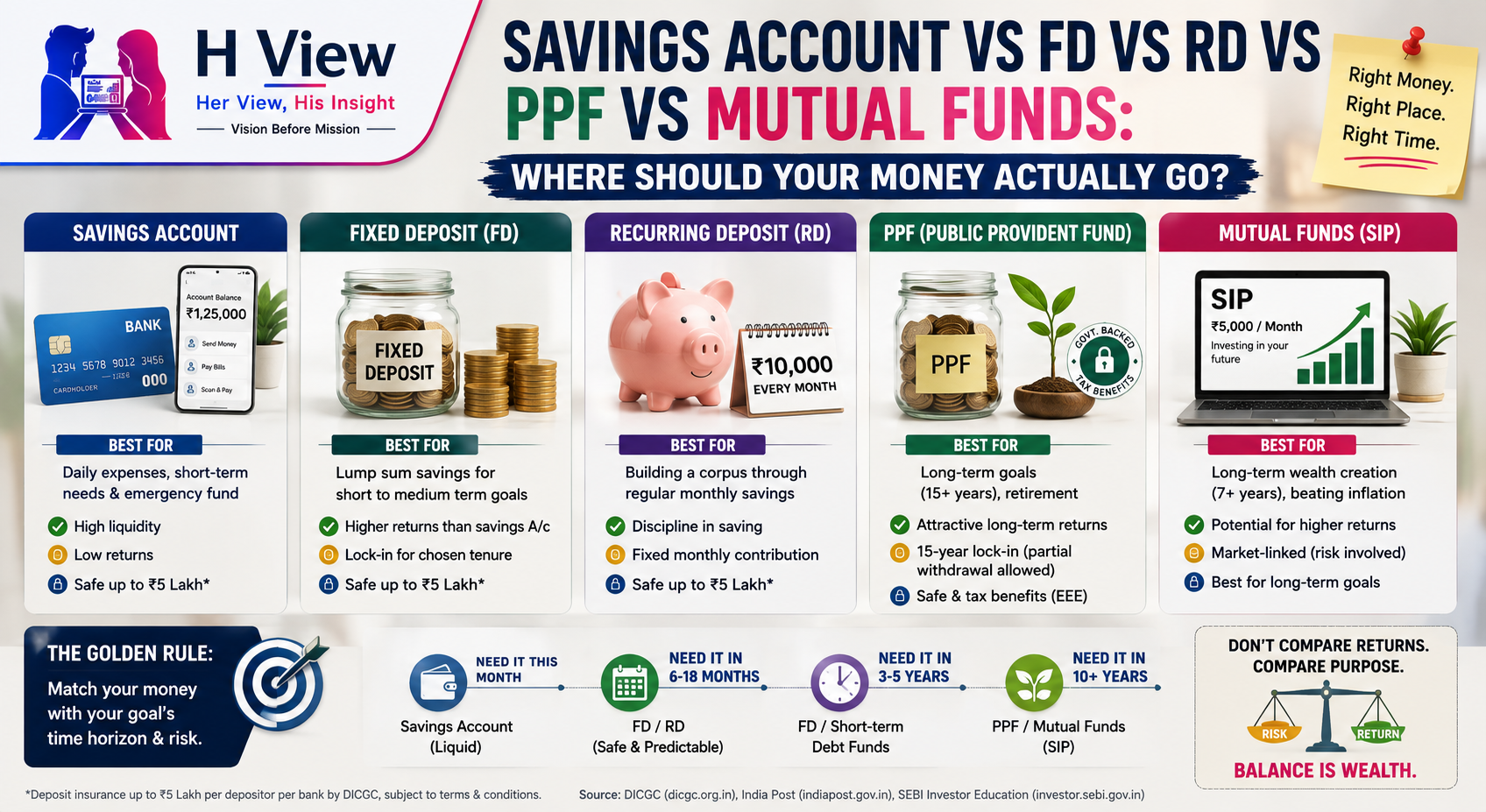
A savings account feels safe because the money is always visible. A Fixed Deposit promises predictable interest. A Recurring Deposit gives structure to monthly saving. PPF is frequently recommended for long-term goals, while mutual funds are discussed whenever the conversation moves toward wealth creation.
The natural reaction is to ask which one is best.
But that is usually the wrong question.
The ₹1 lakh you may need during a medical emergency should not necessarily be kept in the same place as the ₹1 lakh you are saving for retirement twenty years from now. Similarly, money required for school fees next year has a different job from money being accumulated for a house ten years away.
A better approach is to decide when you need the money, how certain that need is, how much risk you can accept, and how quickly you must be able to access it. Once those answers are clear, choosing between a savings account, FD, RD, PPF or mutual fund becomes much easier.
A savings bank account is the natural starting point because this is where salary usually arrives and everyday expenses leave.
Its biggest strength is liquidity. You can pay a hospital bill, transfer rent, withdraw cash or handle an unexpected expense almost immediately. That makes a savings account useful for monthly expenses and at least part of an emergency reserve.
The mistake begins when people leave every rupee there simply because it feels safe.
Imagine Harish has accumulated ₹9 lakh in his salary account. He needs around ₹60,000 every month for household expenses and wants six months of basic expenses available for emergencies. Keeping a meaningful liquid buffer makes sense. But if ₹4 lakh or ₹5 lakh of the account is actually intended for retirement fifteen years later, that money is doing a completely different job.
Easy access can also become a behavioural problem. The same account is connected to UPI, debit cards, shopping apps and automatic subscriptions. Money that was supposedly “saved” sits only a scan away from becoming weekend spending.
Our recent H View article on UPI and spending behaviour explored exactly this problem: digital payments make money convenient to use, which can make savings mixed into the everyday spending account surprisingly easy to consume.
A savings account should therefore be seen as the front desk of your finances, not the warehouse where every future goal has to remain.
There is also a safety point worth knowing. Deposits with insured banks in India are covered by the Deposit Insurance and Credit Guarantee Corporation up to ₹5 lakh per depositor per bank, subject to the scheme’s rules and aggregation of eligible deposits held in the same capacity and right.
A Fixed Deposit becomes useful when you already possess a lump sum that you do not need for everyday spending and you want greater predictability.
Suppose a family has ₹3 lakh that will be needed approximately eighteen months later for a child’s college admission. Keeping all of it in the normal spending account exposes the money to accidental use. Putting it entirely into an equity investment creates another problem: the market could be down exactly when the admission payment becomes due.
An FD can make more sense because the family knows approximately when the money will be needed and values capital stability more than chasing the highest possible return.
This is an important H View principle:
Money with a near-term deadline usually needs predictability more than excitement.
FD interest rates vary between banks, deposit amounts and tenures, so an article like this should not pretend there is one permanent “best FD rate.” What matters more is understanding the role of the product. An FD is generally suitable when you already have the lump sum and want to separate it from daily spending for a relatively defined period.
That does not mean every FD should be locked away blindly. Premature withdrawal rules and penalties vary. Before depositing emergency money, check how quickly it can be withdrawn and what happens to the interest if you close the deposit early.
FD and RD are often discussed together as if they were interchangeable.
They are not.
An FD usually begins with money you already have. A Recurring Deposit helps you create that amount gradually.
Suppose Kavya knows that she will need approximately ₹1.2 lakh next August for annual insurance premiums, school expenses and a planned family trip. She does not have ₹1.2 lakh today, but she can set aside ₹10,000 every month.
That is exactly the kind of situation where an RD can create useful discipline.
Instead of hoping ₹10,000 remains untouched in her salary account each month, the money is assigned to a future expense as soon as income arrives.
The Government’s Post Office savings offering currently lists the National Savings Recurring Deposit at 6.7% per annum, compounded quarterly. Rates on government small-savings products are subject to revision, so the current rate should always be checked before opening an account.
The bigger advantage here is not merely the interest rate. It is that the future expense stops competing with today’s spending.
Many expenses that families describe as emergencies are actually predictable: annual insurance, festivals, school admissions, vehicle insurance or appliance replacement. Using an RD or another dedicated short-term saving arrangement can prevent those known expenses from suddenly becoming credit-card debt.
Public Provident Fund occupies a different part of the financial picture.
It is a long-term government-backed savings vehicle rather than a place for next year’s holiday money. India Post currently lists the PPF interest rate at 7.1% per annum, compounded yearly. As with other government small-savings rates, this can change over time.
The long horizon is part of the design.
That can be useful for someone who wants to build long-term savings without the daily temptation to spend the money. It can also suit people who value government-backed predictability more than market-linked growth.
But the same feature makes PPF unsuitable for money you may need next month.
A family should not proudly put every spare rupee into a long-term product while maintaining almost no emergency liquidity. The purpose of long-term savings is defeated when every unexpected expense forces you to disturb them.
Think again about the structure from our previous H View article on what savings actually means. PPF belongs primarily in the long-term financial-assets layer. It should not be mentally counted as though it is the same as the money available in your UPI-linked bank account today.
This is probably the most important distinction for beginners.
People often hear that mutual funds may generate better long-term returns than bank deposits and conclude that keeping money in a savings account or FD is always a mistake.
That conclusion ignores risk and time.
Mutual funds pool investors’ money and invest according to the scheme’s objective. Different schemes can carry very different risk levels, which is why SEBI requires mutual funds to display a Riskometer ranging from low through very high risk.
The money you invest in a mutual fund is therefore not equivalent to a guaranteed bank balance.
Suppose you plan to buy a house seven years from now. A suitable market-linked investment may have a role because the time horizon allows more room for market fluctuations.
Now imagine the same money is your hospital emergency fund.
You do not want to discover during an emergency that markets have fallen 20% and you are being forced to sell investments at exactly the wrong time.
That is why the phrase “mutual funds give better returns” is incomplete. The real question is whether the investment’s risk and time horizon match the goal.
A SIP also deserves clarification. SIP, or Systematic Investment Plan, is simply a method of investing a fixed amount into a mutual-fund scheme at regular intervals. SEBI’s investor material describes SIPs as a facility for regular investments; the SIP itself does not remove the underlying scheme’s market risk.
An RD and SIP may both involve ₹5,000 leaving your account every month, but financially they can be serving very different purposes.
Consider a household with a monthly income of ₹1 lakh.
They could reasonably have ₹1.5 lakh in their savings account for immediate expenses and emergencies, an FD holding money required within eighteen months, an RD building next year’s school-fee amount, PPF contributions for long-term retirement security and mutual funds for goals ten or fifteen years away.
That is not unnecessary complexity.
Each pool of money has a different deadline.
The financial mistake would be trying to force every goal into whichever product currently has the most attractive interest rate or return chart.
A short-term FD does not “lose” to an equity mutual fund simply because equities may generate higher long-term returns. If the money absolutely has to be available next year, the FD is solving a different problem.
Likewise, a savings account does not become useless because its interest rate is relatively modest. Liquidity itself has value.
People naturally want every rupee to earn the highest possible return.
Emergency money is one place where that instinct needs restraint.
An emergency fund exists for situations that refuse to follow your investment calendar: job loss, hospitalisation, urgent travel, home repairs or family problems.
A portion should therefore be extremely easy to access. Depending on the household’s circumstances, another portion might be kept in suitable deposits that remain reasonably accessible.
What matters most is that the family can actually use it when the emergency arrives.
There is little benefit in earning an extra percentage point if accessing the money becomes complicated at the moment you need it.
The emergency fund’s job is not to impress anyone with returns.
Its job is to prevent one bad month from forcing you into expensive debt or destroying long-term investments.
The hardest part of saving is often not earning interest. It is giving money a purpose before life finds another use for it.
When all savings remain in one bank account, ₹3 lakh can feel like a large comfortable balance. That comfort can quietly justify a better phone, a holiday or several unplanned purchases because the account still “has plenty of money.”
Separate goals make the same money emotionally clearer. The ₹1 lakh meant for an emergency stops feeling available for shopping. The RD meant for school fees is no longer spare cash.
Good saving should create peace, not constant anxiety about whether every rupee is earning the maximum possible return.
Financial products should be compared according to the problem they solve, not simply their advertised return.
Liquidity has value. Predictability has value. Long-term compounding has value. Market-linked growth has value.
The mistake is expecting one product to provide all of them simultaneously.
A savings account offers excellent access but limited growth. An FD provides more predictability but less flexibility. An RD helps create a future lump sum. PPF encourages long-term disciplined saving. Mutual funds can provide market-linked growth but introduce investment risk.
The best choice is therefore rarely one winner.
It is a combination that reflects when your money will actually be needed.
Before moving money anywhere, write one sentence beside it:
“I need this money for ______ in approximately ______.”
That simple exercise can prevent many financial mistakes.
Money required tomorrow belongs somewhere different from money needed next year. Retirement money should not be managed like grocery money, and emergency cash should not be treated like a twenty-year investment.
A savings account, FD, RD, PPF and mutual fund are not competing to become the single best place for all your money. They are different tools.
The better financial habit is learning which tool fits which job.
Once savings have a purpose and a time horizon, the question changes from “Where can I earn the highest return?” to something much more useful:
“Where should this particular money be so that it is available, safe enough and capable of growing appropriately when I need it?”
That is the point where saving begins to look less like collecting money and more like building a financial system.
Usually, money required for monthly expenses and immediate emergencies benefits from high liquidity, but long-term money may need a different home depending on your goals, risk tolerance and time horizon. Keeping every rupee in one account can also make planned savings easier to spend accidentally.
Neither is universally better. An FD generally fits someone who already has a lump sum, while an RD helps someone accumulate a target amount gradually through regular deposits.
They serve different purposes. PPF is a long-term government-backed savings product, while bank FDs are available across different shorter and longer tenures. Your required access date matters more than simply comparing headline interest rates.
A SIP is a method of regularly investing into a mutual fund and therefore carries the risk associated with that scheme. An RD offers a more predictable deposit structure. They may look similar because money is contributed monthly, but they are suited to different goals and risk preferences.
Emergency money should prioritise safety and quick access. Keeping at least part in an easily accessible bank account is common, while some households may use suitable deposits for another portion. The appropriate structure depends on how quickly the family may need the money.
Eligible deposits with insured banks are protected by DICGC up to ₹5 lakh per depositor per bank under the deposit-insurance framework, subject to the scheme’s conditions.
Harika is the co-founder of H View and covers AI, technology, gadgets, digital tools, online platforms, and modern internet trends. Her articles focus on simplifying complex topics with practical explanations, balanced opinions, and reader-first insights.
Share your real experience and help other readers decide better.
No community views yet. Be the first to share yours.
A few years ago, asking for the best AI for coding usually meant asking which…
Every year, Raksha Bandhan arrives with a familiar picture: a sister tying a rakhi around…
There is a particular kind of career uncertainty that many government-job aspirants understand very well.…
Samsung’s Fan Edition phones have always occupied an unusual place in the Galaxy lineup. They…