



H View
  • Home
  • About
  • Categories
    • AI
    • Tech
    • Lifestyle
    • Business
      • Money
    • Sports
  • Reviews
  • Advertise
  • Contact
Advertise
H View
  • Home
  • About
  • Categories
    • AI
    • Tech
    • Lifestyle
    • Business
      • Money
    • Sports
  • Reviews
  • Advertise
  • Contact
Advertise
H View

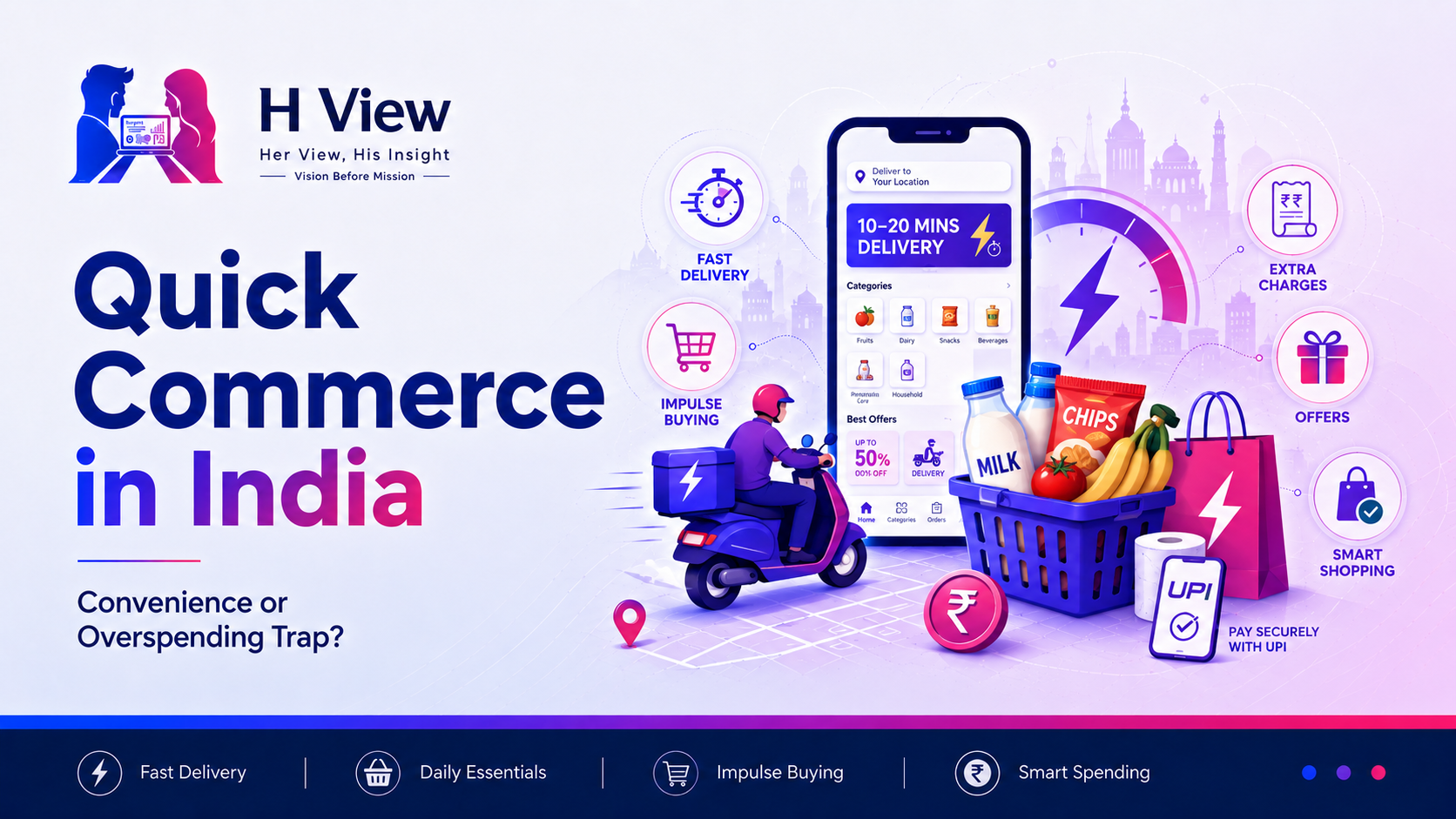
Quick Commerce in India: Convenience or Overspending Trap?

☆☆☆☆☆No reader ratings yet
By HarikaUpdated July 10, 20268 min read10 views

Quick commerce has completely changed how many Indians shop.

Not too long ago, buying groceries or daily essentials usually meant a trip to the local kirana store, supermarket, or pharmacy. Today, with apps like Blinkit, Zepto, and Swiggy Instamart, many products can arrive at your doorstep in just a few minutes.

Need milk for breakfast? Order it.

Forgot toothpaste? Order it.

Unexpected guests arriving? Order snacks and drinks.

Craving ice cream late at night? Order it.

The convenience is hard to ignore.

But there’s another side to this story. When buying things becomes incredibly easy, spending money can become just as effortless.

At H View, we believe quick commerce is a great tool when it saves time and solves real problems. The trouble begins when convenience turns into a habit of unplanned spending.

Let’s explore how quick commerce is changing shopping habits in India, where it adds value, where it can become risky, and how consumers can use it smartly.

What Is Quick Commerce?

Quick commerce, or q-commerce, is a retail model that focuses on delivering everyday products within a very short time—often in just 10 to 30 minutes.

These platforms typically offer:

  • Groceries
  • Snacks and beverages
  • Fruits and vegetables
  • Personal care products
  • Baby essentials
  • Household items
  • Pet supplies
  • Stationery
  • Small electronics
  • Emergency-use products

Unlike traditional e-commerce, which emphasizes variety and scheduled delivery, quick commerce focuses on one thing: immediate need.

The promise is simple:

Order now. Get it fast.

Why Quick Commerce Is Growing So Fast in India

Quick commerce fits perfectly into modern urban lifestyles.

People are juggling demanding jobs, studies, family responsibilities, long commutes, and busy schedules. In such a world, saving even 20 or 30 minutes feels valuable.

The rapid growth of the industry reflects this demand. Millions of Indians now use quick-commerce apps regularly, and the sector has expanded across cities of all sizes.

The reason is simple—it solves real-life problems.

Quick commerce helps when:

  • You don’t have time to visit a store.
  • You run out of essentials unexpectedly.
  • Guests arrive without notice.
  • You need ingredients while cooking.
  • Late-night cravings strike.
  • Elderly family members need something urgently.
  • Busy workdays leave little time for shopping.

For many households, quick commerce has moved beyond being a luxury and become part of daily life.

The Convenience Advantage

There’s no doubt that quick commerce offers genuine benefits.

1. It Saves Valuable Time

For working professionals, students, and parents, time is often the most limited resource. A quick delivery can eliminate an unnecessary trip to the store.

2. It Helps During Emergencies

Running out of milk, baby food, sanitary products, cooking essentials, or household supplies can be stressful. Fast delivery provides immediate relief.

3. It Works Well for Small Purchases

Sometimes you don’t need a full grocery run. You just need two or three items. Quick commerce is ideal for these situations.

4. It Improves Accessibility

Elderly individuals, people without personal transportation, and residents of large apartment complexes often find quick delivery extremely convenient.

5. It Creates Opportunities for Brands

Quick-commerce platforms also help brands reach customers faster and expand their market presence beyond major metropolitan cities.

Clearly, quick commerce isn’t just a trend—it solves real consumer problems.

The Hidden Cost of Convenience

While convenience is the biggest strength of quick commerce, it can also become its biggest drawback.

When products are available with just a few taps, people tend to spend less time thinking before making purchases.

A ₹99 snack.

A ₹149 cold drink.

A ₹199 impulse buy.

A ₹49 add-on product.

A few delivery and handling charges.

Individually, these expenses seem insignificant. But over an entire month, they can add up to a surprisingly large amount.

The real challenge is that consumers often know they are spending more than planned, yet still continue because the process feels so effortless.

How Quick Commerce Encourages Impulse Buying

Quick-commerce apps are designed to make shopping fast. But they are also designed to increase how much customers spend.

Some common triggers include:

  • Free delivery thresholds
  • Flash sales
  • Limited-time offers
  • Recommended products
  • Combo deals
  • Recently purchased items
  • Low-stock alerts
  • One-click reordering
  • Checkout add-ons

These features aren’t necessarily bad. However, they can encourage customers to buy things they never intended to purchase.

For example, you may open the app to buy milk and bread. By the time you reach checkout, your cart includes chips, chocolates, soft drinks, ice cream, and a few random household items.

That’s when convenience starts turning into a spending trap.

UPI and the Psychology of Spending

The rise of quick commerce is closely linked with the rise of digital payments.

UPI has made transactions incredibly simple. While that’s a positive development, it can also make spending feel less tangible than handing over physical cash.

With digital payments:

  • The transaction happens instantly.
  • There is little friction during checkout.
  • Spending often feels less noticeable.

Since most quick-commerce purchases are paid digitally, users may not immediately realize how much they are spending through multiple small orders.

Quick Commerce vs. Kirana Stores

Quick commerce is useful, but local kirana stores still offer unique advantages.

Quick Commerce Is Better For:

  • Urgent requirements
  • Late-night purchases
  • Fast delivery
  • Easy product search
  • Digital payments
  • Small emergency orders

Kirana Stores Are Better For:

  • Personal relationships
  • Credit-based trust
  • Supporting local businesses
  • Flexible quantities
  • Human interaction
  • Physical inspection of products

The smartest approach isn’t choosing one over the other.

It’s using both wisely—quick commerce for urgent situations and local stores or supermarkets for planned shopping.

Is Quick Commerce Good for Small Brands?

Quick-commerce platforms provide visibility and access to customers, especially in urban markets.

However, success isn’t guaranteed.

Small brands often face challenges such as:

  • High competition
  • Platform commissions
  • Discount pressures
  • Inventory management
  • Limited visibility compared to larger brands

For emerging businesses, quick commerce can be a valuable sales channel, but it shouldn’t be the only one.

The Human Side of Fast Delivery

Behind every fast delivery is a delivery partner working under real-world conditions.

Heavy traffic, bad weather, waterlogged roads, apartment access issues, and customer expectations all add to the challenge.

As consumers, it’s important to remember that our convenience relies on someone else’s effort.

Fast delivery should never come at the cost of safety.

How to Use Quick Commerce Wisely

1. Buy What You Need

Before placing an order, ask yourself:

Do I need this right now, or can it wait?

If it can wait, put it on your regular grocery list.

2. Make a List First

Decide what you need before opening the app. A list helps reduce impulse purchases.

3. Avoid Aimless Browsing

Browsing often leads to buying things you never intended to purchase.

4. Set a Monthly Budget

Create a limit for quick-commerce spending and stick to it.

5. Compare Prices

Some products may be more expensive than those available in local stores or supermarkets.

6. Watch Additional Charges

Small fees can quietly increase the total bill.

7. Don’t Chase Free Delivery

Spending extra money just to avoid a delivery fee doesn’t always save money.

8. Review Your Order History

At the end of each month, check how much you actually spent. The numbers may surprise you.

When Convenience Becomes a Problem

Quick commerce may be affecting your budget if:

  • You place orders almost every day.
  • Snacks make up a large part of your purchases.
  • You buy extra products only for offers.
  • Your grocery expenses keep increasing.
  • You rarely track small transactions.
  • You feel guilty after ordering.
  • You have completely stopped visiting nearby stores.
  • You open the app out of boredom.

These are signs that quick commerce may have shifted from a convenience tool to a spending habit.

Her View

From a user’s perspective, quick commerce can feel incredibly helpful. It reduces stress, solves urgent problems quickly, and offers a smooth shopping experience.

However, that same convenience can make spending feel casual and effortless.

For students, families, and young professionals, awareness is key. Quick commerce is useful, but it isn’t always the most budget-friendly option.

His Insight

Quick commerce is a powerful retail innovation, but consumers should understand how these platforms operate.

They don’t simply deliver products. They also influence purchasing decisions, encourage repeat orders, increase basket sizes, and make payments frictionless.

That’s why self-control matters.

The smartest users treat quick commerce as a solution for genuine needs—not emotional, impulsive, or boredom-driven purchases.

H View Recommendation

Quick commerce is a fantastic convenience when used in moderation.

Use it for:

  • Urgent needs
  • Missing essentials
  • Time-sensitive purchases
  • Emergency household items
  • Occasional convenience

Avoid using it for:

  • Every small craving
  • Boredom shopping
  • Repeated snack orders
  • Unplanned add-ons
  • Monthly grocery replacement without comparison

The best habit is simple:

Plan big purchases. Use quick commerce only when speed genuinely matters.

FAQs

What is quick commerce in India?

Quick commerce is a fast delivery model where groceries, household essentials and other daily-use products are delivered within minutes through apps.

Which are popular quick-commerce apps in India?

Popular platforms include Blinkit, Zepto, Swiggy Instamart and other fast-delivery services depending on the city.

Is quick commerce more expensive?

It can be more expensive if users frequently place small orders, add impulse items, pay extra charges or stop comparing prices with regular stores.

Does quick commerce cause overspending?

It can. Fast delivery, easy payments, app suggestions, offers and free-delivery thresholds can encourage impulse buying.

Should I stop using quick commerce?

Not necessarily. Use it wisely for urgent needs and convenience, but avoid making it your default shopping habit for everything.

Final View

Quick commerce in India is both useful and risky.

It saves time, solves urgent needs and brings daily products to your door quickly. But it can also make small unplanned purchases feel normal.

At H View, our final view is simple:

Quick commerce is a convenience tool, not a shopping lifestyle. Use it when it saves time, but do not let it quietly increase your monthly spending.

Pros

  • Saves time for busy users
  • Helpful during urgent household needs
  • Convenient for small essential purchases
  • Useful for elderly people, working professionals and families
  • Supports fast access to groceries and daily items
  • Creates new retail opportunities for brands

Cons

  • Can encourage impulse buying
  • Small orders can increase monthly spending
  • Extra charges may make purchases costly
  • App design can push users to add more items
  • Digital payments may reduce spending awareness
  • Fast delivery can create pressure on riders

Use Quick Commerce for Need, Not Habit

Submit Your View

Share your real experience and help other readers decide better.

🔒 Your review may be published after moderation.

Reader Reviews

No community views yet. Be the first to share yours.

Advertisement

Your Ad Here

728 × 90
Learn More
AdvertisementYour Ad Here300 × 250Learn More
8.0Excellent

H View Score

A quick view of our final rating for this review.

✉

Stay Updated with H View

Get the latest reviews and insights straight to your inbox.

🔒 No spam. Unsubscribe anytime.

Trending Reviews

The Courageous Leader: Why Doing the Right Thing Is the Ultimate Test of LeadershipJuly 10, 2026How Technology Is Transforming FIFA World Cup 2026July 10, 2026Rising Stars to Watch at FIFA World Cup 2026July 10, 2026FIFA World Cup 2026 48-Team Format: Opportunities and ChallengesJuly 10, 2026FIFA World Cup 2026 Host Nations: USA, Canada and Mexico UniteJuly 10, 2026FIFA World Cup 2026: A New Era of Global FootballJuly 10, 2026The Change Agent Leader: Why Great Leaders Challenge the Status QuoJuly 9, 2026AI Influencers: Are Virtual Creators Changing Social Media?July 9, 2026
📢Advertisement

Your Ad Here

1300 × 250

Promote your brand to H View readers.

Learn More
H View

Honest reviews. Smart ratings. Real insights.

Explore

HomeReviewsBlog

Company

AboutAdvertiseContact

Support

Privacy PolicyTerms & ConditionsDisclaimerEditorial Policy

Subscribe to H View

Get the latest updates and exclusive content straight to your inbox.

🔒 No spam. Unsubscribe anytime.
© 2026 H View. All rights reserved.
HomeReviewsBlogContact