

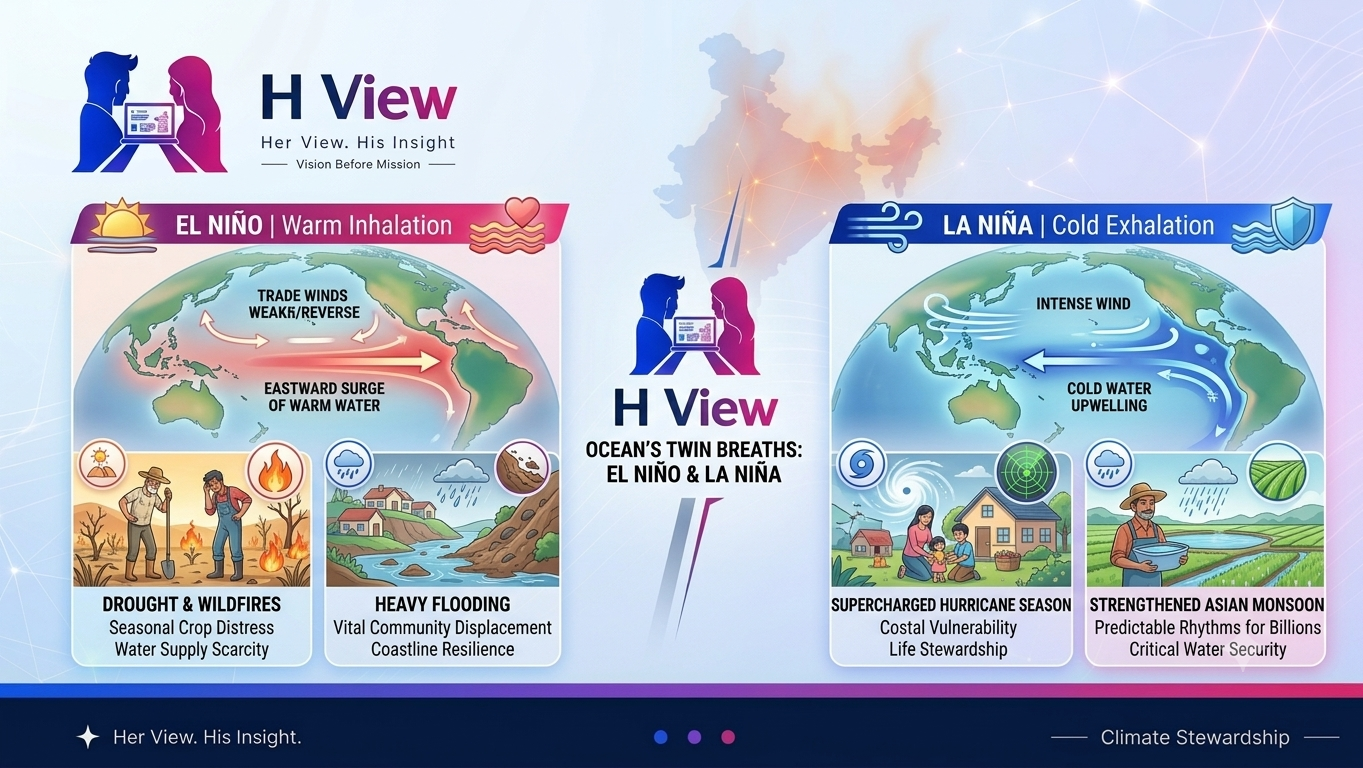


We often read about climate anomalies in the cold, detached vocabulary of meteorology: barometric pressure, sea surface anomalies, and convective cells. Yet, the vast oscillations of the tropical Pacific Ocean—collectively known as the El Niño-Southern Oscillation (ENSO)—are anything but mechanical. They are the grand, shifting breaths of our living planet, and their inhalations and exhalations directly shape the conditions of human survival.
When the Pacific warms or cools, it doesn’t just change the weather; it alters the immediate realities of families worldwide. At H View, our “Vision Before Mission” philosophy compels us to look past the charts and maps to understand the real human lives caught in these oceanic tides.
To navigate what lies ahead, we must look closely at how these twin patterns shift our global climate reality.
1. El Niño: The Warm Inhalation and the Rising Thermometer
An El Niño event begins when the equatorial trade winds that usually blow firmly from east to west suddenly slacken or reverse. Deprived of the force pushing it westward, an immense reservoir of warm subsurface water surges eastward across the Pacific. The ocean’s surface warms rapidly, fundamentally shifting the global atmospheric engine.
- The Human Reality: El Niño alters rain patterns globally. In places like South Asia and parts of Central America, it often brings severe, baking droughts that stress local water supplies and threaten seasonal crop harvests. Conversely, along the western coastlines of the Americas, it can dump torrential rains, turning parched hillsides into treacherous mudslides and overflowing rivers into communities.
2. La Niña: The Cold Exhalation and Intense Rhythms
La Niña is El Niño’s fierce mirror image. Here, the trade winds do not fail; instead, they surge with unusual intensity, aggressively whipping across the ocean surface. They push the warm surface waters far to the west and pull cold, deep ocean water upward along the South American coast.
- The Human Reality: While La Niña brings a cold embrace to the eastern Pacific, it acts as an atmospheric whip elsewhere. It often supercharges the Atlantic hurricane season, translating to sleepless nights and evacuation notices for families along vulnerable coastlines. Yet, it also brings a saving grace: it frequently strengthens monsoons across Asia, filling critical water reservoirs and giving farmers the predictable rainfall they need to feed millions.
Conclusion: Navigating the Swell with Clarity
The ocean’s cycles are inevitable, but human vulnerability is something we can actively manage. Whether the Pacific is warming or cooling, our global mission must be to transition from reactive disaster management to proactive resilience.
By achieving true clarity on these atmospheric rhythms, we can better protect small-scale farmers, reinforce vulnerable coastal infrastructures, and ensure that when the earth takes its next deep breath, humanity is ready.