



H View
  • Home
  • About
  • Blogs
  • Categories
    • AI
    • Tech
    • Lifestyle
    • Business
      • Money
    • Sports
  • Reviews
  • Contact
Connect With Us
H View
  • Home
  • About
  • Blogs
  • Categories
    • AI
    • Tech
    • Lifestyle
    • Business
      • Money
    • Sports
  • Reviews
  • Contact
Connect
Culture

Navratri Day 1, 2026: Why Maa Shailputri Is Worshipped First and What Ghatasthapana Really Means

☆☆☆☆☆No reader ratings yet
By HarikaUpdated October 11, 202615 min read2 views

Sharad Navratri begins today, Sunday, October 11, 2026, and the first morning carries a different feeling from the celebrations that will follow over the next nine nights. Garba grounds will gradually fill, Durga Puja preparations will intensify, temples will become busier, and every day will introduce another form of the Goddess. Yet Navratri does not begin with its most dramatic image of divine power; it begins with Maa Shailputri, a form associated with the mountains, steadiness, roots and the strength required to begin again.

The first day is observed on Shukla Pratipada of the Ashwin month and begins formally with Ghatasthapana, also known as Kalash Sthapana. The kalash is installed in the puja space to mark the beginning of the nine-day worship of Shakti, and Maa Shailputri is honoured as the first among the Navdurga. Panchang calculations confirm October 11 as the first day of Navratri in 2026 because Pratipada is present at sunrise, even though the tithi itself began on the previous evening.

For H View, Day 1 is especially meaningful because its symbolism is remarkably simple: before we try to transform our lives, achieve something extraordinary or overcome a major challenge, we need a stable foundation. Maa Shailputri represents that beginning. Her story is connected with loss, rebirth and returning with greater purpose, making the first day of Navratri much more than a ritual opening to the festival.

Who Is Maa Shailputri?

The name Shailputri comes from two Sanskrit words: shaila, meaning mountain, and putri, meaning daughter. She is therefore remembered as the “daughter of the mountain,” born as the daughter of Himavan, the personification or king of the Himalayas. In the Navdurga tradition, she is the first manifestation of Goddess Durga worshipped during Sharad Navratri.

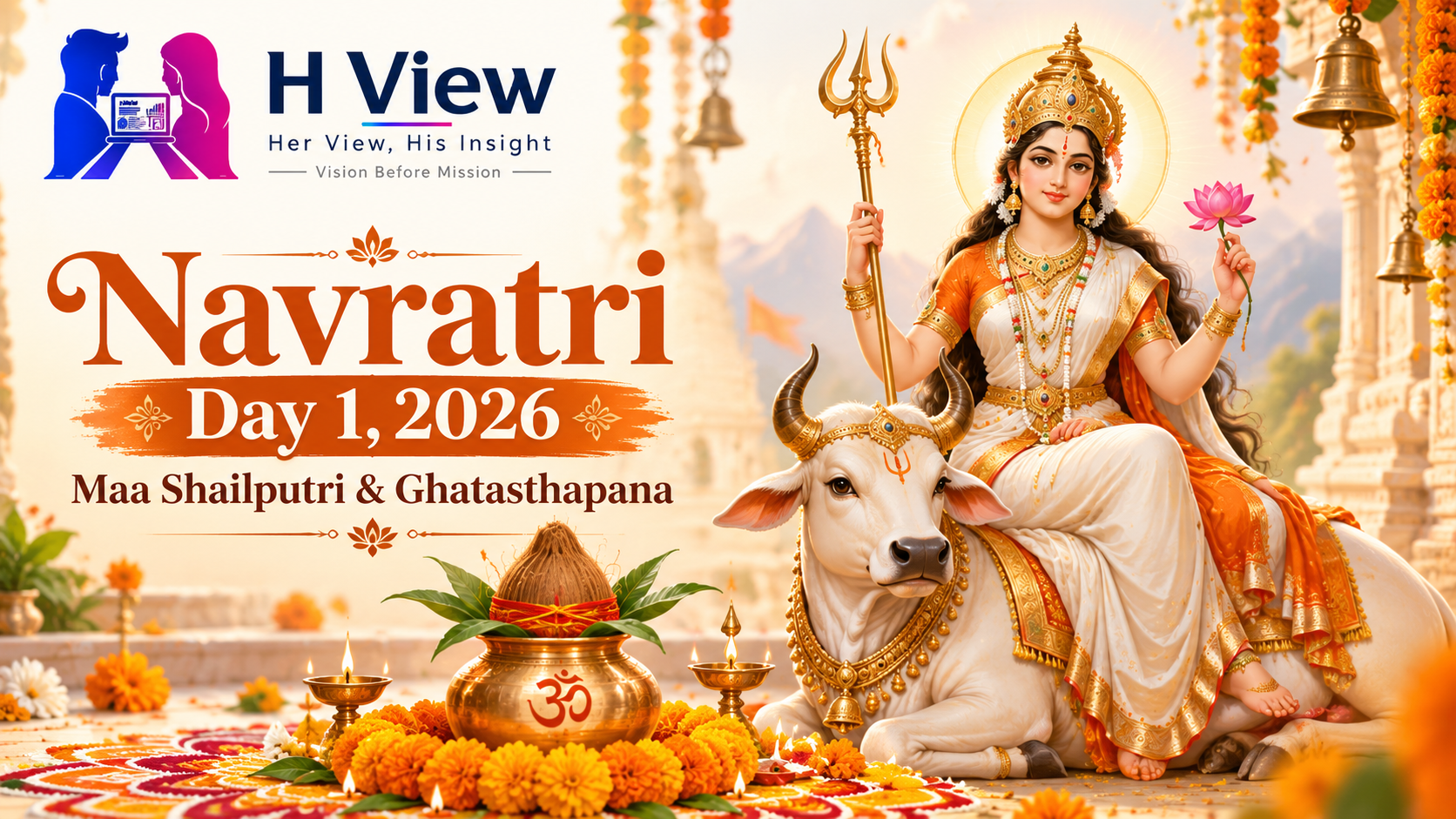
Maa Shailputri is commonly depicted riding Nandi, the bull, with a trident in one hand and a lotus in the other. A crescent moon appears on her forehead, connecting her closely with Lord Shiva and the later form of Parvati. Her appearance is comparatively calm when placed beside some of Durga’s fiercer manifestations, which itself carries symbolism because the spiritual journey of Navratri begins not with confrontation but with stability.

Many traditional interpretations associate Maa Shailputri with grounding, determination, strength and the beginning of spiritual discipline. That makes her particularly appropriate for Pratipada because every serious journey requires a first step that is steady enough to support everything that follows.

The Story of Sati, Rebirth and Shailputri

The story behind Maa Shailputri begins before her birth as the daughter of the Himalayas. According to the traditional narrative, she had previously been born as Sati, daughter of King Daksha, and had chosen Lord Shiva as her husband despite her father’s disapproval. Daksha’s dislike of Shiva eventually became central to one of the most emotionally powerful stories in Hindu tradition.

Daksha organised a great yajna but deliberately did not invite Shiva. Sati nevertheless attended, hoping that a daughter would not require a formal invitation to visit her father’s home, but she was deeply hurt when Daksha insulted Shiva in front of the assembled gathering. Unable to bear the dishonour directed toward her husband, Sati gave up her life in the sacrificial fire.

The story does not end with destruction. Sati is subsequently reborn as the daughter of Himavan and becomes known as Shailputri, eventually reuniting with Shiva as Parvati. This transition from Sati to Shailputri is why Day 1 carries such a strong symbolism of renewal: something may end painfully, but an ending does not always mean the story itself is finished.

Seen from a modern perspective, the story offers a thoughtful beginning to Navratri. Many people enter new phases of life after disappointment, loss, rejection or failure, and the strength required to restart is often quieter than the strength required to fight. Shailputri’s story reminds devotees that transformation sometimes begins simply by standing firmly again.

Why Is Maa Shailputri Worshipped First?

The order of Navdurga is not random. Shailputri represents the foundation from which the remaining stages of Navratri unfold, while later forms progressively express discipline, courage, creativity, nurturing energy, determination, fearlessness, purification and spiritual completion. The sequence can therefore be understood as a gradual movement rather than nine disconnected forms of the Goddess.

Traditional interpretations also associate Shailputri with the Muladhara or root foundation of spiritual practice. Whether one approaches that association literally or symbolically, the idea is easy to understand: a structure cannot rise safely when its base is unstable. The first day therefore encourages grounding before ambition and discipline before transformation.

This is one reason Day 1 can resonate even with readers who are approaching Navratri primarily through its cultural meaning. Every career, relationship, spiritual practice or personal goal eventually depends on the quality of its foundation. We often want the visible result before developing the habits that make the result sustainable, while Navratri begins by reversing that order.

What Is Ghatasthapana and Why Is It Important?

Ghatasthapana or Kalash Sthapana is the central ritual that formally begins the Navratri observance. A sacred pot or kalash is established in the puja space according to family or regional tradition, and it symbolically represents divine presence, fertility, abundance and the beginning of the worship of Shakti. The ritual is performed during Pratipada and traditionally should be completed during an appropriate muhurta.

Many households prepare a bed of clean soil and sow barley or other grains around the kalash. Water, sacred leaves, a coconut and other traditional items may be used depending on the family’s practice, while a lamp is lit and prayers are offered to invoke Maa Durga. The germination of the grains over the following days is traditionally associated with growth, prosperity and life.

It is important not to present one internet version of Ghatasthapana as the only correct procedure. Ritual practice varies across communities, sampradayas, temples and regions, and families who already follow an established tradition should continue following it. What remains common is the larger purpose: the home or puja space is prepared consciously, divine energy is invoked, and Navratri begins with intention rather than merely with celebration.

Navratri Day 1, 2026 at a Glance

Detail Day 1 Information
Date Sunday, October 11, 2026
Tithi Shukla Pratipada
Goddess Maa Shailputri
Meaning of name Daughter of the Mountain
Main ritual Ghatasthapana / Kalash Sthapana
Vehicle Nandi, the bull
Symbols Trident and lotus
Popular colour Orange
Common offering Pure ghee and traditional sweets
Simple mantra Om Devi Shailaputryai Namah
Core symbolism Grounding, stability, strength and new beginnings

The popular Navratri colour sequence for 2026 begins with orange today, followed by white, red, royal blue, yellow, green, grey, purple and peacock green during the remaining days. Orange is commonly interpreted as a colour of energy, warmth and enthusiasm, which suits the optimism associated with beginning a new festive and spiritual cycle.

Ghatasthapana Muhurat for October 11, 2026

Current panchang coverage gives a Delhi-based Ghatasthapana window of approximately 6:19 a.m. to 10:12 a.m., with the Abhijit Muhurta around 11:44 a.m. to 12:31 p.m. as an alternative window. These timings should not be copied blindly across India because local sunrise, longitude and panchang calculations can shift the muhurta by several minutes.

The important principle is that Ghatasthapana is traditionally performed while Pratipada is prevailing and within the recommended local muhurta. Readers in Andhra Pradesh, Telangana, Karnataka, Maharashtra, Gujarat, northern India or elsewhere should therefore check a trusted local panchang or temple calendar before performing the formal ritual.

This is particularly important for H View because festival articles often repeat one city’s timing as though it were universally valid. A cultural article should help the reader understand the ritual rather than accidentally create confusion by presenting Delhi, Mumbai or another city’s muhurta as a nationwide clock.

A Simple Day 1 Puja Flow for the Home

Families already following a traditional procedure should continue with their own customs, but readers looking for a general understanding of the Day 1 sequence can think about the puja in these broad stages:

  • Prepare the space carefully: Clean the puja area, bathe and wear clean clothes before beginning. Navratri traditionally starts with physical and mental preparation rather than rushing directly into the ritual.
  • Perform Ghatasthapana: Establish the kalash according to your family tradition and local muhurta. Where customary, grains are sown in clean soil around the kalash and a coconut and sacred leaves are placed appropriately.
  • Invoke Maa Durga and Maa Shailputri: Offer flowers, incense, lamp and prayers while focusing specifically on the first form of Navdurga. Devotees may recite the Shailputri mantra or Durga prayers familiar to their household.
  • Offer bhog: Pure ghee and ghee-based sweets are commonly associated with Maa Shailputri worship, although household traditions differ. Fruits and other satvik offerings may also be made.
  • Perform aarti and maintain the sankalp: Many devotees take a personal resolve for the nine days, whether that involves fasting, prayer, satvik food, Durga Saptashati recitation or simply greater discipline in everyday behaviour.

The purpose of such a sequence is not to reduce devotion to a checklist. It gives structure to the beginning of Navratri while leaving space for regional and family traditions that have been passed down over generations.

Why Is Ghee Offered to Maa Shailputri?

Pure ghee is widely associated with the first day offering to Maa Shailputri. In traditional Navratri guidance, devotees may offer ghee directly or prepare a simple sweet or bhog using it, with the offering associated with health, strength and well-being. Current Day 1 puja guides also continue to list ghee among the common offerings made to the Goddess.

The cultural meaning can be understood more broadly as an offering of nourishment and purity at the beginning of the nine-day journey. Like most Navratri practices, however, the precise bhog varies considerably between households. A family that has followed a particular offering for generations does not need to replace it because an online calendar lists another option.

This flexibility is important because Indian festivals have survived partly through living traditions rather than strict uniformity. The spirit of devotion is shared, while the foods, prayers, decorations and exact ritual details may change from one region to another.

What Does the Orange Colour Mean on Day 1?

Orange is the popular colour associated with October 11 in the 2026 Navratri sequence. Many devotees enjoy wearing the daily colour to temples, workplaces, Garba events or family gatherings, and offices and schools sometimes use the sequence to organise festive dress days.

The colour is commonly associated with enthusiasm, warmth, confidence and positive energy. Those qualities fit the first day because Navratri begins with an atmosphere of anticipation, preparation and spiritual renewal, particularly after the completion of Pitru Paksha immediately beforehand.

At the same time, wearing orange should not be treated as a mandatory religious requirement. The colour tradition is particularly popular in parts of western India and has become widely shared through contemporary festival culture, but devotion to Maa Shailputri does not depend on the colour of a devotee’s clothing.

A Simple Maa Shailputri Mantra

One of the most commonly used simple mantras for Day 1 is “Om Devi Shailaputryai Namah.” Devotees may repeat it during puja, meditation or quiet prayer according to their personal practice. More elaborate stotras and Durga prayers may also be recited by households accustomed to them.

For readers unfamiliar with Sanskrit rituals, the most important thing is not to become anxious about performing every chant perfectly. A festival meant to create devotion should not become an exercise in fear of making a minor pronunciation or procedural mistake. Following family guidance, a trusted priest or a respected temple tradition is more meaningful than collecting dozens of unrelated rituals from social media.

Navratri becomes richer when the devotee understands why something is being done rather than simply trying to complete the maximum number of rituals.

An Interesting 2026 Detail: Maa Durga Is Said to Arrive on an Elephant

Traditional Navratri belief associates the symbolic vehicle of Maa Durga’s arrival with the weekday on which the festival begins. Because Sharad Navratri 2026 starts on a Sunday, current panchang commentary says the Goddess is believed to arrive on an elephant, a symbol traditionally associated with prosperity, favourable rainfall and abundance.

This belongs to devotional tradition rather than something that should be interpreted as a literal prediction of weather or economic outcomes. Its value lies in the symbolism through which agricultural and community life historically became woven into the festival calendar.

The imagery is particularly appropriate for a festival that begins immediately after the ancestral remembrance period of Pitru Paksha. One cycle closes with gratitude toward those who came before, while Navratri opens another cycle centred on energy, renewal and Shakti.

What Can Day 1 Mean Beyond the Ritual?

The most interesting part of Shailputri worship for H View is the idea that strength begins with grounding. Modern life constantly encourages acceleration: achieve faster, earn more, move ahead, become visible and keep upgrading. We rarely receive equal encouragement to ask whether the foundation beneath that growth is strong enough.

A person may chase a promotion while being completely exhausted, build a business without financial discipline or pursue a relationship without trust. The visible ambition may be impressive, but instability underneath eventually creates problems that cannot be solved by adding more speed.

Shailputri offers a different starting philosophy. Before the nine nights move through progressively more complex manifestations of Shakti, the journey begins with the mountain: something rooted, patient and difficult to shake.

That symbolism feels particularly appropriate on the first morning of Navratri. Beginning again does not require knowing everything that will happen over the next nine days or the next year; it requires establishing enough stability to take the first step properly.

Her View: Starting Again Is Also a Form of Strength

We often celebrate strength only when it looks dramatic. Someone wins a major battle, makes a bold decision, walks away from something difficult or achieves an extraordinary result, and that visible moment becomes the story everyone notices.

Yet many of the hardest beginnings happen quietly. Someone rebuilds confidence after failure, returns to work after years away, creates financial discipline after debt, begins setting boundaries in a difficult relationship or simply decides that the next phase of life cannot repeat the previous one.

That is why the Sati-to-Shailputri story can feel surprisingly modern. Rebirth in the mythological narrative can also be read symbolically as the possibility that painful endings do not have to define the person permanently. The first day of Navratri honours a form of Shakti whose power begins not with noise but with being firmly rooted enough to start again.

His Insight: A Strong Foundation Matters More Than a Fast Beginning

People often become highly motivated at the beginning of anything. New Year resolutions are intense during the first week, career plans look perfect on paper, and spiritual commitments can be strongest on the opening day of a festival. The harder challenge is whether the foundation can carry the commitment after the initial excitement disappears.

That is where Day 1 provides a useful lesson. Ghatasthapana is not the climax of Navratri; it is the preparation for everything that follows. The kalash is established, the intention is set, and only then does the journey through the remaining forms of the Goddess continue.

In everyday terms, this means a beginning becomes powerful when it has structure behind it. Discipline, realistic expectations, consistency and clarity may not look as impressive as dramatic motivation, but they are usually what decide whether transformation survives beyond the first few days.

The H View Verdict

Navratri Day 1 is often introduced through a familiar collection of details: Maa Shailputri, orange colour, Ghatasthapana, ghee bhog and a mantra. All of those traditions are valuable, but together they point toward a deeper idea that deserves more attention.

The first day is about establishing the foundation before seeking transformation.

Maa Shailputri’s story moves from Sati’s painful ending toward rebirth as the daughter of the Himalayas. Her imagery connects her with the mountain, the bull, the trident and the lotus, all of which reinforce themes of grounded strength, endurance and spiritual beginning. Ghatasthapana then gives that symbolism a physical form inside the home as devotees consciously establish the sacred space from which the nine-day observance will unfold.

Perhaps that is why Navratri begins with her rather than one of Durga’s fiercer manifestations. Strength does not always begin with fighting. Sometimes it begins by becoming steady enough that whatever comes next cannot easily shake us.

As Navratri 2026 begins today, the most meaningful sankalp may therefore be something more personal than simply completing nine days of ritual. It may be choosing one part of life that needs a stronger foundation and giving it the patience, discipline and attention required to rebuild properly.

The celebration will become more colourful with every passing day, but Day 1 gives us something quieter and perhaps more useful: the reminder that every meaningful transformation has to begin somewhere stable.

Sources and Related Reading

The October 11, 2026 observance and the Delhi Ghatasthapana and Abhijit windows in this guide follow the New Delhi panchang timings reported by The Times of India’s Navratri 2026 schedule. These are Delhi timings; check a local panchang or temple calendar for your city.

For the festival’s wider regional context, see H View’s Navratri 2026 guide.

Frequently Asked Questions

Which Goddess is worshipped on Navratri Day 1 in 2026?

Maa Shailputri, the first form of Navdurga, is worshipped on Day 1 of Sharad Navratri. Her name means “daughter of the mountain,” and she is traditionally identified with the rebirth of Sati as the daughter of Himavan before later becoming Parvati.

When does Navratri begin in 2026?

Sharad Navratri begins on Sunday, October 11, 2026. Pratipada began on the evening of October 10, but because the tithi is present at sunrise on October 11, Udaya Tithi rules place the first Navratri observance and Ghatasthapana on October 11.

What is the Ghatasthapana time for Navratri 2026?

For New Delhi, commonly published panchang calculations list approximately 6:19 a.m. to 10:12 a.m., with an Abhijit alternative around 11:44 a.m. to 12:31 p.m. Timings vary by location, so devotees should check the panchang for their own city before performing Kalash Sthapana.

What is the Navratri Day 1 colour for 2026?

The popular Day 1 colour for October 11, 2026 is orange. It is culturally associated with warmth, enthusiasm and positive energy, although wearing the daily Navratri colour is an optional cultural practice rather than a universal religious requirement.

What should be offered to Maa Shailputri?

Pure ghee is widely associated with Maa Shailputri’s Day 1 bhog, and some families offer sweets prepared with ghee alongside fruits and other satvik foods. The exact offering varies across regions and family traditions, so devotees may follow the practice already established in their household.

What is a simple Maa Shailputri mantra?

A commonly recited simple mantra is “Om Devi Shailaputryai Namah.” Devotees may chant it during Day 1 worship alongside Durga prayers, aarti or other stotras followed within their family tradition.

Written by

Harika

Harika is the co-founder of H View and covers AI, technology, gadgets, digital tools, online platforms, and modern internet trends. Her articles focus on simplifying complex topics with practical explanations, balanced opinions, and reader-first insights.

Topics coveredAIAutoBusinessCultureCyber SafetyDigital MarketingGuidesH ViewHistoryLeadershipLifestyleMoneyReviewsTechAudioGadgetsLaptopsWordpress
View all posts by author

Submit Your View

Share your real experience and help other readers decide better.

🔒 Your review may be published after moderation.

Reader Reviews

No community views yet. Be the first to share yours.

8.0Excellent

H View Score

A quick view of our final rating for this review.

✉

Stay Updated with H View

Get the latest reviews and insights straight to your inbox.

🔒 No spam. Unsubscribe anytime.

Trending Reviews

Why Are Women Entrepreneurs Still Struggling to Grow Even After Joining SHGs and Starting Businesses?October 11, 2026When Management Changes the Rules Mid-Project but Keeps the Same DeadlineOctober 11, 2026amazon great indian festival 2026Amazon Great Indian Festival 2026 Laptop Deals: Are the Discounts Really Worth It or Just Inflated MRP Marketing?October 10, 2026from self-help groups women entrepreneursFrom Self-Help Groups to Women Entrepreneurs: Are SHGs Creating Real Economic Independence?October 10, 2026navratri 2026 begins october nineNavratri 2026 Begins October 11: Nine Nights of Shakti, Tradition, Fasting and Celebration Across IndiaOctober 10, 2026when ownership looks like defianceWhen Ownership Looks Like Defiance: Why Good Work Can Still Be Misread by ManagementOctober 10, 2026digital marketing tools 2026 marketersBest Digital Marketing Tools in 2026: What Marketers Actually Need and What They Can SkipOctober 6, 2026stop replacing employees who leaveStop Replacing Employees Who Leave. Start Fixing Why They Wanted to LeaveOctober 6, 2026

Related Blogs

Entrepreneurship

Why Are Women Entrepreneurs Still Struggling to Grow Even After Joining SHGs and Starting Businesses?

By Dr. A. Alimelu Annapurna Women’s entrepreneurship is often discussed as though the most difficult…

Annapurna October 11, 2026
Leadership

When Management Changes the Rules Mid-Project but Keeps the Same Deadline

Software projects are often estimated using a particular team structure, toolset, workflow, and development speed.…

Harika October 11, 2026
amazon great indian festival 2026
Tech

Amazon Great Indian Festival 2026 Laptop Deals: Are the Discounts Really Worth It or Just Inflated MRP Marketing?

Every festive sale in India begins with the same visual language: giant discount percentages, crossed-out…

Harika October 10, 2026
from self-help groups women entrepreneurs
Entrepreneurship

From Self-Help Groups to Women Entrepreneurs: Are SHGs Creating Real Economic Independence?

By Dr. A. Alimelu Annapurna For millions of rural women in India, the first step…

Annapurna October 10, 2026
H View

Honest reviews. Smart ratings. Real insights.

Explore

HomeReviewsBlog

Company

AboutAdvertiseContact

Support

Privacy PolicyTerms & ConditionsDisclaimerEditorial Policy

Subscribe to H View

Get the latest updates and exclusive content straight to your inbox.

🔒 No spam. Unsubscribe anytime.
© 2026 H View. All rights reserved.
HomeReviewsBlogContact