



Best AI for Coding in 2026: ChatGPT, Claude, Gemini or Something Else?
A few years ago, asking for the best AI for coding usually meant asking which…

There is a particular kind of frustration that only appears after you have already left home. You reach the airport and cannot remember whether the suitcase made it into the cab. You leave a restaurant and suddenly wonder where your backpack is. Or you spend fifteen minutes at home checking sofas, drawers and pockets for a set of keys that somehow disappeared.
Bluetooth trackers exist for exactly these moments, but until recently the Indian market was still fairly fragmented. Apple users naturally looked toward AirTag, Android users had Google-compatible alternatives, and households using both ecosystems often had to think carefully about which tracker would work with which phone.
JioTag 2 is trying to simplify that decision.
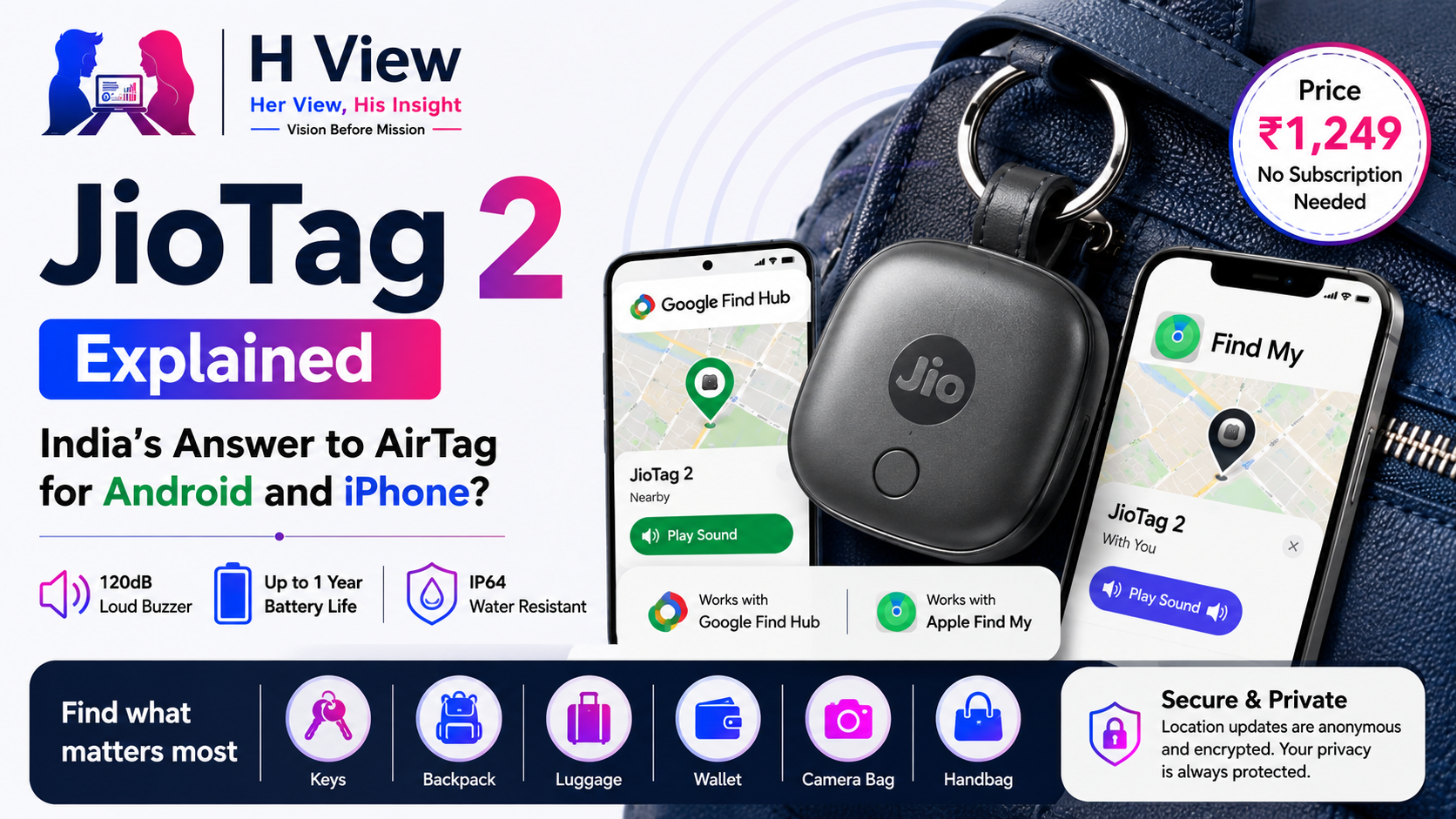
Reliance Jio’s second-generation tracker has launched with support for both Apple Find My and Google Find Hub, which is its biggest upgrade over earlier Jio trackers. Android users can pair it with Google’s tracking network, while iPhone and iPad users can use Apple’s native Find My system. That cross-platform support makes JioTag 2 unusually practical for Indian families where one person may use an iPhone and another a Samsung, Pixel, Nothing or other Android phone.
At around ₹1,249 in launch coverage, it is also positioned well below the cost associated with Apple’s AirTag ecosystem. The more interesting question, though, is whether lower price and broader compatibility are enough to make JioTag 2 the smarter buy.
JioTag 2 is a small Bluetooth item tracker designed to stay attached to things you do not want to lose.
Keys are the obvious example, but the same tracker can be attached to a backpack, handbag, luggage, camera bag or other belongings. Jio specifically positions the device for everyday items such as wallets, bags, luggage and valuables.
When the tag is nearby, Bluetooth is used to communicate with your phone. If you cannot see the item, you can trigger the built-in alarm and follow the sound. JioTag 2 has a 120dB buzzer, which is loud enough to be genuinely useful when something is buried beneath clothes or left inside another room.
Things become more interesting when the tag is no longer within direct Bluetooth range.
Instead of relying on GPS inside the tracker itself, JioTag 2 uses the wider finding network supported by the phone ecosystem you pair it with. On Android, that means Google Find Hub. On Apple devices, it means Apple Find My. Nearby compatible devices can anonymously help update the location of the lost tag, allowing the owner to see where it was detected.
That distinction is important because JioTag 2 is not a miniature GPS tracker with its own mobile data connection.
It is a Bluetooth tracker that becomes more useful because millions of other devices can participate in locating it.
Jio has already experimented with multiple tracker models.
The original JioTag worked through Jio’s own companion experience, while JioTag Go was designed around Google’s finding ecosystem. JioTag Air targeted Apple users through Find My. The second-generation JioTag combines the most useful part of those approaches by supporting either Google Find Hub or Apple Find My.
That makes the product easier to recommend.
Imagine a family where one parent uses an iPhone and the other uses Android. If they buy a tracker only for Apple’s ecosystem, the Android user cannot manage it in the same way. If they buy a Google-only tracker, the opposite problem appears.
With JioTag 2, the same hardware can fit either household member’s device ecosystem.
There is an important practical limitation, though: the tracker is paired into the ecosystem you choose. It is not simultaneously visible inside Apple Find My and Google Find Hub as one shared cross-platform object. The advantage is that the same product works with either platform, not that both platforms merge into one tracker interface.
That is still valuable because it reduces the risk of buying the wrong version.
AirTag remains the product most people think about when item trackers are mentioned, largely because Apple made the category mainstream.
Its strongest advantage is the enormous Find My network and deep integration with iPhone. The experience is polished, the ecosystem is mature, and Apple has invested heavily in privacy and unwanted-tracking protections.
JioTag 2 is not trying to beat AirTag by becoming a more premium object.
Its advantage is value and flexibility.
At roughly ₹1,249, JioTag 2 is much easier to justify for several bags or sets of keys. If you want four trackers for a family, price differences multiply quickly.
The other advantage is obvious: an AirTag is an Apple ecosystem product, while JioTag 2 can also be used with Android through Google Find Hub.
For an iPhone owner deeply invested in Apple devices, AirTag may still feel like the more natural purchase.
For someone who may switch between Android and iPhone, or for a household using both, JioTag 2 has a stronger practical argument.
One of the most common misunderstandings around products such as AirTag and JioTag is the assumption that they provide continuous GPS tracking.
They do not.
JioTag 2 does not need a SIM card or subscription because it is not independently transmitting live GPS coordinates over a cellular network. Jio confirms that the device uses Bluetooth and supported finding networks instead.
That makes it perfect for things such as:
But it should not automatically be treated as a replacement for a GPS tracker where continuous location updates are necessary.
Jio actually sells a separate product called JioFind, which does use a SIM and mobile connectivity for real-time GPS tracking. That product works very differently and is better suited to use cases requiring ongoing location updates.
This distinction matters especially when people start thinking about children, vehicles or pets.
A Bluetooth item tracker can sometimes help locate an object when compatible devices pass nearby. A dedicated GPS tracker is designed to report its location much more directly.
Most people buy trackers because they imagine losing luggage hundreds of kilometres away.
In reality, the feature they may use most often is simply Play Sound.
Keys disappear inside homes more often than suitcases disappear in airports.
JioTag 2’s 120dB built-in alarm allows users to trigger a loud sound when the tracker is nearby. Jio also advertises left-behind alerts and lost-item recovery features through its supported ecosystem.
A realistic example is someone preparing for work in the morning and unable to find the bike keys. Instead of searching every surface in the house, they open Find Hub or Find My and make the tag ring.
That small convenience is arguably the strongest reason to own a tracker.
The global network is insurance for the rare serious loss. The buzzer solves the everyday problem.
Jio’s current tracker information emphasises a replaceable CR2032 battery with around a year of claimed battery life across its tag lineup.
That is a sensible approach for this type of gadget.
A tracker becomes much less useful if it needs charging every few days. It is supposed to disappear into a bag or keychain and remain ready when required.
Replaceable coin cells also mean the entire tracker does not need to be discarded when the battery eventually wears out.
The trade-off is that users need to remember the battery exists at all.
If a tag spends eleven months attached to luggage and then dies just before a trip, its convenience disappears. The associated tracking app should therefore be used to watch for low-battery alerts rather than assuming the tracker will last forever.
JioTag 2 carries an IP64 rating, meaning it is designed to resist dust and water splashes.
That is appropriate for a tracker intended to live on bags and keys.
It may encounter rain, spilled water or dust inside luggage, but it is not designed as a diving accessory.
This is another area where marketing language needs common sense. “Water resistant” does not mean “waterproof in every situation.”
For everyday commuting and travel, IP64 should be sufficient. I would still avoid intentionally submerging it.
A tracker becomes much more compelling during travel.
Suppose your checked suitcase does not appear on the baggage carousel. Without a tracker, you are completely dependent on the airline’s baggage system to tell you where it is.
With a JioTag 2 inside the bag, there is at least a chance that nearby compatible devices have updated its location through Apple Find My or Google Find Hub.
That does not guarantee recovery, and the tracker should never be treated as a substitute for airline baggage procedures.
But having an independent location clue can reduce uncertainty.
The same applies to backpacks on trains, camera bags during road trips and luggage inside hotels.
For someone who travels several times a year, ₹1,249 may be easier to justify than it is for someone who rarely leaves home.
The cross-platform story becomes even stronger in India because households frequently mix brands.
One person may use an iPhone because of work. Another may use Samsung. A student may have a Nothing phone. Parents may be using older Android devices.
JioTag 2 officially supports Android 9 or later and iPhones/iPads running iOS 14.5 or later.
That means a family can buy the same type of tracker even if the devices around the house change later.
You still need to reset and pair the tracker appropriately when moving between ecosystems, but you are not locked into purchasing entirely different hardware.
This is one of those features that sounds boring until someone actually switches phones.
Bluetooth trackers have an uncomfortable side to them.
Anything that can help locate lost luggage can potentially be misused to track a person without their knowledge.
Apple and Google have spent considerable effort developing unwanted-tracker alerts and interoperability around these networks. Because JioTag 2 participates in Apple Find My or Google Find Hub, it benefits from the protections those ecosystems provide.
Jio also states that location updates through nearby devices are handled securely without exposing other users’ personal information.
Users should still treat trackers responsibly.
They are meant for locating belongings, not secretly monitoring people.
That distinction should be obvious, but the popularity of tiny trackers makes it worth saying clearly.
For the feature set, the price is aggressive.
JioTag 2 costs more than the original JioTag did at launch, but it also provides much broader network compatibility. Launch coverage places it below the ₹1,499 price at which JioTag Go originally appeared.
At around ₹1,249, the decision becomes less about whether the technology is impressive and more about whether you regularly lose or travel with things valuable enough to track.
Someone who carries a ₹1 lakh laptop in a backpack has an easy answer.
Someone thinking about putting trackers on every inexpensive household object probably does not need five of them.
The value is strongest when the item being protected would be expensive, inconvenient or stressful to lose.
What I like about JioTag 2 is that it solves an ordinary problem without asking the user to learn another complicated system.
If I use an iPhone, I can work through Find My. If I use Android, Google Find Hub handles the tracking. That feels more practical than installing an unfamiliar tracker app that I may forget exists six months later.
I also think people may underestimate how useful these devices are inside the house. Global tracking sounds more exciting, but being able to make keys or a handbag ring when I am already late is probably the feature I would use more often.
The one thing I would be careful about is buying trackers simply because they are affordable. They make the most sense on things where losing them creates real inconvenience.
The most important specification on JioTag 2 is not the buzzer volume or IP rating. It is access to Apple and Google’s finding networks.
A Bluetooth tracker becomes more valuable as the number of nearby devices capable of detecting it increases. Jio does not need to build a massive independent crowdsourced network because it can work within the ecosystems people already carry in their pockets.
That is strategically smart.
The limitation is that JioTag 2 still remains a Bluetooth item tracker. Buyers who need real-time vehicle, pet or person tracking should understand the difference between this and a cellular GPS product such as JioFind.
Used for the job it was designed for, however, ₹1,249 looks competitive.
JioTag 2 may be one of the more practical small gadgets launched in India this year because it fixes an ecosystem problem rather than inventing a new one.
Previous trackers often forced buyers to decide between Android and Apple first. The second-generation JioTag gives the same hardware the flexibility to work with Google Find Hub or Apple Find My, while keeping the familiar advantages of a loud alarm, no subscription and a replaceable battery.
It is not a GPS tracker, and it should not be purchased with the expectation of continuous real-time tracking. It also does not magically guarantee that lost luggage will be recovered.
What it does provide is an inexpensive extra layer of visibility around belongings that matter.
For frequent travellers, people who regularly misplace keys or bags, and households mixing Android and iPhones, JioTag 2 makes a strong case.
At ₹1,249, the bigger question may not be whether it is cheaper than an AirTag.
It is whether the peace of mind is worth roughly the cost of a phone case.
For many people, it probably is.
JioTag 2 launched at around ₹1,249 according to current launch coverage. Pricing can change depending on retailer and promotions.
Yes. It supports Google Find Hub on Android and Apple Find My on iPhone and iPad. Jio lists Android 9 or later and iOS/iPadOS 14.5 or later as supported.
No. It uses Bluetooth and the supported Apple or Google finding network, so no SIM or separate subscription is required.
Potentially, yes. Nearby compatible devices participating in Apple Find My or Google Find Hub can anonymously help update the tag’s location when it is outside the owner’s Bluetooth range.
No. It is a Bluetooth item tracker. Users needing continuous GPS-based location tracking should consider a dedicated device such as JioFind instead.
JioTag 2 includes a 120dB built-in buzzer that can be triggered to help find nearby items.
It has an IP64 rating, meaning it is protected against dust and water splashes but should not be treated as fully waterproof for submersion.
Harika is the co-founder of H View and covers AI, technology, gadgets, digital tools, online platforms, and modern internet trends. Her articles focus on simplifying complex topics with practical explanations, balanced opinions, and reader-first insights.
Share your real experience and help other readers decide better.
No community views yet. Be the first to share yours.
A few years ago, asking for the best AI for coding usually meant asking which…
Every year, Raksha Bandhan arrives with a familiar picture: a sister tying a rakhi around…
There is a particular kind of career uncertainty that many government-job aspirants understand very well.…
Samsung’s Fan Edition phones have always occupied an unusual place in the Galaxy lineup. They…