

Mobile Radiation and Pregnancy: Gentle Wisdom for Expectant Mothers
Pregnancy is a journey filled with incredible joy, heightened awareness, and a fair share of…
 Rajesh September 6, 2026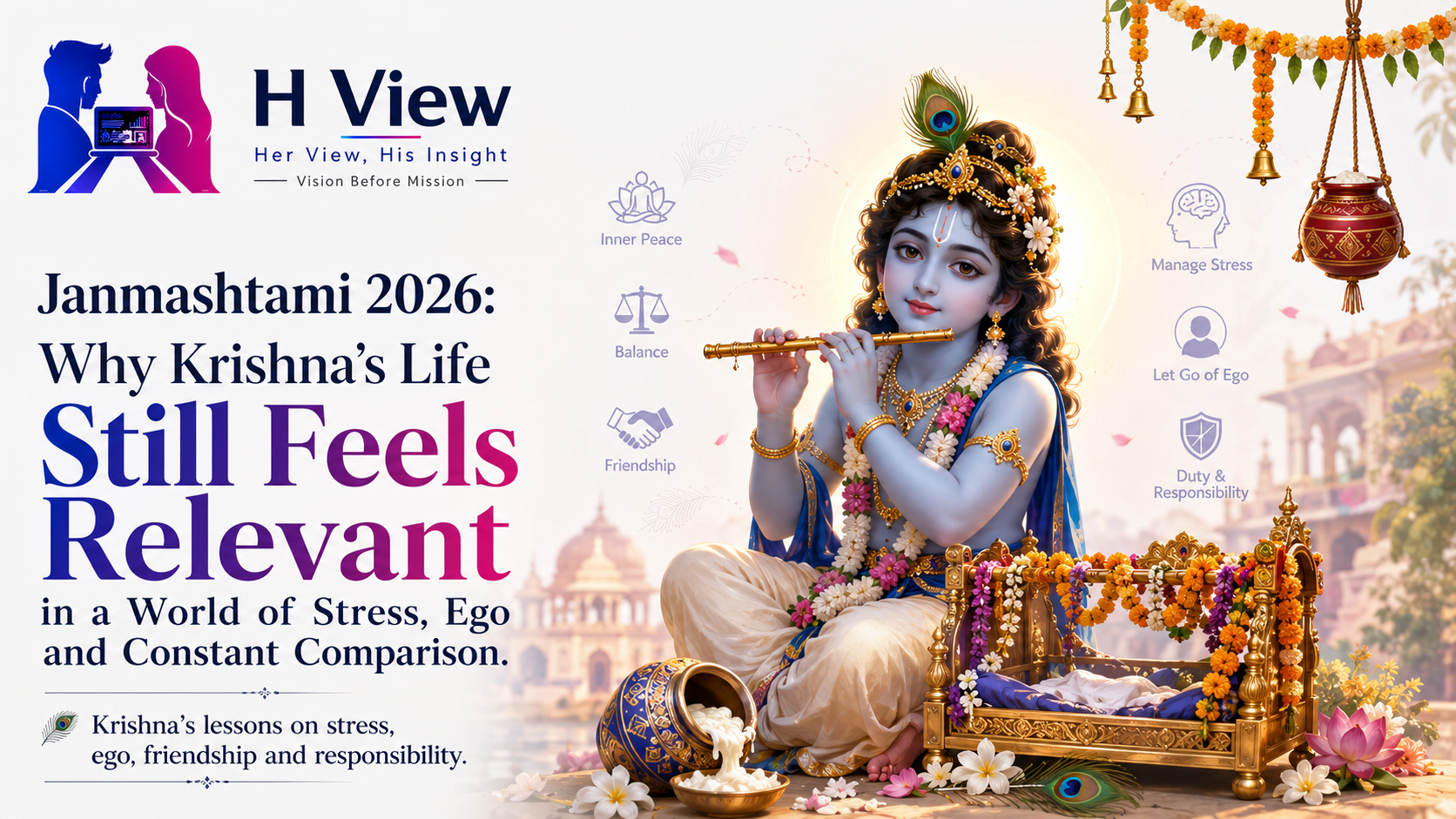
 By AnnapurnaUpdated September 3, 202612 min read4 views
Janmashtami is often remembered through familiar images: a beautifully decorated cradle, tiny Krishna footprints drawn through the house, children dressed as Radha and Krishna, butter pots, bhajans, fasting, and the midnight celebration of Krishna’s birth. These traditions make the festival warm, colourful and deeply personal for millions of families, but Krishna’s continued relevance cannot be explained by ritual alone. His life touches problems that still feel remarkably modern, including anxiety about results, family expectations, friendship, pride, comparison, moral confusion, responsibility, and the exhausting desire to control what happens next.
Krishna appears in Indian tradition in many different roles. He is remembered as a playful child, a loyal friend, a strategist, a ruler, a guide and, most importantly for many readers, the voice who speaks to Arjuna at the exact moment when Arjuna is overwhelmed by doubt. That range gives Janmashtami a depth that goes beyond celebrating a divine birth. It gives people an opportunity to reflect on why Krishna’s teachings still return in conversations about careers, relationships, leadership, stress and emotional balance even thousands of years later.
In 2026, Krishna Janmashtami is being observed primarily on Friday, September 4, with the midnight celebration continuing into the early hours of September 5. This overlap is one reason some calendars and communities create confusion around the date. Current panchang-based coverage places the Ashtami Tithi across September 4 and into the midnight period, when the Nishita puja traditionally associated with Krishna’s birth is performed.
Popular Janmashtami imagery naturally focuses on Bal Krishna. Stories of Krishna stealing butter, playing with friends, troubling Yashoda and filling Gokul with mischief make him emotionally accessible, especially to children. These stories are not merely cute additions to the festival. They create an image of divinity that feels close to family life rather than distant from it. Krishna is welcomed into the home as a child who can be loved, dressed, fed and celebrated.
But Bal Krishna is only one part of the larger story. The Krishna of the Mahabharata is very different. He advises rulers, understands political conflict, negotiates with opponents, protects friends and eventually becomes Arjuna’s guide at the moment when the warrior loses confidence before battle. The same figure associated with playfulness also becomes the source of one of India’s most influential philosophical conversations.
That range may be one reason Krishna continues to speak to different stages of life. Children connect with his playfulness. Young adults may connect with friendship and identity. People facing difficult choices often return to the Bhagavad Gita. Leaders and professionals may see lessons in strategy, responsibility and judgement. Janmashtami therefore celebrates the beginning of a life whose cultural meaning extends far beyond childhood.
One of the most frequently discussed ideas associated with the Bhagavad Gita is the principle of performing one’s duty without becoming completely attached to the result. This is often quoted as spiritual advice, but its relevance in modern life is very practical.
Consider a student preparing for a competitive examination. Months of effort gradually become emotionally attached to one number: the final rank. A professional works late for a promotion and begins to treat that promotion as proof of personal worth. A business owner launches a product and refreshes sales dashboards repeatedly. A creator posts something online and judges the work entirely by views, likes and comments. In all of these situations, effort becomes inseparable from outcome.
The problem is not ambition. Goals matter, performance matters and results matter. The difficulty begins when the result becomes the only measure of whether the effort had value. Krishna’s advice to Arjuna is often understood as a reminder to concentrate seriously on right action while accepting that outcomes are influenced by factors beyond one person’s control.
This does not mean becoming careless or indifferent. It means refusing to hand over your emotional stability completely to something you cannot control. That is especially relevant in 2026, when almost everything is measured through rankings, ratings, dashboards and comparisons. We live in an environment where performance is constantly visible, and it becomes easy to mistake measurement for meaning.
Social media has made comparison almost continuous. A 25-year-old sees someone of the same age buying a house. Another person announces a ₹30 lakh salary. Someone else travels internationally several times a year. Friends post weddings, promotions, business launches and expensive purchases. The natural response is to wonder whether we are falling behind.
The deeper question is: behind whom?
One of the broader ideas associated with Krishna’s teaching is the importance of acting according to one’s own responsibility or dharma rather than blindly copying somebody else’s path. That does not mean refusing to improve or hiding behind excuses. It means recognising that another person’s life is weak evidence for what your own should look like.
Imagine two friends. One leaves a stable job to build a startup. The other stays employed because they support ageing parents and value financial predictability. Social media may make the second person feel less ambitious, but responsibility does not look identical in two lives. Krishna’s relevance here is not about telling everyone exactly what their duty is. It is about reminding people that a meaningful life cannot be built through constant imitation.
That idea alone can save people from many emotional and financial decisions made only because someone else’s life looked more impressive.
Krishna’s stories remain powerful partly because friendship appears repeatedly within them. One of the most familiar examples is the story of Krishna and Sudama. Sudama arrives in poverty while Krishna is remembered as a powerful ruler, yet the emotional centre of the story is not status. It is recognition, affection and dignity between old friends.
That feels very relevant today because adult friendships often become vulnerable to comparison. One friend earns more. One becomes professionally successful. One moves abroad. One marries into greater wealth. Another faces unemployment or financial difficulty. Relationships that once felt effortless can become uncomfortable when success changes how people see themselves and each other.
The Sudama story survives because it expresses an ideal that still matters: genuine friendship should be able to survive unequal circumstances without becoming unequal in dignity. A friend should not need to match your success before feeling comfortable around you. In a culture increasingly shaped by visible achievement, that is a valuable reminder.
Krishna is also remembered as a strategist, and this part of his personality can be misunderstood because modern discussions often reduce strategy to cleverness. Cleverness, if used without ethics, can easily become manipulation. The Mahabharata presents a much more complicated world in which Krishna repeatedly faces situations where simple choices are not available.
He negotiates, advises, anticipates consequences and adapts to opponents who are themselves willing to ignore rules. The useful modern lesson is not that every outcome justifies every method. It is that morality does not always operate inside simple situations.
A manager may have to choose between protecting one employee and preserving an entire team. A family may have to decide how to divide limited money during a medical emergency. A leader may face two imperfect options rather than one obviously correct answer. Good judgement therefore requires more than memorising rules. It requires understanding context, consequence and responsibility.
Krishna’s strategic intelligence is most useful when viewed as the ability to understand complex situations deeply rather than as an ability to simply outsmart other people.
One of the most overlooked reasons Krishna’s teachings continue to feel relevant is that the Bhagavad Gita does not begin with Arjuna feeling strong. It begins with him overwhelmed.
He sees teachers, relatives, friends and people he respects on opposing sides of the battlefield. He doubts what he is about to do, struggles with the consequences and becomes emotionally paralysed. That starting point matters because it makes the conversation deeply human.
People often imagine spiritual wisdom as something offered to someone who is already calm enough to receive it. In the Gita, the discussion begins precisely because Arjuna is not calm. He is confused and emotionally exhausted.
Modern anxiety obviously cannot be reduced to a battlefield analogy, and serious mental-health concerns deserve appropriate professional care. But the broader human experience is still recognisable. Sometimes people become paralysed because every available decision carries a cost. Krishna does not simply tell Arjuna to stop thinking. The conversation explores responsibility, identity, action, attachment and perspective.
That makes it more useful than shallow motivational advice telling people to “stay positive.” Sometimes the solution to confusion is not avoiding the hard question. It is identifying what part of the situation is actually ours to act upon.
There is another reason Janmashtami feels different from many solemn observances: Krishna’s childhood is full of joy. There is music, friendship, food, mischief, affection and play.
Modern adults often behave as though enjoyment must be earned only after productivity is complete. The problem is that productivity is never complete. There is always another email, deadline, financial target, qualification or skill to learn. If enjoyment is postponed until everything is finished, it may be postponed indefinitely.
Krishna’s cultural image repeatedly makes room for leela, or play. That does not mean irresponsibility. It suggests that a meaningful life cannot be measured only through output.
A family decorating a small Krishna cradle may not be doing anything economically productive. Children dressing as Krishna and Radha are not improving their résumés. Singing bhajans does not improve a quarterly target. Yet those experiences may remain in memory far longer than another hour spent checking work messages.
Festivals protect spaces like this. They remind people that not everything valuable must also be productive.
Krishna’s childhood love of butter is one of the most recognisable parts of his popular image. Stories of Makhan Chor, the butter thief, eventually became connected with traditions such as Dahi Handi, especially in Maharashtra.
During Dahi Handi, teams form human pyramids to reach and break an earthen pot suspended high above the ground. The event is associated with Krishna and his friends trying to reach butter and curd stored beyond their reach. Yet the modern celebration also contains a powerful lesson about teamwork.
No one reaches the handi alone. The person at the top gets the most attention, but their success depends entirely on the structure below. That makes Dahi Handi an unusually strong metaphor for modern achievement. A CEO standing on a stage may be supported by hundreds of employees. A successful student may have parents, teachers and friends behind the result. A public figure’s visible success may depend on teams most people never see.
Dahi Handi makes that dependency physically impossible to ignore. One person climbs because many others hold.
Janmashtami is celebrated across India, but Krishna’s geography gives different places distinct emotional relationships with him. Mathura is traditionally associated with his birth. Vrindavan and the wider Braj region are connected with his childhood, Radha, the gopis and pastoral stories. Dwarka in Gujarat remembers Krishna more strongly as ruler and statesman.
These differences matter because Krishna cannot be reduced to one image. Mathura remembers a birth. Vrindavan remembers childhood and devotion. Dwarka remembers leadership. The Bhagavad Gita remembers guidance during crisis.
Together, these different traditions create a personality that people encounter according to their own needs and stage of life. This is also why Janmashtami feels different from region to region while still remaining recognisably connected to Krishna.
Not everyone participating in Janmashtami in 2026 approaches Krishna through the same level of religious belief. Some people celebrate primarily because of faith. Others participate because their family has always done so. Some connect through philosophy, art, music or childhood memory.
That range does not automatically make the festival less meaningful.
Someone can appreciate the idea of acting without destructive attachment to results without performing a midnight puja. A child can first connect with Krishna through stories before understanding the deeper philosophy. A family may value Janmashtami because it gives grandparents an opportunity to pass stories to children.
Culture often operates on several levels at once. The important thing is that a festival does not become only a beautiful photograph while the ideas behind the symbols are forgotten.
Krishna’s stories are often remembered for their colour, charm and beauty, but what makes them endure is the emotional range inside them. He is playful without being shallow, affectionate without being weak and intelligent without being confined to one role.
That feels especially relevant today because people are constantly told to build one fixed identity. Be ambitious. Be productive. Be successful. Be strong. Real life does not work so neatly. Sometimes we need discipline, sometimes friendship, sometimes strategy and sometimes the ability to enjoy a moment without asking whether it improves our future.
Perhaps one reason Krishna remains so loved is that his life never suggests human existence must be reduced to only one of those things.
Krishna’s most useful lesson for modern professionals may be the separation between action and emotional ownership of the outcome. You still prepare seriously, compete and make decisions using the best information available. But after a point, the result leaves your control.
Modern stress often begins because people intellectually understand that truth while emotionally refusing to accept it. The goal should not be indifference to outcomes, because indifference produces poor work. The healthier goal is to avoid allowing an uncertain outcome to destroy the quality of the action you can still control.
That distinction is simple to explain and difficult to practise, which is precisely why it remains useful.
Krishna Janmashtami is being observed primarily on Friday, September 4, 2026, across India. The midnight birth celebration continues into the early hours of September 5, which explains why both dates may sometimes appear in festival discussions.
Traditional accounts place Krishna’s birth at midnight, which is why the Nishita Kaal midnight puja is one of the most important parts of Janmashtami observance.
The Ashtami Tithi continues across the midnight boundary, and many of the most important birth celebrations begin late on September 4 and continue into September 5. This creates confusion when people look only at civil-calendar dates rather than the lunar tithi.
Dahi Handi recreates stories of young Krishna and his friends trying to reach pots containing butter or curd. Modern teams form human pyramids to reach the suspended handi, making teamwork and coordination central to the celebration.
One widely discussed lesson is to focus seriously on the action and responsibility within your control without becoming psychologically consumed by an outcome that cannot be controlled completely.
No. Traditions vary significantly. Mathura and Vrindavan strongly emphasise Krishna’s birth and childhood, Maharashtra is especially known for Dahi Handi, while Gujarat has major Krishna traditions connected with Dwarka and public Janmashtami celebrations.
Annapurna is an H View contributor covering relationships, family, lifestyle, entrepreneurship, and everyday decision-making. Her articles focus on emotional clarity, practical understanding, and human-centered perspectives that help readers think better about personal and professional situations.
Share your real experience and help other readers decide better.
No community views yet. Be the first to share yours.
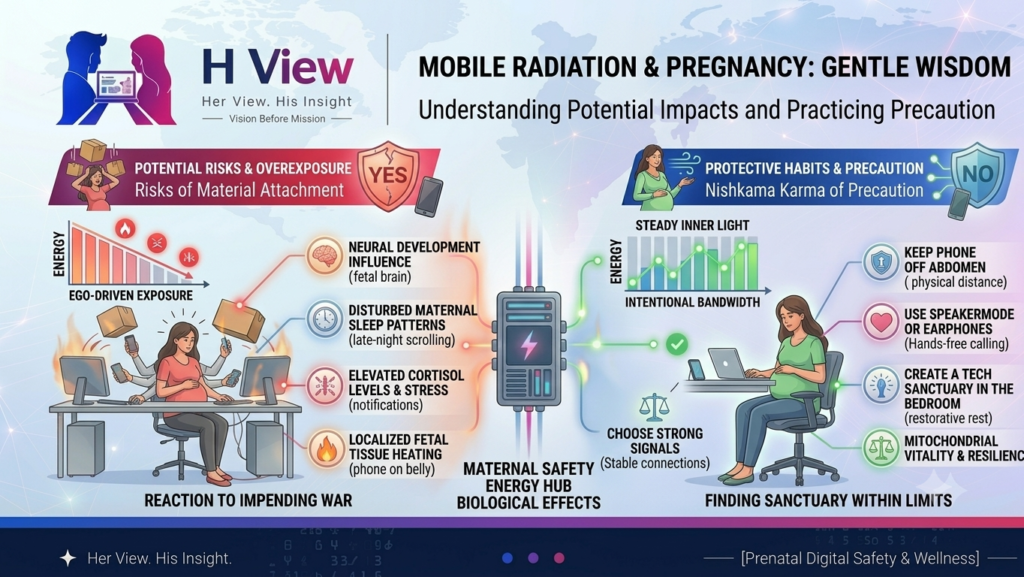
Pregnancy is a journey filled with incredible joy, heightened awareness, and a fair share of…
Rajesh September 6, 2026 
In a world where our smartphones are practically attached to our hands—or resting against our…
Rajesh September 6, 2026 
We live in an age of endless noise. Every day, we are bombarded with advice…
Rajesh September 6, 2026 
A woman can spend the day managing clients, attending meetings, answering calls, meeting deadlines, handling…
Annapurna September 6, 2026