

Mobile Radiation and Pregnancy: Gentle Wisdom for Expectant Mothers
Pregnancy is a journey filled with incredible joy, heightened awareness, and a fair share of…
 Rajesh September 6, 2026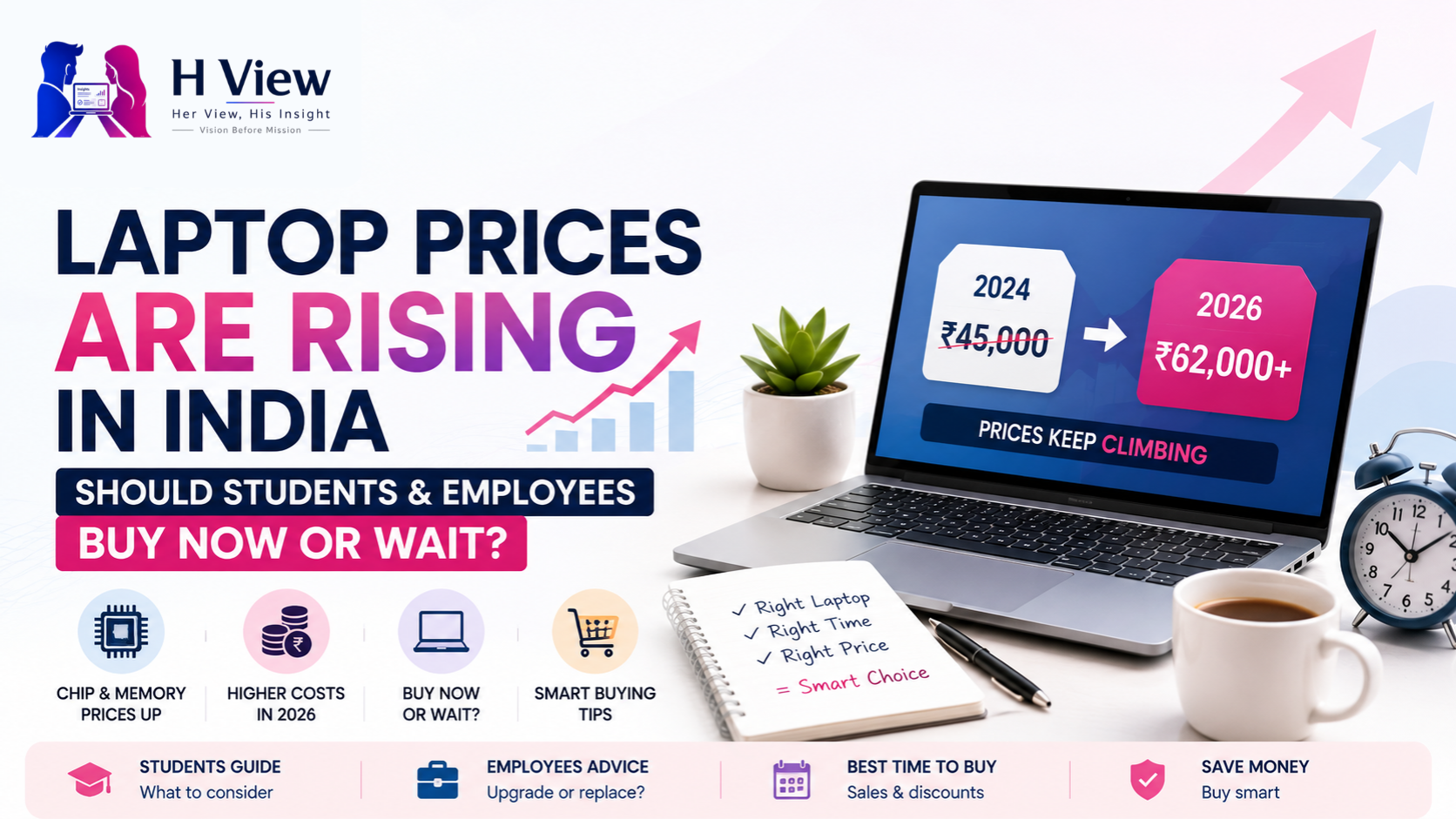
 By HarikaUpdated September 3, 202614 min read20 views
Buying a laptop in India has become noticeably more difficult in 2026. Students who once expected a decent machine around ₹40,000 to ₹50,000 are increasingly finding that the configuration they actually need costs more than planned. Employees who were thinking about replacing a three- or four-year-old laptop are delaying upgrades because a capable new model with 16GB RAM and 512GB storage can quickly move into the ₹60,000 to ₹80,000 range. Even companies are rethinking replacement cycles, upgrading only essential systems or buying earlier than planned because they expect prices to rise further.
This is not only a perception created by premium AI laptops and expensive MacBooks. The wider PC market is under genuine cost pressure. TrendForce says conventional DRAM contract prices are expected to rise another 13–18% quarter-on-quarter in the third quarter of 2026, while NAND Flash prices are expected to rise 10–15%. The same research firm has warned that higher memory and CPU costs could push the retail price of a mainstream notebook significantly higher if manufacturers and retailers pass those costs through.
India’s own PC market is already reacting. IDC-linked reporting says shipments jumped 12.1% year-on-year in Q2 2026 partly because businesses and retailers were buying ahead of expected price increases. Commercial PC shipments rose faster than consumer shipments, while IDC expects higher prices and inventory challenges to weigh on demand during the second half of 2026 and potentially into 2027.
For students and employees, the practical question is no longer simply, “Which laptop is best?” It has become: Should I buy now before prices rise further, wait for discounts, or keep using my existing laptop for another year?
The biggest reason is not one particular brand or processor. It is the rising cost of the components that every modern laptop needs.
RAM and SSD storage have become significantly more expensive because memory manufacturers are prioritising high-margin server and AI infrastructure demand. Large AI data centres consume enormous quantities of DRAM, high-bandwidth memory and enterprise SSD storage. When manufacturers redirect more production capacity toward those markets, less supply is available for ordinary notebooks and consumer devices.
TrendForce says DRAM suppliers are continuing to allocate more capacity toward server applications, while PC manufacturers are still replenishing inventories. That combination keeps PC memory supply tight and pushes component costs upward. NAND Flash is facing similar pressure because data centres are absorbing more enterprise SSD capacity.
This means AI infrastructure can indirectly make an ordinary student laptop more expensive even if the student has no interest in AI features at all.
A student may simply want Chrome, Office, VS Code and Zoom. An employee may only need Excel, Teams and a browser. Yet both still need RAM and SSD storage, and those are exactly the components being affected by the broader AI-driven memory market.
This is one of the more frustrating parts of the current market.
Laptop brands are heavily promoting Copilot+ PCs, Intel Core Ultra systems, Ryzen AI processors and dedicated NPUs. Those devices are becoming more common, but even buyers who do not need them can still feel the price impact because newer processors, memory and storage are becoming more expensive across the market.
TrendForce warned earlier this year that memory price increases alone could raise the retail price of a mainstream $900 notebook by more than 30%, and combined CPU and memory increases could theoretically push the total increase close to 40% if manufacturers preserved their existing margins.
That does not mean every laptop in India has suddenly become 40% more expensive. Retail pricing varies by brand, inventory, configuration and discounts. What it does show is how much pressure manufacturers are facing before the laptop even reaches a store.
This also explains why some models that would previously have launched with 16GB RAM and 512GB SSD at an attractive mid-range price now appear with compromises, higher launch prices or aggressive promotional discounts that disappear after a few weeks.
Students are especially vulnerable because their budgets are usually fixed before they begin shopping.
A family may decide that ₹50,000 is the maximum budget for a college laptop. That amount has to cover not only the laptop but sometimes a bag, mouse, software, extended warranty and accessories. When the price of a sensible 16GB configuration moves above that budget, the buyer is forced to compromise somewhere.
The wrong compromise can become expensive later.
For example, buying an 8GB laptop because it is ₹7,000 cheaper may look sensible at first. But a computer science student using Android Studio, Docker, browsers, databases or virtual machines may find 8GB frustrating very quickly. A design student using Photoshop, Illustrator or Premiere Pro may run into the same problem.
In that situation, choosing a slightly older processor with 16GB RAM can be smarter than buying the newest AI-branded chip with only 8GB.
The priority should be the workload, not the newest processor name.
Working professionals often have another option available to them: keeping the existing laptop.
If a three-year-old machine still has a decent processor, a fresh battery, 16GB RAM and enough SSD space may be all it needs to remain useful. In some cases, upgrading memory or storage can extend a laptop’s life for several years at a fraction of the cost of replacing the entire computer.
This is becoming increasingly relevant because businesses are making similar decisions. Reporting on the Indian corporate PC market shows some companies are extending device refresh cycles or selectively replacing only critical machines because rising hardware costs make a complete fleet replacement harder to justify.
That does not mean everyone should keep an old laptop indefinitely. A machine with a failing battery, unsupported operating system, broken hinge, poor display and very old processor can become more expensive to maintain than replace.
The important change in 2026 is that replacing a laptop simply because it feels slightly old is no longer always the financially sensible option.
For years, laptop manufacturers pushed increasingly thin designs with soldered RAM and fewer user-replaceable components.
That trend made laptops lighter and more compact, but it also removed one of the easiest ways to extend their usable life.
During a period of rising component prices, upgradeability becomes financially valuable again.
A laptop with one free RAM slot and an accessible M.2 SSD can be bought with a modest configuration and upgraded later when required. A machine with permanently soldered 8GB RAM cannot.
This is something students and employees should check before purchasing.
A slightly thicker laptop with upgradeable RAM may be a better long-term investment than a beautiful ultra-thin machine that becomes permanently limited by its original configuration.
That does not mean every buyer needs upgradeable hardware. Apple Silicon MacBooks, for example, use integrated memory architecture and cannot be upgraded later, but they compensate with strong efficiency and performance. The point is that buyers should understand whether future upgrades are possible before paying.
For very light usage, 8GB can still work.
A student who mainly writes documents, watches lectures, uses a few browser tabs and attends video calls may get by without major problems. But for a laptop expected to last through four years of college, 16GB is becoming the safer choice.
Browsers are heavier, development tools are more demanding, and AI-enabled applications increasingly consume more memory. Modern Windows itself also benefits from having more headroom.
If the budget is tight, we would usually prioritise the following order:
16GB RAM first, then 512GB SSD, then the best processor the remaining budget allows.
That may sound unusual because processor names receive most of the marketing attention, but the practical difference between two nearby mid-range CPU generations can be much smaller than the difference between 8GB and 16GB RAM during heavy multitasking.
AI PCs are one of the biggest marketing categories in 2026.
Intel Core Ultra, AMD Ryzen AI and Copilot+ systems are increasingly common, and many are excellent laptops. The problem is that not every employee needs to pay a premium for the NPU inside them.
Someone working mainly in Excel, Outlook, Teams, PowerPoint and browser-based ERP systems may benefit more from good battery life, 16GB or 32GB RAM, a comfortable keyboard and reliable support than from paying extra for local AI acceleration.
The new Acer Swift Neo AI is a good example of where the market is moving. It recently launched in India from ₹67,999 with Intel Core Ultra processors, up to 32GB RAM and up to 1TB SSD.
That can be a good machine for someone who actually values those capabilities. But an employee whose existing ₹50,000 laptop already handles their daily workload does not automatically need to upgrade because “AI PC” is the new industry phrase.
AI hardware should solve a real problem before it becomes part of the buying decision.
Waiting can help, but only if expectations are realistic.
Festival sales can reduce the effective purchase price through bank discounts, exchange bonuses, cashback and clearance of older inventory. That can make September, October and year-end sales good buying opportunities.
However, there is currently little evidence that underlying laptop component costs are about to collapse.
TrendForce’s latest September bulletin says PC DRAM contract-price increases have actually been revised upward, while pricing remains firm despite weak end-user demand.
The broader Q3 forecast also says memory prices remain elevated because AI server demand continues to support the market, even though consumer demand is weakening.
So a festival sale may give you a better deal on a particular model, but it does not necessarily mean laptop prices as a whole are about to return to 2024 or 2025 levels.
The answer depends on how urgently you need the machine.
If your laptop is failing, college has already started, your job requires better hardware or you find the correct configuration at a genuine discount, buying now is reasonable. Waiting six months for a hypothetical price crash could cost more in productivity than the amount you save.
If your current machine works well and you are only upgrading because a newer processor exists, waiting makes more sense. Prices are high, and there is little reason to replace functional hardware for a minor performance improvement.
Students who know they will need a laptop for engineering, coding, architecture or design should avoid waiting until assignments have already started. The cost of struggling with an unsuitable device can become bigger than a small price difference.
Employees who already own a decent laptop should first investigate upgrades, battery replacement or a fresh operating-system installation before replacing the whole system.
For most college students, the safest target is still a balanced configuration rather than the cheapest available laptop.
For general degree courses, management, B.Com and office-oriented study, we would look for 16GB RAM, 512GB SSD, a modern Core i5/Ryzen 5/Core Ultra 5-class processor, a decent IPS or OLED display and reliable battery life.
Computer science and engineering students should prioritise 16GB RAM even more strongly. If Docker, Android Studio, local databases, virtual machines or heavier development environments are part of the course, 32GB may eventually become useful.
Design, architecture and video students need a different machine entirely. Screen quality, GPU performance and thermal design become more important, which can push the realistic budget higher.
There is no single “student laptop” because a B.Com student and an architecture student are buying computers for completely different workloads.
Employees should start with the work they actually do.
For office productivity, a reliable thin-and-light laptop with 16GB RAM and 512GB SSD is usually enough. Managers should prioritise battery life, webcam, microphone, keyboard, security and portability.
Developers may need 32GB RAM if they run Docker, virtual machines or large development environments. Designers and video editors should prioritise colour-accurate displays and dedicated graphics where appropriate.
The most important point is to avoid overbuying.
An employee working in spreadsheets does not need a high-end gaming laptop. Likewise, a developer running multiple containers should not save money by buying 8GB RAM simply because the laptop has a new processor.
One of the best strategies during a rising-price cycle is buying the previous generation after the new one launches.
A 2025 premium laptop discounted to ₹65,000 can sometimes be a better purchase than a 2026 mid-range machine launched at the same price.
Processors improve every year, but not every generation brings a dramatic leap in normal productivity. A high-quality display, excellent keyboard, better build and larger memory configuration can matter more over five years than a slightly newer CPU.
Students and employees should therefore compare actual specifications and current prices rather than assuming the newest model is automatically the best value.
Rising prices make the cheapest laptop look tempting.
This is where buyers need to be careful.
A ₹32,000 laptop with 8GB soldered RAM, 256GB SSD, weak display and entry-level processor may save money initially but become frustrating after two years. Replacing it early can cost more than buying a stronger ₹45,000 or ₹50,000 machine once.
The goal should not be finding the lowest possible purchase price. It should be finding the lowest total cost over the number of years you expect to use the machine.
A ₹60,000 laptop used comfortably for five years costs less per year than a ₹35,000 laptop replaced after two.
The hardest part of buying a laptop today is that people feel pressured from both directions. Prices are rising, which makes waiting seem attractive, but every new launch makes the current laptop feel older than it actually is.
For students, I think the safest approach is to buy for the entire course rather than only the first semester. Saving a few thousand rupees on RAM today may create four years of unnecessary frustration.
For employees, the calculation is different. If the current laptop still performs well, there is no reason to replace it just because a new generation has AI written on the sticker. A battery replacement, SSD upgrade or additional RAM may sometimes be the smarter financial decision.
The current laptop-price cycle is a reminder that the PC market is connected to a much larger technology supply chain.
AI data centres are competing for memory and storage capacity, manufacturers are prioritising higher-margin server products, and those decisions eventually affect the cost of ordinary consumer machines. TrendForce’s current data shows PC DRAM pricing remains elevated, while AI infrastructure continues to support memory demand.
This also means buyers should think differently about future-proofing. Upgradeability, memory capacity and storage are becoming more valuable because replacing an entire laptop is getting more expensive.
The best purchase in 2026 may not be the newest laptop. It may be the machine that can remain useful for the longest period without forcing another purchase.
Laptop prices in India are genuinely under pressure in 2026, and there is no clear evidence that they are about to suddenly fall back to earlier levels. Memory prices remain high, manufacturers are reallocating capacity toward AI and server products, and Indian businesses have already been buying systems early to protect themselves against further increases.
That does not mean everyone should rush out and buy a laptop today.
Students who genuinely need a machine for college should focus on getting the right configuration rather than waiting indefinitely. For most users, 16GB RAM and 512GB SSD should be the target, even if that means choosing a slightly older processor or previous-generation model.
Employees with functional laptops should first ask whether an upgrade, repair or battery replacement can extend the device’s life. Those buying new should avoid paying a large premium for AI hardware unless their actual applications benefit from it.
Our H View recommendation is simple: buy when you need the laptop and when the right configuration appears at a fair price; wait when the upgrade is optional.
Trying to perfectly time the bottom of the laptop market is nearly impossible. Buying the wrong laptop because you were afraid prices might increase can be just as expensive as waiting too long.
The goal in 2026 should not be to buy the cheapest laptop. It should be to buy one you will not need to replace again soon.
The biggest factors are rising DRAM and NAND Flash costs, tighter consumer memory supply and stronger demand from AI and server infrastructure. TrendForce expects conventional DRAM prices to rise 13–18% quarter-on-quarter in Q3 2026 and NAND Flash prices by 10–15%.
There is currently no strong evidence of a major near-term decline. Memory prices remain elevated, and TrendForce says PC DRAM pricing continues to face upward pressure even as consumer demand weakens.
If college work already requires a laptop, buying the correct configuration now is generally more sensible than waiting indefinitely. Students who can continue comfortably with an existing device may benefit from waiting for festival discounts or older-model clearance.
It can handle basic work, but 16GB is the safer target for a laptop expected to last through several years of college. Coding, design, engineering applications and heavier multitasking benefit significantly from additional memory.
If the processor is still adequate and the laptop supports RAM or SSD upgrades, upgrading can be significantly cheaper than replacement. Battery replacement can also extend the useful life of otherwise capable hardware.
Only if the AI capabilities solve a real need. Most office users should prioritise RAM, SSD storage, battery life, display quality and keyboard comfort before paying extra for an NPU or AI branding.
Yes. During a high-price cycle, discounted previous-generation premium laptops can provide better overall value than newly launched mid-range models, particularly when the older system includes more RAM, better displays or stronger build quality.
For most students, 16GB RAM and 512GB SSD is a sensible baseline. Processor and GPU requirements then depend on the course, with engineering, coding, architecture and creative work generally requiring stronger hardware than standard office and management courses.
Harika is the co-founder of H View and covers AI, technology, gadgets, digital tools, online platforms, and modern internet trends. Her articles focus on simplifying complex topics with practical explanations, balanced opinions, and reader-first insights.
Share your real experience and help other readers decide better.
No community views yet. Be the first to share yours.

Pregnancy is a journey filled with incredible joy, heightened awareness, and a fair share of…
Rajesh September 6, 2026 
In a world where our smartphones are practically attached to our hands—or resting against our…
Rajesh September 6, 2026 
We live in an age of endless noise. Every day, we are bombarded with advice…
Rajesh September 6, 2026 
A woman can spend the day managing clients, attending meetings, answering calls, meeting deadlines, handling…
 Annapurna September 6, 2026