

Mobile Radiation and Pregnancy: Gentle Wisdom for Expectant Mothers
Pregnancy is a journey filled with incredible joy, heightened awareness, and a fair share of…
 Rajesh September 6, 2026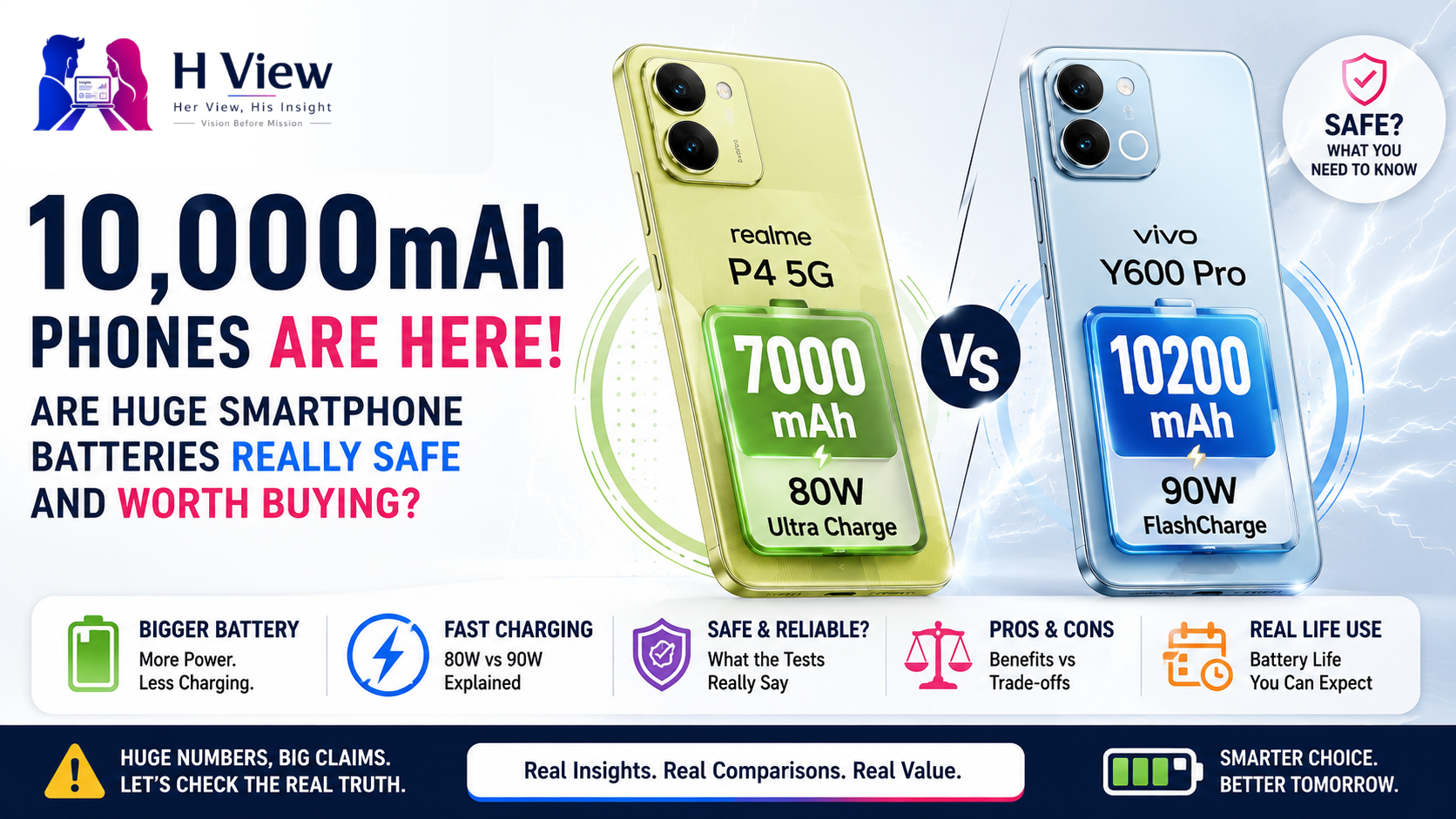
 By HarikaUpdated August 30, 202613 min read18 views
For years, a 5,000mAh battery felt like the comfortable standard for Android phones. It was large enough to promise a full day of use, familiar enough that buyers understood what to expect, and small enough for manufacturers to keep phones relatively slim. That balance is now changing very quickly.
In 2026, we are seeing phones move well beyond 6,000mAh or even 8,000mAh. Realme has already introduced the P4 Power 5G with a 10,001mAh battery, while Vivo’s Y600 Pro in China carries an even larger 10,200mAh battery. These are not rugged phones designed to look like power banks. They are mainstream-looking smartphones with modern displays, capable processors and fast charging. (realme.com)
That sounds exciting, but it also creates a completely new set of questions for buyers. Is a 10,000mAh battery actually safe to carry every day? Will such a large battery take hours to recharge? Does twice the capacity mean twice the battery life? Will the phone become too heavy? What happens to battery health after three or four years? And if high refresh rates, 5G, gaming and background apps can still drain the battery quickly, are these huge numbers really as useful as they sound?
Those concerns are more important than the marketing headline. A bigger battery can be a genuine improvement, but only when the manufacturer has solved the problems that come with it.
The biggest reason is the wider use of silicon-carbon battery technology.
Traditional smartphone batteries have relied heavily on graphite-based anodes. Silicon can store significantly more lithium ions than graphite in the same amount of space, so combining silicon with carbon-based materials allows manufacturers to increase energy density. In practical terms, that means more battery capacity can fit inside a phone without making the device twice as thick. (gadgets360.com)
This is why the current generation of large-battery phones looks very different from the old rugged phones that used to carry enormous batteries. Those older devices often felt bulky because the only straightforward way to increase endurance was to physically increase battery volume.
Realme says the P4 Power’s 10,001mAh Titan Battery uses a third-generation silicon-carbon anode and a redesigned internal stacking structure. Despite the battery size, the phone weighs about 219g and measures around 9.08mm thick. (realme.com)
That is not especially light, but it is surprisingly normal for a phone carrying twice the capacity many buyers are used to.
A larger battery is not automatically unsafe simply because the capacity number is bigger.
Battery safety depends much more on cell quality, thermal management, manufacturing consistency, physical protection and the software that controls charging. A poorly manufactured 5,000mAh battery can be more dangerous than a well-designed 10,000mAh one.
Realme says its Titan Battery has undergone tests involving overcharging, drops, compression and extreme temperatures, while the P4 Power has received TÜV Rheinland battery certification. The company also describes multiple internal protection layers designed to monitor and isolate problems before they become dangerous. (realme.com)
That should be reassuring, but no lithium-based battery should be treated as completely risk-free. Physical damage, excessive heat, water intrusion, faulty chargers and manufacturing defects can still create problems.
The better way to think about safety is this: 10,000mAh is not the danger. Poor engineering is.
For buyers, that means certification, brand reputation, service support and charging protection matter more than simply comparing capacity numbers.
Silicon-carbon technology helps manufacturers increase energy density, but it also brings its own engineering challenges.
Silicon expands more during charging than conventional graphite. If that expansion is not properly controlled, repeated charging cycles can place stress on the internal structure and potentially affect long-term battery life.
Modern silicon-carbon cells use composite structures, binding materials and battery-management systems to reduce that problem, which is why the technology has moved from laboratories into commercial phones. Still, buyers are right to wonder how these cells will behave after several years of daily use.
We currently have much more long-term real-world evidence for conventional lithium-ion designs than for the newest high-silicon implementations.
That does not mean silicon-carbon batteries are unsafe. It simply means long-term battery health is an area worth watching rather than assuming that bigger capacity automatically means longer life in every sense.
This is probably the most natural concern.
If you double battery capacity but leave charging speed unchanged, charging will obviously take much longer. That is why the new generation of big-battery phones is also arriving with aggressive fast charging.
The Vivo Y600 Pro supports up to 90W charging, while Realme pairs the P4 Power with 80W Ultra Charge. (vivo.com.cn)
Realme claims its 10,001mAh battery can reach roughly 50 percent in about 36 minutes under its testing conditions. That is important because half of a 10,000mAh battery already contains about as much charge as an entire conventional 5,000mAh phone.
This changes the way charging needs to be understood.
A user with a normal 5,000mAh phone may need to charge from 20 to 100 percent every night. Someone with a 10,000mAh phone may still have 40 or 50 percent remaining after a full day, meaning they may only need a short top-up before leaving home the following morning.
A full 0-to-100 percent charge may take longer, but it may also happen much less frequently.
Fast charging creates heat, and heat is one of the biggest enemies of battery longevity.
However, modern charging systems do not simply force the advertised maximum wattage into the battery from zero to 100 percent. Charging speeds normally peak during certain stages and then reduce as battery temperature or state of charge increases.
Phones also monitor temperature, voltage and charging behaviour continuously.
Realme says its P4 Power includes a Titan Long-Life Algorithm designed to manage charging patterns and reduce degradation. The company claims the battery can retain more than 80 percent capacity after 1,650 complete charge cycles under its laboratory conditions. (realme.com)
Those figures should still be treated as manufacturer claims rather than promises that every user will experience identical results. Someone gaming while charging in a hot room will create very different thermal conditions from someone charging the phone on a desk at moderate temperature.
The safest approach remains familiar: use a good-quality charger, avoid unnecessary heat and do not make heavy gaming while fast-charging a daily habit.
Yes, absolutely.
This is one of the most important misconceptions around battery capacity. A phone with a bigger battery has more stored energy, but the hardware and software determine how quickly that energy is consumed.
A bright 144Hz display, weak mobile signal, 5G, GPS navigation, hotspot usage, camera recording and high-performance gaming can all drain a battery rapidly. Poorly optimised apps running in the background can also consume power without the user actively doing anything.
Realme’s own P4 Power is a good example. The phone includes a 144Hz screen and Dimensity 7400 Ultra processor, so it is designed for demanding use. Realme claims approximately 11.7 hours of BGMI gaming under one of its test configurations. (realme.com)
That is impressive gaming endurance, but it also proves that even 10,000mAh is not unlimited.
The advantage of a huge battery is not that it cannot drain. It is that heavy users begin with a much larger energy reserve.
The smartphone industry has repeatedly taught us that one large number rarely tells the whole story.
A 200MP camera is not automatically better than a 50MP camera. More RAM does not always make a phone feel faster. Charging at 150W does not automatically make the overall battery experience better.
Capacity should be treated the same way.
A well-optimised 6,000mAh phone can sometimes deliver more satisfying endurance than an inefficient 8,000mAh model. Processor efficiency, display technology, modem behaviour and software optimisation all matter.
This is why battery reviews need to move beyond simply repeating mAh specifications. Real-world testing should look at standby drain, screen-on time, gaming, 5G, photography and overnight battery loss.
The ideal phone is not the one with the largest battery. It is the one that wastes the least energy while still giving the user enough capacity for their routine.
Silicon-carbon technology helps, but physics still matters.
Realme’s 10,001mAh P4 Power weighs around 219g. That is impressive for the capacity, yet it is still noticeably heavier than many slim phones.
A few extra grams may sound irrelevant until you spend an hour reading, gaming or recording video while holding the phone one-handed.
Some users would happily accept that weight in exchange for two or three days of battery life. Others would rather carry a lighter phone and charge it every evening.
Neither preference is wrong.
This is one reason huge-battery phones may not automatically become the best option for every buyer even if the technology continues improving.
The hesitation around 8,000mAh and 10,000mAh phones is not only about safety.
Many buyers simply do not know what the trade-offs are yet. Silicon-carbon technology is still unfamiliar to the average consumer, and unfamiliar battery chemistry naturally creates concerns about reliability and replacement costs.
Charging time can also sound intimidating. Someone who sees “10,000mAh” may assume the device will sit plugged in for three hours, even when 80W or 90W charging changes the experience significantly.
There is also the fear that huge batteries are becoming another specification race. If one company advertises 10,000mAh, another may want 11,000mAh and then 12,000mAh simply because the larger number attracts attention.
That is where buyers should become cautious. Battery innovation is valuable only if phone makers continue balancing capacity with weight, heat, charging speed and longevity.
There is an interesting argument in favour of larger batteries.
A phone that needs charging every day goes through charging cycles more frequently than one that lasts two or three days. If the larger battery genuinely reduces charging frequency, the number of equivalent full cycles accumulated over several years may also decrease.
Realme uses this reasoning when discussing its Titan Battery longevity claims. (realme.com)
However, cycle count is only one factor in degradation. Heat, charging voltage, time spent near 100 percent and battery chemistry all influence ageing.
A larger battery therefore has the potential to age well, but it is not automatically guaranteed to do so.
We will only know how the newest high-silicon cells perform after millions of users have lived with them for several years.
This may be where 10,000mAh phones make the biggest practical difference.
For years, a power bank has been almost essential for travellers, field workers and heavy smartphone users. A standard 5,000mAh phone can easily struggle during a day filled with navigation, photography, mobile data and video.
A 10,000mAh phone effectively carries the capacity of a small power bank inside the handset.
Realme even supports 27W reverse wired charging on the P4 Power, allowing the phone to provide power to other compatible devices. (realme.com)
That will not make power banks disappear. People travelling with tablets, laptops, cameras or multiple phones will still need external power.
For everyday use, though, many people could stop carrying one.
The strongest use case is someone who regularly stays away from chargers for long periods.
Travellers, delivery workers, field employees, gamers and students can all benefit. People using navigation, mobile data and cameras heavily throughout the day may finally be able to stop planning their routine around battery percentage.
A huge battery may also appeal to someone who simply dislikes battery anxiety.
The value is much smaller for a light user who works beside a charger all day. If compact size and low weight matter more than endurance, carrying an extra 3,000 or 5,000mAh may not improve the experience enough to justify the additional mass.
The right battery capacity depends on how the phone is actually used.
The idea of charging a phone every two or three days instead of every night is genuinely appealing, especially because charging has quietly become part of our daily routine. We plug the phone in before sleeping, search for sockets in airports and keep power banks in bags almost automatically.
At the same time, I would not choose a phone based only on its battery number. Comfort matters every single time the device is picked up. A 10,000mAh phone becomes genuinely attractive only when manufacturers can keep it reasonably thin, comfortable and balanced while still delivering a good camera, display and overall experience.
For me, the battery should remove inconvenience rather than introduce a new one.
The move toward 10,000mAh batteries is one of the more meaningful smartphone trends of 2026 because it addresses a problem users actually understand.
The important innovation is not simply increasing capacity. It is combining silicon-carbon chemistry, fast charging, battery-management algorithms and improved energy density so that the phone does not feel like a rugged power bank.
Realme P4 Power is a good example because its 10,001mAh battery comes with 80W charging and a 219g body rather than one extreme specification existing in isolation. Vivo’s Y600 Pro follows a similar direction with 10,200mAh and 90W charging. (vivo.com.cn)
If brands continue improving that overall balance, battery capacity may become one of the rare specification races that genuinely benefits users.
The arrival of 10,000mAh smartphones is not something buyers need to fear simply because the capacity looks unusually large.
A huge battery is not automatically unsafe, nor does it automatically take forever to charge. Silicon-carbon technology is allowing manufacturers to pack more energy into relatively normal phone designs, while 80W and 90W charging systems make those batteries practical to refill.
At the same time, bigger does not automatically mean better. A 10,000mAh phone can still drain quickly under heavy gaming, poor network conditions or badly optimised software. It can still feel heavy, and long-term durability depends on battery chemistry and thermal management rather than the mAh number alone.
The smarter buying question is therefore not “Does this phone have 10,000mAh?” but “How well has the manufacturer managed everything around that 10,000mAh battery?”
For heavy users, travellers and people tired of carrying power banks, this new generation could be one of the most useful smartphone improvements in years. For lighter users who prioritise thin and compact designs, a smaller but efficient battery may still make more sense.
Huge batteries are not automatically the future of every smartphone. But if manufacturers continue solving weight, heat, charging and longevity, charging a phone every single night may eventually feel surprisingly old-fashioned.
Yes, they can be safe when properly engineered. Battery safety depends on cell quality, thermal management, charging controls and internal protection rather than capacity alone. Major manufacturers are also using certification and extensive battery testing for newer high-capacity models.
A larger battery would take longer at the same charging wattage, but current models compensate with fast charging. Realme P4 Power supports 80W charging, while Vivo Y600 Pro supports up to 90W.
Not necessarily. Real-world endurance also depends on display brightness, refresh rate, processor efficiency, 5G, gaming, GPS, background applications and software optimisation.
Silicon-carbon batteries are already being used commercially by major smartphone manufacturers. The technology can deliver higher energy density, although managing silicon expansion and long-term degradation requires careful engineering.
Yes. High-performance gaming, poor network signal, maximum screen brightness, 5G, GPS and background activity can still consume power quickly. A bigger battery provides more reserve but does not eliminate energy consumption.
Not necessarily, although these phones are generally not ultra-light. Realme P4 Power weighs around 219g despite carrying a 10,001mAh battery, showing how higher-density batteries are reducing the size and weight penalty.
For many ordinary users it may reduce or eliminate the need for one during daily use. Travellers carrying multiple devices or laptops may still benefit from a dedicated power bank.
Harika is the co-founder of H View and covers AI, technology, gadgets, digital tools, online platforms, and modern internet trends. Her articles focus on simplifying complex topics with practical explanations, balanced opinions, and reader-first insights.
Share your real experience and help other readers decide better.
No community views yet. Be the first to share yours.
Pregnancy is a journey filled with incredible joy, heightened awareness, and a fair share of…
Rajesh September 6, 2026 
In a world where our smartphones are practically attached to our hands—or resting against our…
Rajesh September 6, 2026 
We live in an age of endless noise. Every day, we are bombarded with advice…
Rajesh September 6, 2026 
A woman can spend the day managing clients, attending meetings, answering calls, meeting deadlines, handling…
 Annapurna September 6, 2026